
Sports
Hardik, Dube, spinners hand India series win


England will be wondering how they managed to lose in Pune. They squandered a chance to take the series into a decider after winning the toss, reducing India to 12 for 3 and then 79 for 5, got off to a flying start on a flat pitch and heavy dew around it, but ended up losing wickets in clumps after getting to 62 for 0 inside the powerplay. They were still favourites at 129 for in the 15th over, but lost two wickets in Varun Chakravarthy’s last over.
One of the answers they will get is they lost six wickets to spinners bowling on a true pitch with a wet ball. The other answer is India’s intent with the bat: they never really slowed down even as the wickets fell. Abhishek Sharma kept going after the triple-wicket maiden early in the innings, and Shivam dube and Hardik Pandya overcame the mid-innings blows with some targeted hitting to score 53 each and take India to a fighting total of 181.
Another answer – although they should never have let it play such a significant role – will be that India were allowed to play fast and loose with the concussion substitution. Dube, who was hit on the helmet in the final over and continued batting, complained of delayed onset of concussion symptoms, and was replaced by a full-time bowler in Harshit Rana even when a batting allrounder was available in Ramandeep Singh. Making his debut, Rana took the wickets to Liam Livingstone, Jacob Bethell and Jamie Overton to go with a six-run 19th over.
Saqib Mahmood checks in
India had the right idea to go after the bowling with the ball neither seaming nor swinging, but they ended up hitting everything straight to hand. Bowling his first over of the series Saqib Mahmood accepted the gifts although England did play a part with some inventive fields. Sanju Samson found deep square leg, Tilak Varma edged the first ball he faced to deep third, and then Suryakumar Yadav middled one straight to short mid-on.
India don’t back down
Quite often in the past, India have been guilty of taking the conservative option when forced to make a choice. Over the last year and a half, though, they have played differently. Abhishek is the flag-bearer of brave options. He made sure India had some momentum even as Rinku Singh got stuck. Not for the lack of trying, though.
When Abhishek got out for 29 off 19, India held back Hardik in order to target Adil Rashid with Dube. Rashid responded beautifully with a teasing loopy delivery first up with an attacking field, but Jos Buttler dropped a half chance at slip.
Rinku’s dismissal to Brydon Carse meant Hardik had to come in with Rashid overs still left. He channelled in his inner MS Dhoni by blocking out Rashid with proper front-foot defence. Dube helped him out by making sure Rashid went for 35 in his four even as Hardik warmed up to 13 off 16.
He returned the favour when Mahmood and Jofra Archer came back with shots full of swagger. Those two comeback overs went for 37, which meant India had something to fight with even though Overton conceded just three off the last over. He also clocked Dube in the head, an event that would assume larger significance.
Duckett stuns India, but they spin their way back
The chase started on a batting beauty, and Ben Duckett silenced the raucous crowd. More importantly, he reverse-swept Varun for a boundary, took 16 off Axar Patel’s first over, and seemed to be getting the better of spin challenge. RaviBishnoi, who had been digging the ball in, gambled with the last ball of the powerplay. With no boundary rider down the ground, he bowled the only flighted delivery of the over, and drew the mis-hit to dismiss Duckett for 39 off 19.
Phil Salt, who managed to get to spin for the first time in the series, exposed his stumps in trying to cut Axar and was done in by one that skidded on. Buttler became the victim of a touch of extra bounce for Bishnoi to make it 65 for 3, but the presence of the fielder taking the catch at short third, Rana, left him infuriated according to Kevin Pietersen on air.
Rana strikes immediately
Even at 65 for 3, this was England’s game to lose. Harry Brook and Livingstone made an assured start to their stand despite the troubles Brook has had against spin all series. There was hardly any turn to worry about. They had added 27 off 21, and the asking rate was under 10 when Rana came on to bowl in the 12th over. Livingstone guided the second ball straight to the keeper. Done in by the extra bounce when attempting the late-cut.
Brook still has it, but not quite
Even then Brook showed how easy batting was in those conditions. He took down Rana for 18 in his second over and even managed to hit his nemesis Varun for two fours, but then pre-meditated a ramp off Varun, possibly expecting the seam-up variation so he could use his pace, but ended up lobbing the slower legbreak to short fine leg. Carse made it worse with a slog-sweep straight to deep square leg in the same over.
Overton and Rashid flickered for a moment, bringing it down to 21 off 11, but fizzled out amid Overton’s questionable tactics of not taking singles even though Rashid had slogged Arshdeep Singh for a six.
Brief scores:
India 181 for 9 in 20 overs (Hardik Pandya 53, Shivam Dube 53, Abhishek Sharma 29, Rinku Singh 30; Saqib Mahmood 3-53, Brydon Carse 1-39, Jamie Overton 2-32, Adil Rashid 1-35 ) beat England 166 in 19.4 overs (Phil Salt 23, Ben Duckett 39, Harry Brook 51; Arshdeep Singh 1-35, Varun Chakrawarthy 2-28, Axar Patel 1-26, Ravi Bishnoi 3-28, Harshit Rana 3-33) by 15 runs
[Cricinfo]

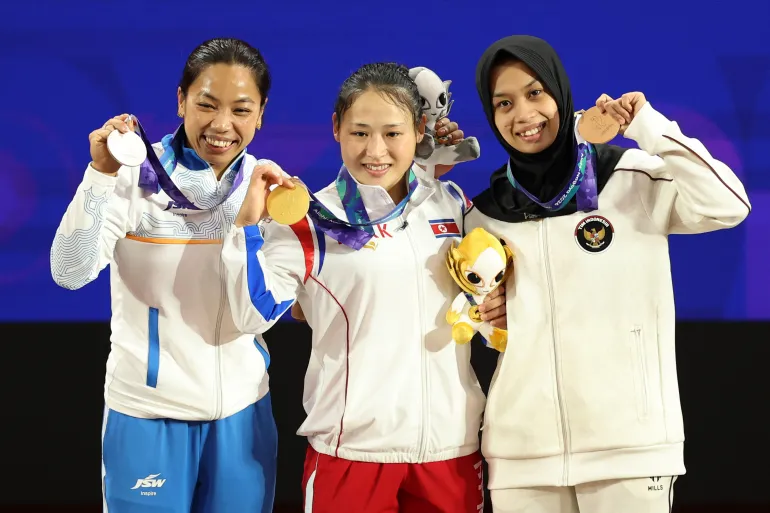
North Korean weightlifter Ri Song Gum has broken three world records en route to winning gold in the women’s 49kg (108lbs) competition, which saw India’s Mirabai Chanu win an elusive Asian Games medal by finishing second.
Ri gave North Korea its first gold of the games in Nagoya, Japan, on Wednesday, joining an elite club of four weightlifters who have won three Asian Games gold medals.
The 28-year-old hauled 94kg above her head in the opening snatch discipline – the first official segment of the competition where athletes lift a barbell from the floor to an overhead position in a single motion. The lift was 1kg heavier than the previous world record of 93kg.
Ri followed it up by breaking the world record twice in the 115kg clean and jerk – a two-part movement where a barbell is lifted from the floor to the shoulders and then pushed overhead. The 4ft-7in (139.7cm) weightlifter hoisted 116kg and 121kg above her head.
Ri’s total lift of 215kg obliterated the old world record total by 7kg.
She is the fourth lifter, and first woman, to win three Asian Games weightlifting golds and joined Iran’s Mohammad Nassiri (1966-74), South Korea’s Kim Tae-hyun (1990-98) and Iran’s Behdad Salimi (2010-18), who all won three gold medals. No athlete has won four weightlifting gold medals.

In the same category, India’s Chanu finally won an Asian Games medal at the third time of asking. She won a silver medal at the Tokyo Olympics in 2021.
The 32-year-old is India’s most decorated weightlifter, with three Commonwealth gold medals and a silver to her name, along with multiple global titles.
She lifted a total of 198kg after a snatch of 87kg and a clean and jerk of 111kg, while Indonesia’s Diana Tri Wijayana took bronze with a total of 191kg, comprising 88kg and 103kg.
Chanu’s silver also ended India’s 28-year wait for a weightlifting medal at the games since Karnam Malleswari won silver in 1998.

(Aljazeera)

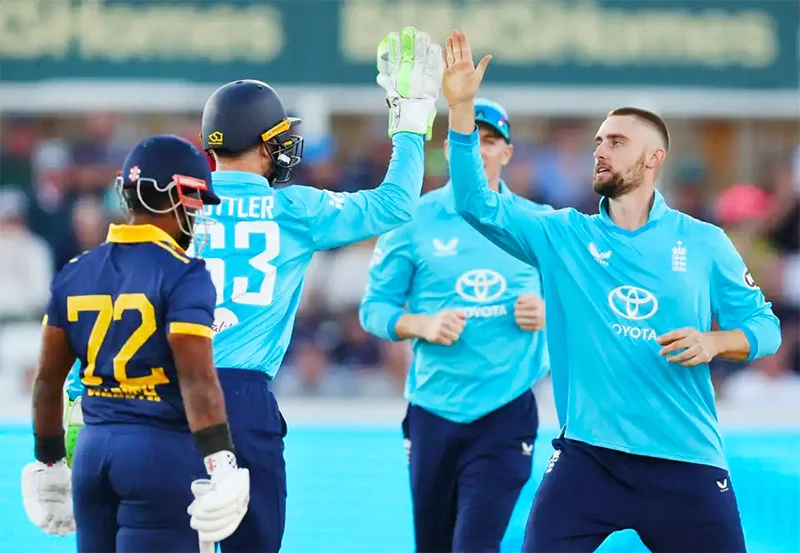
Just when you thought Sri Lanka had finally turned a corner by bowling England out inside 49 overs for 265 and sensed an opportunity to register their first win of the tour, along came another batting horror show to bring everyone crashing back to earth.
Bowled out for 176 in 37 overs, Sri Lanka slumped to yet another humiliating defeat. The statistic that really rubs salt into the wounds is that after four games on tour, not a single Sri Lankan batter has managed a half-century.
Had this happened with Jofra Archer breathing fire and blowing the top order away for under 200 you could perhaps have understood. Had Gus Atkinson made the new ball talk and run through the batting, as often happens to subcontinental teams in northern England, there might have been some mitigation.
 But when a part time off-spinner walks away with a maiden five wicket haul and career best figures, there is nowhere to hide. To put it bluntly, the batters should hang their heads in shame.
There was no character. There was no application. Most worryingly, there was precious little evidence of batsmen thinking on their feet.
Against spin, the sweep appears to have become the only scoring option in the playbook, while footwork seems to have been thrown out of the window. The sweep, conventional or reverse, can be a devastating weapon when produced unexpectedly, before the opposition has set a field for it. But when it becomes your staple diet, bowlers do not need to be rocket scientists to work you out. Sooner or later, the high risk stroke will bring about your downfall.
That was precisely what happened at Chester-le-Street on Tuesday night.
Charith Asalanka was once one of Sri Lanka’s finest finds, a batsman capable of holding the lower order together and dragging the side towards competitive totals. An ODI average of 41 and five hundreds speak volumes about his ability. Of late, however, he has been dismissed tamely far too often. You can only hope this does not become another case of a rich talent being allowed to drift away.
One of the few things that has worked consistently for Sri Lanka in limited overs cricket over the last 18 months has been the opening combination of Pathum Nissanka and Kusal Mendis. There is an old rule in sport: if it ain’t broken, don’t fix it.
Yet Mendis has been pushed down the order and Kamindu Mendis promoted to open, leaving you wondering what exactly Sri Lanka are trying to achieve. Kamindu is badly needed in the middle order, particularly against spin. Removing him from that role merely weakens an area that is already crying out for stability.
Amid the wreckage, there was at least one encouraging sign in leg-spinner Sachindu Colombage. Hailing from Negombo, the 28-year-old has hardly set domestic cricket alight in recent seasons, but his unusual action caused England problems, with several batsmen struggling to pick him. He marked his debut with three wickets and gave the selectors something to think about.
More significantly, his inclusion kept Wanindu Hasaranga on the sidelines. After what unfolded in the final T20I, perhaps that was no bad thing either.

by Reemus Fernando
Triple jumper Madushani Herath and the 4×400 metres mixed relay team face an uphill task as Sri Lanka’s track and field team begins its Asian Games campaign in Nagoya, Japan, today.
Bahrain, India and Kazakhstan, who claimed podium places in the mixed relay at the last edition, are joined by China, hosts Japan and Sri Lanka in what promises to be an intriguing battle for medals in the Games’ first relay event. Kazakhstan, China and India go in as favourites, having produced the leading times this season.
For Herath, 2026 has been a breakthrough year. She shattered the national record that had stood unchanged for seven years, with the national champion clearing a new mark of 13.68 metres earlier this season.
With a strong field of Uzbek, Chinese and host-nation athletes on show, Herath will need a top-level performance to secure a podium finish in the women’s triple jump. Uzbekistan’s Sharifa Davronova, a two-time World Junior Champion, leads the Asian rankings this season with a leap of 14.24 metres at the Asian Under-23 Championships in July, and she will look to defend the title she first won as a 17-year-old in China. At least three other athletes have also cleared the 14-metre mark this year — China’s Yi Li and Yingying Huang, and Japan’s Maoko Takashima.
Herath’s coach, Krishantha Kumara, said a personal best would be a realistic target for the former Nannapurawa M.V., Bibila athlete. “Anything can happen. We were targeting to peak during this period. She broke the national record during the preparation phase. However, we have set a realistic goal of her reaching a personal best,” Kumara said in an interview with ‘The Island’ on Wednesday.
The Asian Under-20 Championship silver medallist is currently an undergraduate at the University of Kelaniya.

Showerss above 100 mm are likely at some places in the Western, Sabaragamuwa, Central and North-western provinces and in Galle and Matara Districts

Mirabai Chanu wins Asian Games silver as Ri breaks weightlifting record

Trump greets China’s Xi Jinping on arrival for three-day US

BASL calls for conscience vote on 22nd Amendment

IMF: Sri Lanka on course for 2027 market return

President appoints three new judges to High Court

‘Dates have the highest sugar content to fight Coronavirus’

Sunday Island 27 December – Headlines

#SundayIsland 17th December – Headlines

Sunday Island – 28th March

Sunday Island Headlines – 21 March

Sunday Island – 21st February – Headlines
-

 News5 days ago
Shanakiyan urges urgent action over reported death sentence for Lankan in Saudi Arabia
-

 News6 days ago
Bid for Basil’s extradition nears final stage: Police
-

 News4 days ago
Namal Rajapaksa Buddhist gambit fails, bail denied
-

 Features4 days ago
Why the spelling Sri Lankan names in English vary
-

 Features4 days ago
Three bands, a new identity: Sri Lankan wolf snake recognised as distinct species
-
 Business4 days ago
SLIIT holds largest-ever convocation
-

 News4 days ago
Govt monitors reported Saudi death sentence – Foreign Ministry
-

 Business4 days ago
All-new Bolero MaXX Pik-Up unveiled in Lanka