
News
JVP faults govt. for reopening universities, schools without providing proper facilities

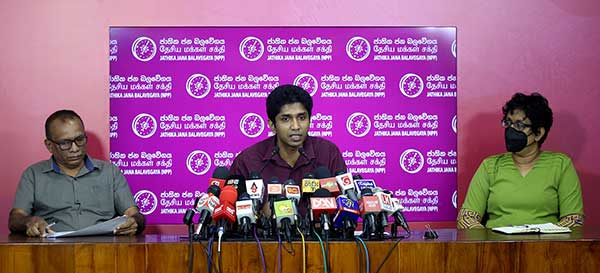
The JVP-led NPP has called on the government to stop tinkering with the country’s education sector because such action would only result in negative outcomes.
Addressing the media at the JVP headquarters in Pelawatte on Wednesday, MP Dr Hairini Amarasuriya said that the government’s failure to manage the COVID-19 pandemic was clearly visible when one looked at the prevailing situation in the country’s education sector.
“The government seems to think that reopening of schools and universities would be the solution. The question is whether these institutions have enough facilities to help prevent COVID-19. When the universities are reopened undergraduates are required to come to their hostels. Whether these hostels have facilities to ensure the safety of students is the question. The situation in the schools is also the same. Both teachers and students are exposed to the virus.
“We already have unsolved problems with regard to the quarantine and treatment. It is not wise for the government to reopen universities and schools in such a situation. We call on the government not to place the lives of our children in danger.”
NPP Operational Committee Member Dr Anura Karunathilaka of the University of Kelaniya said that amidst the prevailing chaos in the country’s education sector the government was now trying to change the number of years of school education. “There is a common criticism against the duration of schooling. The criticism is true. A student may attend school for 13 years and spend four to five years in universities and, therefore, the professionals such as doctors, engineers join the workforce when they are of the age of 30. In other countries the corresponding figure is around the age of 25. The delay of five years is due to various delays in the system that cannot be remedied by bringing down the number of years in school from 13 to 12. The delays are in the examination systems, issuance of results and moving from one stage to another, for example students who complete GCE Advanced Level examination have to wait at home months to enrol in universities. The delays are caused by lack of human and physical resources. But inflicting irreparable damages on the system due to whims and fancies of one or two persons in the name of solving problems cannot be countenanced.”
National Organiser of the Socialist Students’ Union, Rangana Devapriya said that universities, higher education institutes offering degrees and higher national diplomas had remained closed for nearly a year. “The government is now in a mighty hurry to reopen them. The responsibility of keeping these institutions open while fighting the pandemic is lies with their administrators. The heads of these institutes are told that they can reopen their institutions whenever they want. It is clear that the administrative officials of those institutes cannot counter the effects of a global pandemic. There is a need for a national level mechanism for that. The government overlooked the health and safety of children and teachers to reopen schools and we will see the results in the coming weeks,” Devapriya said.

Latest News
Sun directly overhead Kalpitiya, Talawa, Sinharagama, Galkadawala, Nachchaduwa, Padikaramaduwa, Gomarankalla and Verugal about 12.10 noon today (01)


The sun is going to be directly over the latitudes of Sri Lanka from 28th of August to 07th of September due to its apparent southward relative motion.
The nearest places of Sri Lanka over which the sun is overhead today (01) are Kalpitiya, Talawa, Sinharagama, Galkadawala,
Nachchaduwa, Padikaramaduwa, Gomarankalla and Verugal about 12.10 noon.
… stresses need for action if claims were proved false
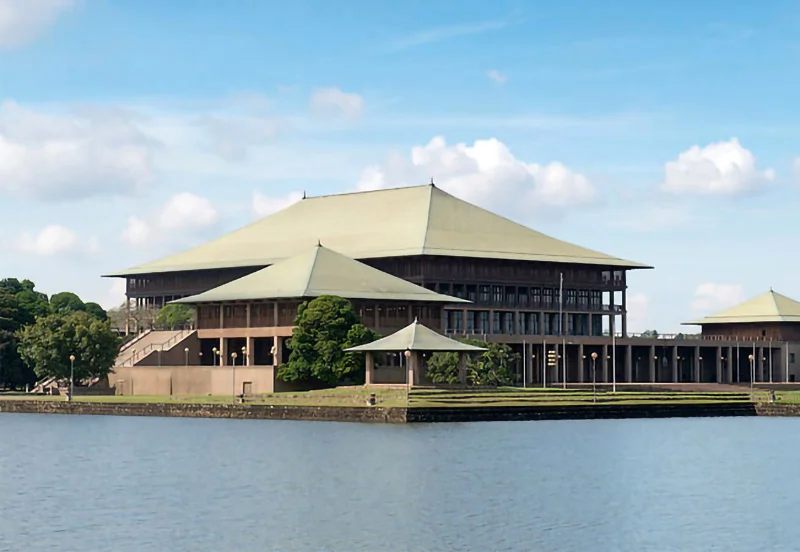
Samagi Jana Balawegaya (SJB) MP Dayasiri Jayasekera has sought a clarification from Speaker Dr. Jagath Wickremaratne regarding several allegations against Chief Justice Preethi Padman Surasena, in Parliament, recently.
In a letter dated 31 August, Jayasekera has asked the Speaker whether he received any documentary evidence from MPs in support of the allegations at issue. The SJB MP has also inquired about the steps taken by the Speaker regarding the allegations and whether the issue had been taken up with the relevant agencies authorised to probe the assets of the CJ and members of his family.
MP Jayasekera confirmed that he had raised the issue with the Speaker, following the accusations relating to the high profile X-Press Pearl case, which received significant public attention in the recent past.
The Kurunegala District MP has also asked the Speaker whether the latter contemplated taking action in case the allegations were proved false to ensure that the dignity of the Chief Justice and the judiciary was safeguarded.
Among the issues raised by MP Jayasekera are the acquisition of valuable property in Colombo by the CJ’s son, the circumstances in which he was able to procure the property, as well as accusations regarding the CJ’s birth certificate, marriage certificate and birth certificates of his children.
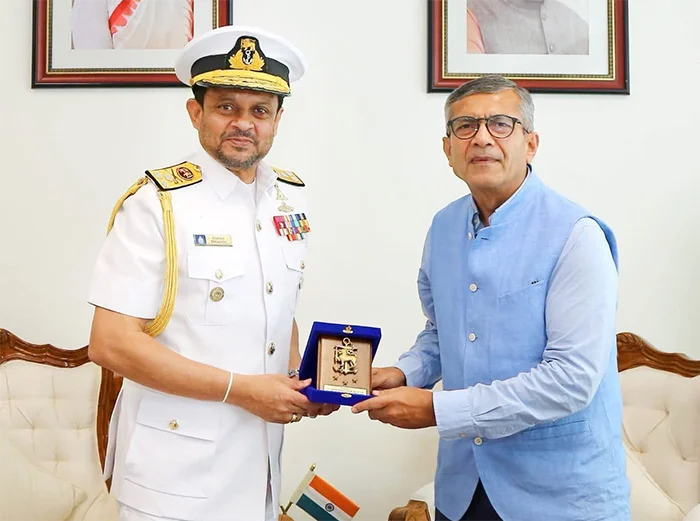
Navy Chief Vice Admiral Damian Fernando held a series of strategic-level discussions with senior Indian defence and military officials during a three-day official visit to New Delhi. He returned on Sunday (30).
Navy Headquarters said that the two sides discussed ways to further strengthen maritime security cooperation between the two Navies in support of security in the Indian Ocean region. They also exchanged views on expanding training opportunities and capacity-building programmes, as well as other areas of bilateral importance.
During his visit to New Delhi, Vice Admiral Fernando also held official discussions with India’s Chief of Defence Staff, General N.S. Raja Subramani, Defence Secretary Rajesh Kumar Singh and Vice Chief of the Air Staff, Air Marshal Ashutosh Dixit and defence industry representatives. Discussions at these meetings focused on bilateral defence cooperation, joint training programmes, and opportunities to enhance air and maritime cooperation in the Indian Ocean Region.
As part of efforts to further expand cooperation in naval training and professional development, Vice Admiral Fernando also met Vice Admiral Sameer Saxena, Flag Officer Commanding-in-Chief of India’s Southern Naval Command, at its headquarters in Kochi, Kerala. The two sides discussed existing naval training exchange programmes and opportunities for introducing and expanding further training initiatives. The meeting followed the Commander of the Sri Lanka Navy’s visit to INS Dronacharya, the Indian Navy’s training establishment where he previously completed the Long Gunnery and Missile Course.

Nahida, Marufa help Bangladesh brush aside Indonesia

Showers will occur in the Western, Sabaragamuwa, Southern and Uva provinces and in Kandy and Nuwara-Eliya districts

Sun directly overhead Kalpitiya, Talawa, Sinharagama, Galkadawala, Nachchaduwa, Padikaramaduwa, Gomarankalla and Verugal about 12.10 noon today (01)

SJB asks what Speaker intended to do about allegations against CJ

Navy Chief attends strategic-level discussions in Delhi

ICRS: Sustained and collective efforts critical to address issue of missing persons

‘Dates have the highest sugar content to fight Coronavirus’

Sunday Island 27 December – Headlines

#SundayIsland 17th December – Headlines

Sunday Island – 28th March

Sunday Island Headlines – 21 March

Sunday Island – 21st February – Headlines
-

 News4 days ago
Eight politicians in drug kingpin probe
-

 Features2 days ago
“Wrap Me Up in My Blazer”— A Gentlemanly Bradby Reminiscence
-
 Business4 days ago
Sri Lanka opens up: A new season of direct connectivity
-
 Features4 days ago
Redefining ageing in Sri Lanka
-
 Features6 days ago
Insights from Chieftains of Uva: Genealogy of two Kandyan Families – Part II
-
 Latest News5 days ago
Nepal-Tibet floods: What happened, what caused them and who is missing?
-

 Editorial6 days ago
Warning of power cuts: El Niño and corruption
-

 Features6 days ago
Export diversification: Missing the wood for the trees – Part I