
Opinion
Tribute to late Commander (MCD) Shanthi Kumar Bahar, RWP Sri Lanka Navy


by Admiral Ravindra
C Wijegunaratne(Retired from Sri Lanka Navy)
Former Chief of Defence Staff and Commander of the Sri Lanka NavyThe Former Sri Lanka’s High Commissioner to Pakistan
(The 60th Anniversary of Sri Lanka Navy Diving and Salvage Unit falls on 11th January 2025. The writer commanded it in 1987.)
A distinguished old boy of Trinity College, Kandy, who excelled both in studies and sports, young Shanthi Bahar joined the Sri Lanka Navy to 3rd Intake of Cadets in 1974. Then, he was 19 years old. He became a UK qualified Explosive Ordnance Disposal (EOD) underwater expert and Mine Clearance Diver (MCD) besides being a crack marksman, both rifle and pistol and winner of the first President’s Cup in Practical Pistol firing meet in 1984. The late President J. R Jayewardene, whose son, Ravi who introduced Practical Pistol Firing Sport to Sri Lanka, was so impressed with Shanthi’s ability and presented him with a .45 Colt Gold Cup Pistol as a gift. It is now on display at our Olympic standard Navy firing range at Welisara. In addition, he was a Navy Coloursman in Sailing and Rowing, who took part in International Sailing Regattas. His knowledge on jungle warfare and small arms was considered exceptional. He was an avid reader. There was no Internet and he used to order Jungle Warfare and gun manuals and magazines through his mother in Hawaii, USA.
All junior officers, especially trainees like me at the time were afraid of him. However, after I worked under him onboard the Light House Relief Vessel Pradeepa, and after taking part in Basses Lighthouse relief work, he had a lot of faith in me. When we anchored our ship at Uda Potthana bay, we would take a Gemini craft and go to the Yala National Park (Yala block 2). I used to follow him in this jungle terrain. I became his follower at a very junior level. He had noticed my love for the fishing rod and guns, and started teaching me about guns and jungle warfare. I am yet to see a marksman holding a six- battery torch with one hand,.22 caliber rifle with the other, aim and fire at night. Such was Lt. Bahar’s marksmanship! To develop such skills, you require very strong upper body strength and agility. Anyway, he was a Mine Clearance Diver, trained in the UK with huge lung capacity and very strong arms. His breathing was controlled to near perfection when he fired the weapon. This hand-eye coordination of Lt Bahar came with hard work and training. He would never miss his target. When in action against an enemy in close quarters he believed more in accuracy of his repeater shotgun on his right hand than the US manufactured 5.56mm M-16 Carbine slung on his shoulder. With MCD and EOD knowledge, he made his own IEDs (Improvised Explosive Devices).
I am extremely grateful to him for what he taught me because these skills and knowledge stood me in good stead while I was training the Special Boat Squadron (SBS – Naval Commando Unit) in November 1993.
Lt Commander Shanthi Bahar died during a small group operation in Ichchantivu, Muttur on 15 Jan. 1986. He led a 10-man team to target EROS local terrorist leadership and terrorist safe house in Muttur/Ichchantivu sector. All 10 in his team were junior sailors trained by him personally for months. The Divers of SLN helped him to travel from the Naval Base Trincomalee to Muttur in their Diving Unit Dinghy boat and silently landed them near the target area at night. They eliminated eight terrorists (including their leader), but Lt Commander Bahar and his Muslim informant died in an enemy grenade attack. We lost a great naval officer.
The most senior man among those brave 10 junior sailors, Naval Patrolman (then) KG Samaratunga took over command following the demise of Lt Commander Bahar, regrouped the men and returned to R/V point of Diving Unit boat, carrying the body of Lt Commander Bahar. Later, Samaratunga said with tears welling up in his eyes, “Sir, I did exactly what Bahar Sir had asked me to. He said that if he died, I had to take over the Command and take the boys back to safety.” Samaratunga rose up to Master Chief Petty Officer later and was my Master-at-Arms while I was commanding the SBS in 1993. He gained his commission in 1999 and retired as a Lieutenant. He is now engaged in organic farming in Pannala. Great sailors! Unsung heroes!
Lt Commander Bahar was promoted to rank of Commander posthumously and awarded the Rana Wickrama Medal for individual bravery in the face of enemy action.
I salute my guru!

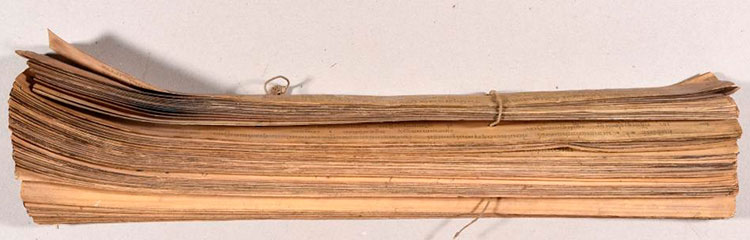
Medical prescriptions were written on palm leaf manuscripts. Bhesajja Manjusa (Casket of Medicine) is the oldest medical manuscript written in Sri Lanka. There is a Sinhala translation of the Pali original in the Colombo Museum library. The manuscript of Bhesajja Manjusa held in Ayurveda Research Institute, Maharagama was included in the UNESCO Memory of the World national register in 2016.
The Bhesajja manuscripts can be found in Dalada Maligawa Patirippuwa library, Galvene purana vihara Angoda, Mettaramaya in Bambalapitiya, Colombo Valukaramaya at Pamburana, Matara and Kosgodella Raja Maha Vihara.
Sirancee Gunawardana says she has seen a medical manuscript belonging to Sirimavo Bandaranaike, handed down from her grandfather, a medical practitioner. It had prescriptions using herbs, roots, barks of trees and indigenous seeds, for ailments ranging from stomach trouble, pediatric, pregnancy, fever, headaches, cholera, smallpox, chicken pox, eye, cancer and snake bite. It was written in 1850. There are 39 other such manuscripts in the collection.
Palm leaf manuscripts mention immersion therapy and acupuncture. Sirancee has paid special attention to acupuncture. Sirancee found a very old manuscript on acupuncture in the Institute of Ayurveda, Rajagiriya. It is very well illustrated. Pelmadulla Raja Maha Vihara has a 12th century manuscript giving acupuncture points for humans, also for cock, horse, buffalo. The full manuscript is reproduced in her book. She has also included in full another acupuncture manuscript by Sadiris Perera.
Manuscripts that give remedies for snake bites were known as Sarpa Veda oth. Colombo Museum Library has one where the prescriptions are given in verse. Sirancee owned a ‘very interesting’ ola on herbal treatment of cobra and other snake bites.
The Sinhala state had its own healing system in the Udarata before the British took over the kingdom. Western medicine soon displaced the Vederala (local doctor) but some parts of the native system survived up to the middle of the 20 century.
The Report of the 1950 Commission on the Ancient system of Sinhalese Medicine (SP 17 of 1950) stated that Sihala “vedakam” was a distinct medical system with its own drugs, diagnostic methods and treatments. It was particularly effective for snake bite, fractures, rabies and cancerous tumors, said the Report.’ The Sinhala “vedakam” or “Desiya chikithsa” physicians saw themselves as a distinct group, belonging to ‘veda parampara’ through the possession of secret family recipes, the report said. A national health system cannot operate on secret prescriptions. This secrecy would have been a later aberration.
Sinhala vedakam prescriptions would have been recorded on palm leaf. The National Library of Sri Lanka has publicized the fact that it has manuscripts on Sinhala Vedakam. Hugh Neville collection has a Sinhala pharmacopeia, written in the 19th century. Pelmadulla Purana Viharaya had an ola dealing with surgical specialties, written in Sinhala, copied in 1862.
There are many palm leaf manuscripts written in Sinhala containing herbal prescriptions that have originated in Sri Lanka, said Sirancee. Firstly, there is the collection of prescriptions which the vederala carries with him for immediate use. It is a collection compiled by him or his ancestors and is known as ‘beheth vattoru potha.’ This potha contained prescriptions for emetics, purgatives, medicine for diarrhea, piles, worm treatment and blood ailments.
There is a ‘beheth vattoru pota’ in the Kosgoda vihara library. There are about 103 beheth vattoru poth in the TPP Goonetilleke collection. Historical Manuscripts Commission was shown a Udarata beheth potha, one manuscript held in a curated collection, contained the prescriptions of a physician named Hatara Korale Huhgampola Ruppege Dara Mudalihami (sic).
Elephants played a major role in the Sinhala state. There are many palm leaf manuscripts on how to manage elephants and treat their illnesses. The manuscript titled ‘Hasti Yoga Silpa’ , seen by Sirancee is in verse and has charms for protection of elephants. Harakola Sri Anandarama Viharaya in Gampola had two manuscripts on elephants, one manuscript was an Ali veda pota , the other was on elephant charms and sensitive spots.
Palm leaf manuscripts provide scattered information on music, song and dance. Alutnuwara Raja Maha Vihara had a manuscript with music notations. Sirancee Gunawardana in her book ‘Palm leaf manuscripts of Sri Lanka’ said she has not seen anything else like it and published a photograph of the manuscript in her book. Historical manuscripts Commission found a manuscript which had a stanza in very rare meter in a chant for Kataragama Deviyo.
On the subject of drums, Andreas Nell presented the Colombo Museum library with a copy of an ola titled “Bera, davul, tammata adiye upata.” The original is in the British Library. The Tupavamsa manuscript mentions 20 types of drums used in Sri Lanka. The “Isavara nartaya” manuscript in the Colombo Museum, which is in Sinhala, gives 32 tunes for drums written in kavi style.
Regarding dance, Hugh Neville collection has a manuscript titled “nrutya upata“. It has three sections, gitaya, nrutya, and pada and provides 36 different beats for the drum. Alutnuwara Raja Maha Vihara had a manuscript called Pada Natuma.
There were three other manuscripts on movement. Hugh Nevill collection had a 100-year-old manuscript on Sokari nateema. There were many palm leaf manuscripts on leekeli in Colombo Museum library. Historical Manuscripts Commission (1951) had found a manuscript, titled Pandama ganna kavi ,5 verses sung to invoke the blessing of the gods before the dancers approached the road. This would have been for a perahera.
There was some information on the song. Historical Manuscript Commission (1933) found in family collections, lots of panegyric type songs for the Udarata kings. One manuscript had verses sung at the coronation of Kandyan kings. Verses sung at the coronation of king Narendrasinha were recorded in a manuscript titled “Sringara alamkaraya” (1842).
Sri Lanka has a notable “kavi” tradition. There are many kavi manuscripts dating from the 18th and 19th centuries, in palm leaf collections. An interesting feature in these collections are the kavi to be sung at work, including songs to be sung when spinning thread.
Colombo museum library has a manuscript with two sets of “kavi“. Kavi to be sung when weeding paddy fields and “Nelum kavi” to be sung when reaping the harvest. The “Nelum kavi” manuscript was prepared by Tikiri Yadesguru in 1862.
Olas contain kavi for harvesting Kurakkan. Colombo Museum library has a manuscript on growing kurakkan (millet), how to sow the grain, protect it, fence it from wild pigs , how to put up a watch hut, how to harvest the millet and how to cook it.
Hugh Nevill collection has a “kavi” manuscript titled “Peduru Male” This manuscript relates the story of a rush mat weaving competition between a mother-in-law and a daughter in law. They first weave ordinary mats then a strong knotted mat, gold flowered mat, tasseled mat, mat with hare, mat showing a jackal about to eat the hare, then a deer mat, leopard mat, cat, rat, lion and elephant mats. Thereafter, they weave a mat with a buddha’s throne and finally a mat with loha-maha-paya and dagoba design. Sirancee observed that this ballad describes various unusual mat designs and provides information on the art of weaving rush mats.
Historical Manuscripts Commission (1933) found an architectural plan at Lankatilleke vihara, 17th or 18th century. It was the ground plan of a royal palace, a ‘raja maliga salasma’. Design was rectangular, with ornate triangular and circular buildings within the space. The plan gave the Sinhala names for special buildings and the different departments set aside for different services. This was of considerable value since these words are rarely met and indicates the functions of these apartments.
Cook books were found among curated collections. Dalada Maligawa library has a book titled ‘Supa Sastra’ containing recipes and food prepared for the king. Hugh Neville collection has a manuscript in Sinhala which gives rules for selecting a cook, how to arrange the logs in a hearth, how to make a fire and how rice should be cooked. The ola gave instruction on cooking fish, meat, broths, vegetables, sambals, chutneys and spiced curries. The ola had recipes for making milk rice, pickle, jackfruit curry, and oil cakes. There was advice on how to avoid overeating and how to distinguish poisons in food.
Traditional Sinhala society believes in astrology. Horoscopes are cast when a child is born. The chart and interpretation are inscribed on an ola. This was the tradition up to the first half of the 20 century. My horoscope, prepared in the 1940s, is on palm leaf. It is wound round and round and fastened through a slit in the leaf itself. From 1960 onwards, horoscopes were written on paper, but there are persons capable of recording them on palm leaf, if requested, even today.
Traditional Sinhala society also believes in the supernatural. There is a great fear of sorcery in our society. Yantra (talismans) are used in Sri Lanka to counter such sorcery. Yantra are mystic diagrams and geometrical designs, drawn onto strips of palm leaf or engraved onto copper or gold foil which are then rolled up and worn in a little metal case around the neck or upper arm as a protection against harm.
Yantra are meant to be protective charms primarily, but yantra are also used for curative purposes, for soliciting favors, and in rituals of revenge. Yantra were inscribed on palm leaves until recently. They are now etched on thin copper sheets.
Yantra manuscripts are profusely illustrated. They have diagrams and also ritual images drawn on them. Yantra drawings are in secret code. The Hugh Neville collection has a manuscript containing seven yantras which served as guidelines for those creating yantra images. These were kept secret by the practitioners.
LSD Peiris has one of the largest collections of Yantra manuscripts in the country. He has written a book titled ‘Yantra drawings in palm leaf, Sri Lanka.’ He has studied the subject for many years and has some interesting observations.
He says there is intricacy in the art forms way beyond what is needed, while preserving their ritual properties and intended purpose. I found the proportions and the ornamentation around the geometric outlines, the circles, ovals, squares, rectangles, diagonals and arcs very pleasing to the eye, though I could not appreciate their ritual significance.
Peiris says the script in which the text is written has ‘the authentic flavor of the Sinhala written script’. He says it is possible to locate fragments of letters from the Sinhala alphabet in the drawings. This can be seen in the fingers, toes and facial features of the figures drawn in the yantra. CONCLUDED.
REFERENCES
1st report of Historical Manuscripts Commission 1933 SP 9 of 1933
3rd report of Historical Manuscripts Commission 1951, SP 19 of 1951.
Report of the Commission on ancient system of Sinhalese medicine SP 17 of 1950
Sirancee Gunawardana Palm leaf manuscripts of Sri Lanka . 1977
L.S.D. Pieris Yantra drawing on palm leaf Sri Lanka 2018
https://www.natlib.lk/NLDSB/unesco-mow/
by KAMALIKA PIERIS

On June 2, 2026, the U.S. government once again proposed a new tariff on 60 economies, including Sri Lanka, because these countries have failed “to address the importation of goods made with forced labor.” The proposed additional duty on 54 economies is 12.5%. On other six economies, namely Canada, Ecuador, European Union, Indonesia, Mexico and Pakistan, the proposed additional duty is 10%. Surprisingly, Sri Lanka is in the 12.5% group.
This U.S. policy initiative marks a significant paradigm shift in international trade rules, as this is the first time that forced labour has been used as a rationale to trigger blanket retaliatory tariffs by any country. Earlier, “forced labour” was factored into bilateral trade agreements and preferential trade arrangements. For example, the European Union’s GSP labour arrangement, which was introduced in 1999, provided an additional tariff preference to developing countries which had ratified and effectively implemented the key ILO conventions, including two core conventions on forced labour. Interestingly, Sri Lanka was the first developing country to become eligible to receive tariff concessions under this arrangement. In other words, more than twenty years ago, the European Union recognized that Sri Lanka had effectively implemented core ILO conventions on forced labour and provided additional duty concessions.
So then, why did the U.S. suddenly introduce these “forced labor” tariffs?
To understand this, let’s start from that awful day in April 2025… the day President Trump announced with much glee and fanfare his sweeping “reciprocal tariffs” on over 90 countries under the International Emergency Economic Powers Act (IEEPA). The additional tariffs imposed ranged from 10% to 50%. Sri Lanka was hit with one of the highest additional tariffs at 44 percent! Mercifully, this was later negotiated down to 20%.
On February 20, 2026, the United States Supreme Court struck down these reciprocal tariffs and ruled that President Trump did not have the authority to impose tariffs under the IEEPA, because under the Article 1 of the U.S. Constitution the power to impose tariffs belongs exclusively to the U.S. Congress.
With that, President Trump’s executive powers on tariffs narrowed down to the Trade Act of 1974 (Trade Act), which grants the President the authority to combat unfair foreign trade practices. Section 122 of the Trade Act authorizes the President to impose temporary import surcharges to address fundamental balance-of-payments problems, up to a maximum of 150 days. Section 301 of the Trade Act authorizes the USTR to investigate and impose sanctions on foreign countries that violate U.S. trade agreements or engage in policies that are “unjustifiable,” “unreasonable,” or “discriminatory” and burden U.S. commerce.
Thus, immediately after the Supreme Court’s decision, on February 24th, President Trump imposed an additional 10% tariff on all imports from all trading partners, under Section 122. However, these tariffs cannot be extended beyond July 24, 2026, without the approval of the U.S. Congress. So, on March 12, 2026, the USTR initiated sixty investigations into the United States’ most important trading partners, from where 99.4 percent of U.S. imports are shipped. “….to determine whether the acts, policies, and practices of various economies related to the failure to impose and effectively enforce a prohibition on the importation of goods produced with forced labor are actionable under Section 301 of the Trade Act of 1974.“
Sri Lanka’s Failure to Participate in Consultations and Public Hearings
After launching the 301 investigations on March 12th, the USTR requested consultations with the governments of each economy subject to investigation, and the USTR participated in confidential government-to-government consultations with 46 economies. As per available information, Sri Lanka was one of the fourteen countries that did not participate in these consultations. In addition to that, a public comment period was also opened for written submissions by all governments and other stakeholders, and the Section 301 Committee conducted a public hearing on April 28 and 29, 2026, with interested parties. Sri Lanka was once again conspicuously absent from these public hearings. It is difficult to understand why the Embassy of Sri Lanka in Washington, D.C., failed to participate in these consultations and public hearings! Participating in these consultations is an important part of the duties of Washington based diplomats. For example, at the public hearing held on April 29, Pakistan was represented by the ambassador and a leading garment exporter. Diplomats and trade experts from India, Indonesia, Egypt and other countries participated at these hearings. According to available information, by participating in these discussions and by taking appropriate follow-up measures, Pakistan, Ecuador, and Indonesia managed to get into the 10% duty category.
As these consultations are ongoing, one can only hope Sri Lanka will at least participate in the public hearings on July 7 and manage to get the duty reduced. After all, in the fight against forced labour, Sri Lanka has a much better track record than most other countries.
(The writer, a retired public servant, can be reached at senadhiragomi@gmail.com)
by Gomi Senadhira
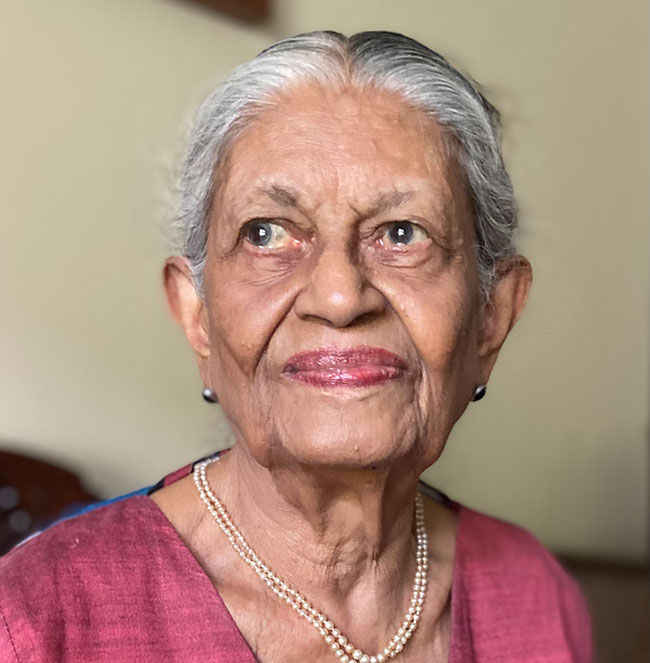
A familiar presence who enlivened these pages for over 30 years is no more. Nanda Pethiyagoda Wanasundera who wrote the People and Events column for the Sunday Island under the pseudonym Nan died on Wednesday morning at the age of 93 after a short illness and was cremated the next day in accordance with her wishes. Her last two columns, which she dictated to her younger son, Rajiv, visiting his mother from the US, and to a niece a week later, appeared in April.
Nanda was already on board this newspaper when I became its editor in 1997, writing a weekly column for quite awhile. When I saw her first piece under my stewardship – I think it was on her good friend Ayya Khema of the Dodanduwa nun’s island – I found it so readable and substantial that I realized I had a treasure of a columnist on my newspaper. It remained so for early 30 years when she had written close to maybe 2,000 articles not just her People and Events for the Sunday Island but for The Island (daily) where she had a weekly column, Cassandra Cry as well as under her initials NPW.
She regarded one of my aunts, Mrs. Ratna (NQ) Dias, as her kalyana mitta (mentor or companion who supports, inspires, and guides you on the path to enlightenment) and this could not but further endear her to me. She and Ratna nenda would take a bus to Dodanduwa to visit the island hermitage and those trips were anything but comfortable.
Nanda trained and worked both as a teacher and a librarian. She taught at the Kataluwa government school in the South and later in Colombo at Bishop’s College and Buddhist Ladies College. She was thereafter the librarian at the Overseas School and the Law Faculty of the Colombo University. A loyal alumnus of Girl’s High School, Kandy, where she had both her primary and secondary education, she must surely have been the oldest old girl living at the time of her passing.
Our relationship soon moved from that of professional colleagues to personal friends. She was always immaculately groomed with a collection of Thai/Indonesian lungis matched with stylish tops. She loved to entertain her friends in her well appointed apartment at Fifth Lane, Kollupitiya, laying an elegant table with stoneware crockery and all the trimmings. Although she claimed she couldn’t cook she was supported by her loyal and efficient domestic, Karuna, who had worked in New York for her elder son. Nanda knew how to choose her menus offering us goodies Rajiv brought her from abroad.
I was fortunate to belong to one of her close knit social circles and we met regularly at each other’s homes and restaurants and always had a whale of a time sharing anecdotes and memories, often chatting on the phone of this and that and mutual friends. It is hard to accept that she is gone.
Nanda wrote fluently and had the feel for a story written in a warm and chatty style. Memories of a happy childhood near Kandy, holidays with an elder brother who was one of the first batch of Ceylon’s DROs with a remote posting, extensive travel, work experience, warm relations with a wide and varied circle of friends and acquaintances equipped her with a vast reservoir of background information to draw on.
She swam at the Ladies College pool, a short walk along the barrel drain fro her home on Fifth Lane well into her eighties, practiced yoga, read voraciously and was extremely generous to those who worked for her. It wasn’t long ago that she with Rajiv did a long drive to the rural heartland to visit Podi Hamy who had looked after her two boys and later worked as her cook in Colombo.
Nanda was a very good Buddhist who meditated, She was close to many erudite bhikkus who turned to her to write and publicize many matters of interest to Buddhists and Buddhism. Let me relate a single anecdote to complete this appreciation of a remarkable woman who added light to many lives. It illustrates her ability to deftly turn the tables on whoever when the circumstances so demanded.
Nanda and I, both friends of Capt. Elmo Jayawardena, participated in a ‘Talkmates’ program he set up to improve the English of poor speakers of the language by pairing them with good English speakers for longish telephone conversation. A young woman called Piumi was mentored by both Nanda and I.
She invited Piumi and me along with a cousin of hers to her home for lunch one day. The cousin and I were swapping yarns across the table when I used the ‘b’ word. Piumi turned to Nanda and asked her, “Madam what does ‘b—r’ mean? Nanda responded instantly saying “you better ask the person who used it!”
Touche´! Incidentally Piumi left the lunch with a very generous gift from Nanda.
Manik de Silva

Mandhana, Deepti, Ghosh star as India breeze past Pakistan

Showers will occur in the Western, Sabaragamuwa and North-western provinces and in Galle, Matara, Kandy and Nuwara-Eliya districts

Theft of USD 2.5 mn from Treasury: CoPF accused of complicity in NPP cover-up

Viral diseases on the rise

Ranil warns of another economic crisis, calls for Opposition unity

Govt. eyes multi-billion dollar green hydrogen future

‘Dates have the highest sugar content to fight Coronavirus’

Sunday Island 27 December – Headlines

#SundayIsland 17th December – Headlines

Sunday Island – 28th March

Sunday Island Headlines – 21 March

Sunday Island – 21st February – Headlines
-
 News3 days ago
CIABOC summons Yoshitha over his participation in British Navy training programme
-
 News5 days ago
Local firms move millions of dollars overseas for phantom imports: Govt.
-
 Midweek Review5 days ago
July 09: An inexcusable overall security failure and exceptional contingency plan
-

 Opinion6 days ago
Could Sri Lanka once again face an economic crisis similar to 2022?
-

 News5 days ago
AI raises concerns over arrest of Sallay and rapper under PTA
-
 News6 days ago
Sallay refuses to end hunger strike unless probe is taken out of CID led by Shani
-

 News2 days ago
Commonwealth lawyers urge Lanka to uphold rule of law
-
 Latest News6 days ago
Iran and Israel say they will pause strikes but warn of retaliation if ceasefire breached again