
Business
Brandix redefining the strategic pillars of its Smart Factory journey


Showcases its AI-powered technologies
One of Sri Lanka’s leading proponents of technology solutions in manufacturing, Brandix, took stock of its transformative journey and discussed new innovative solutions to propel the business forward at the ‘Digital Horizon 2024’, the second edition of Brandix’s own digital keynote session held at Trace Expert City in Colombo.
The event highlighted the significant progress made across the organization over the past two years, showcasing several innovative advancements. A key focus was on the integration of AI, automation, and value addition in Brandix’s Smart Factory journey. These Smart Factories exemplify the synergy between efficiency and empathy, offering numerous benefits such as reducing physical exertion and fatigue for employees, enhancing workplace safety, and fostering inclusivity by enabling individuals with disabilities to join the workforce. Leveraging the Internet of Things (IoT) and automation, Brandix has also achieved greater resource efficiency, reduced waste, and minimized its ecological footprint, underscoring its commitment to sustainability.
Brandix was also among the first Sri Lankan companies to adopt Copilot for Microsoft 365, the software solution provider’s cutting-edge artificial intelligence assistance platform, having been invited to join the Global Early Access Program.
Digital Horizon 2024 also discussed the development and deployment of several other AI-led programs that have been instrumental in driving the company’s digital transformation journey. Oshada Senanayake, Director and Chief Operating Officer for Digital Transformation at Brandix, said “A lot has changed in the sphere of apparel manufacturing; it is no longer the mere traditional cut-and-sew operation that many perceive it to be. Our Associates on the shop floor employ some of the most modern technologies that have completely changed their quality of work, whilst driving greater learning and technology adoption across the group and the communities we serve. Engaging with some of the biggest names in the technology domain, Brandix is also proud of its in-house talent and innovators who constantly challenge and advance the way we do business. The Horizon platform has been an ideal platform to discuss and take these conversations forward.”


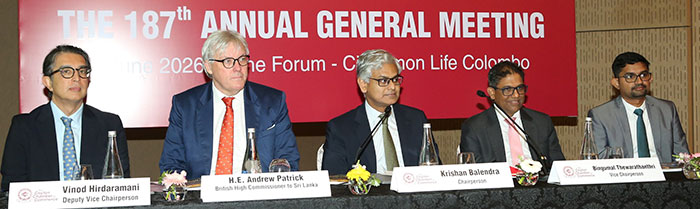
The Ceylon Chamber of Commerce announced the re-election of Chairperson Krishan Balendra and the election of its Board for the Year 2026/27 at the Chamber’s 187 th Annual General Meeting on June 25. High Commissioner of Britain to Sri Lanka, Andrew Patrick, attended as Chief Guest.
The 2026/27 office-bearers are Chairperson Krishan Balendra, – Chairperson John Keells Holdings PLC, Vice Chairperson Bingumal Thewarathanthri – CEO, Standard Chartered Bank Sri Lanka, and Deputy Vice-Chairperson Vinod Hirdaramani – Chairman, Hirdaramani Group.
Jayanthi Dharmasena – Managing Director, Hayleys Agriculture Holdings Ltd., Kasturi Chellaraja Wilson – Chief Operating Officer, Head of APAC – 5Hour International Corporation Singapore, Shibani Thambiayah – Managing Director, Renuka Hotels PLC,Supun Weerasinghe – Director/Group CEO – Dialog Axiata PLC, and Shiran Fernando – Secretary-General and CEO will serve as Board Members. Rohana Dissanayake – Group Chairman and Managing Director of David Pieris Motor Company Pvt. Ltd. will also join the Board, replacing Bernhard Stefan – Managing Director – Nestlé Lanka PLC, who relocated overseas.
In his remarks, Balendra noted that over the past year, the Chamber adopted a more solutions-oriented approach to advocacy, focusing not only on identifying challenges but also on developing constructive recommendations in collaboration with government, industry stakeholders, and development partners, with this approach yielding stronger results. “Through our engagement in the Budget 2026 process, eighteen recommendations proposed by the Chamber were incorporated into the national budget, covering areas such as trade facilitation, investment promotion, digitalisation, infrastructure, and improving the ease of doing business.
This builds upon the strong momentum established in previous years and demonstrates the value of evidence-based, constructive engagement.
The Chamber also contributed to addressing emerging global trade challenges, including tariff-related issues affecting Sri Lankan exports. By representing private sector perspectives in Presidential Committees, we supported efforts to safeguard export competitiveness and strengthen trade resilience.”
Beyond advocacy, it significantly expanded its engagement footprint, strengthening bilateral partnerships across more than twenty countries, and supporting more than 1,800 SMEs through training, advisory services, and market access initiatives.
He added that over the next year, the Ceylon Chamber is committed to deepening engagement with members, strengthening global partnerships, enhancing support for SMEs, and accelerating efforts to promote exports and attract investment, and is committed to working with the Government and stakeholders to ensure a resilient and prosperous Sri Lanka.

In the hill capital of Kandy, a husband-and-wife duo has won the admiration of music lovers with their shared passion for singing and their dedication to the art.
Vijitha Kingsley Bandara and Umesha Kalhari Navaratne have become familiar voices among audiences in Kandy, entertaining crowds with their musical talents while building a reputation as a versatile singing couple.
Kingsley began his musical journey at the age of 17, performing at outdoor musical shows before gaining opportunities to showcase his talent at several hotels in the Kandy area. His performances for local and foreign tourists further enhanced his reputation as a singer. He later took his musical talents overseas, entertaining audiences in several countries.
For the past 12 years, Kingsley has been engaged in singing at establishments operated by the Devon Group and The Grand Kandyan Hotel in Kandy, following an opportunity extended by Group Chairman Gamini Weeraratne.
Supporting him both in life and music, Umesha has also established herself as a singer, performing at Devon establishments. She also runs a home-based cake-making venture.
The couple, who continue to receive appreciation from music enthusiasts, said they are ready to accept invitations to perform at musical events across the country. They can be contacted on 071-1519130.
Text and Pic by SK Samaranayake

Recognising the rapid emergence of the gig economy in Sri Lanka, the Commercial Bank of Ceylon has introduced ‘ComBank GIG+’ – a specialised banking solution designed for freelancers, digital entrepreneurs, social media influencers, and individuals and businesses earning in foreign currency through overseas engagements to receive their foreign earnings, including PayPal-linked withdrawals, through a structured banking account.
ComBank GIG+ reflects a decisive shift in the country’s employment landscape, where a growing number of professionals are leveraging global digital platforms and remote work opportunities to build independent income streams. From freelance service providers operating on platforms such as Fiverr, Upwork and Freelancer.com, to content creators monetising audiences across YouTube, TikTok, Meta and X, this segment represents a dynamic and increasingly influential contributor to foreign exchange inflows.
ComBank GIG+ is tailored to meet the specific needs of these digital earners, offering account options in Sri Lanka Rupees as well as major foreign currencies including USD, EUR, GBP and AUD. The account is available to Sri Lankan citizens aged 18 and above residing in the country, as well as duly registered business entities, subject to verification of foreign currency income derived through recognised digital and remote work channels.
Commenting on the introduction of ComBank GIG+, Hasrath Munasinghe, Chief Operating Officer of Commercial Bank said: “The rise of independent digital earners represents a structural shift in how value is created and exported from Sri Lanka. With ComBank GIG+, we are establishing a banking framework that not only recognises this segment, but also integrates it more meaningfully into the formal financial system. This enables individuals and businesses operating beyond traditional employment models to build a verifiable financial track record, access formal financial services, scale their operations, and contribute more visibly to the country’s economic growth.”
The launch of ComBank GIG+ is particularly timely following Sri Lanka’s recent enablement of PayPal linked withdrawals, which has simplified the process of bringing overseas digital earnings into the country.
In addition to facilitating PayPal-linked withdrawals and foreign currency inflows, the Bank said the ComBank GIG+ account offers a range of value-added benefits including first-year fee waivers on credit cards and digital banking services, preferential foreign exchange rates for qualifying conversions into Sri Lanka Rupees, and the opportunity to establish a structured banking relationship that may support future access to financing and other financial solutions. These features are designed to enhance financial efficiency while supporting the day-to-day banking needs of digitally active customers.
By aligning its product innovation with evolving global work patterns, Commercial Bank continues to strengthen its position as a forward-looking, technology-driven institution. The introduction of ComBank GIG+ underscores the Bank’s commitment to supporting new economic segments, enhancing financial inclusion, and enabling Sri Lankan talent to participate more effectively in the global digital economy.

Zafar, Feroza lead Pakistan to consolation win

Jangoo 233, Chase 194 put West Indies in commanding position

Showers will occur at times in the Western, Sabaragamuwa and North-western provinces and in Galle, Matara, Kandy and Nuwara-Eliya districts

Venezuelans dig for earthquake survivors as death toll rises to 1,430

Chemmani mass graves: Govt to seek international forensic help

ADB approves $57.4 million package to boost Lanka’s rooftop solar drive

‘Dates have the highest sugar content to fight Coronavirus’

Sunday Island 27 December – Headlines

#SundayIsland 17th December – Headlines

Sunday Island – 28th March

Sunday Island Headlines – 21 March

Sunday Island – 21st February – Headlines
-

 Features7 days ago
Sri Lanka developing independent hydrographic capabilities
-

 Opinion6 days ago
Ranasinghe Premadasa: The man who would not take ‘No’ for an answer
-

 News1 day ago
Another 1,132 Sri Lankan Personnel to be deployed for United Nations Peacekeeping Missions
-

 Opinion5 days ago
Sri Lanka’s national security: Justice, reconciliation, and forward-looking vigilance
-

 News5 days ago
US Assistant Secretary of State for South and Central Asian Affairs meets President
-

 News3 days ago
Kelaniya emerges as highest ranked Lankan uni in Times Higher Education Sustainability Impact Ratings
-

 Opinion4 days ago
A triumph for Pakistan’s skilled diplomacy at Iran-US talks
-

 Business7 days ago
University of West London opens Sri Lanka’s first full UK university branch campus