
Latest News
Rahmat’s gritty hundred extends Afghanistan lead


Afghanistan dragged themselves to a position of advantage on an attritional third day, with Rahmat Shah’s gritty century, his third in Test cricket, headlining their much improved batting display from their first innings.
On the second day where 13 wickets fell, Afghanistan conceded an 86-run first-innings lead to Zimbabwe and lost three wickets before wiping out even half the deficit.
But on Saturday, Rahmat, with help from Shahidullah and debutant Ismat Aslam, stretched Afghanistan’s lead beyond 200 with three wickets still remaining, before rain forced early stumps.
For Zimbabwe, Blessing Muzarabani added two wickets to his overnight tally of two, while Richard Ngarava struck twice, including the prized scalp of Rahmat, but they know with Ismat still at the crease along with Rashid Khan, who is capable of scoring some quick runs, they are going to be staring at a steep chase on a pitch where batting fourth is a daunting proposition.
Afghanistan’s innings revolved around two partnerships. The first was a 67-run stand between Rahmat and Shahidullah that saw the visitors take a 50-run lead by the time it was broken. The pair got together after Afghanistan lost two wickets in the first hour of play while still 17 runs behind.
From the way Rahmat started the day, it was evident he wanted to bat long for Afghanistan to get into a winning position. He played out 19 balls before scoring the first run off his bat on the day.
Ngarava removed the nightwatcher Zia-ur-Rehman the very next ball, and dismissed Afsar Zazai soon after.
This prompted Rahmat to take the initiative as he punished two consecutive bad balls from Muzarabani – a full toss and a half-volley – with drives down the ground for boundaries.
There was a short rain delay that followed, after which the two dealt in singles till Afghanistan were in the lead in the 30th over.
Rahmat and Shahidullah took on Sikandar Raza and Newman Nyamhuri for two boundaries off the next two overs before Rahmat brought up a half-century off 99 balls. The boundaries kept coming as the two trudged along to lunch with a 39-run lead.
In the fourth over after tea, a smart piece of captaincy brought about Shahidullah’s downfall.
With Muzarabani testing him outside off from around the wicket, Craig Ervine brought on a silly point fielder and the next delivery, Shahidullah fended at a length ball in the corridor to offer the simplest of chances to Takudzwanashe Kaitano at silly point.
Zimbabwe knew they had to capitalise on the opportunity, and put the screws on Afghanistan.
Ismat, who was out without scoring in the first innings, copped a blow on the helmet trying to duck under a Muzarabani bouncer that stayed low and needed multiple check-ups from the physio over the next few overs.
Rahmat survived an lbw chance when Raza, who toiled away for 23 wicketless overs in the day, got one to spin in sharply to strike his pad only for the umpire to turn it down. Rahmat responded by dancing down the track and lofting him down the ground for a boundary before he took a hit on the shoulder from an Ngarava short ball.
But the two were unfazed and went about steadily increasing Afghanistan’s lead. Rahmat brought up his century with a single of Nyamhuri off 209 balls, following up on his double in the first Test.
Ismat, who was on 16 off 46 at the point, then started to shift gears with two boundaries off Nyamhuri before tea.
After tea, there were 11 consecutive overs of spin, but Raza and Bennett couldn’t break through or keep the scoring rate down to apply pressure.
As soon as the new ball became available, Zimbabwe found some immediate chances. Ngarava drew the edge from Ismat but he was dropped by Ervine at first slip, when he was three runs short of his fifty. One over later, Ismat brought up a half-century.
The set batters used the extra pace of the new ball to cash in on a few more boundaries before Muzarabani finally broke the stand on 132 – the highest for the seventh wicket for Afghanistan.
Muzarabani got a length ball to seam in past Rahmat’s inside edge and hit his back pad. Rahmat wasn’t best pleased when the umpire ruled him out leg before, but with no DRS available in this series, he had to walk back after a marathon innings.
Rashid then quickly moved to 12 off as many deliveries, hitting Nyamhuri through midwicket for a boundary off what proved to be the last ball of the day before the players were called off for rain.
Brief scores:
Afghanistan 157 and 291/7 in 91 overs (Rahmat Shah 139, Ismat Alam 64*; Blessing Muzarabani 4-71, Richard Ngarava 2-47) lead Zimbabwe 243 in 73.3 overs (Craig Ervine 75, Sikandar Raza 61, Sean Williams 49; Rashid Khan 4-94, Yamin Ahmadzai 3-62, Fareed Ahmad 2-27) by 205 runs
[Cricinfo]

Latest News
Heat Index at Caution Level in the Northern, North-central, North-western, Western, Sabaragamuwa, Eastern and Southern provinces and in Monaragala district

Warm Weather Advisory
Issued by the Natural Hazards Early Warning Centre
Issued at 3.30 p.m. on 15 April 2026, valid for 16 April 2026.
The Heat index, the temperature felt on human body is likely to increase up to ‘Caution level’ at some places in the Northern, North-central, North-western, Western, Sabaragamuwa, Eastern
and Southern provinces and in Monaragala district.
The Heat Index Forecast is calculated by using relative humidity and maximum temperature and this is the condition that is felt on your body. This is not the forecast of maximum temperature. It is generated by the Department of Meteorology for the next day period and prepared by using global numerical weather prediction model data.
Effect of the heat index on human body is mentioned in the above table and it is prepared on the advice of the Ministry of Health and Indigenous Medical Services.
ACTION REQUIRED
Job sites: Stay hydrated and takes breaks in the shade as often as possible.
Indoors: Check up on the elderly and the sick.
Vehicles: Never leave children unattended.
Outdoors: Limit strenuous outdoor activities, find shade and stay hydrated.
Dress: Wear lightweight and white or light-colored clothing.
Note:
In addition, please refer to advisories issued by the Disaster Preparedness & Response Division, Ministry of Health in this regard as well. For further clarifications please contact 011-7446491

Pakistan’s army chief, Field Marshal Asim Munir, has landed in Iran as part of a delegation to hold high-level talks on the resumption of talks between Iran and the US.
Iran’s army has warned it will block trade through the Red Sea along with the Gulf and Sea of Oman if the US naval blockade on Iranian ports continues.
The US military says it has “completely halted economic trade going into and out of Iran by sea” as its blockade in the Strait of Hormuz continues for a second day.
US President Donald Trump says the war is “close to over” after hinting at a second round of face-to-face talks with Iran in Pakistan in the coming days.
(Aljazeera)

More than 200 Iranian sailors left stranded in Sri Lanka after a US torpedo attack are returning home after being stuck in the country for more than a month.
On Wednesday, Sri Lanka’s Deputy Defence Minister, Aruna Jayasekara, confirmed 32 sailors rescued from the Iris Dena and 206 from Irins Bushehr, had left the country.
The Iranian warship, Iris Dena, sank on 4 March about 40km (25 miles) from Sri Lanka’s southern coastline after it was hit by a torpedo from a US submarine, killing 104 sailors.
On March 5, Sri Lanka took control of the Iranian naval vessel, Irins Bushehr, after it had requested to dock at one of country’s ports after one of its engines malfunctioned.
Speaking to Reuters, Jayasekara confirmed the crew of both ships were flown out on Tuesday night.
The stranded sailors were granted 30-day entry visas by the Sri Lankan government and were housed in navy and air force camps.
The Iris Dena had been returning from a military exercise hosted by India when it was attacked.
Video released by the US Department of Defense after the incident showed a ship being struck, causing the stern to rise up before exploding.
The bodies of 84 Iranian sailors killed in the attack were recovered and later repatriated in a chartered plane arranged by Iran.
Its sinking in international waters came just a few days into the current US-Israeli war with Iran and marked a dramatic widening of the conflict.
Iran has since launched retaliatory strikes across the Middle East – targeting Gulf countries allied with the US.
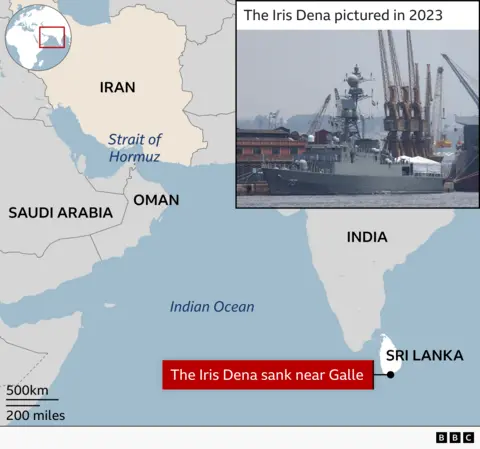
About 15 Iranian sailors will remain in Sri Lanka to operate the Irins Bushehr, which is anchored off Trincomalee in the northeast of the island.
Sri Lankq had allowed the Iranian vessel to dock at a north-eastern port on 5 March after hours of discussion, with its president saying they would “never hesitate to protect humanity”.
“Our position has been to safeguard our neutrality while demonstrating our humanitarian values,” President Anura Kumara Dissanayake said in a statement at the time.
“[Sri Lanka] intervened in a way that demonstrated our commitment to international conventions, protecting the reputation and dignity of our country, and protecting human lives,” he said.
Sri Lanka has maintained a long-standing policy of non-alignment since it became independent in 1948.
It has strong economic and diplomatic ties with both Iran and the US.
(BBC)

Heat Index at Caution Level in the Northern, North-central, North-western, Western, Sabaragamuwa, Eastern and Southern provinces and in Monaragala district

Pakistani army chief in Tehran amid bid to restart US talks

Sri Lanka repatriates 238 Iranian sailors stranded after US torpedo attack

Indonesian Navy Sailing Ship KRI BIMA SUCI – 945 makes port call in Colombo

PM initiates children into learning at the auspicious time while observing New Year traditional customs and rituals

Navy seize an Indian fishing boat poaching in seas north of Mannar

‘Dates have the highest sugar content to fight Coronavirus’

Sunday Island 27 December – Headlines

#SundayIsland 17th December – Headlines

Sunday Island – 28th March

Sunday Island Headlines – 21 March

Sunday Island – 21st February – Headlines
-

 News4 days ago
CEB orders temporary shutdown of large rooftop solar systems
-
 Features4 days ago
From Royal College Platoon to National Cadet Corps: 145 years of discipline, leadership, and modern challenges
-

 Business6 days ago
Israeli attack on Lebanon triggers local stock market volatility
-

 Business6 days ago
HNB Assurance marks 25 years with strategic transformation to ‘HNB Life’
-

 Latest News3 days ago
PNS TAIMUR & ASLAT arrive in Colombo
-

 News5 days ago
Anura Solomons passes away
-

 Features4 days ago
CIA’s hidden weapon in Iran
-

 Latest News3 days ago
Prasidh, Buttler set up comfortable win for Gujarat Titans