
Latest News
“The success of the “Clean Sri Lanka” initiative depends solely on the active participation of the public” – President

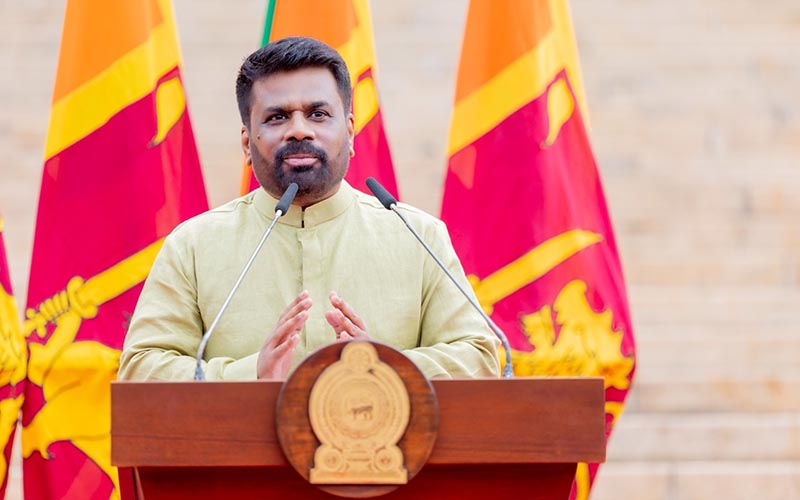
President Anura Kumara Disanayake stated that the success of the “Clean Sri Lanka” initiative depends solely on the active participation of the public.
The President made these remarks today (01) at an event held at the Presidential Secretariat to inaugurate the “Clean Sri Lanka” program.
During his address, President Disanayake further elaborated:
“We believe that as 2024 concludes and we step into 2025, the dawn of a new year presents us with a critical question. Despite decades of similar beginnings, have we truly embraced renewal for the betterment of our nation? Or have we regressed, adapting only to perpetuate past failures? This question confronts us as we welcome the New Year. Our firm resolution is to usher in transformative change for our country this year. This is both our challenge and responsibility, and we are fully committed to fulfilling it.
Together with my cabinet, deputy ministers, and the entire political leadership, we are dedicated to this cause. This year marks the start of a new political culture in our country, as we lay the necessary foundations for its development. We aim to abolish practices such as nepotism, the abuse of power against the people, and the creation of a political elite that prioritizes personal interests over the public good. Instead, we are committed to a political culture aligned with the aspirations of the people.
Economically, we recognize the severe challenges our nation has faced in recent years, leading to a state of near-collapse. Over the past year, we achieved some stability on the surface level of the economy and officially emerged from bankruptcy in the latter half of the year. This progress is owed to the immense efforts of officials from the Ministry of Finance, the Central Bank, and the political leadership. However, surface-level stability is not enough. This year, we will implement an economic policy framework aimed at addressing the deeper structural problems within our economy.
Our country has also faced various security threats over the years. It is with great confidence that we can now assure our citizens of a robust and secure national defence. Last year, reports surfaced regarding a potential attack cantered on Arugam Bay. Our police, intelligence services, and armed forces acted decisively to maintain the nation’s security and instil public trust. We have also begun systematically reinstating the rule of law, which had been neglected for far too long. In the past, criminals, corrupt individuals, and even political authorities operated above the law, disregarding constitutional principles. In some instances, former presidents were found guilty of constitutional violations by the Supreme Court. In such a context, the rule of law had become merely an abstract notion.
To re-establish and strengthen the rule of law, we are making significant efforts. Our country has been plagued by widespread corruption, malpractice, and inefficiency within the state apparatus, political institutions, and society as a whole. Corruption has become a malignant cancer spreading throughout our nation, and eliminating it requires a tremendous collective effort. The Attorney General’s Department has a critical role to play in this endeavour, and I trust they will perform their duties with the necessary diligence and support.
Similarly, institutions such as the Criminal Investigation Department and the judiciary bear the principal responsibility for transforming our country into one free from corruption and fraud. We believe these institutions will act with the dedication required to achieve this transformation. As political leaders, we are committed to setting an example through both our words and actions.
However, leadership and intervention from the political sphere alone will not suffice. Relevant state institutions must understand their responsibilities and contribute actively to this process of change.
Therefore, I call upon all relevant institutions and officials to provide their unwavering support. This collective effort is vital for the transformative progress our nation needs in the coming year.
To construct any strong building or initiate any successful project, a solid foundation is essential. Our nation, however, is one that has lost its foundation. For this reason, we have focused our initial efforts on successfully establishing the fundamental groundwork required to rebuild this country. This foundation encompasses political authority, state mechanisms, the rule of law, respect for and protection of the Constitution, and a rejection of corruption, fraud, and bribery. These elements form the bedrock necessary to advance the nation. We are rapidly and systematically laying this foundation. The benefits of the robust economy built on this foundation must flow to our citizens.
Our government is focusing on three main projects, or key objectives, to lead this initiative. The first priority is to rescue our country and its people. Economic reforms are being formulated to ensure that economic benefits reach rural communities, as an economy concentrated in the hands of a small group can never bring stability to society. Such an imbalanced economy fosters instability for the nation and its people. Therefore, achieving economic stability requires extending economic benefits to rural populations.
With the upcoming budget, we aim to steer economic programs toward the eradication of poverty in our nation. Our second goal is to embrace digital transformation. By establishing a foundation for digitalization, we seek to minimize inefficiency and corruption while enabling citizens to interact seamlessly and effectively with state mechanisms.
The third major initiative is the “Clean Sri Lanka” project. This endeavour goes beyond merely cleaning up the environment. It aspires to restore the deeply eroded and deteriorated social and environmental fabric of our motherland. We aim to create cleanliness and rejuvenation across all sectors of society.
Allow me to highlight a few critical issues to emphasize the importance of these efforts. Sri Lanka is endowed with an exceptionally beautiful and vital environment. Our strategic geographic location is a significant advantage, and visitors often remark on the stunning beauty of our country. However, despite this natural wealth, Sri Lanka faces grave challenges.
In 2023 alone, 181 people lost their lives in human-elephant conflicts, and 484 elephants were killed by human action. Although we possess an aesthetically and ecologically rich environment, we are a nation where 484 elephants die annually. Furthermore, floods and landslides displace significant populations; resulting in loss of life, and cause substantial economic damage.
Restoring our environmental system must become a core focus of the “Clean Sri Lanka” program. Our nation and its people need a new value system. We have mistakenly elevated incorrect values to positions of importance, embedding them as the fundamental ethos of our society. It is crucial to establish a new framework of values.
Where do we begin? The first step must be cultivating an appreciation for one’s own life. Sadly, many of our citizens lack a sense of self-worth or value for their lives. I say this because, in the past year, 550 people drowned, whether in the sea, reservoirs, wells, or ponds. A total of 2,321 people died due to such incidents. These figures highlight the urgent need to foster respect for life in our society.
On average, approximately seven people lose their lives daily due to road accidents in our country. This reflects the emergence of a society that lacks a sense of value for life; one where individuals have little regard for their own lives or the lives of others. It is a society devoid of empathy, concern, and consideration for one another.
Therefore, it is essential to heal our society and introduce a new system of values and principles. Under the ‘Clean Sri Lanka’ Initiative, we aim to establish these new values and systems. Minimizing road accidents is a priority. To achieve this, my trust lies first and foremost in the citizens rather than the law. Citizen participation and engagement are vital. If citizens fail to comply, we are prepared to enforce the law. However, we are committed to driving this transformation with a thoughtful, inclusive and adaptive approach. Nonetheless, if any one obstructs this progress, we are equally ready to act decisively and assertively to ensure the recovery and well-being of our society.
Furthermore, it is essential to address the concerns of our citizens regarding the safety and quality of the food they purchase from the market. As a state, it is our responsibility to provide food that is free from harmful substances.
The Clean Sri Lanka initiative encompasses the responsibility to act towards these goals. Furthermore, as a society, we must care for our citizens, including those with disabilities. This is a matter of social justice. Can we marginalize individuals simply because they have grown old? Can we exclude those with disabilities from society, treating them as outsiders instead of equals? A society that does so can never truly be considered a just or compassionate one. If we lack empathy and compassion for the disabled community, the elderly, and the women and youth in our midst, we fail to nurture and uphold a sense of collective care. Such a society will become one characterized by cruelty and indifference toward one another. Therefore, we must cultivate a new social mind-set that prioritizes inclusivity and compassion.
Additionally, the protection of public assets is vital. For a long time, Sri Lankan citizens held a deep respect for public property. However, in recent times, there has been a shift where people protect their personal possessions but neglect the preservation of national resources and public goods. This stems from a lack of understanding about the intrinsic value of these shared assets.
A state must ensure that all citizens recognize the importance of safeguarding national resources—not just for their benefit but for the benefit of future generations. These resources are not exclusively ours to exploit or destroy. Our generation has a responsibility to protect and preserve them for those who will come after us.
It is within this framework that the Clean Sri Lanka initiative is prepared to act. Moreover, we understand that the government machinery and political authorities must function with efficiency and urgency. Every citizen must take responsibility for fulfilling their respective duties to ensure the success of this collective vision.
If responsibility is neglected, the weight of that responsibility will inevitably cause the system to collapse. The strength and stability of this structure are built upon various frameworks, including government, political, and private sectors. When members of these frameworks fail to fulfill their assigned responsibilities, it leads to significant harm to the system as a whole. Therefore, we urge, particularly from the state sector, to be prepared to uphold your duties with diligence and commitment. Numerous examples today highlight the importance of responsibility and selfless service. Many critical institutions in Sri Lanka, vital to economic progress and national security, are led by individuals who voluntarily take on significant responsibilities.
The Chairperson of Sri Lankan Airlines, the Chairperson of Sri Lanka Telecom, the Chairperson of the Port City, the Chairperson of the Board of Investment, and the Chairperson of the Gas Company, among many others, are professionals with exceptional skills and expertise. These individuals have stepped into their roles within our institutions to serve voluntarily, without any personal financial gain. Additionally, on a personal level, I have three advisors who also contribute their knowledge and expertise without receiving a single rupee as remuneration from the government.
On a personal note, my own three advisors work without receiving a single rupee in compensation from the government. These examples of selfless dedication serve as powerful reminders of the impact individuals can make when they place national progress above personal gain.
Sri Lanka is fortunate to have some of its most brilliant minds contributing voluntarily to national progress. Among them is a distinguished expert in digital transformation with extensive experience in the field. Having conducted ground-breaking research in science and technology at a leading American university, this individual is now working selflessly for the betterment of our nation.
Similarly, an expert with practical experience in economics, who has accumulated invaluable insights, has chosen to dedicate their time and expertise voluntarily. These are the kind of leaders our country needs—visionaries with fresh perspectives and transformative ideas. They are not driven by monetary gain or personal benefit but by the desire to serve the nation. These individuals have set aside their prestigious careers and dedicated their knowledge, time, and effort to rebuild our country, serving as an extraordinary example of selflessness and commitment.
A remarkable example has been set for our country. Because of this, I am telling you that we have been given an opportunity to rise. I do not consider this the final opportunity, because there are no “final moments” for people there are only opportunities. Today, as a nation, as a country, we have the chance to rise.
What I ask of the citizens of this country is this: Will you let this opportunity slip away, or will you seize it with determination and use it to rebuild our country and our nation? Are you ready to fulfil your duties and contribute to this cause? This is the question I am asking you.
Is this responsibility solely that of the government? Is it just a political manifesto? No. This is a collective effort. Throughout history, various nations around the world have faced challenges at different times. I don’t believe that any nation has ever gone through its journey without facing challenges from the beginning to the present. Every country has faced its unique set of challenges at various points in time. However, in each case, the political leadership, state machinery, and collective effort of the citizens have come together to overcome these challenges.
We don’t need to go far back in history. If we think of just the last century, we can see how many countries in Asia rose up in unity based on the message of collective effort. But what have we done? Instead of rising together, we have fostered distrust among ourselves, allowing nationalism, religious extremism, and divisive political battles to undermine our society. We’ve let mistrust, anger, and hatred grow among us through divisive politics. If the people are never ready to rise together, we will never have the chance to overcome these challenges. Therefore, the opportunity has presented itself. We now have the chance to rise up and take this opportunity.
We are ready to put an end to all divisions. As people born in the same Sri Lanka, we are prepared to come together and work collectively to build this country. Therefore, especially the success of the ‘Clean Sri Lanka’ program will depend solely on the active participation of the people. Without that, this cannot be achieved merely by laws imposed by the government or by officials appointed by the government. It is only through the collective effort of the public that we can make this a success.
A government mechanism is needed for this. Already, a task force of about 18 individuals has been appointed towards this end. I want to emphasize that everyone is working voluntarily. Furthermore, we hope to establish a Clean Sri Lanka Secretariat for this purpose. We also aim to form a Clean Sri Lanka Council to bring the people together for this cause, throughout the country. Ultimately, this is not a project that will conclude at a specific time. It is a continuous program that adapts to new global circumstances and is a part of the effort to restore governance within society. This is not a one or two-year project. If it were a project, it would be something that could be completed in one place, but the world is rapidly changing, and significant global victories are being achieved.
Social values, new principles, and fresh systems are continuously evolving. All of these elements are contributing to the formation of a new Sri Lankan nation in this country. For this cause, we are establishing a separate fund to support this effort. Citizens of this country will have the opportunity to contribute to this fund. The Ministry of Finance has appointed a supervisory board to oversee it. Therefore, this work is a collective effort that we must carry out to succeed, and we invite everyone to join in. By working together, we can accomplish this with great success. May this year be a prosperous new year for everyone.
Thank you very much.”
[PMD]








Defending gold-medal winners India overcame hosts Japan by eight wickets in the fourth quarter-final of the women’s cricket competition at the Asian Games in Nisshin on Friday. India chased down 58 in five overs to comfortably secure their place in the semi-finals. They will now face Bangladesh on September 20.
Japan did not exit the competition empty-handed. Their effort to bat as close to the full 20 overs as possible, their running between the wickets and their fielding effort were big positives. But they were bowled out for 57 in 19.5 overs after a solid start, leaving India with little to chase.
India, who opted to field, made the most of a pitch offering turn and bounce, which made stroke-making difficult for Japan. Shree Charani led the attack with another four-wicket haul, continuing an impressive run after taking 4 for 20 in the Women’s T20 Asia Cup final. She struck twice off consecutive balls in the seventh over, removing opener Haruna Iwasaki for 10 before having captain Mai Yanagida caught behind for a duck, but couldn’t convert it into a hat-trick.
Iwasaki and Ayaka Kato Stafford had put on 24 for the opening wicket, but Japan struggled to build partnerships once the stand was broken. Kato-Stafford top-scored with 25 off 47 balls, while Iwasaki made 10 off 22. Japan lost their last eight wickets for just 33 runs.
Charani finished with 4 for 10 from her four overs, while Shafali Verma took 2 for 13 and Deepti Sharma claimed 1 for 14.
Shrevanka Patil, returning to international cricket for the first time in three months after recovering from an ankle ligament injury suffered during the T20 World Cup in June, took 1 for 8 from 3.5 overs. Japan’s innings ended when Patil bowled Nonoha Yasumoto for a duck.
Chasing 58, Shafali opened the innings aggressively, smashing four boundaries in the first over to immediately put Japan under pressure. G Kamalini, who opened in place of Smriti Mandhana, and No. 3 Bharti Fulmali then threw their wickets away to fielders at long-on and point respectively. Left-arm seamer Yasumoto, who dismissed Kamalini, also delivered a wicket-maiden with the new ball.
Shafali finished the game with a six over long-on, staying unbeaten on 40 off just 15 balls. She struck six fours and two sixes at a strike rate of 266.66, as India won with 15 overs to spare.
Scores:
India Women 59 for 2 in 5 overs (Shafali Verma 40*, Richa Ghosh 12*; Nonoha Yasumoto 1-08, Ayaka Kato-Stafford 1-14) beat Japan Women 57 in 19.5 overs (Haruna Iwasaki 10, Ayaka Kato-Stafford 25; Shree Charani 4-10, Shreyanka Patil 1-08, Deepti Sharma 1-14, Shafali Verma 2-13) by eight wickets
[Cricinfo]
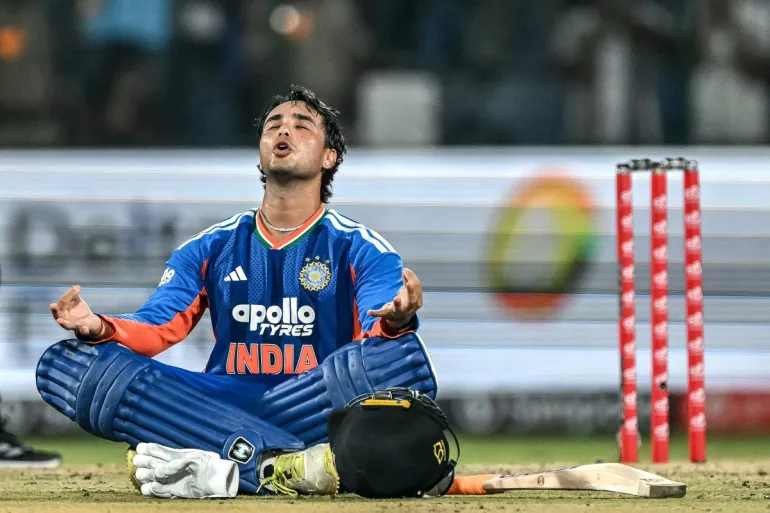
Opener Abhishek Sharma hit a record T20 century off 30 balls to set up a crushing 127 run win for India in the third match against Afghanistan and sweep the series 3-0.
Left-handed Abhishek’s ton on Thursday was the fastest in a T20 international between full Test-playing nations as he guided India to 221-7 at New Delhi’s Arun Jaitley Stadium.
Afghanistan, who were the official hosts for the series, checked the opposition surge after Abhishek departed for 108 off 34 balls and India lost their way from 142-1 in 10 overs.
But the Afghan batters once again disappointed and were bowled out for 94 in 14.1 overs.
Afghanistan had posted 156-8 and 159-8 while batting first in the first two matches.
Left-arm spinner Axar Patel struck twice in his first over to send back Rahmanullah Gurbaz, for 15 and Sediqullah Atal, for one. Afghanistan could never recover from the losses.
Seam bowler Nitish Kumar Reddy also took two wickets in one over to return figures of 3-25.
Leg-spinner Ravi Bishnoi wrapped up the Afghanistan innings with his third strike of the match.
Abhishek stood out with his third T20 century as he surpassed Zimbabwean Sikandar Raza’s ton off 33 balls against Gambia in 2024 and Finn Allen’s effort from the same number of deliveries in New Zealand’s T20 World Cup semi-final win over South Africa earlier this year in India.
The only two faster T20I hundreds came in matches between the lower-tiered associate members of the ICC.
Sahil Chauhan of Estonia holds the overall record of 27 balls after his century against Cyprus two years ago, while Muhammad Fahad needed just 29 balls for his ton for Turkey against Bulgaria in 2025.
Abhishek tore into the Afghanistan bowling attack after India were invited to bat first.
The swashbuckling opener hit a six to reach 99. He completed the hundred with a single and sat in meditation pose to celebrate.
He finally fell for 108 off 34 balls to leg-spinner Rashid Khan. The 26-year-old’s knock was laced with nine fours and 11 sixes.
His opening stand of 142 with Sanju Samson, who hit 50, put India on course for a big total but the Afghan bowlers hit back with regular wickets.
Tilak Varma was run out for two by Rashid and Samson departed after his second successive half-century as he fell to pace bowler Azmatullah Omarzai.
Omarzai struck another blow helped by a stunning catch by Rashid in the deep to send back Shivam Dube for 14.
India raised their 100 in six overs but managed just 79 from the last 60 balls.
India now head to Japan for the Asian Games starting September 19 at Nagoya-Aichi.
Afghanistan will send a largely different team to the Asian Games under Darwish Rasooli.
[Aljazeera]

United States President Donald Trump’s administration has asked lawmakers to clear the sale of 48 F-35 fighter jets to Saudi Arabia for an estimated $24.3bn.
“This proposed sale will support the foreign policy and national security objectives of the United States by improving the security of a major non-NATO ally that is a force for political stability and economic progress in the Gulf region,” the State Department said in a statement on Thursday.
The administration said the sale of the jets, the most advanced fighter aircraft the US has, would “not alter the military balance in the region” in keeping with longstanding US policy that Israel must have a military edge over potential regional adversaries.
The announcement comes after the Houthis in Yemen claimed on Wednesday they shot down a Saudi F-15 fighter jet over Marib, a key city in their battle against Saudi-backed Yemeni government forces. The group released video of fighters in the city standing before burning wreckage of what appeared to be a US-made F-15 fighter jet with Saudi Arabian markings.
The Houthis claim the aircraft was shot down with a “locally made” surface-to-air missile, which would mark a dramatic change in the group’s ability to wage war in the area. Until now, Saudi Arabia’s military has enjoyed relative air superiority in Yemen, and has relied heavily on its ability to carry out air strikes in the neighbouring country.
Intensifying fighting between Saudi Arabia and the Houthis reportedly killed at least five people, including three children, on Thursday.
[Aljazeera]

Charani, Shafali power India past Japan and into Asian Games semi-finals

Athapaththu and Dilhari muscle Sri Lanka past Malaysia in mismatch

Abhishek Sharma hits record T20 ton as India beat Afghanistan by 127 runs

Trump administration approves sale of F-35 jets to Saudi Arabia

Banton steers England into unassailable 2-0 series lead

Showers expected in the Western, Norrh-western and Sabaragamuwa provinces and in Galle, Matara, Kandy and Nuwara-Eliya Districts.

‘Dates have the highest sugar content to fight Coronavirus’

Sunday Island 27 December – Headlines

#SundayIsland 17th December – Headlines

Sunday Island – 28th March

Sunday Island Headlines – 21 March

Sunday Island – 21st February – Headlines
-

 News6 days ago
Gnanasara Thero absconding after SC ruling
-

 Latest News7 days ago
Sri Lanka thwart Fatima Sana challenge to secure Asia Cup final spot
-

 News7 days ago
Ammunition cache found in old Kandy bungalow
-

 News7 days ago
Green Climate Fund (GCF) Regional Dialogue for East and South Asia will be held from 14 to 17 September 2026 at Cinnamon Life at City of Dreams Hotel, Colombo
-

 News7 days ago
Prof. Pieris says Buddha Dhamma recognised as source of law under Constitution
-

 Opinion5 days ago
From Galkissa (Mount Lavinia) to Tambuttegama
-

 Latest News7 days ago
ITS Giuseppe Garibaldi’ departs Colombo
-

 Business6 days ago
HNB Finance strengthens Board with four independent directors