
Features
Agnotology, ethnicity, and New Year resolutions

by Geewananda Gunawardana
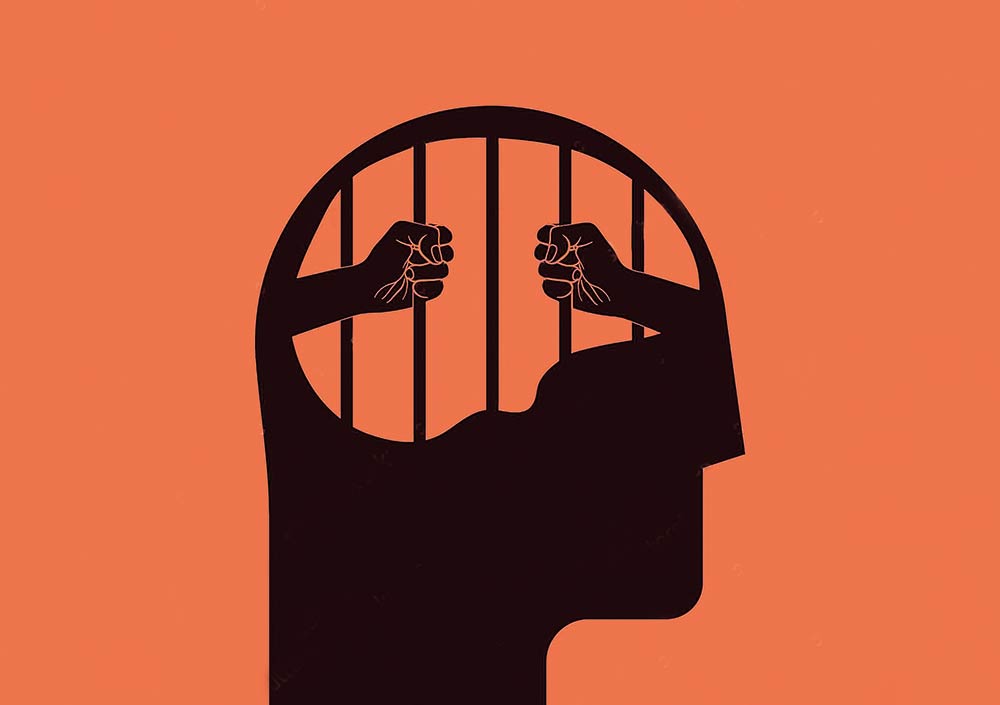
It is encouraging that the piece on agnotology and ethnicity (The Island December 4, 2024) elicited an erudite discourse (‘Ethnicity and genetics – A non-racial academic response’ and ‘Ethnicity – a synonym for confusion,’ The Island December 11 and 16, 2024, respectively) concluding that ethnic divisions have no biological basis. However, we cannot overlook the fact that humans have an evolutionary tendency to belong to a group, clan, or cult for survival purposes; we are social animals. Not having fangs, claws, venom, or any other protective anatomy, tribalism is the way humans have chosen to defend themselves. Unfortunately, the same evolutionary force makes us blind to the hazards of this habit. Throughout human history, this vulnerability has been exploited by story tellers of all stripes and spots to bring us under their fold and fatten themselves. We Sri Lankans tend to fall for such stories at an alarming rate with grave consequences. That is the focus of agnotology: the investigation of our weakness in believing stories, or the resulting culturally induced ignorance, and its effects on our society. It goes beyond ethnic relations.
One thing must be made clear, there is no point in continuing endless academic discourse and hoping for problems to go away. What is necessary is to find ways to reduce and finally eradicate culturally induced ignorance, or the habit of adhering to baseless, false stories that are harmful or counterproductive, and put them into action.
It is a fact that unlearning is much harder than learning. Therefore, it is best if we can stop learning such baseless, fake stories in the first place. The unpleasant truth is that it can be too late for some segments of society as such stories are deeply engraved in their minds. They will reject the facts, and we have no choice but to look beyond their objections. Therefore, the best remedy is to stop our children from learning culturally inherited myths, beliefs, and practices that disrupt harmony, waste valuable resources, and stop us from joining the 21st century. We must tell them the truth that they are poems, myths, and beliefs, etc., and they should not be accepted as undisputable truths. We must train the younger generation to think critically and have the skill to separate facts from fiction, instead of being blind followers. If the Buddha could say that about his teaching, why cannot we say the same about fabricated stories with hidden agendas?
It is inevitable that there will be a deafening outcry that such actions will ruin our proud culture and heritage. There is absolutely no need to let that happen; we can continue culturally and religiously important activities intelligently if we knew their true meaning and that we are not manipulated by some storyteller for their benefit. We must give our children the facts and train them to make sensible decisions rather than blindly following rituals. Even Buddhism teaches us that following rituals blindly is a barrier to liberation.
We have paid dearly for inflaming ethnic division. Let us not forget that the civil strife had cost the nation more than twice the current debt. Should we continue to spread questionable theories that try to prove one is superior to the other or one arrived before the other and has a larger claim to the land? Is it necessary to impress children by glorifying the battle between Dutugamunu and Elara that happened two thousand three hundred years ago? Or, is it more important to convince them that divided we will continue to wallow in misery?
Let us not forget that whether it is the iron age or the 21st century, the root cause of these evils is the elite that manipulate these stories to their benefit. We managed to sideline the old elite, the establishment, or the aristocracy, but there is a new elite trying to raise its ugly head: the so-called academic elite. Please do not jump to conclusions. There is no need to explain again when elite becomes a dirty word but let us be clear that there is an honourably learned community that provides a valuable service to the country. We value them. It is the fake academics that we must be weary of. Let us admit that it is the cream of the cream that enters our public universities. Whether they exhibit additional letters before or after their names or not, we must bear in mind that they are the smartest lot the country has produced. Whether the country reaps the investment made in them or not is a different issue.
Those who could not get in are not necessarily inferior, it is just that the others did better; and if they can afford it, they continue their education in private institutions here or abroad. Unfortunately, this is where elitism raises its ugly head; we want meritocracy for good reasons, but did everyone get an equal opportunity to collect such merits? We have a habit of giving more weight to foreign degrees, a residue of elite veneration, without verifying the quality of the granting institution or the veracity of their claims. It is no secret that it is possible to buy a degree in some countries. Even worse, I know firsthand an individual who worked as a checkout clerk at a pharmacy chain abroad and paraded as a doctor back at home! However, in this internet age, there is no need to be ignorant, to be gullible and believe their stories; few questions and a quick search of the web can verify their claims, and stop the emergence of a new elite, the bad kind. Let us ask not what letters they have added to their names but ask what they have done or can do to solve problems (my apologies to JFK).
We shamelessly propagate many stories that originated in the iron age without ever questioning their relevance to the 21st century. The ugliest of them is the caste system. We must question the value, or the purpose of following a social stratification system started by nomadic farmers from the central Eurasian Steppes to safeguard their feudal system four thousand years ago. Once again, it was their elite that deceived the humble peasants and took advantage. Imagine starting a similar system by treating descendants of computer programmers differently from those of civil engineers, for example. Force them to have different naming systems, prevent intermarriages, live in segregated enclaves, and assume one is above the other. It is a disgrace that we keep this system and go to the extent of forming separate voting blocks.
Another antiquated practice we hang onto is astrology, which started in Mesopotamia. They used the cyclic movement of celestial bodies as a calendar to plan their agricultural activities. Their geocentric models of the cosmos did not allow them to realise that the seasonal changes are the result of the tilt in earth’s rotational axis and varying distance to the sun. This ignorance made them elevate seasonal changes to acts of divinity. It is true that the gravitational force of the moon causes tides, but how can nuclear furnaces that are light years away impact human lives on earth? Science has yet to discover any such forces or find any evidence that astrological predictions have any basis. There are billions of people who lead healthy successful lives in this world without ever following astrology. Instead of astrology, let us teach the children astronomy, so that they will understand that climate change is not a hoax.
The Age of Reason along with scientific revolution started in the 17th century helped humanity get rid of baseless beliefs and myths that were used by the elite to retain power. Unfortunately, we seem to have missed that revolution and are still trapped in the past. That is no accident either: the elite had done their part to limit our access to knowledge. The underlying reasons that resulted in the widespread tuition business that sells knowledge are good examples. The disparity in the quality of public schools between urban and rural areas is another; do the elite send their children to rural schools? According to one report, over eight hundred rural schools had been closed permanently by 2023. The school dropout rate due to poverty is estimated to be about 30 to 35 percent. Is there any doubt that quality education is only for the elite?
Not only that many practices we engage in have no real value, but they also funnel our precious resources to nefarious activities. Unfortunately, these stories are so deeply engraved in our collective psyche that we do not have the will to challenge them. That is the power of storytelling, and its role in shaping our destiny. This is particularly ironic for one important reason. The goal of the ‘Age of Reason’ and the ancient tradition that most Sri Lankans venerate, protect, and give their lives to preserve have the same goal: understanding the natural world and humanity’s place in it through reason: knowing reality. Unfortunately, instead of following that guidance, we have shrouded that timeless truth we inherited with practices based on beliefs, myths, and mysticism. We have legitimized many primitive practices such as rituals centered on appeasing deities, demons, ghosts, clairvoyant reading, and other numerous spirits bringing them under the umbrella of that venerated tradition and blinding ourselves to truth.
We fail to see that communicable diseases are caused by germs and not by angry spirits, and the absurdity of appeasing higher powers for cures instead of using proven medications. The facts of a simple biological event such as reaching puberty are often buried under rituals; the associated taboos impact females from participation in education and in the work force and, at times, risk their health. The period poverty is discussed in high circles, but does it help the needy? These practices teach our children to leave their destinies at the mercy of mystic superpowers instead of taking control of their lives themselves. There lies the biggest obstacle to prosperity. These are all difficult subjects to deal with, but we must initiate a dialogue on the information gap at a minimum if we must move the country forward.
There are many more practices and beliefs that hamper our progress. Hopefully, we will have the courage and wisdom to have that discussion, someday. Until then, we can do one thing at home: let us tell our children the truth. If our practices have artistic, cultural, and economic values, let us tell them so without wrapping them in mysticism. Let us teach them poems for their literary value but not as historical facts. Let them know that history is written by the victors and often gives the writer’s perspective. Let us teach them the value of rational thinking and help them join the 21st century along with the rest of the world. Let us have no doubt that a prosperous country can be built only on fact-based information that is objective, and not on opinions, beliefs, or assumptions inherited from the dark ages. Let elimination of such culturally acquired ignorance be our new year resolution.

Features
Counting cats, naming giants: Inside the unofficial science redefining Sri Lanka’s Leopards and Tuskers

For decades, Sri Lanka’s leopard numbers have been debated, estimated, and contested, often based on assumptions few outside academic circles ever questioned.
One of the most fundamental was that a leopard’s spots never change. That belief, long accepted as scientific fact, began to unravel not in a laboratory or lecture hall, but through thousands of photographs taken patiently in the wilds of Yala. At the centre of that quiet disruption stands Milinda Wattegedara.
Sri Lanka’s wilderness has always inspired photographers. Far fewer, however, have transformed photography into a data-driven challenge to established conservation science. Wattegedara—an MBA graduate by training and a wildlife researcher by pursuit—has done precisely that, building one of the most comprehensive independent identification databases of leopards and tuskers in the country.
“I consider myself privileged to have been born and raised in Sri Lanka,” Wattegedara says. “This island is extraordinary in its biodiversity. But admiration alone doesn’t protect wildlife. Accuracy does.”
Raised in Kandy, and educated at Kingswood College, where he captained cricket teams, up to the First XI, Wattegedara’s early years were shaped by discipline and long hours of practice—traits that would later define his approach to field research.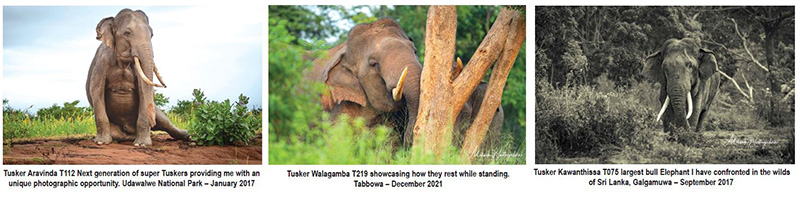
Though his formal education culminated in a Master’s degree in Business Administration from Cardiff Metropolitan University, his professional life gradually shifted toward Sri Lanka’s forests, grasslands, and coastal fringes.
From childhood, two species held his attention: the Sri Lankan leopard and the Asian elephant tusker. Both are icons. Both are elusive. And both, he argues, have been inadequately understood.
His response was methodical. Using high-resolution photography, Wattegedara began documenting individual animals, focusing on repeat sightings, behavioural traits, territorial ranges, and physical markers.
This effort formalised into two platforms—Yala Leopard Diary and Wild Tuskers of Sri Lanka—which function today as tightly moderated research communities rather than casual social media pages.
“My goal was never popularity,” he explains. “It was reliability. Every identification had to stand scrutiny.”
The results are difficult to dismiss. Through collaborative verification and long-term monitoring, his teams have identified over 200 individual leopards across Yala and Kumana National Parks and 280 tuskers across Sri Lanka.
Each animal—whether Jessica YF52 patrolling Mahaseelawa beach or Mahasen T037, the longest tusker bearer recorded in the wild—is catalogued with photographic evidence and movement history.
It was within this growing body of data that a critical inconsistency emerged.
“As injuries accumulated over time, we noticed subtle but consistent changes in rosette and spot patterns,” Wattegedara says. “This directly contradicted the assumption that these markings remain unchanged for life.”
That observation, later corroborated through structured analysis, had serious implications. If leopards were being identified using a limited set of spot references, population estimates risked duplication and inflation.
The findings led to the development of the Multipoint Leopard Identification Method, now internationally published, which uses multiple reference points rather than fixed pattern assumptions. “This wasn’t about academic debate,” Wattegedara notes. “It was about ensuring we weren’t miscounting an endangered species.”
The implications extend beyond Sri Lanka. Overestimated populations can lead to reduced protection, misplaced policy decisions, and weakened conservation urgency.
Yet much of this work has occurred outside formal state institutions.
“There’s a misconception that meaningful research only comes from official channels,” Wattegedara says. “But conservation gaps don’t wait for bureaucracy.”
That philosophy informed his role as co-founder of the Yala Leopard Centre, the world’s first facility dedicated solely to leopard education and identification. The Centre serves as a bridge between researchers, wildlife enthusiasts, and the general public, offering access to verified knowledge rather than speculation.
In a further step toward transparency, Artificial Intelligence has been introduced for automatic leopard identification, freely accessible via the Centre and the Yala Leopard Diary website. “Technology allows consistency,” he explains. “And consistency is everything in long-term studies.”
His work with tuskers mirrors the same precision. From Minneriya to Galgamuwa, Udawalawe to Kala Wewa, Wattegedara has documented generations of bull elephants—Arjuna T008, Kawanthissa T075, Aravinda T112—not merely as photographic subjects, but as individuals with lineage, temperament, and territory.
This depth of observation has also earned him recognition in wildlife photography, including top honours from the Photographic Society of Sri Lanka and accolades from Sanctuary Asia’s Call of the Wild. Still, he is quick to downplay awards.
“Photographs are only valuable if they contribute to understanding,” he says.
Today, Wattegedara’s co-authored identification guides on Yala leopards and Kala Wewa tuskers are increasingly referenced by researchers and field naturalists alike. His work challenges a long-standing divide between citizen science and formal research.
“Wildlife doesn’t care who publishes first,” he reflects. “It only responds to how accurately we observe it.”
In an era when Sri Lanka’s protected areas face mounting pressure—from tourism, infrastructure, and climate stress—the question of who counts wildlife, and how, has never been more urgent.
By insisting on precision, patience, and proof, Milinda Wattegedara has quietly reframed that conversation—one leopard, one tusker, and one verified photograph at a time.
By Ifham Nizam ✍️

This summary document is based on an exemplary webinar conducted by the Bandaranaike Academy for Leadership & Public Policy ((https://www.youtube.com/watch?v=TqZGjlaMC08). I participated in the session, which featured multiple speakers with exceptional knowledge and experience who discussed various aspects of incorporating artificial intelligence (AI) into the education system and other sectors.
There was strong consensus that this issue must be addressed early, before the nation becomes vulnerable to external actors seeking to exploit AI for their own advantage. Given her educational background, the Education Minister—and the Prime Minister—are likely to be fully aware of this need. This article is intended to support ongoing efforts in educational reform, including the introduction of AI education in schools for those institutions willing to adopt it.
Artificial intelligence is no longer a futuristic concept. Today, it processes vast amounts of global data and makes calculated decisions, often to the benefit of its creators. However, most users remain unaware of the information AI gathers or the extent of its influence on decision-making. Experts warn that without informed and responsible use, nations risk becoming increasingly vulnerable to external forces that may exploit AI.
The Need for Immediate Action
AI is evolving rapidly, leaving traditional educational models struggling to keep pace. By the time new curricula are finalised, they risk becoming outdated, leaving both students and teachers behind. Experts advocate immediate government-led initiatives, including pilot AI education programs in willing schools and nationwide teacher training.
“AI is already with us,” experts note. “We must ensure our nation is on this ‘AI bus’—unlike past technological revolutions, such as IT, microchips, and nanotechnology, which we were slow to embrace.”
Training Teachers and Students
Equipping teachers to introduce AI, at least at the secondary school level, is a crucial first step. AI can enhance creativity, summarise materials, generate lesson plans, provide personalised learning experiences, and even support administrative tasks. Our neighbouring country, India, has already begun this process.
Current data show that student use of AI far exceeds that of instructors—a gap that must be addressed to prevent misuse and educational malpractice. Specialists recommend piloting AI courses as electives, gathering feedback, and continuously refining the curriculum to prepare students for an AI-driven future.
Benefits of AI in Education
AI in schools offers numerous advantages:
· Fosters critical thinking, creativity, and problem-solving skills
· Enhances digital literacy and ethical awareness
· Bridges the digital divide by promoting equitable AI literacy
· Supports interdisciplinary learning in medicine, climate science, and linguistics
· Provides personalised feedback and learning experiences
· Assists students with disabilities through adaptive technologies like text-to-speech and visual recognition
AI can also automate administrative tasks, freeing teachers to focus on student engagement and social-emotional development—a key factor in academic success.
Risks and Challenges
Despite its potential, AI presents challenges:
· Data privacy concerns and misuse of personal information
· Over-reliance on technology, reducing teacher-student interactions
· Algorithmic biases affecting educational outcomes
· Increased opportunities for academic dishonesty if assessments rely on rote memorisation
Experts emphasise understanding these risks to ensure the responsible and ethical use of AI.
Global and Local Perspectives
In India, the Central Board of Secondary Education plans to introduce AI and computational thinking from Grades 3 to 12 by 2026. Sri Lanka faces a similar challenge. Many university students and academics already rely on AI, highlighting the urgent need for a structured yet rapidly evolving national curriculum that incorporates AI responsibly.
The Way Forward
Experts urge swift action:
· Launch pilot programs in select schools immediately.
· Provide teacher training and seed funding to participating educational institutions.
· Engage universities to develop short AI and innovation training programs.
“Waiting for others to lead risks leaving us behind,” experts warn. “It’s time to embrace AI thoughtfully, responsibly, and inclusively—ensuring the whole nation benefits from its opportunities.”
As AI reshapes our world, introducing it in schools is not merely an educational initiative—it is a national imperative.
BY Chula Goonasekera ✍️
on behalf of LEADS forum admin@srilankaleads.com

The Trump paradox is easily explained at one level. The US President unleashes American superpower and tariff power abroad with impunity and without contestation. But he cannot exercise unconstitutional executive power including tariff power without checks and challenges within America. No American President after World War II has exercised his authority overseas so brazenly and without any congressional referral as Donald Trump is getting accustomed to doing now. And no American President in history has benefited from a pliant Congress and an equally pliant Supreme Court as has Donald Trump in his second term as president.
Yet he is not having his way in his own country the way he is bullying around the world. People are out on the streets protesting against the wannabe king. This week’s killing of 37 year old Renee Good by immigration agents in Minneapolis has brought the City to its edge five years after the police killing of George Floyd. The lower courts are checking the president relentlessly in spite of the Supreme Court, if not in defiance of it. There are cracks in the Trump’s MAGA world, disillusioned by his neglect of the economy and his costly distractions overseas. His ratings are slowly but surely falling. And in an electoral harbinger, New York has elected as its new mayor, Zoran Mamdani – a wholesale antithesis of Donald Trump you can ever find.
Outside America it is a different picture. The world is too divided and too cautious to stand up to Trump as he recklessly dismantles the very world order that his predecessors have been assiduously imposing on the world for nearly a hundred years. A few recent events dramatically illustrate the Trump paradox – his constraints at home and his freewheeling abroad.
Restive America
Two days before Christmas, the US Supreme Court delivered a rare rebuke to the Trump Administration. After a host of rulings that favoured Trump by putting on hold, without full hearing, lower court strictures against the Administration, the Supreme Court by a 6-3 majority decided to leave in place a Federal Court ruling that barred Trump from deploying National Guard troops in Chicago. Trump quietly raised the white flag and before Christmas withdrew the federal troops he had controversially deployed in Chicago, Portland and Los Angeles – all large cities run by Democrats.
But three days after the New Year, Trump airlifted the might of the US Army to encircle Venezuela’s capital Caracas and spirit away the country’s President Nicolás Maduro, and his wife Celia Flores, all the way to New York to stand trial in an American Court. What is not permissible in any American City was carried out with absolute impunity in a foreign capital. It turns out the Administration has no plan for Venezuela after taking out Maduro, other than Trump’s cavalier assertion, “We’re going to run it, essentially.” Essentially, the Trump Administration has let Maduro’s regime without Maduro to run the country but with the US in total control of Venezuela’s oil.
Next on the brazen list is Greenland, and Secretary of State Marco Rubio who manipulated Maduro’s ouster is off to Copenhagen for discussions with the Danish government over the future of Greenland, a semi-autonomous part of Denmark. Military option is not off the table if a simple real estate purchase or a treaty arrangement were to prove infeasible or too complicated. That is the American position as it is now customarily announced from the White House podium by the Administration’s Press Secretary Karolyn Leavitt, a 28 year old Catholic woman from New Hampshire, who reportedly conducts a team prayer for divine help before appearing at the lectern to lecture.
After the Supreme Court ruling and the Venezuela adventure, the third US development relevant to my argument is the shooting and killing of a 37 year old white American woman by a US Immigration and Customs Enforcement (ICE) officer in Minneapolis, at 9:30 in the morning, Wednesday, January 7th. Immediately, the Administration went into pre-emptive attack mode calling the victim a “deranged leftist” and a “domestic terrorist,” and asserting that the ICE officer was acting in self-defense. That line and the description are contrary to what many people know of the victim, as well as what people saw and captured on their phones and cameras.
The victim, Renee Nicole Good, was a mother of three and a prize-winning poet who self-described herself a “poet, writer, wife and mom.” A newcomer to Minneapolis from Colorado, she was active in the community and was a designated “legal observer of Immigration and Customs Enforcement (ICE) activities,” to monitor interactions between ICE agents and civilian protesters that have become the norm in large immigrant cities in America. Renee Good was at the scene in her vehicle to observe ICE operations and community protesters.
In video postings that last a matter of nine seconds, two ICE officers are seen approaching Good’s vehicle and one of them trying to open her door; a bystander is heard screaming “No” as Good is seen trying to drive away; and a third ICE officer is seen standing in front of her moving vehicle, firing twice in the direction of the driver, moving to a side and firing a third time from the side. Good’s car is seen going out of control, careening and coming to a stop on a snowbank. Yet America is being bombarded with two irreconcilable narratives – one manufactured by Trump’s Administration and the other by those at the scene and everyone opposed to the regime.
It adds to the explosiveness of the situation that Good was shot and killed not far from where George Folyd was killed, also in Minneapolis, on 25th May, 2020, choked under the knee of a heartless policeman. And within 48 hours of Good’s killing, two Americans were shot and injured by two federal immigration agents, in Portland, Oregon, on the Westcoast. Trump’s attack on immigrants and the highhanded methods used by ICE agents have become the biggest flashpoint in the political opposition to the Trump presidency. People are organizing protests in places where ICE agents are apprehending immigrants because those who are being aggressively and violently apprehended have long been neighbours, colleagues, small business owners and students in their communities.
Deportation of illegal immigrants is not something that began under Trump. It has been going on in large numbers under all recent presidents including Obama and Biden. But it has never been so cruel and vicious as it is now under Trump. He has turned it into a television spectacle and hired large number of new ICE agents who are politically prejudiced and deployed them without proper training. They raid private homes and public buildings, including schools, looking for immigrants. When faced with protesters they get into clashes rather than deescalating the situation as professional police are trained to do. There is also the fear that the Administration may want to escalate confrontations with protesters to create a pretext for declaring martial law and disrupt the midterm congressional elections in November this year.
But the momentum that Trump was enjoying when he began his second term and started imposing his executive authority, has all but vanished and all within just one year in office. By the time this piece appears in print, the Supreme Court ruling on Trump’s tariffs (expected on Friday) may be out, and if as expected the ruling goes against Trump that will be a massive body blow to the Administration. Trump will of course use a negative court ruling as the reason for all the economic woes under his presidency, but by then even more Americans would have become tired of his perpetually recycled lies and boasts.
An Obliging World
To get back to my starting argument, it is in this increasingly hostile domestic backdrop that Trump has started looking abroad to assert his power without facing any resistance. And the world is obliging. The western leaders in Europe, Canada and Australia are like the three wise monkeys who will see no evil, hear no evil and speak no evil – of anything that Trump does or fails to do. Their biggest fear is about the Trump tariffs – that if they say anything critical of Trump he will magnify the tariffs against their exports to the US. That is an understandable concern and it would be interesting to see if anything will change if the US Supreme Court were to rule against Trump and reject his tariff powers.
Outside the West, and with the exception of China, there is no other country that can stand up to Trump’s bullying and erratic wielding of power. They are also not in a position to oppose Trump and face increased tariffs on their exports to the US. Putin is in his own space and appears to be assured that Trump will not hurt him for whatever reason – and there are many of them, real and speculative. The case of the Latin American countries is different as they are part of the Western Hemisphere, where Trump believes he is monarch of all he surveys.
After more than a hundred years of despising America, many communities, not just regimes, in the region seem to be warming up to Trump. The timing of Trump’s sequestering of Venezuela is coinciding with a rising right wing wave and regime change in the region. An October opinion poll showed 53% of Latin American respondents reacting positively to a then potential US intervention in Venezuela while only 18% of US respondents were in favour of intervention. While there were condemnations by Latin American left leaders, seven Latin American countries with right wing governments gave full throated support to Trump’s ouster of Maduro.
The reasons are not difficult to see. The spread of crime induced by the commerce of cocaine has become the number one concern for most Latin Americans. The socio-religious backdrop to this is the evangelisation of Christianity at the expense of the traditional Catholic Church throughout Latin America. And taking a leaf from Trump, Latin Americans have also embraced the bogey of immigration, mainly influenced by the influx of Venezuelans fleeing in large numbers to escape the horrors of the Maduro regime.
But the current changes in Latin America are not necessarily indicative of a durable ideological shift. The traditional left’s base in the subcontinent is still robust and the recent regime changes are perhaps more due to incumbency fatigue than shifts in political orientations. The left has been in power for the greater part of this century and has not been able to provide answers to the real questions that preoccupied the people – economic affordability, crime and cocaine. It has not been electorally smart for the left to ignore the basic questions of the people and focus on grand projects for the intelligentsia. Exhibit #1 is the grand constitutional project in Chile under outgoing President Gabriel Borich, but it is not the only one. More romantic than realistic, Boric’s project titillated liberal constitutionalists the world over, but was roundly rejected by Chileans.
More importantly, and sooner than later, Trump’s intervention in Venezuela and his intended takeover of the country’s oil business will produce lasting backlashes, once the initial right wing euphoria starts subsiding. Apart from the bully force of Trump’s personality, the mastermind behind the intervention in Venezuela and policy approach towards Latin America in general, is Secretary of State Marco Rubio, the former Cuban American Senator from Florida and the principal leader of the group of Cuban neocons in the US. His ultimate objective is said to be achieving regime change in Cuba – apparently a psychological settling of scores on behalf Cuban Americans who have been dead set against Castro’s Cuba after the overthrow of their beloved Batista.
Mr. Rubio is American born and his parents had left Cuba years before Fidel Castro displaced Fulgencio Batista, but the family stories he apparently grew up hearing in Florida have been a large part of his self-acknowledged political makeup. Even so, Secretary Rubio could never have foreseen a situation such as an externally uncontested Trump presidency in which he would be able to play an exceptionally influential role in shaping American policy for Latin America. But as the old Burns’ poem rhymes, “The best-laid plans of men and mice often go awry.”
by Rajan Philips ✍️
-
 News2 days ago
Sajith: Ashoka Chakra replaces Dharmachakra in Buddhism textbook
-

 Business2 days ago
Dialog and UnionPay International Join Forces to Elevate Sri Lanka’s Digital Payment Landscape
-

 Features2 days ago
The Paradox of Trump Power: Contested Authoritarian at Home, Uncontested Bully Abroad
-

 News7 days ago
Interception of SL fishing craft by Seychelles: Trawler owners demand international investigation
-

 Features2 days ago
Subject:Whatever happened to (my) three million dollars?
-

 News2 days ago
Level I landslide early warnings issued to the Districts of Badulla, Kandy, Matale and Nuwara-Eliya extended
-
 News7 days ago
Broad support emerges for Faiszer’s sweeping proposals on long- delayed divorce and personal law reforms
-

 News2 days ago
65 withdrawn cases re-filed by Govt, PM tells Parliament