
News
Salt production can help create jobs for youth in North and East, says expert

By Rathindra Kuruwita
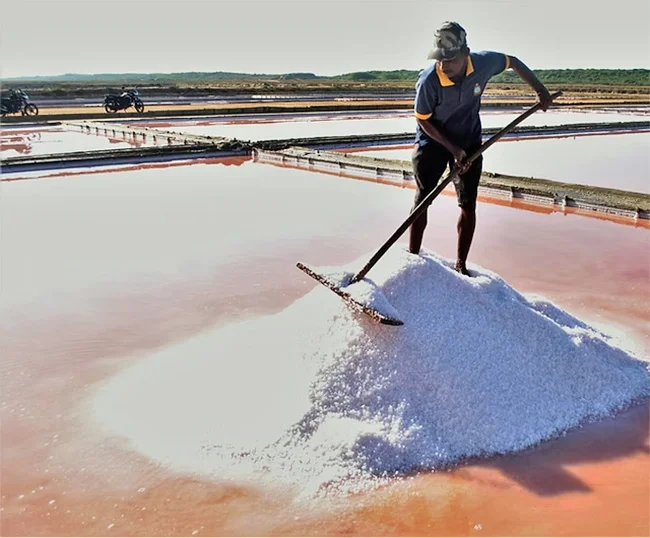
Sri Lanka’s Northern and Eastern provinces are ideal locations for establishing salterns, which could support ancillary domestic industries creating a range of new employment opportunities for the youth in those parts of the counntry, says Dr Mahinsasa Rathnayake, Senior Lecturer at the Department of Chemical and Process Engineering, Faculty of Engineering, University of Moratuwa
In an interview with Asoka Dias on Sirasa, Dr. Rathnayake, commenting on the government’s recent decision to import salt, said such imports consisted mainly of raw, non-iodised salt intended for industrial applications. He noted that Sri Lanka was largely self-sufficient in iodised table salt but was currently struggling to meet the demand for industrial salt essential for various applications
Sri Lanka needs 200,000 MT of salt annually, but the local salterns produce only 150,000 to 170,000 MT. A significant shortfall exists in vacuum salt production, a chemically purified type of salt used extensively in industries such as food preservation, confectionery, mineral solutions like Jeevani, animal feed, vitamin supplements, and water purification. While the demand for vacuum salt is around 30,000 to 40,000 MT annually, Sri Lanka produces only about 3,000 MT.
Hambantota and Puttalam are Sri Lanka’s primary salterns, with the former’s 1,000-acre facility capable of producing up to 100,000 MT annually and Puttalam’s 800-acre saltern offering a potential output of 60,000 MT. Smaller facilities include the saltern at Manthai, Mannar, which has a capacity of 8,000 MT but produces only 4,000 MT currently, and Elephant Pass, with a potential of 20,000 MT but producing 12,000 MT. A new saltern is also under construction in Kuchchaveli.
Sri Lankan salterns produce sea salt using solar evaporation, a natural process where seawater enters shallow ponds and evaporates, leaving salt crystals. As this method relies on environmental conditions, several factors must be considered when establishing new salterns.
Key considerations include soil characteristics, average wind speed, sunlight availability, and low rainfall levels. Seawater salinity is particularly critical; for instance, Hambantota’s high salinity levels make it highly productive for salt extraction. In contrast, the Northern and Eastern regions, as well as Puttalam, have comparatively lower seawater salinity, which impacts their potential salt yields. Identifying suitable locations requires careful evaluation of these factors to ensure optimal production.
In 2024, altered rainfall patterns driven by climate change brought significant rainfall to many areas where salterns are located. Dr. Rathnayake emphasised the need to improve the efficiency of existing salterns and minimise waste to adapt to such conditions, which may persist in the future. He also stressed the importance of establishing new salterns to meet the country’s entire salt demand.
“Kurinchantivu, near Elephant Pass, is a promising location,” he noted. “Historically, there was a saltern in the area, but operations ceased during the war. The site has the potential to host a 1,000-acre saltern, comparable in size to the one in Hambantota. Another opportunity lies in reviving the old saltern in Chemmani, which is currently non-operational, offering a chance to kickstart industries in the Northern region.”
Dr. Rathnayake explained that while the salinity of the seawater in Kurinchantivu is lower than in Hambantota, the location could still produce approximately 30,000 tonnes annually. He also recommended conducting studies to explore the feasibility of establishing salterns in the Eastern Province.
The senior lecturer at the Moratuwa University identified Panama and Palatupana, located near Hambantota, as areas with significant potential for salt production. He explained that the proximity to Hambantota ensures high salinity in the surrounding seas, where salt naturally forms.
He also highlighted the potential of salterns as eco-tourism attractions, noting the unique ecosystems they support. In other countries, salterns are popular tourist destinations due to the diverse wildlife adapted to high-salinity environments. “For example, flamingos thrive in these ecosystems,” he said.
Dr. Rathnayake pointed out that Sri Lanka’s salterns could also support the farming of Artemia salina, a species of brine shrimp. “These shrimp are highly valuable and widely used as animal feed, with a kilogram fetching approximately 15,000 rupees. Farming Artemia during off-seasons for salt production could be a lucrative venture. This would not only diversify income but also provide an opportunity to increase workers’ wages,” he explained.
He suggested further diversification by commercialising bittern, the bitter liquid left after sodium chloride crystallises. Bittern is used in Japan to produce tofu and can also be applied in industrial wastewater treatment. Other industries, such as manufacturing coconut fertilisers, caustic soda, and chlorine, could also be developed around salterns.
“By diversifying production and exploring these opportunities, salterns can become hubs for economic growth, bringing in more revenue and creating additional industries,” he said.




Can a country put a fixed limit on its population? That is the question Switzerland will be answering on Sunday when voters go the polls to decide on a proposal to cap their population at 10 million, a move that has exposed divisions about immigration in the Alpine nation.
The move is backed by the right-wing Swiss People’s Party, which describes it as a “sustainability initiative” aimed at easing pressure on housing, public services and the environment. However some voters see this as the party’s latest anti-immigration move.
Dubbing it a “chaos initiative”, the government, other political parties, business leaders and trade unions argue it will deprive hospitals and hotels of much needed staff, and damage hard-won relations with the European Union, leaving non-EU member Switzerland isolated in a very risky world.
Switzerland’s population has grown rapidly since 2002, when it stood at 7.3 million. Now it is 9.1 million, 27% of whom are Swiss residents who were born abroad.
Switzerland’s system of direct democracy means all major decisions are taken via the ballot box. Campaigners simply have to gather 100,000 signatures to ensure a nationwide vote.
Many voters are concerned by overcrowded trains, expensive apartments and rising health costs.
The latest opinion polls indicate this could be a very close vote.
They suggest voters are inching towards a no vote by a wafer thin margin, with 52% opposed – but polls remain divided, with 45% saying they are in favour of the proposal and a significant number of voters still undecided.
[BBC]


Anuradhapura Chief Magistrate, Siyapath Sasindu Wickramaratne, on Friday (12) ordered former Atamasthanadhipathi Pallegama Hemarathana Thera, who stands accused in a case involving the alleged serious sexual abuse of a minor girl, to provide a blood sample for DNA testing.
Accordingly, the court directed the suspect monk to appear before the Government Analyst’s Department on June 16 and provide a blood sample to the Government Analyst.
The order was issued after considering a further report submitted to court by the Nittambuwa Police.
Police informed the court that, pursuant to an earlier court order, certain case material had been forwarded to the Government Analyst on May 4, 2026, for DNA examination.
According to police, the material consisted of clothing allegedly stained with blood, which had been buried and concealed by the girl and later recovered during investigations.
Police further informed the court that the Government Analyst’s report had confirmed the presence of DNA evidence on the clothing.
Investigators told court that it was necessary to obtain a biological sample from the suspect monk in order to compare it with the DNA evidence recovered from the garments.
Police therefore requested an order compelling the suspect to provide a blood sample so that it could be determined whether the DNA evidence found on the girl’s clothing matched that of the suspect.
Having considered the submissions, the Magistrate ordered the suspect monk to provide the blood sample. The court also directed the Government Analyst to submit the report of the subsequent DNA examination.Pallegama Hemarathana Thera was previously remanded in connection with the case and was later released on stringent bail conditions.

(Asiatimes) From this week, those using private buses in Sri Lanka may face severe transport disruption, as operators in the sector have decided to cut services by 50%. Among the reasons for the protest are mounting losses, rising fuel costs and the government’s failure to grant fare concessions. At a press conference held on 7 June, Gemunu Wijeratne, president of the Sri Lanka Private Bus Owners’ Association, explained that “the authorities have not responded positively to requests for a review of bus fares and support measures regarding fuel”.
Meanwhile, around 25% of private transport vehicles have already voluntarily ceased operations due to financial difficulties. According to the majority of owners, “the decision comes after ongoing disputes with the authorities regarding fare adjustments and financial relief, which have not been met to date, despite numerous requests made over a long period”. Commuters, especially in Colombo and the surrounding areas, risk facing delays and overcrowding as the reduced fleet operates under the new directive.
According to Wijeratne, “the association will continue to provide a reduced service until the government approves a revised bus fare, in line with the rise in fuel prices”. The alternative for the government, he continues, is to provide “a direct subsidy to operators, as recent fuel price increases have placed considerable pressure on daily transport operators”.
During peak hours such as the morning, school finishing times and the evening rush hour, only essential services will be guaranteed. During these times, instead of four journeys, only three will be made. Overall, operations will be reduced to around 50%. “The government,” the chairman clarifies, “must take responsibility for this situation, as the majority of students and employees use private buses for their daily commutes, particularly to and from Colombo to various parts of the country.”
Operators in the sector point out that although they requested a temporary exemption to guarantee bus services for one month, neither the National Transport Commission nor the Minister of Transport responded positively. The annual fare review is due to be implemented during the first week of July, adding that they have the “legal authority” to “apply the revised fares”. On 5 June, Wijeratne continues, “we held discussions that were unsuccessful. Diesel prices are expected to rise by the end of this month. In view of all this, we are proceeding with the fare review. This year’s fare adjustment will be difficult for the public to bear, as all costs have risen by around 20–25%”.
The president of the Association of Private Bus Owners concludes by noting that “we cannot continue to operate at a loss. For this reason, we have asked the authorities for some concessions on diesel within the regulatory framework, but these measures have not been implemented. We have therefore decided to step up our industrial action. This week we will intensify our action by changing timetables and limiting operations. The decision was taken – he notes – due to the lack of a positive response to the request for a fare review following the recent rise in fuel prices”.
Recently, the Ceylon Petroleum Corporation (CPC) increased fuel prices in accordance with its monthly pricing formula. Among the changes, the price of a litre of petrol was increased by 15 rupees, rendering the current tariff structures unsustainable. To grasp the scale of the emergency and understand the impact on the population, AsiaNews spoke to Akalanka Punchihewa, Senuli Amrasekara and Dunesh Mayadunne, commuters from various parts of the country who travel to the capital every day for work. “We struggle,” they confirm, “to get to work from Kandy, Kurunegala and Galle. The recent decision by private bus operators is a severe blow, as we have to spend several hours in long queues just to get on a bus. The service provided by buses run by the Sri Lanka Transport Board (SLTB) is inferior to that of private buses. And we cannot,” the commuters conclude, “afford to travel to work by car or motorbike, as we are unable to bear the increased cost of fuel.”
by Arundathie Abeysinghe

Vinicus Jr recues draw for Brazil against Morocco

Kidnapped Nigerian retired general dies in captivity

Switzerland to vote on plan to cap population at 10 million

Gill, Rahul seal India’s chase for 1-0 lead after Gurbaz century

Trump says US-Iran deal to be signed on Sunday as Tehran casts doubt on timing

Litchfield, spinners hand Australia big win over South Africa

‘Dates have the highest sugar content to fight Coronavirus’

Sunday Island 27 December – Headlines

#SundayIsland 17th December – Headlines

Sunday Island – 28th March

Sunday Island Headlines – 21 March

Sunday Island – 21st February – Headlines
-

 Editorial6 days ago
Probe Sallay’s complaint
-
 News4 days ago
Local firms move millions of dollars overseas for phantom imports: Govt.
-

 News2 days ago
CIABOC summons Yoshitha over his participation in British Navy training programme
-

 Midweek Review4 days ago
July 09: An inexcusable overall security failure and exceptional contingency plan
-

 Opinion5 days ago
Could Sri Lanka once again face an economic crisis similar to 2022?
-

 News4 days ago
AI raises concerns over arrest of Sallay and rapper under PTA
-
 News5 days ago
Sallay refuses to end hunger strike unless probe is taken out of CID led by Shani
-
 Latest News5 days ago
Iran and Israel say they will pause strikes but warn of retaliation if ceasefire breached again