
Latest News
Akash Deep, Bumrah ensure India successfully avoid follow-on


Australia, who were down to just two front-line pacers, saw more overs taken out of the game by rain and had their victory push thwarted by solid half-centuries from KL Rahul (85) and Ravindra Jadeja (77) as well as a dogged unbeaten 39-run stand for the last wicket between Akash Deep and Jasprit Bumrah that helped India avoid the follow-on. India ended the day still 193 adrift of Australia’s 445 but Australia will now have a maximum of 98 overs, weather permitting, to close out India’s innings, build a quick lead and then give their Hazelwood-less bowling attack enough time to push for victory.
In the absence of their fast bowling partner, Pat Cummins and Mitchell Starc toiled for 18.5 and 16 overs respectively on the fourth day and might have even paved the doors for victory with a little bit of luck. Cummins was denied off the very first ball of the day’s play when Rahul, resuming on 33, edged a length ball only for Steve Smith to put down a regulation chance at second slip.
Viewed with the benefit of hindsight, it turned out to be a pivotal moment in the day for India, whose batting travails in a heavily-truncated third day’s play meant they already faced a tough prospect to get to 246 – the magic number that would force Australia to bat again and ensure further time taken away from the game. India recovered from almost being 51 for 5 before eventually being reduced to 74 for 5 inside that first hour of play.
Captain Rohit Sharma, the other overnight batter, was made to pay for his first mistake after being worked over by Cummins in his probing five-over burst. The Australia skipper played with the out-of-form Rohit’s weight transfers by bowling a sharp, short ball before a follow-up full delivery, which as it turned out wasn’t full enough for the drive. Sensing a rare scoring opportunity, Rohit reached for it and feathered an edge to the ‘keeper with the ball still only 23 overs old.
It was then that Rahul and Jadeja got together to stitch India’s best partnership of the innings. Both batters batted with great control with Rahul, in particular, continuing to make good decisions after getting into good positions with his technique. He picked only the really full deliveries for his shots as well as favouring the square drive to the more expansive variant towards extra cover. He waited for the bowlers to bowl straighter to him, which he then flicked, tucked away or on-drove.
As has been the case through the series, batting got significantly easier once the ball was more than 30-overs-old and Rahul and Jadeja added risk-free runs before the 67-run stand was ended against the run of play by Smith, who atoned for his earlier drop by anticipating and leaping to his right to hold on to Rahul’s attempted cut off Nathan Lyon.
Jadeja set about putting together another half-century stand with Nitish Reddy as Australia now faced a race against time with only 13.2 overs of play possible through the middle session during which time Jadeja, playing his first game of the series, got to his 22nd Test match fifty. The seventh-wicket pair managed to see off a Starc spell after 67-minute rain delay but weren’t as lucky against Cummins, who produced a nip backer to Reddy that dislodged his bails via an inside edge. At that stage, India still needed 51 to avoid the follow on with only the three fast bowlers left to partner Jadeja.
India had Siraj batting at No.9 and Jadeja’s decision to leave him to face six deliveries from Starc proved to be a mistake as the left-arm quick found the outside edge of the tailender for a sharp catch behind the stumps. Jadeja tried to farm the strike with Bumrah and managed to add a six off Lyon followed by a fortuitous four off Cummins before a well laid out short ball plan ended the all-rounder’s innings on 77, with Cummins grabbing his fourth wicket.
At that stage India were still 33 runs away from making Australia bat again, but Deep and Bumrah held firm against a two-man pace attack that was now visibly crumbling under the bowling loads it had undertaken. Bumrah got inside the line to a Cummins bouncer and pulled him for a six before starting to calmly nudge singles in the gaps. Deep added another crucial boundary by slashing Starc over the cordon.
India had come to within 14 runs off the follow-on mark when Cummins was forced to go back to Lyon to replace Starc. The Australia captain willed himself on to keep bowling from the other end in search of the last wicket, which would have brought him another five-fer, and ended up conceding seven runs off his 20th over. In his 21st, he was edged over the cordon for a four by Deep which took India past the important milestone. As if to celebrate the moment, which was marked with much gusto in the Indian dressing room, Deep slogged Cummins for a six over deep mid-wicket before the umpires took the player off for bad light.
Brief scores:
India 252/9 (KL Rahul 84, Ravindra Jadeja 77; Pat Cummins 4-80) trail Australia 445 (Travis Head 152, Steve Smith 101; Jasprit Bumrah 6-76) by 193 runs.


Iranian strikes on military bases used by the US in the Middle East caused about $800m (£600m) in damage in the first two weeks of the war, a new analysis shows.
Much of the damage was caused in initial retaliatory strikes by Iran in the week after the US and Israel launched the war, according to a report by the Center for Strategic & International Studies (CSIS) and an analysis by the BBC.
The full extent of the damage caused by Iranian strikes on US assets in the region is not clear.
But the $800m in estimated damages to US military infrastructure – a figure that’s higher than has been previously reported – offers a picture of the steep costs to the US as the conflict drags on.
“The damage to US bases in the region has been underreported,” said Mark Cancian, a CSIS senior adviser and co-author of the think tank study. “Although that appears to be extensive, the full amount won’t be known until more information is available.”
In response to a request for comment, the US Department of Defense referred the BBC to US Central Command, which is leading the war. Officials there declined to comment.
Iran’s retaliatory strikes targeted US air-defence and satellite-communication systems, among other assets, in Jordan, the United Arab Emirates, and other countries across the Middle East.
A significant portion of damage was caused by a strike on a US radar for a Thaad missile defence system at an air base in Jordan.
The AN/TPY-2 radar system costs approximately $485m according to a CSIS review of defence department budget documents. The air-defence systems are used for the long-range interception of ballistic missiles.
Strikes by Iran caused an additional $310m in estimated damages to buildings, facilities and other infrastructure on US bases and military bases used by American forces in the region.
Iran also has struck at least three air bases more than once, according to an analysis of satellite imagery by BBC Verify. The repeat strikes underscore Iran’s efforts to target specific US assets. Russia has reportedly shared intelligence with Tehran on American military forces in the region.
Satellite imagery shows the three air bases – Ali Al-Salim base in Kuwait, Al-Udeid in Qatar and Prince Sultan in Saudi Arabia – with fresh damage appearing during different phases of the conflict.
The US has also lost 13 military service members since President Donald Trump joined Israel in launching the attacks on Iran on 28 February.
The US-based Human Rights Activists News Agency (Hrana) estimates the overall death toll has reached nearly 3,200, including 1,400 civilians.
Trump has said the US is on track to achieve his goals of destroying Iran’s nuclear program, degrading its conventional military power, and ending the regime’s support for proxy groups in the region.
“We’re doing extremely well in Iran,” Trump said at a White House event on Friday.
But the war has rattled the global economy with the near-closure of the Strait of Hormuz, and uncertainty over the duration of the conflict and whether Trump will deploy ground troops.

[BBC]

[BBC]
Analysis of satellite imagery has been hampered by restrictions imposed by major US-based providers on the release of the imagery.
But it is possible to discern certain patterns in Iran’s retaliatory action against US military interests in the region.
Radar and satellite systems have been a focus from the start, when Iranian strikes hit a US naval base in Bahrain. They function as the eyes and ears of modern military operations.
Satellite imagery most notably showed the destruction of two radomes – protective enclosures for such sensitive equipment. It is highly probable the systems themselves were damaged, although it is not possible to gauge the extent.
Radar sites were hit at Camp Arifjan, a US military facility in Kuwait, and Saudi Arabia’s Prince Sultan Air Base, where US aircraft are located. Imagery of the latter shows smoke rising from a radar component for a Thaad air-defence system.
More extensive damage to Thaad systems is evident at US bases in the UAE and Jordan. It’s unclear what the cost of that damage was. The degradation of these systems reportedly led the US to redeploy Thaad components from South Korea to the Middle East.
The damage from Iran’s retaliatory strikes account for a fraction of the overall costs to the US for the war.
Defense Department officials reportedly briefed members of Congress that the first six days of the war cost $11.3bn. The first 12 days cost 16.5bn, according to CSIS.
The Pentagon is asking for another $200bn in funding for the war. Defence Secretary Pete Hegseth said on Thursday that the figure “could move.”
“It takes money to kill bad guys,” Hegseth said.
[BBC]
Latest News
Heat Index likely to increase up to ‘Caution level’ at some places in the Western, Sabaragamuwa, North-central, Southern and North-western provinces and in Monaragala, Mannar, Vavuniya and Mullaitivu districts
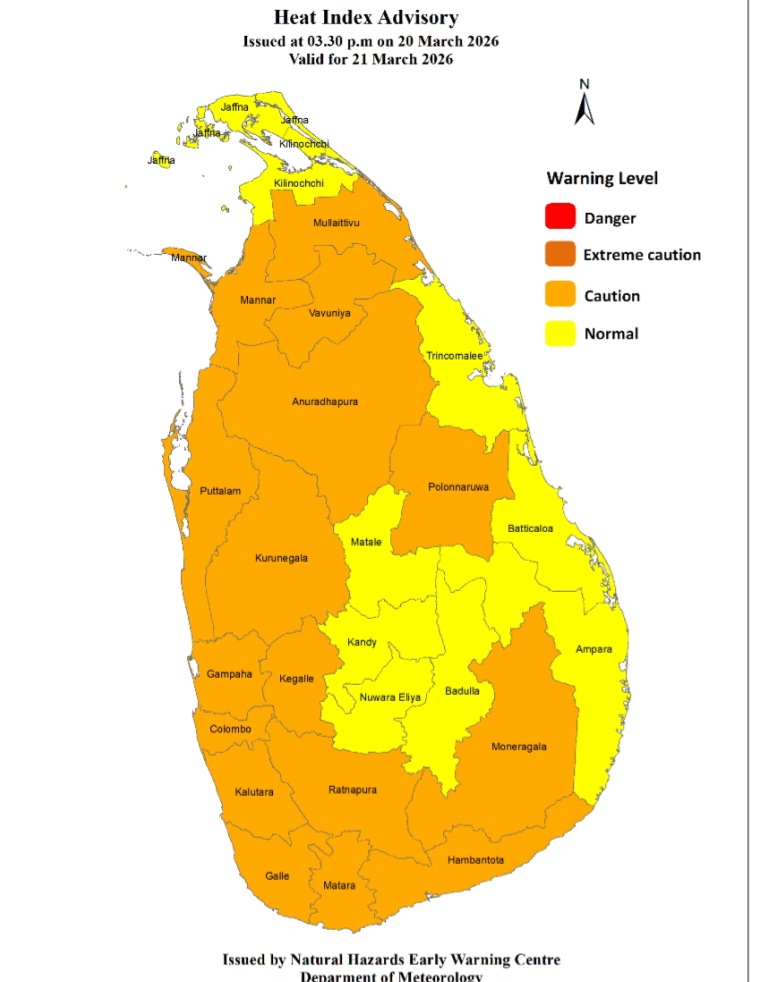
Warm Weather Advisory Issued by the Natural Hazards Early Warning Centre of the Department of Meteorology at 3.30 p.m. on 20 March 2026, valid for 21 March 2026
The public are warned that the Heat index, the temperature felt on human body is likely to increase up to ‘Caution level’ at some places in the Western, Sabaragamuwa, North-central, Southern and North-western provinces and in Monaragala, Mannar, Vavuniya and Mullaitivu districts.
The Heat Index Forecast is calculated by using relative humidity and maximum temperature and this is the condition that is felt on your body. This is not the forecast of maximum temperature. It is generated by the Department of Meteorology for the next day period and prepared by using global numerical weather prediction model data.
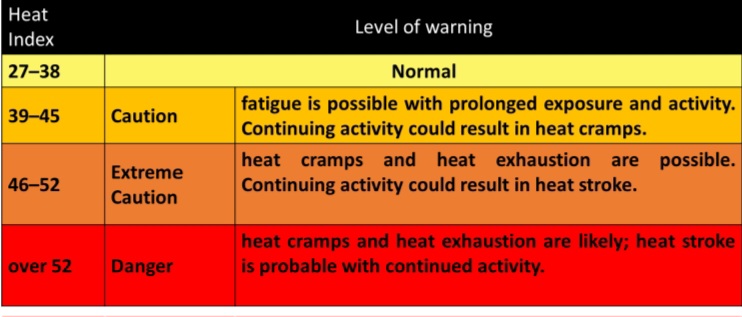
Effect of the heat index on human body is mentioned in the above table and it is prepared on the advice of the Ministry of Health and Indigenous Medical Services.
ACTION REQUIRED
Job sites: Stay hydrated and takes breaks in the shade as often as possible.
Indoors: Check up on the elderly and the sick.
Vehicles: Never leave children unattended.
Outdoors: Limit strenuous outdoor activities, find shade and stay hydrated.
Dress: Wear lightweight and white or light-colored clothing.
Note:
In addition, please refer to advisories issued by the Disaster Preparedness & Response Division, Ministry of Health in this regard as well. For further clarifications please contact 011-7446491
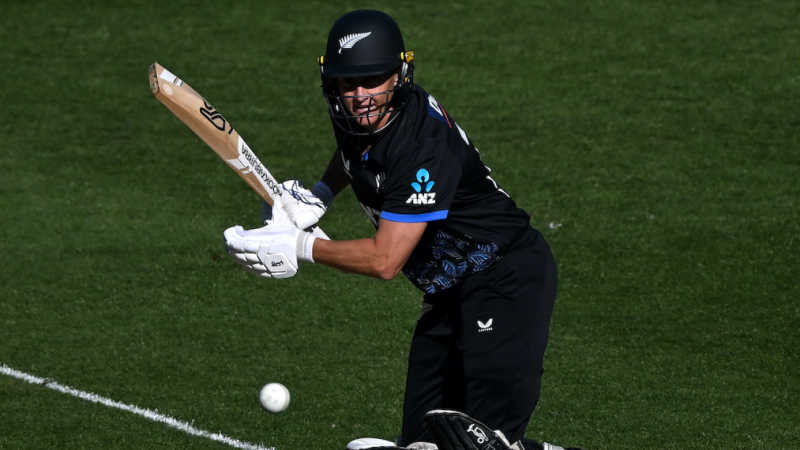
Sophie Devine made Eden Park her own little playground as she brought up her 22nd T20I half-century and carried New Zealand to a 2-1 series lead over South Africa with two games to go. She had also picked up a couple of wickets earlier in the day and backed up her words when she said South Africa’s 149 for 7 was a little bit under par.
New Zealand have never chased more than 150 at home. The small boundaries in Auckland were a friend in that regard, particularly with Annerie Dercksen and Ayanda Hlubi occasionally straying down leg. South Africa tightened up though and the wickets of Amelia Kerr and Brooke Halliday in the 10th over left the chase in a tense situation. New Zealand needed 82 off 60 with six wickets in hand. Devine was 13 off 10.
A pull shot off Chloe Tryon to start the 11th over signalled the shift in momentum. The square boundaries are bigger than the straight ones at Eden Park and yet Devine kept finding them. She collected 46 runs at a strike rate of 219 on the leg side. At the time the fifth-wicket partnership had hit 50, Maddy Green had made only 12 off 15. It was all Devine from the other end and it was all Devine till the end. Her superpowers now include winning the game without touching the ball. Dercksen missed the cut strip as she tried to hide it away from the batter’s reach.
Those five no-balls bringing an end to proceedings highlighted how wayward South Africa’s attack was compared to New Zealand’s. Jess Kerr’s early swing dominated the powerplay. Devine and Suzie Bates taking pace off kept control through the middle and barring another Kayla Reyneke onslaught, it was one-way traffic.
South Africa had to wait 23 balls for the first boundary off the bat on Friday. Dercksen made it worth the wait with a neat little flick off her legs that travelled all the way for six over deep midwicket. Dercksen arrived with the score on 9 for 2 in the third over and put the pressure back on New Zealand. While she was at the crease, she was responsible for more then half the boundaries (4 out of 7) her team scored. Thanks to that, Laura Wolvaardt could drop anchor and go at her preferred pace, though 37 off 39 wasn’t a good look for the captain, who later admitted they were well short of a competitive total.
A pitch with 10mm of grass offered enough for the seamers and even someone with their eye in was found out when Devine went into the pitch. The little legcutter – a response to being hit for six the previous ball – found Dercksen in two minds, whether to attack or defend, and took down her off stump. South Africa lost 59 for 5 between the eighth and the 18th overs, going 38 balls without a boundary.
Bates continued to find more success with the ball. She took a wicket in her first over and took responsibility in the death as well. New Zealand held their line and length really well, refusing access to the straight boundary and routinely cramping the batters up, guiding them to hit the areas – midwicket and square leg – that they had covered in the field.
Then Mair missed her length and was clubbed down the ground for six. It highlighted how a bowler had to be perfect against a batter of such power. Reyneke is immense when she can free her arms and go down the ground. She grew up playing in boys’ teams. She came into this series with a 75 off 63 for Western Province, who were 93 for 6 and still ended up winning the Pro50 game thanks to their 20-year-old phenom. She captained South Africa in the Under-19 World Cup when they went to the final last year. She’s marked for big things.
Reyneke’s presence forced Jess Kerr to go wide in the final over – too wide. The umpire penalising her made the bowler shift her line and that little bit was enough for Reyneke to smash two sixes and a four, all down the ground, and hoist South Africa to 149 for 7. She wasn’t given a lot to get under but as soon as she was given one, she smashed it out of the park. The margin for error was breathtakingly small.
Brief scores:
New Zealand Women 152 for 4 in 18.4 overs (Isabella Gaze 17, Amelia Kerr 30, Sophie Devine 59*, Maddie Green 34*; Annerie Dercksen 1-17, Ayanda Hilubi 1-31, Nonkululeko Mlaba 1-30 ) beat South Africa Women 149 for 7 in 20 overs (Laura Wolvaardt 37, Annerie Dercksen 27, Kayla Reyneke 34*; Jess Kerr 1-30, Rosemary Mair 1-32, Sophie Devine 2-21, Suzie Bates 2-10) by six wickets
(Cricinfo)

Sri Lanka says it denied US request to land two aircraft at Mattala airport

Eid celebrations dimmed by war and displacement across Middle East

Showers may occur at several places in the Western, Sabaragamuwa, Northwestern and Uva provinces and in Galle, Matara, Kandy and Nuwara-Eliya districts after 1.00 pm.

Iranian strikes on bases used by US caused $800m in damage, new analysis shows

President maintains Lanka has been even-handed in dealing with Iran and US

Heat Index likely to increase up to ‘Caution level’ at some places in the Western, Sabaragamuwa, North-central, Southern and North-western provinces and in Monaragala, Mannar, Vavuniya and Mullaitivu districts

‘Dates have the highest sugar content to fight Coronavirus’

Sunday Island 27 December – Headlines

#SundayIsland 17th December – Headlines

Sunday Island – 28th March

Sunday Island Headlines – 21 March

Sunday Island – 21st February – Headlines
-

 Business5 days ago
Browns EV launches fast-charging BAW E7 Pro at Rs. 5.8 million
-

 Life style6 days ago
From culture to empowerment: Indonesia’s vision for Sri Lanka
-

 News3 days ago
CIABOC questions Ex-President GR on house for CJ’s maid
-

 Life style6 days ago
Ranjith Fernando celebrates cricketing journey with Hob Nails to Spikes
-

 News4 days ago
Sri Lankan marine scientist Asha de Vos honoured at UNGA opening
-

 Features5 days ago
Achievements of the Hunduwa!
-

 Latest News6 days ago
QR code system will be implemented for fuel with effect from 06.00 a.m. today (15th)
-

 News4 days ago
Australian HC debunks misleading travel risk claims for Sri Lanka