
Foreign News
Trump vows to end ‘very costly’ daylight saving time


US President-elect Donald Trump has said he wants to end daylight saving time (DST), arguing it is “inconvenient” and “very costly” to Americans.
In a post on his platform Truth Social, Trump said DST had “a small but strong constituency, but shouldn’t” and that his Republican party would work to end it.
DST is the practice of moving the clock ahead by one hour in the spring and back an hour in the autumn to make better use of natural daylight.
It is observed in a third of the world’s countries, according to Pew Research Center, including most of Europe. Some in the US, however, have long advocated to end the timeworn tradition.
Those who want to stick with standard time say it benefits our health, as it is better to have more light in the morning, paving the way for improved sleep cycles on darker evenings. They say DST can be disorienting to sleep schedules.
But others want to make DST permanent instead, arguing that brighter evenings, especially for those commuting from work or school, would reduce crime, conserve energy and even save lives in terms of reduced road accidents.
Both sides say their preferred option would be better for the economy.
Trump’s plan is not the first attempt to alter the biannual practice of changing clocks seasonally in the US.
Making daylight saving time permanent was the aim of a 2022 bill that passed the Democratic-controlled Senate.
But the Sunshine Protection Act, which was introduced by Republican Senator Marco Rubio, never made it to President Joe Biden’s desk.
Rubio has since been picked by Trump for the role of secretary of state under his incoming administration.
The US first began changing its clocks seasonally in 1918 during World War One in an effort to conserve fuel. It was unpopular with farmers, and was repealed after the war.
But DST returned again during World War Two, and was made permanent in 1966, though states could opt out.
Hawaii and most of Arizona currently do not follow time changes under DST.
Research by Joan Costa-i-Font, a professor at the London School of Economics, found that DST has had “detrimental effects on sleep and physical health, and on feelings of fatigue, stress, time stress and mental health”.
Prof Costa-i-Font’s study found that, in monetary terms, an end to DST would lead to an increase in economic output of $ 792 per person per year.
Countries that have ended the practice include Mexico in 2022, though DST is still maintained in regions near the US border for economic and logistical reasons. Jordan also ended the practice that year.
Others, like Turkey and Russia, have implemented a permanent DST instead in the past decade.
In a Monmouth University Poll, researchers found that about two thirds of people in the US want make DST permanent.
[BBC]

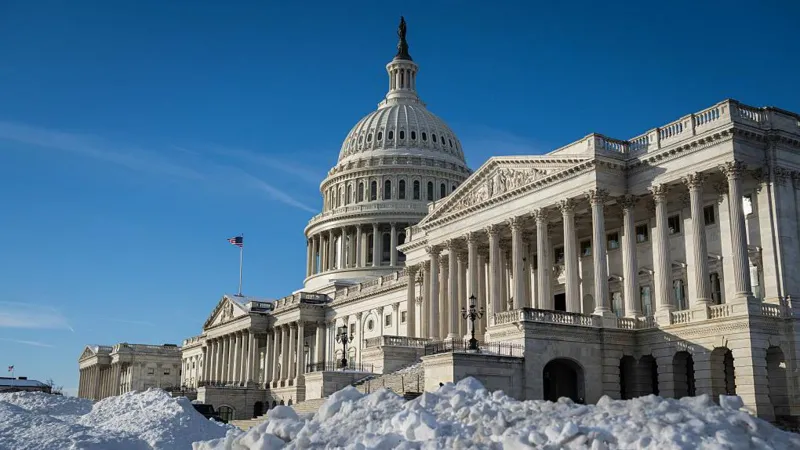
The US federal government has partially shutdown despite a last-ditch funding deal approved by the Senate.
The funding lapse began at midnight US eastern time (05:00 GMT) on Saturday, hours after senators agreed to fund most agencies until September. The bill includes just two weeks’ funding for the Department of Homeland Security, which oversees immigration enforcement, instead of shutting it down entirely.
The bill has yet to be approved by the House of Representatives, which is out of session.
US President Donald Trump struck the deal with Democrats after they refused to give more funding for immigration enforcement following the fatal shooting of two US citizens in Minneapolis by federal agents.
It is the second such government shutdown in the past year and comes just 11 weeks after the end of the previous funding impasse that lasted 43 days, the longest in US history.
That shutdown in 2025, which spanned 1 October to 14 November, had widespread impacts on essential government services including air travel and left hundreds of thousands of federal workers without pay for weeks.
This shutdown, however, is unlikely to be that long or widespread as the House of Representatives is set to be back in session on Monday.
The White House, though, has directed several agencies, including the departments of transportation, education and defence to execute shutdown plans.
“Employees should report to work for their next regularly scheduled tour of duty to undertake orderly shutdown activities,” a White House memo to agencies said. “It is our hope that this lapse will be short.”
Trump has urged Republicans, who hold the majority of seats in the US House, to vote for the deal.
Lawmakers plan to use the fortnight in which the DHS will continue to be funded to negotiate a deal. Democrats want that deal to include new policies for immigration enforcement agents.
“We need to rein in ICE and end the violence,” Senate Minority Leader Chuck Schumer said referring to Immigration and Customs Enforcement.
“That means ending roving patrols. It means requiring rules, oversight, and judicial warrants… Masks need to come off, cameras need to stay on, and officers need visible identification. No secret police.”
Both Republican and Democratic lawmakers have sharply criticised tactics used by immigration agents in the wake of the fatal shooting of Alex Pretti in Minneapolis last weekend.
Pretti, an intensive care nurse, was shot by a US Border Patrol agent after an altercation in which several agents tried to restrain him.
On Friday, the Justice Department launched a civil rights investigation into the shooting.
[BBC]

Sustained heavy gunfire and loud explosions have been heard in Niger near the international airport outside the capital, Niamey.
Multiple eyewitness accounts and videos showed air defence systems apparently engaging unidentified projectiles in the early hours of Thursday.
The situation later calmed down, reports say, with an official reportedly saying the situation was now under control, without elaborating.
It is not clear what caused the blasts, or if there were any casualties. There has been no official statement from the military government.
The gunfire and blasts began shortly after midnight, according to residents of a neighbourhood near the Diori Hamani International Airport, the AFP news agency reports. They said calm returned after two hours.
The airport houses an air force base and is located about 10km (six miles) from the presidential palace.
Niger is led by Abdourahamane Tiani who seized power in a 2023 coup that ousted the country’s elected civilian president.
Like its neighbours Burkina Faso and Mali, the country has been fighting jihadist groups who have carried out deadly attacks across the region.
It is also a major producer of uranium.
A huge uranium shipment destined for export has been stuck at the airport amid unresolved legal and diplomatic complications with France after the military government nationalised the country’s uranium mines.
“The situation is under control. There is no need to worry,” the Anadolu news agency quoted a Foreign Affairs ministry official as saying, without elaborating.
The official told the agency they were trying to determine whether the gunfire was linked to the uranium shipment.
[BBC]

A South Korean court has sentenced former First Lady Kim Keon Hee to one year and eight months in prison after finding her guilty of accepting bribes from the Unification Church, according to South Korea’s official Yonhap news agency.
The Seoul Central District Court on Wednesday cleared Kim, the wife of disgraced ex-President Yoon Suk Yeol, of additional charges of stock price manipulation and violating the political funds act.
Kim was accused of receiving bribes and lavish gifts from businesses and politicians, as well as the Unification Church, totaling at least $200,000.
The prosecution team had also indicted Unification Church leader Han Hak-ja, now on trial, after the religious group was suspected of giving Kim valuables, including two Chanel handbags and a diamond necklace, as part of its efforts to win influence with the president’s wife.
Prosecutors in December said Kim had “stood above the law” and colluded with the religious sect to undermine “the constitutionally mandated separation of religion and state”.

Prosecutor Min Joong-ki also said South Korea’s institutions were “severely undermined by abuses of power” committed by Kim.
The former first lady had denied all the charges, claiming the allegations against her were “deeply unjust” in her final testimony last month.
But she has also apologised for “causing trouble despite being a person of no importance”.
[Aljazeera]

Shipping giant Maersk to take over Panama Canal ports after court ruling

India face Pakistan for a place in the semi-finals of the Under-19 World Cup

More than 200 killed in mine collapse in DR Congo

US government partially shuts down despite last minute funding deal

Harmanpreet 82* in vain as Gujarat Giants break Mumbai Indians hoodoo and seal Eliminator spot

Myanmar election delivers walkover win for military-backed political party

‘Dates have the highest sugar content to fight Coronavirus’

Sunday Island 27 December – Headlines

#SundayIsland 17th December – Headlines

Sunday Island – 28th March

Sunday Island Headlines – 21 March

Sunday Island – 21st February – Headlines
-

 Business6 days ago
ComBank, UnionPay launch SplendorPlus Card for travelers to China
-

 Business7 days ago
ComBank advances ForwardTogether agenda with event on sustainable business transformation
-

 Business3 days ago
Climate risks, poverty, and recovery financing in focus at CEPA policy panel
-

 Opinion7 days ago
Conference “Microfinance and Credit Regulatory Authority Bill: Neither Here, Nor There”
-

 Opinion2 days ago
Sri Lanka, the Stars,and statesmen
-

 Business18 hours ago
Hayleys Mobility ushering in a new era of premium sustainable mobility
-

 Opinion6 days ago
Luck knocks at your door every day
-

 Business18 hours ago
Advice Lab unveils new 13,000+ sqft office, marking major expansion in financial services BPO to Australia