
Features
America has two presidents as the world braces for another Trump term


by Rajan Philips
The election of Donald Trump as US President for yet another term has sent many world leaders scurrying for cover. Especially in the West. But even China is concerned. In the US itself, the longstanding maxim that there can only be one president at a time is being put to the test every day. Joe Biden, the outgoing president, is scrambling to salvage his legacy after a disastrous last year that has diminished all his achievements over the first three years on the domestic front.
Externally, Biden’s presidency has been a monumental failure, from the impulsive withdrawal from Afghanistan that kickstarted it, to the hopelessly painful stalemate in Ukraine and the relentless mass devastation in Gaza that are dragging out its end. With the pardoning of his son Hunter Biden, the outgoing president has ceded even the little moral hump that he had over Trump.
Donald Trump who would not have succeeded in getting a major party nomination as a presidential candidate in any other democratic country, has sequestered the Republican Party, arrogated himself to be its candidate, and won a second election with even a small popular vote majority albeit under 50% of the total. That Trump’s popularity could grow from under 30% when he first started his political venture in 2015 to nearly 50% in ten years in spite of all the scandals, criminal convictions, and worst of all the 2021 January 6 attack on the American constitution and democracy itself, is a statement not so much on Trump’s resilience as it is on America’s sociopolitical decadence.
The Tariff Man
Trump’s second term is poised to be even more inglorious than his first but with much greater organization, and persistence and fortified by – thanks to Chief Justice Robert’s creative legal mind, absolute immunity in most instances and presumed immunity in all other instances. But even the Supreme Court cannot help Trump to form a cabinet of his choosing and full of sycophants (not the Lincoln’s team of rivals) without the Senate’s approval. The Republicans have only a slender majority in both houses, and enough Republican Senators have already signalled that they are not prepared to support his more questionable cabinet appointees.
What the world leaders are now going through is the dilemma of having to put up with two presidents at the same time. One they can smile and ignore and the other they have to grin and suffer for four more years. Biden is trying hard to strengthen Ukraine’s military to gain some territorial advantage before Ukraine is forced into negotiations with Russia under pressure from Trump. President Biden is even more desperate for a ceasefire in Gaza, but Prime Minister Netanyahu who has betrayed Biden at every turn in the Gaza conflict is not about to do him any favours with less than a month left in Biden’s term.
Biden’s eleventh hour initiatives in Ukraine and in the Middle East have raised eyebrows among Washington watchers because all of them could be torpedoed without notice by Trump on his first day President. Yet the two presidents seem to be adhering to the transition protocol – with the Biden Administration briefing the Trump transition on the new initiatives although Trump himself has not said much about either front after the election. Except the usual bravado that there will be hell to pay by Hamas if all the remaining hostages are not released before his inauguration in January.

Arms Sales for Ceasefire
At the same time, Trump is threatening to hold America’s trading partners hostage with his tariff threats. He has warned neighbouring Canada and Mexico that on his first day in office, he will impose a flat 25% tariff on all imports from them unless the two countries mend their borders to his liking. And a further 10% tariff on already tariffed Chinese goods. In another bluster, Trump has threatened 100% tariffs on imports from BRICS countries unless they stop planning an alternative currency to the dollar.
Trump is stoned on the idea of tariffs although it will lead to domestic price increases and will not bring back lost American jobs. The captains of American businesses do not believe Trump will actually impose tariffs but will only use them in bargaining to get what he wants from other countries. On the other hand, the blue collar foot soldiers who voted for Trump are now googling to find out the meaning of tariff.
Like the word Brexit in Britain after the Brexit referendum, Google search for the meaning of tariff has seen a massive spike in the US after Trump’s election. It is already too late for the American voters to know what tariff means. Just like with Brexit in Britain. If Trump were to go ahead and impose tariffs on imports that will only increase the price of many goods that Americans buy. The midterm Congress and Senate elections in two years will give them the opportunity to vent but that will not stop Trump from going on for another two years.
A Weak West, Divided World
For the rest of the world, there is no midterm election to protest against a man whom 49% of Americans have elected. The countries that Trump threatens with tariffs cannot even unite to provide a collective response. With one tariff tweet, Trump has driven a wedge between Canada and Mexico who have trilateral free trade agreement with the US that is now 30 years old. Even the BRICS member countries will be forced to go their separate ways to deal with Trump’s tariffs. Only China can show some muscle against this madness, but that will only aggravate the madness. All in all, it will be every country for itself, with no god for all.
Trump’s second coming is also coinciding with an exceptionally weak moment in Europe. Britain is neither here nor there, and the new Labour government can do nothing about it. France is in political turmoil with a lame duck president who has no majority in parliament. This week, the hard left and the far right combined to defeat the government of Prime Minister Michel Barnier whom President Emmanuel Macron had appointed after a deadlock parliamentary election in June. No government in France has lost a no confidence motion in 62 years.
President Macron is insisting on staying on as President until his term is over in 2027, and no parliamentary election can be called till June next year. For now, the President can distract the French with the multi-day celebration of this Saturday’s reopening of the Notre-Dame cathedral that was ravaged by fire in 2019 and is now fully renovated. World leaders will be in attendance, but Pope Francis has declined the invitation. President elect Trump will be there, after apparently accepting a pleading invitation by the French President. As the old saying goes, “the children of this world are in their generation wiser than the children of light.”
The political and economic crises are even worse in Germany which has been the EU’s main anchor for much of its life. After the collapse of the governing (traffic-light) coalition in November, elections have been scheduled for 23 February 2025. The elections will be held under a new hybrid (single constituency and proportional) system that has made the results and the shape of the next government quite unpredictable.
With Germany and France in crisis, the EU is not at all in position to respond to Trump. And Trump will have welcoming allies in Italy’s Giorgio Meloni and the Hungarian strongman Viktor Orban. Besides its own tariff fears, the EU’s bigger problem is avoiding being caught in the crossfire of tariffs between the US and China. EU and NATO will also have to come to terms with whatever Trump comes up for Ukraine. What is mostly expected now is a potential peace agreement through the personal agencies of Trump, Putin and Zelensky.
India is “less concerned about a second Trump term than many other US allies and partners,” according to Tanvi Madan writing in Foreign Affairs. Foreign Minister Jaishankar has said that India “always had a positive political relationship with Trump,” and that Trump in turn “has also had a positive view of India.” New Delhi has also dissociated itself from potential de-dollarisation plans by BRICS countries. A specific upshot of the Trump presidency for the Modi government could be an easing of the heat from Washington over the Modi government’s alleged involvement in the targeted attacks, including murder, against Sikh individuals in the US and Canada.
As world leaders recalibrate their governments to Trump’s second coming, Sri Lanka will have to chart its own course to navigate the choppy waters around it. Sri Lanka does not have to do anything grand by way of either the non-alignment of old or the all-alignment of Modi’s India. If the new government can competently manage its internal political challenges, it does not have to do anything more than keeping Sri Lanka’s trade channels open to expand its exports and settle its debts.

Features
Mayors of Working Class Manchester and Melting Pot New York pose new challenges to Regressive Populism in Britain and America
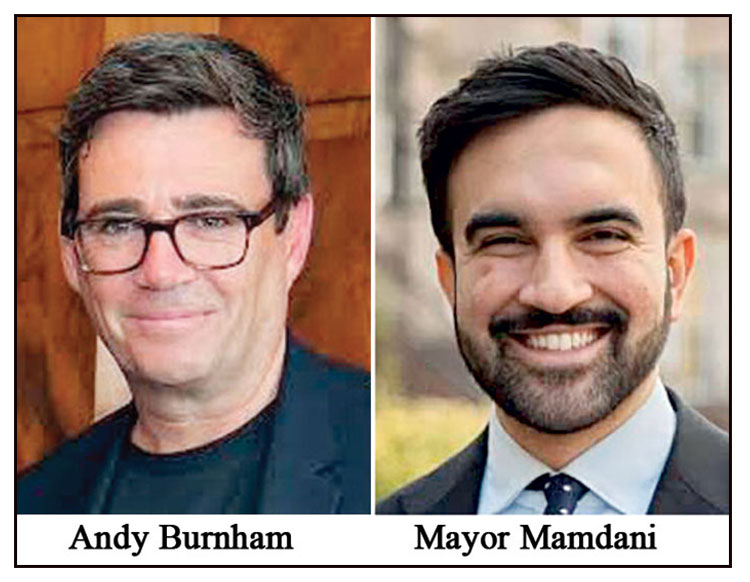
Way back in 1844, Friedrich Engels, a wealthy school dropout from Germany, wrote the first of his many books, “The Condition of the Working Class in England in 1844.” He was 24. The book soon became a classic on nascent urbanism and an intimate account of the making of the industrial working class. The setting and the location for both was Manchester, the burgeoning 19th century Lancashire town, which Engels called “the most important” and “the most sensational” city in England, after London. He went on to describe it as “the principal site of … the Industrial Revolution … the ur-scene, concentrated specimen and paradigm of what such a revolution was portending both for good and bad.”
Now nearly 200 years later and 10 years after Brexit, not to mention the splendid rise and the stately fall of a whole empire in between, a man from Manchester is going to London to see the King and become Britain’s next Prime Minister. Its seventh in a decade and fourth in five years. The national mood seems ready both for good and bad. There is no other choice.
Andrew Murray (Andy) Burnham, the popular Mayor of Greater Manchester will soon replace the beleaguered Sir Keir Starmer whose premiership finally unraveled over the last weekend leading to the Monday morning resignation. Sir Kier left with genuine grace, great pathos and total disbelief in the rapid fall from high promises to hopeless frustration. It was also quite different from the end games of Starmer’s five predecessors, all of them Tories.
James Cameron, who started the procession in 2016 by calling a boneheaded referendum on Brexit, left in a mighty hurry no sooner than his gamble had backfired. His successor Teresa May thought she could reconcile the Brexit blunder and the British reality but failed and left. Boris Johnson came as a clown and left as a clown but only after being the wrecking villain of pre-Brexit Britain. Liz Truss, out of depth and out of sync, lasted little over a month. Rishi Sunak had all the depth he needed to succeed as a fiscally conservative PM, but he had no chance of winning an election after Johnson’s antics as Prime Minister. Inadvertently, as well, Sunak became the convenient immigrant prototype to lead Britain’s grand old party with its white elders fleeing formal politics and its rank and file flocking to the anti-immigrant Reform UK Party.
It is the rise of Reform UK and the thrashing it gave to both Labour and Conservatives in this year’s local elections that hastened the collapse of the Starmer government and Starmer’s exit as Prime Minister. There were other factors too, both personal and political, which contributed to Starmer’s rapid and ultimate failure. His new successor Andy Burnham is a different political persona even though there will likely be not much difference in the policies of the two men. The great British hope now is that Burnham’s personality and Mayoral record in Manchester would help him stem the Reform tide in the country and reverse its current momentum. Time will tell.
Keir Starmer: Rapid Rise and Sudden Fall
In the election that Prime Minister Sunak called in 2024, Starmer led the Labour Party to a seemingly landslide victory, but that was also hugely lopsided. Labour won 411 out of 650 (63%) seats in the House of Commons, but it managed only 34% of the popular vote. “Loveless landslide” was the verdict of the pundits, but the tenuousness of the victory was lost in the euphoria of Labour returning to power after 14 years in opposition wilderness. Prime Minister Starmer and the whole government started on the wrong political foot on every government initiative and even announcements.
The worst of them was to limit Winter Fuel Payment benefit that helped millions of households in England and Wales. The irony of it is that this payment was perhaps the first benefit measure of the Labour government under Tony Blair in 1997. It was the brainchild of then Chancellor Gordon Brown who introduced it as a universal benefit for pensioners. Tory governments after 2010 were critical of the universality of the program but would not cancel or scale back what had become a popular program. Starmer as Prime Minister dared to go where Tories wouldn’t and the backlash was swift and became the start of the government’s slide even before it had found its footing.
Although acknowledged for his skills and strengths in policy, Starmer turned out to be an ineffectual and bumbling politician. Surprisingly so for someone who was an accomplished barrister and a highly successful prosecutor with interest in human rights. As a prominent Member of UK’s Haldane Society of Socialist Lawyers, Starmer had extended his professional tentacles to the Soviet Union before its collapse, to South Africa after apartheid, to Northern Ireland, as well as European and Caribbean countries. All of this has come to nought at 10 Downing Street.
Despite his failure as Prime Minister, Starmer was not new to politics or the Labour Party. Like most Labour politicians, Starmer’s political roots also go back to his parents who were both working class Labour supporters. Starmer himself became a young Labour activist as a teenager and a member of the university Labour Clubs at Leeds and at Oxford. He was even associated with one of the Trotskyite tendencies, the Pabloites, in the Labour Party. His entry into parliamentary politics came late, becoming an MP in in 2015 at the age of 53, a year before Brexit, and became leader of the Labour Party in his first attempt following Labour’s defeat in the 2019 election and the resignation of Jeremy Corbyn.
The trajectory of Andy Burnham, the next Prime Minister, has been a different one within the Labour Party. Born in Manchester, in 1970, and eight years younger to Starmer, Burnham made an early start in parliament. He was young at 30 when he was first elected in the 2001 general election that started Tony Blair’s second term as PM. Burnham made his mark as an MP, held several junior minister positions under Blair, and joined the full cabinet under Gordon Brown. Ideologically, Burnham was to the left of Blair and closer to Gordon Brown, the socialist from Glasgow. After the Labour defeat in 2010, Burnham ran for the party leadership twice, in 2010 and again in 2015, and lost both, first finishing fourth to Ed Miliband and later finishing second to Jeremy Corbyn. In the 2020 leadership race that Starmer won, he was supported by Burnham who by then had become Mayor of Manchester.
Mayor Burnham as Prime Minister
Burnham had left Westminster in 2017 for local politics, contested the Greater Manchester mayoral election, and was elected Mayor garnering 63% of the vote and winning majorities in all ten of the regional boroughs. He has since been re-elected twice as Mayor with the same popular vote. During Covid-19, Burnham provided an alternative local leadership to fighting the pandemic that was quite the contrast to the blunders at the national level under Boris Johnson.
With the unpopularity of the Starmer government, the blowup from the Epstein scandal, and the local elections debacle, there was pressure within the Labour Party for Mayor Burnham to return to Westminster and challenge Starmer for the leadership. After months of bureaucratic party infighting, a by-election path was found for Burnham to become an MP and be eligible as a leadership candidate.
On June 18, Burnham won the by-election as a Labour candidate in Makerfield, a riding in the Greater Manchester Area where a vacancy had been created by the resignation of the incumbent Labour MP. Burnham won impressively with a 54.8% vote, upending Reform UK’s gains in the local elections. He won a plurality of votes from all the main parties – Conservative, Lib-Dem and Green – with all their candidates losing their deposits. He ran on his record of achievements as Mayor – in public housing, public transport, public inquires into child sexual exploitation and facilitating universal access to university education.
Already as an MP and Minister, Burnham had gained national prominence – promoting a National Care Service paralleling the National Health Service, and for making a statement in parliament condemning the cover-up of police abuse and suggesting that the cover up had been “advanced in the committee rooms of this House and in the press rooms of 10 Downing Street.” Those who are supporting Burnham now are obviously hoping that he would be able to reignite the old Labour flame that went dead under Starmer. This was unfortunate because Starmer had already moved the government to the left on many policy fronts, including re-nationalization of sectors that had failed under privatization.
Andy Burnham is not the first City Mayor to become British Prime Minister. There have been two rather unsettling predecessors. First was Neville Chamberlain who was the Mayor of Birmingham during World War I, before he became Prime Minister at the start of World War II. Most recently, Boris Johnson served two terms (2008-2016) as the Mayor of London before becoming Prime Minister. Andy Burnham should know Britain’s Mayoral history well, but he will also know that he is cut from a different political cloth and that he is entering Downing Street in a different era facing different challenges.
One of the areas where Burnham’s predecessor slipped up and never recovered was in dealing with Donald Trump and his mercurial ways. The more hopeful among British commentators have been citing from one of Burnham’s campaign speeches during the Makerfield by election: “This is a final chance to change. This is what people said directly to me on the hundreds of doorsteps that I stood on. We must hear it, we must act upon it and we must get it right. There will be no second chance. But there is a chance now from this result tonight to build a new politics based on unity and hope. Turning away from the path that takes us to a divided, dark politics of the kind we see in the United States.” The battle might be on, to put it mildly.
Mamdani’s New York Magic
Unlike in Britain, there is no national mood as such in the US. Instead, there are many moods across the nation with the pushes and pulls between them shaping the course of politics in this midterm election year. In one of those moods in New York, Mayor Mamdani has pulled off a stunning sweep within the Democratic Party in the primary nomination contests to elect party candidates for New York’s Congressional Districts in the November election. Mamdani endorsed three candidates, all of them members of the Democratic Socialists of America. All three of them have defeated establishment candidates of the Democratic Party and won nominations to contest the November election.
Before the primary vote in New York on Tuesday, none of the mainstream pundits expected Mamdani to pull this off. After Tuesday, none of them have stopped talking about it. President Trump was exercised enough to declare on social media, his only pulpit, that “America the Beautiful will NEVER be a Communist Country!!!”. Giving fake praise to the Mayor, Trump wrote that Mamdani had, “pulled through three solid Communists, and has received loud and universal applause from the Fake News Media. Congratulations Mr. Mayor.”
It is too late for Mr. Trump to learn the differences between democratic socialism in America and communism that is in his nightmare. The Democratic Socialists of America are a broad civil society organization that grew from a membership of 6,000 when Bernie Sanders ran his primary campaign for the 2016 presidential election that Trump ended up winning. And thanks mostly to Trump and his executive actions, the membership has now grown to over 100,000 with activists in every state. The primary reason for their being is opposing Trump’s indefensible policies and initiatives – from immigration to domestic welfare and foreign warfare. New York is the organization’s nerve centre even as it is the vibrant microcosm of the nation’s diversities and contradictions.
One of New York’s Congressional Districts (the Seventh) is the country’s “Commie Corridor”, while the 12th District is America’s wealthiest enclave. Progressive Democrats have won nominations in both as well as in the 10th and the 13th Districts. President Kennedy’s grandson, Jack Schlossberg, went to defeat in the 12th, while the surprising nominee for the 13th District is a firebrand democratic socialist, Darializa Avila Chevalier. Ms. Chevalier is an Afro-Latina from the Dominican Republic who is a community organizer and a sociology Ph.D. student at Columbia.
Ms. Chevalier, known to be “like AOC, but to the Left,” defeated Adriano Espaillat, a 71-year old veteran Latino Congressman also the from Dominican Republic and the first Dominican to be elected to the US Congress. Mr. Espaillat was once an ‘undocumented immigrant’, a category that Trump and his MAGA base now want deported. His defeat sent shockwaves through the American Latino establishment, but to his Latina critics, the Congressman had grown too flabby in office in spite of his own beginnings and early challenges.
The convulsions in New York may or may not make an impact on the course of the campaign for and the results of the midterm elections in November. But they are indicative of new grassroots forces and processes that define the emerging political push backs against racist, right wing and anti-immigrant populism, not only in the US but also in Britain and other western democracies. The current transition in Britain reflects that dynamic.
The essence of the new thrust is that it is shaking up the traditional opposition of American Democrats to right wing populism, which has become too conventional and even elitist. The campaigns of Hillary Clinton and Kamala Harris were culturally elitist and they lost to the most financially elitist presidential candidate in American history. Former President Barak Obama is trying hard to prevent his post-presidential politics from being similarly branded as politics of elitism in retirement.
What sustains this elitism is the myriad of establishment silos claiming to represent every ethnic and immigrant group in America. They operate transactionally at the top in utter isolation from their own grassroots. The genius of Mamdani is in attacking these silos and establishing grassroots solidarity irrespective of religion, ethnicity and immigrant diversity. He has demonstrated that this approach can work in New York’s melting pot, and that it can be politically successful. Trump, the consummate market politician, gets this instinctively. But traditional and elitist Democrats are too timid to embrace the new mode politics in New York City.
by Rajan Philips ✍️
During the election period, soon after the killing of the so-called FARC (The Revolutionary Armed Forces of Columbia) dissident commander Iván Idrobo, alias Marlon, a question began circulating across Colombia. Can the Colombian state finally become strong enough that armed groups no longer step into the vacuum where government authority should exist?
The timing could hardly have been more symbolic. While President Gustavo Petro presented the military operation against Marlon as a major victory against illegal armed structures, his own political project was entering its weakest moment. The first left-wing president in Colombia’s modern history, who promised to transform the country through social reform, peace building and a different relationship between the state and marginalized communities, was watching political power shift towards a completely different force.
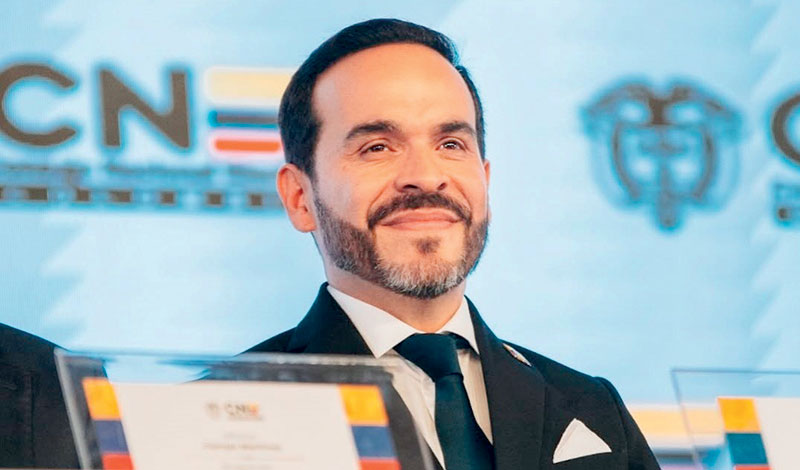
Colombia narrowly chose Abelardo de la Espriella, a millionaire lawyer and political outsider who built his entire campaign around the image of a political predator. He called himself “El Tigre” and offered voters a message centered on strength, punishment and national revival. In many ways, his victory places Colombia within the same political current that has lifted figures such as Javier Milei in Argentina and Nayib Bukele in El Salvador. It is a movement fuelled by frustration, anger and exhaustion with traditional politics, but also by a growing belief that complex national problems can be defeated through force of personality rather than patient institution-building.
The Colombian election was not simply a victory for the right. It was a rejection of a political establishment that, despite decades of promises from both sides of the ideological divide, failed to solve the fundamental problems shaping ordinary life. The left promised equality and social transformation but struggled to deliver security, economic confidence and effective state control in many regions. The traditional right promised order but failed to eliminate the structural causes that allow criminal economies, corruption and inequality to survive. Between these two failures, political space opened for a figure who promised to destroy the old system entirely.
That is the reality behind Colombia’s political transformation. The country did not suddenly become far-right because millions of Colombians adopted a new ideological identity overnight. Many voters moved because they felt abandoned by governments of different political colours. They saw illegal armed groups expanding their influence, extortion becoming normal in some communities, rural populations trapped between criminal organizations and weak institutions, and politicians endlessly debating while ordinary citizens lived with insecurity.
The victory of De la Espriella is therefore part of a broader Latin American pattern. Across the region, voters have repeatedly punished governments that appear unable to address insecurity, economic stagnation and declining trust in institutions. The political pendulum has swung repeatedly from left to right and from right to left, yet the deeper failures remain unresolved. Elections increasingly resemble political theatre where angry citizens replace the actors while the underlying stage remains unchanged.
Colombia has experienced this cycle before. Álvaro Uribe Vélez rose to power in 2002 by promising security during one of the darkest periods of the country’s armed conflict. His hardline approach weakened the FARC insurgency and restored confidence among many Colombians who believed the state was losing control. His influence continued long after leaving office, creating the powerful Uribista movement. His political allies Juan Manuel Santos and Iván Duque both reached the presidency with his backing.
However, Uribismo eventually faced its own political limits. The movement became associated not only with security achievements but also with allegations surrounding human rights abuses, illegal surveillance, links between sections of the political establishment and paramilitary networks, and the scandal of false positives, in which civilians were killed and falsely presented as guerrilla combatants. The political brand that once represented order became increasingly connected, in the eyes of critics, with unresolved questions about Colombia’s past.
The defeat of Paloma Valencia exposed this decline. She represented the traditional Uribista right, yet many voters who once followed Uribe were no longer automatically loyal. They wanted something more aggressive, more emotional and less connected to the old political establishment. De la Espriella understood this shift. He did not attempt to revive Uribismo. He attempted to replace it.
His campaign succeeded because it understood the modern political battlefield. It was not built around detailed policy documents or traditional party structures. It was built around identity, symbolism and digital warfare. The tiger image, patriotic slogans, military gestures and relentless social media presence created a political brand that appeared energetic, rebellious and anti-establishment. His campaign used influencers, viral content and emotionally charged messaging to dominate online spaces where many younger voters increasingly form political opinions.
His rival Iván Cepeda represented almost the opposite model. A veteran left-wing politician known for human rights advocacy and political seriousness, Cepeda struggled to translate his message into the language of the digital age. His campaign relied heavily on speeches, arguments and traditional political communication. In a political environment where algorithms reward anger, simplicity and spectacle, his approach often appeared slower and less emotionally powerful.
This was one of the central failures of the Colombian left. It underestimated the emotional dimension of politics. It assumed that explaining problems would be enough to win public support. But voters facing insecurity, unemployment and declining trust in institutions were not searching only for analysis. They were searching for someone who appeared capable of taking control.
Petro’s government contributed significantly to this disappointment. His historic victory in 2022 represented a breakthrough after decades of conservative dominance. Millions hoped his administration would finally confront Colombia’s deep inequality, rural abandonment and social exclusion. However, his government struggled to transform ambitious promises into visible results.
His “Total Peace” strategy became the clearest example. The idea recognized an important reality: Colombia’s violence was never caused only by armed men. It was connected to poverty, land inequality, weak institutions and forgotten regions.
The problem was implementation. Several armed groups interpreted negotiations as opportunities to expand territory, recruit fighters and strengthen criminal economies. Organizations involved in drug trafficking, illegal mining and extortion increased their influence in various areas. Communities expecting peace often experienced uncertainty instead. The state appeared to be negotiating while criminal groups continued expanding.
This is where both the Colombian left and right repeatedly fail. The left often correctly identifies the social roots of violence but struggles to impose security and state authority. The right promises security but frequently avoids confronting the deeper inequality, corruption and institutional weakness that allow criminal networks to regenerate. The result is a permanent cycle of crisis management.
At the same time, De la Espriella’s victory reflects the rise of a new international conservative network in Latin America. His political success fits within a broader movement associated with leaders such as Milei and Bukele, as well as wider alliances among right-wing forces that emphasize security, national identity and confrontation with progressive politics. These movements have gained strength by exploiting public frustration with ineffective governments.
The danger is that political anger can become a substitute for governing. The promise of a “miracle homeland” is powerful because it provides emotional satisfaction. It tells citizens that someone finally understands their frustration and will punish those responsible. But governing requires more than punishment. It requires functioning institutions, economic planning, administrative competence and long-term solutions.
De la Espriella has won, but his victory does not represent national unity. It represents a deeply divided country where millions voted against the previous government rather than simply for the new one. His mandate is narrow, his congressional support remains limited and expectations among his supporters are extremely high.
The real test will not be whether De la Espriella can win elections. He has already achieved that. The real test is whether he can succeed where generations of Colombian leaders have failed. The question now is whether he will become a builder of stronger institutions or simply another performer in Colombia’s long-running political theatre.
by Nilantha Ilangamuwa ✍️
The editorial in last Sunday’s Sunday Island, captioned “Fuel Crisis: Beyond Price Debate,” deserves to be applauded because it called on both the government and the opposition to stop playing politics over fuel prices. The editor concluded by stating, “It is hoped that the government and the opposition will stop fighting over fuel prices and address the serious issues that threaten the country’s energy security and economic stability.”
I believe that most Sri Lankans would agree with that sentiment, except perhaps those engaged in politics whose primary objective appears to be the attainment of power, often regardless of the cost to the country.
Unfortunately, opposition parties seldom assess government policies on their merits. This was also true of the NPP when it was in opposition. There is, however, an important difference between exposing political hypocrisy and opposing sound economic policies. Criticism of policy reversals is legitimate, but it should not undermine reforms essential to the country’s economic recovery and long-term stability.
TAX REVENUE-TO-GDP RATIO
The most important indicator of a government’s capacity to finance public services is its tax revenue-to-GDP ratio. In 1990, Sri Lanka’s tax revenue-to-GDP ratio stood at approximately 19%. Over the following three decades, however, successive governments steadily eroded the country’s tax base through tax concessions, exemptions, rate reductions, and weak enforcement. As a result, the ratio declined significantly and averaged between 10% and 12% before collapsing to around 8% following the sweeping tax cuts introduced by the Gotabaya Rajapaksa administration in late 2019.
The economic consequences that followed were devastating. Government revenue fell sharply. The resulting fiscal imbalance contributed significantly to the economic crisis that culminated in sovereign default, shortages of essential goods, inflationary pressures, and widespread social unrest.
The World Bank considers a tax-to-GDP ratio of around 15% to be the minimum required for developing countries such as Sri Lanka to provide basic public services and maintain fiscal sustainability. According to the latest available figures, Sri Lanka has now increased its ratio to approximately 15.5%, thereby reaching that minimum threshold.
While this represents a significant achievement considering the depth of the crisis, it is hardly a cause for celebration. To place matters in perspective, neighbouring India has achieved a tax-to-GDP ratio of approximately 19.6%, despite operating a far larger and more complex economy. Many developed countries record ratios well above 25%.
Sri Lanka’s recovery in tax revenue has been driven largely by substantial increases in taxation. Value Added Tax (VAT), which is an indirect tax, has increased to 18%, while the top personal income tax, a direct tax, now stands at 36%. These measures have imposed a considerable burden on taxpayers, particularly in the aftermath of inflation reaching nearly 70% in September 2022. Although inflation has since fallen substantially, the prices of most goods and services remain significantly higher than they were before the crisis;
Consequently, many income taxpayers feel aggrieved. They are paying more taxes while simultaneously struggling with a higher cost of living. Their frustration is understandable.
THE ONLY CERTAINTIES IN LIFE ARE DEATH AND TAXES
The famous saying that “the only certainties in life are death and taxes” is attributed to Benjamin Franklin in 1789. Yet, for much of Sri Lanka’s post-independence history, large segments of the population have effectively avoided income tax.
Successive governments, driven by short-term political considerations, frequently reduced income tax rates, expanded exemptions, or abolished taxes altogether. Over time, this fostered a culture in which many citizens came to view taxes, such as personal income tax, as unusual or even unfair. Once such attitudes take root in public thinking, they are difficult to reverse.
What has understandably angered many taxpayers, however, is the perception that the burden of personal income tax and corporate income tax has been borne disproportionately by a relatively small segment of the population employed in the formal sector.
For instance, a person employed in the formal economy and earning a monthly salary of Rs. 350,000 would pay Rs. 32,000 in Advance Personal Income Tax (APIT). By contrast, a person earning a similar amount in the informal sector may remain entirely outside the tax net.
THE NEED TO BROADEN THE TAX BASE
Sri Lanka has a serious problem with tax evasion. This challenge is compounded by the fact that the informal economy is estimated to account for nearly 65% of overall economic activity. Therefore, a significant portion of the workforce and businesses operate outside conventional tax structures and regulatory oversight.
While many workers in the informal sector legitimately earn incomes below the personal income tax threshold, it is equally true that numerous business owners generate significant incomes while remaining largely outside the tax net. Many of these businesses fall within the category of small and medium-sized enterprises.
As a consequence, a relatively small group of individuals and corporations shoulder a disproportionately large share of the country’s direct tax burden. Such an arrangement is neither equitable nor sustainable in the long term.
The objective should not necessarily be to increase tax rates further, but rather to ensure that more participants contribute to the system. When a greater number of taxpayers contribute, the burden on existing taxpayers can potentially be reduced over time. Equally important, a broader tax base enhances transparency, improves record-keeping, and encourages businesses to operate within the formal economy.
THE GOVERNMENT’S DECISION TO REVERSE THE VAT THRESHOLD REDUCTION
Against this backdrop, it is disappointing that the government has decided to retreat from an important tax reform by reversing the reduction of the annual VAT registration threshold from Rs. 60 million to Rs. 36 million.
The proposed reduction was a modest but meaningful step towards broadening the tax base and bringing more businesses into the formal economy. Requiring businesses to register for VAT would also have facilitated proper accounting records to be maintained, especially for sales, which in turn would help determine taxable profits for income and corporate tax purposes. However, following public criticism and political pressure, the government reversed course.
At a recent meeting of the Committee on Public Finance (COPF), its Chairman, Dr Harsha de Silva, asked officials from the Ministry of Finance how many additional businesses would be brought into the VAT system through the proposed reduction of the threshold. The officials estimated the number to be approximately 10,000, although they appeared unable to provide a definitive figure.
What was particularly striking during the discussion was that several participants appeared not to fully understand how the VAT system actually functions in Sri Lanka. This is unfortunate because informed public debate requires a sound understanding of the facts.
For example, a substantial proportion of the turnover of even a large supermarket consists of goods that are exempt from VAT. When I served as CFO of a leading supermarket chain, approximately 40% of turnover came from VAT-exempt goods. Although that percentage may have declined over time, it remains significant. In a typical neighbourhood grocery store, the proportion of VAT-exempt sales is likely to be even higher.
Consequently, many smaller retailers would not have been affected by the reduction in the VAT threshold, as their taxable supply would have been well below the threshold. Therefore, the claim made by Dr Harsha De Silva in a post on the X platform that “This Govt was about to fine your local shop Rs. 1 million for not registering for VAT’ is misleading.
The claim that the withdrawal of the proposed reduction in the threshold is a victory for consumers, too, is incorrect. Sri Lankan law requires manufacturers and importers to display a Maximum Retail Price (MRP) on all consumer products. In practice, this means that the retail price of a bottle of Coke is the same regardless of whether it is sold through a VAT-registered supermarket or a smaller retailer.
Ironically, the non-VAT-registered grocery store earns a higher margin than the tax-compliant supermarket. Therefore, the assertion that reducing the VAT threshold would have imposed an additional burden on consumers purchasing goods is incorrect and misleading.
The situation is somewhat different for service providers. Businesses supplying services that became subject to VAT may have sought to pass some or all of the tax burden on to consumers through higher fees. However, that possibility should not obscure the broader objective of expanding the tax base and improving compliance.
There were further criticisms that businesses were given only two weeks’ notice before implementation and would need to invest Rs 200,000 in a POS machine. Yet the government’s intention to reduce the threshold had been announced when presenting the budget about seven months ago. Therefore, it is difficult to understand where the claim of a two-week notice came from. Equally, it is not unreasonable to expect a business generating turnover of Rs. 36 million annually to purchase a POS machine to maintain adequate records of its sales.
A VALUABLE OPPORTUNITY LOST
In my view, a valuable opportunity to widen the tax net has been lost. What should have been a rational discussion on tax policy instead became another example of political point-scoring, misinformation, and a failure to properly explain the operation of the VAT system to the public.
It is therefore difficult to understand why Dr Harsha De Silva has been such a strong critic of reducing the annual VAT threshold to Rs. 36 million, given that during his time as a minister between 2015 and 2019, the threshold stood at only Rs. 12 million.
This type of political gamesmanship serves neither the government nor the opposition. More importantly, it does not serve the country’s interests. Sri Lanka’s economic recovery requires difficult decisions, honest public debate, and a willingness among political leaders to place national interests above short-term political advantage.
That is precisely why the Sunday Island editorial was correct. The country needs less politics and more policy. On issues as fundamental as taxation, energy security, public finances, and fiscal sustainability, consensus is not a sign of weakness. It is a prerequisite for long-term economic stability and national progress.
The challenge before Sri Lanka is not merely to collect more taxes. It is to create a tax system that is fair, credible, broad-based, and capable of supporting the services and infrastructure that citizens expect from the state. Achieving that objective requires competence, transparency, and political courage.
(The views and opinions expressed in this article are solely those of the author and do not necessarily reflect the policy or position of any organization or institution with which the author is affiliated).
By Sanjeewa Jayaweera ✍️

Zafar, Feroza lead Pakistan to consolation win

Jangoo 233, Chase 194 put West Indies in commanding position

Showers will occur at times in the Western, Sabaragamuwa and North-western provinces and in Galle, Matara, Kandy and Nuwara-Eliya districts

Venezuelans dig for earthquake survivors as death toll rises to 1,430

Chemmani mass graves: Govt to seek international forensic help

ADB approves $57.4 million package to boost Lanka’s rooftop solar drive

‘Dates have the highest sugar content to fight Coronavirus’

Sunday Island 27 December – Headlines

#SundayIsland 17th December – Headlines

Sunday Island – 28th March

Sunday Island Headlines – 21 March

Sunday Island – 21st February – Headlines
-

 Features7 days ago
Sri Lanka developing independent hydrographic capabilities
-
 Opinion6 days ago
Ranasinghe Premadasa: The man who would not take ‘No’ for an answer
-
 News1 day ago
Another 1,132 Sri Lankan Personnel to be deployed for United Nations Peacekeeping Missions
-

 Latest News7 days ago
Sooryavanshi thumps fastest List A fifty as India A win tri-series
-

 Opinion5 days ago
Sri Lanka’s national security: Justice, reconciliation, and forward-looking vigilance
-

 News5 days ago
US Assistant Secretary of State for South and Central Asian Affairs meets President
-

 News3 days ago
Kelaniya emerges as highest ranked Lankan uni in Times Higher Education Sustainability Impact Ratings
-
 Opinion4 days ago
A triumph for Pakistan’s skilled diplomacy at Iran-US talks