
Latest News
Cabinet nod to establish ‘Clean Sri Lanka Fund’ and implement ‘Clean Sri Lanka ‘ program

The Cabinet of Ministers approved the proposal presented by the President, to establish a presidential task force and to establish a fund by the name of “Clean Sri Lanka Fund” which will be controlled by a governing body to provide necessary funds to implement the ‘Clean Sri Lanka ‘ program.
The ‘Clean Sri Lanka program’ is a transformative, initiative, guided by the new government’s vision of a “a rich country, a beautiful life” will be implemented with the objective of social, environmental and ethical awakening.


Tilak Varma (c), Priyansh Arya, Vaibhav Sooryavanshi, Riyan Parag (vc), Ayush Badoni, Nishant Sindhu, Harsh Dubey, Suryansh Shedge, Prabhsimran Singh (wk), Kumar Kushagra (wk), Vipraj Nigam, Yash Thakur, Yudhvir Singh, Anshul Kamboj, Arshad Khan
Saudi Arabia is set to host its first franchise league later this year, with the ‘Dunes League T20’ due to launch in October. The league has been sanctioned by the Saudi Arabia Cricket Federation (SACF) and is expected to feature players who have recently retired from international cricket but remain active on the franchise circuit.
Saudi Arabia has been a major disruptor in the sporting world over the last five years as the oil-rich kingdom looks to diversify its economy, staging lucrative football, tennis and boxing events. The nation’s Public Investment Fund (PIF) also launched the breakaway LIV Golf tour, though has recently announced that it will withdraw funding at the end of this season.
There have been widespread rumours over the last three years that Saudi Arabia would disrupt cricket by launching a T20 league to rival the IPL, with further speculation last year about potential investment in a ‘Grand Slam-style’ circuit of T20 leagues floated by the Australian Cricketers’ Association.
In practice, Arabia’s entry into the cricketing world has been gradual, via sponsorship deals with the ICC and staging the IPL auction in 2024. The SACF also partnered with the UAE’s ILT20 last year, and has signed a long-term agreement to stage the FairBreak Women’s T20 Challenge, though the first edition has been postponed due to conflict in the Gulf region.
The six-team Dunes T20 League is planned to launch in October with matches played in Taif, near Jeddah. It has been developed in partnership with the Sports Asian Network and two talent agencies: Unique Sports Group, whose clients include Jofra Archer, and Prolithic, who manage Abhishek Sharma. Prolithic’s Yuvraj Singh will act as the league’s ambassador.
The SACF initially announced provisional plans for the league late last year and said that it was designed to put Saudi Arabia “on the global cricket map” and “develop Saudi talent”.
The league is expected to feature a maximum of four players who have played full-member international cricket in the last two years, thereby falling under the threshold that demands approval from the ICC. Top salaries could reach USD 100,000.
[Cricinfo]
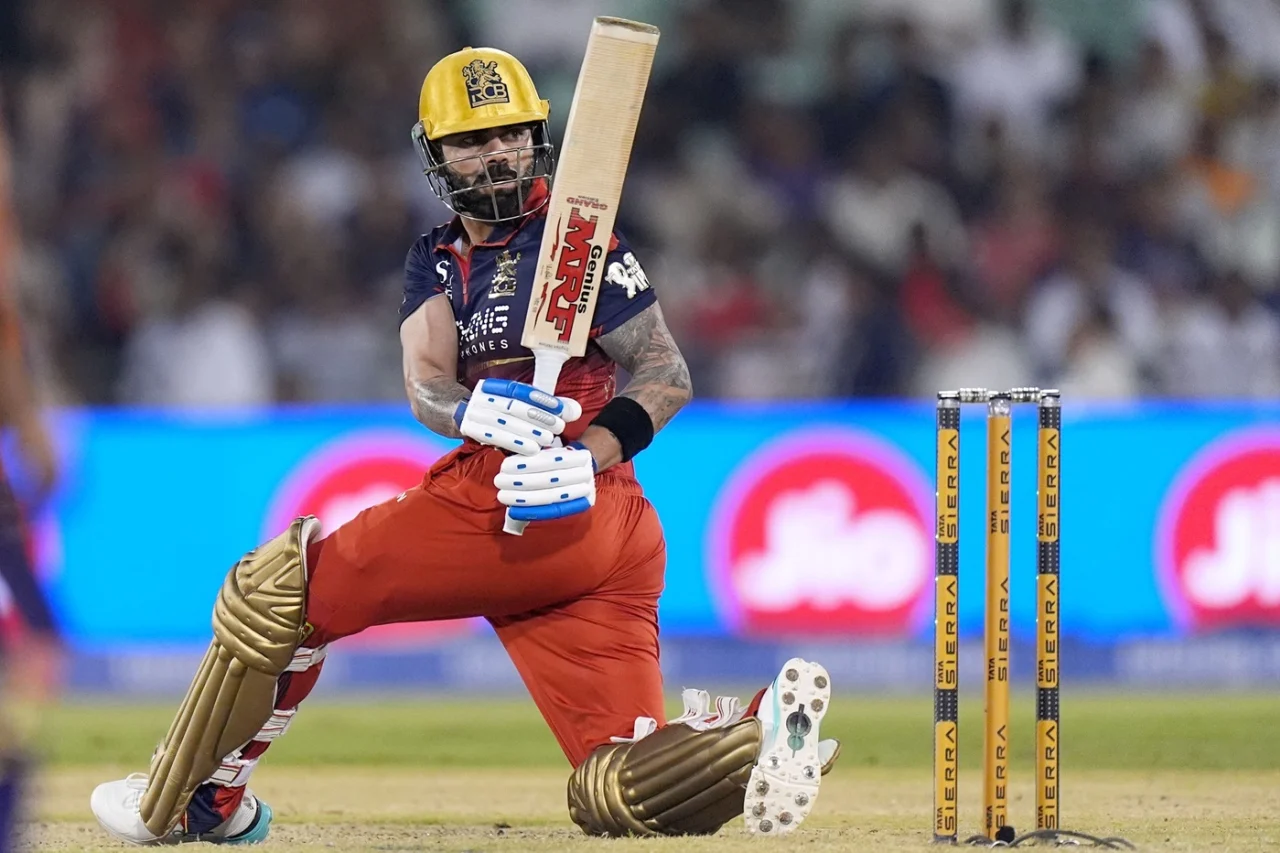
After back-to-back ducks in his last two innings, Virat Kohli showed most emphatically that he had merely been out of runs and not out of form, scoring his ninth IPL hundred to lead Royal Challengers Bengaluru (RCB) to the top of the IPL 2026 table with a commanding win over Kolkata Knight Riders (KKR) in Raipur.
Kohli’s unbeaten 60-ball 105 was a vintage effort in a run-chase – smooth, controlled, and full of both relentless sprinting between the wickets and gorgeous strokeplay, particularly at either end of his innings. That he never seemed stretched, however, was perhaps the story of the match – it may have been decided by the relative quality of the bowling attacks, particularly the seamers.
RCB’s bowlers did a superb job to keep KKR down to below 200 even though they only lost four wickets, and KKR’s inexperienced seam attack simply couldn’t match them for discipline and ability to extract misbehaviour from a slightly two-paced surface – with the caveat that it may have eased up a little during the second innings.
This was the first time RCB had fielded all three of Bhuvneshwar Kumar, Jacob Duffy and Josh Hazlewood – the legspinner Suyash Sharma made way. This suggested RCB expected conditions to play similarly to their previous game in Raipur, against Mumbai Indians, with seam movement and inconsistent bounce throughout.
When the match began – after a rain delay of an hour and a quarter – it became clear that this was a much better pitch to bat on, but there was still something in it for the seamers. Bhuvneshwar showed this with a cross-seamer that nipped away to nick off Finn Allen in the third over, and Hazlewood showed this by getting a short-of-length ball to rear at Ajinkya Rahane and have him caught and bowled off a miscued pull in the fifth over.
KKR still scored 56 in their powerplay, though, and 31 of those runs came in two overs from Duffy, who took the new ball ahead of Hazlewood, and didn’t do too much that was obviously wrong, but Allen, Rahane and Angkrish Raghuvansh were good enough to put away marginal errors in line and length.
That Dubey over was the last bit of real joy with the ball for KKR. Vaibhav Arora kept drifting onto Kohli’s pads in an 18-run second over, and then Bethell took his revenge on Dubey by going 6, 4, 4 at the start of the third.
Kartik Tyagi removed Bethell with a nasty short ball that rushed him on the pull, but he followed that up by straying down the leg side and overcompensating with width, and Devdutt Padikkal put both away to the boundary to get his innings moving.
RCB finished the powerplay at 66 for 1, with Kohli swivelling to pull Tyagi for six in the sixth over and ending that phase on 30 off 14.
From there, it was just a case of ticking off the remaining runs with no need for undue risk. No one is better at that game than Kohli. He scored eight twos – the joint third-most for him in an IPL innings – and found the boundary whenever the viewer may have wondered how long it had been since the last one. Mishaps at the other end – Tyagi dismissed Padikkal with an into-the-pitch cutter before pinging Rajat Patidar on the helmet; a Sunil Narine carrom ball forced a miscue from Patidar; Manish Pandey took a flying one-hander at point to send back Tim David – were mere blips in RCB’s otherwise silky-smooth ride.
And as the end neared, Kohli grew more expansive, playing two of his most eye-catching shots – a straight six off Anukul Roy with barely any follow-through, and a whipped six of iron wrists off Tyagi – to hurry towards the century mark. He got there with a single off Arora in the 19th over, and Jitesh Sharma finished the game soon after, flat-batting Dubey past long-on to bring up victory with five balls remaining.
Brief scores:
Royal Challengers Bengaluru 194 for 4 in 19.1 overs (Jacob Bethell 15, Virat Kohli 105*, Devdutt Padikkal 39, Rajat Patidar 11; Kartik Tyagi 3-32, Sunil Narine 1-31) beat Kolkata Knight Riders 192 for 4 in 20 overs (Ajinkya Rahane 19, Finn Allen 18, Angkrish Raghuvanshi 71, Rinku Singh 49*, Cameron Green 32; Bhuveneshwar Kumar 1-34, Josh Hazelwood 1-35, Raasik Salam 1-35) by six wickets
[Cricinfo]

Vaibhav Sooryavanshi picked in India ‘A’ squad for one-day tri-series in Sri Lanka

Saudi Arabia set to host Dunes League T20 from October

The guidance of Religious Leaders is essential to strengthen coexistence among communities. — Prime Minister

‘Watermelon deaths’ in Mumbai puzzle investigators

Mass sex abuse allegations force closure of boarding school in Indonesia

Gunshots fired in Philippine Senate where lawmaker wanted by ICC is holed up

‘Dates have the highest sugar content to fight Coronavirus’

Sunday Island 27 December – Headlines

#SundayIsland 17th December – Headlines

Sunday Island – 28th March

Sunday Island Headlines – 21 March

Sunday Island – 21st February – Headlines
-

 News5 days ago
Lanka Port City officials to meet investors in Dubai
-
 News2 days ago
Ex-SriLankan CEO’s death: Controversy surrounds execution of bail bond
-
 News6 days ago
SLPP expresses concern over death of former SriLankan CEO
-

 Editorial7 days ago
The Vijay factor
-
 News6 days ago
Police inform Fort Magistrate’s Court of finding ex-CEO of SriLankan dead under suspicious circumstances
-
 Features3 days ago
When University systems fail:Supreme Court’s landmark intervention in sexual harassment case
-
Features3 days ago
High Stakes in Pursuing corruption cases
-
 Features7 days ago
Palm leaf manuscripts of Sri Lanka – 1