
Foreign News
Singapore hangs drug trafficker, third such execution in a week

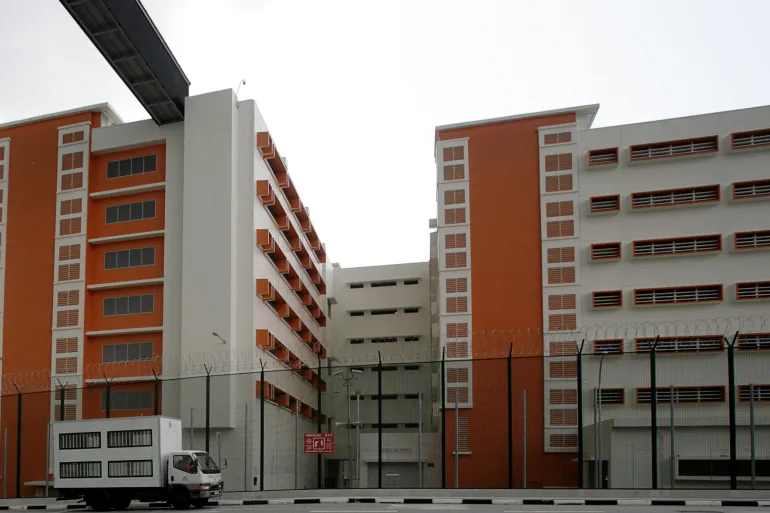
Singapore has carried out its third hanging of a convicted drug trafficker in a week despite appeals for clemency from the United Nations.
Rosman Abdullah, 55, was executed for trafficking 57.43 grams of heroin into the Southeast Asian city-state, Singapore’s drug enforcement agency said on Friday.
Rosman, a Singaporean, was “accorded full due process under the law, and was represented by legal counsel throughout the process,” the Central Narcotics Bureau said in a statement.
“Capital punishment is imposed only for the most serious crimes, such as the trafficking of significant quantities of drugs which cause very serious harm, not just to individual drug abusers, but also to their families and the wider society,” the CNB added.
UN experts had called on Singaporean authorities to spare Rosman, arguing that the death penalty does little to deter crime and that authorities had not made proper accommodations for his intellectual disabilities.
“We are gravely concerned that Mr. Rosman bin Abdullah does not appear to have had access to procedural accommodations, including individualised assistance, for his disability during his interrogation or trial,” the experts said in a statement released by the Office of the UN High Commissioner for Human Rights on Wednesday.
Amnesty International had condemned Rosman’s scheduled execution as “chilling” and “extremely alarming”.
Rosman’s hanging at Singapore’s Changi Prison comes exactly a week after the execution of a 39-year-old Malaysian and a 53-year-old Singaporean for drug trafficking.
Despite its reputation as a modern city-state and international business hub, Singapore ranks among only a handful of countries, including China and North Korea, that impose the death penalty for drug offences.
Under the country’s laws, anyone trafficking more than 500 grams of cannabis or 15 grams (0.5 ounces) of heroin faces mandatory capital punishment.
Since resuming executions in March 2022 following a hiatus due to the COVID-19 pandemic, Singaporean authorities have carried out 24 executions, including eight so far this year.
Singapore’s government, which keeps a tight rein on public protest and the media, has defended the death penalty as a deterrent against drug abuse, citing surveys that show most citizens support the law.
[Aljazeera]


Thirty-five people have been killed after gunmen struck Niger’s largest airport on Thursday, officials say – the second attack in less than five months.
Residents in the predominately Muslim country told the BBC they had just finished their morning prayers when explosions and gunshot sounds rang out from Diori Hamani international airport, located in the capital, Niamey.
Niger’s defence ministry said the fatalities comprised 22 assailants, 11 soldiers, and two civilians.
On Thursday evening, Al-Qaeda affiliate Jama’at Nusrat al-Islam wal-Muslimin [JNIM] claimed responsibility for the attack.
Niger has been fighting an Islamist insurgency for a decade and in January, an organisation linked to the Islamic State group claimed responsibility for an attack on the same airport.
Thursday’s violence settled by mid-morning and security forces have since launched a manhunt for any remaining attackers.
Lawalli Tsalha, who lives near the airport, which also hosts a military base, told the BBC: “We finished our prayer at about 05:50 (04:50 GMT) and shortly afterwards we heard a loud bang – like something had exploded, perhaps a tyre.
“It was only a little later that we realised what was happening.”
Authorities said alongside the 22 attackers that were killed, another four were wounded. They added that 20 suspects had been arrested.
A large cache of weapons including RPG-7 launchers, AK-47 rifles, explosives, grenades, communications equipment and thousands of rounds of ammunition were also reportedly seized.
Armed local residents joined the manhunt, though witnesses told the BBC that security personnel attempted to stop civilians getting involved.
One resident, who did not wish to be named, said: “The attackers mixed in with the local population, so finding them was not easy. Civilians picked up machetes and sticks to defend themselves and to strike anyone they did not recognise who came their way.”
The airport vicinity had been locked down on Thursday afternoon, with security forces searching vehicles entering and leaving the area.
African Union Commission Chairperson Mahmoud Ali Youssouf “strongly condemned” the assault and praised Nigerien forces whose actions “made it possible to repel the attack and secure the airport facilities.”
Diori Hamani international airport is one of Niger’s most sensitive security installations, serving as both a civilian aviation hub and a military base.
It also hosts facilities linked to the Alliance of Sahel States (AES), which comprises Niger and its neighbours, Mali and Burkina Faso.
All three countries are run by juntas which came to power in part because of a failure to deal with years of jihadist violence in the region.
In January’s attack on the airport, four military personnel were injured and 20 attackers were killed, Niger’s defence ministry said.
At the time, the head of Niger’s military government, which has been in power for three years, thanked Russia for its help in foiling the attack. Abdourahamane Tiani also accused the presidents of France, Benin and Ivory Coast of backing those responsible.
He did not give details of what help Russia had provided, or provide any evidence to support his accusations against the other countries.
In recent weeks, authorities in Niger have demolished neighbourhoods near the airport, citing “terrorist risks”.
They have also extended the airport’s perimeter fence and installed more than 350 surveillance cameras, AFP reports.
[BBC]

More than 400 cats destined for slaughter have been rescued in Vietnam after authorities dismantled an alleged feline theft ring, an animal welfare group has said.
Nine people have been arrested in connection with what police described as a “criminal group specialising in stealing and collecting cats”, according to the official newspaper of Ho Chi Minh City police.
Officers recovered more than 400 live cats and around 80 dead animals preserved on ice during raids on sites in Tay Ninh Province and Ho Chi Minh City last week. A further 21 cats were seized at a separate facility.
The consumption of dog and cat meat is legal in Vietnam, but vendors require permits that show the origin of animals.
Police said they tracked down the group on 11 June after investigating a spate of pet thefts in Ho Chi Minh City, according to local media reports.
The suspects admitted trapping and collecting cats across southern Vietnam over the past three years, police said. According to investigators, the suspects allegedly transported stolen cats to holding facilities before selling them on to traders, with transactions taking place every two to three days.
Around 40 of the stolen cats have since been reunited with their owners, Humane World for Animals said in a statement on Tuesday.
The organisation praised local authorities for “decisive action that has saved the lives of so many animals”, but said “a number had later died as a result of their ordeal.
It added that it was providing food and other supplies for animals still being held by police as evidence while the case continues.
Police said the investigation was ongoing and urged residents who believe their pets have been stolen to come forward to help identify recovered animals.
An estimated five million dogs and one million cats are captured, stolen, trafficked and slaughtered for meat in Vietnam each year, according to Humane World for Animals.
The organisation says pets are frequently stolen from homes, with dogs often seized using poisoned bait tasers and iron pincers, and cats with spring-loaded snares.
While the consumption of dog and cat meat remains more common in Vietnam than other Asian countries, campaigners say attitudes are changing.
A 2023 survey commissioned by Humane World for Animals found growing public opposition, particularly among younger people and pet owners, with majorities backing bans on both the dog and cat meat trades.
(BBC)
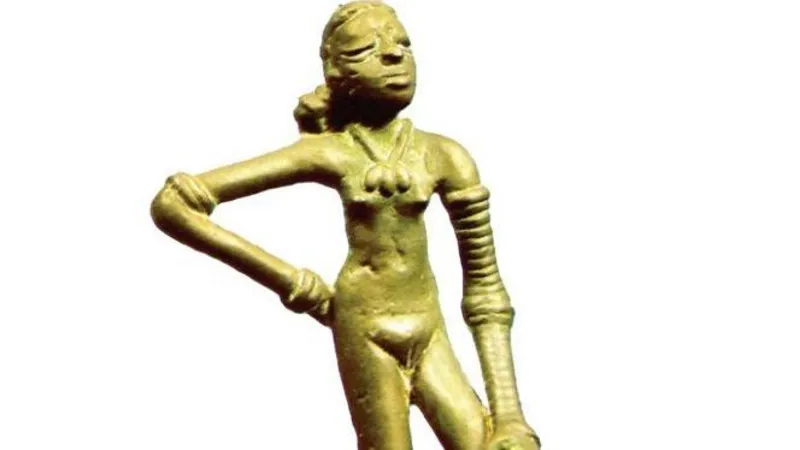
The “covered-up” image of a nude artefact has been withdrawn from an Indian school textbook after it sparked a massive backlash from historians and educationists.
The bronze sculpture – known as the Dancing girl from Mohenjo-daro – shows a girl standing with one hand on her hip and is one of the most recognisable artefacts from the Indus Valley civilisation.
But in a newly released grade nine textbook, the figurine’s torso was covered with dark shading, hiding its anatomical features.
After it created an uproar, officials said that the original image has been restored in the digital version of the book and that new print editions would also carry the unedited photo of the bronze sculpture.
After news broke of the inclusion of the modified image, historians had accused the National Council of Educational Research and Training (NCERT) – which drafted the textbook – of disfiguring the iconic artefact.
The NCERT, an autonomous organisation under the federal education ministry, oversees syllabus changes and textbook content for children taking exams under the government-run Central Board of Secondary Education (CBSE).
NCERT director Dinesh Saklani told reporters that the modified image would be withdrawn from the textbook.
“Following consultations with experts, the department is replacing the image of the Dancing Girl with its original version,” Saklani told ANI news agency.
The BBC has contacted Saklani for comment.
A chapter on the Indus Valley has been a staple in Indian school curriculum, and though the Dancing Girl sculpture has appeared in textbooks for decades – including in earlier versions of NCERT textbooks – its torso has never been censored in any way.
The NCERT has not yet shared a reason for introducing the modified image but media reports have speculated that it could be due to concerns over nudity.

An editorial in the Indian Express newspaper, which first broke the news, criticised the modification of the artifact, saying:
“The Dancing Girl has been significant not because it conforms to a blindfolded standard of modesty but because it embodies poise, confidence and unmistakable presence. If the task of education is to equip young people to engage with the world as it is, then NCERT would do better to trust both students, and women – both contemporary and millennia old – with a little more agency.”
The textbook is part of the NCERT’s new Arts Education Series, introduced under the latest National Education Policy (NEP) to integrate visual, performing and literary arts into mainstream schooling.
The Dancing Girl sculpture, which was discovered at Mohenjo-daro – one of the largest settlements of the ancient Indus Valley Civilisation – depicts a girl adorned with ornaments with her hair tied in a bun.
Her posture captures the human body in motion and archaeologists have long considered the sculpture to be of great artistic value and evidence of the civilisation’s advanced knowledge of metallurgy.
The sculpture is currently housed in the National Museum in Delhi.
[BBC]

Asia’s richest man Ambani announces what could be India’s biggest share sale

Educational equipment Provided to University Students through the President’s Fund

Fears for US-Iran deal as talks delayed by Israeli strikes on Lebanon

BCCI secretary hints at early start to IPL 2027

Cricket journalist and broadcast legend Qamar Ahmed dies aged 88

Stafanie Taylor, spinners help West Indies overcome Scotland threat

‘Dates have the highest sugar content to fight Coronavirus’

Sunday Island 27 December – Headlines

#SundayIsland 17th December – Headlines

Sunday Island – 28th March

Sunday Island Headlines – 21 March

Sunday Island – 21st February – Headlines
-

 News5 days ago
Release of 2025 O/L results likely to be delayed
-

 Sports5 days ago
Tharanga set for high-profile javelin clash in Ostrava
-

 Features6 days ago
Politics of protected species
-

 News4 days ago
Beijing Capital Airlines to resume flights to Colombo signalling boost to tourism
-

 News5 days ago
Theft of USD 2.5 mn from Treasury: CoPF accused of complicity in NPP cover-up
-

 News7 days ago
Commonwealth lawyers urge Lanka to uphold rule of law
-

 Opinion5 days ago
Decoding Trump’s 12.5% “Forced Labor Tariff” on Sri Lanka
-
 Features3 days ago
Killing of Colombo’s ancient trees — a warning on UN’s World Desertification Day – 17 June