
Latest News
West Indies ride on Greaves’ 115 to exert dominance over Bangladesh


A maiden Test century for Justin Greaves headlined a dominant day for West Indies against Bangladesh on day two of the Antigua Test. After his 115 helped West Indies post 450 for 9, West Indies bookended the day with two Bangladesh wickets, leaving the visitors 410 behind with eight wickets in hand.
It was a fine recovery after slipping to 261 for 7 despite an overnight score of 250 for 5. Greaves shared a 140-run eighth wicket stand with Kemar Roach, who batted for more than four hours for 47, his highest Test score in his 15-year career.
Greaves’ unbeaten 115 justified his Super50 form, where he struck three consecutive centuries earlier this month. He made a patient effort, striking just four boundaries in his 206-ball stay. It was the perfect follow-up to the nineties that Alick Athanaze and Mikyle Louis had scored on day one to lay the foundation.
Bangladesh continued to give away strong positions with the ball, toiling for 144.1 overs, but unable to bowl out the home side. Hasan Mahmud took three wickets, all of them on the second day. Taksin Ahmed toiled hard and even found the edge of Greaves’ bat once but nobody appealed. The spinners, stand-in captain Mehidy Hasan Miraz and Taijul Islam, shared three wickets from their combined 73.1 overs.
West Indies declared with Bangladesh needing to bat out a maximum time of an hour and 45 minutes. But there was no respite for them against the four-man West Indian pace attack. Zakir Hasan fell for 15 after he under-edged a Jayden Seales delivery onto his stumps. The left-hander struck three fours in his short stay, all off Seales, but was slightly unlucky with the ball shaving the leg-stump. Mahmudul Hasan Joy edged Alzarri Joseph for 5, shortly after he was dropped on the same score.
It was a long way from the start of the day for the visitors, having started the day in the best possible way by taking two early wickets.
Mahmud removed Joshua Da Silva with the fifth ball of the morning session, trapped lbw with a delivery that darted into his front pad. This was Mahmud’s first wicket in the game despite bowling well on the first day. It was also his 24th wicket this year, making him the highest wicket-taker in a calendar year among Bangladesh’s pace bowlers.
That number became 25 when Alzarri fell in Mahmud’s next over. Zakir took a superb two-handed catch at gully, reminiscent of how he opened the Pakistan tour with Abdullah Shafique’s catch at gully in August. If Bangladesh sensed they had their opening to bowl out West Indies for under 300 runs, that was blunted by Roach.
He was the right type of foil for Greaves, who was willing to grind out the Bangladesh attack. Greaves handed the strike to Roach from time to time, as the pair didn’t allow any more wickets in the first session. There were only two boundaries in those 26 overs too, but that hardly bothered the home side who needed a recovery.
Greaves started the second session with his third boundary when he pulled Taskin through midwicket. He, however, survived a caught-behind chance on 77 with neither Taskin nor wicketkeeper Jaker Ali (who was deputizing for Litton Das after the first session) hearing a faint nick. it was only a replay on the big screen that showed what Bangladesh missed out on.
Shortly afterwards, a Roach single brought up the team’s maiden century partnership for the eighth wicket against Bangladesh. It was followed by a rain break of seven minutes, after which Roach slammed Mehidy over his head for his first boundary. Mahmud finally removed Roach with a fine angling delivery, clipping the top of his middle-stump. Their 140-run stand was West Indies’ third-highest for the eighth wicket.
Greaves soon reached his century with his fourth boundary shot, driving Taijul through the covers. It was potentially his best shot of the innings and the landmark was only his second first-class ton.
West Indies declared in the 145th over of their innings, after their tail-enders Seales and Shamar Joseph struck some meaty blows. That left enough time for the bowlers to have a crack, which they successfully did.
Brief scores:
Bangladesh 40 for 2 in 20 overs (Alzarri Joseph 1-2,Jayden Seales 1-15) trail West Indies 450 for 9 in 144.1 overs (Justin Greaves 115, Mikyle Louis 97, Alick Athanaze 90, Kemar Roach 47, Kavem Hodge 25, Kemar Roach 47; Hasan Mahmud 3-87, Taskin Ahmed 2-76, Mehidy Hasan Miraz 2-99) by 410 runs
[Cricinfo]


It has been reported quoting family sources that veteran singer Mariazelle Goonetilleke has passed away this morning (10) at the age of 68
She had been receiving treatment at the Kalubowila Teaching Hospital.
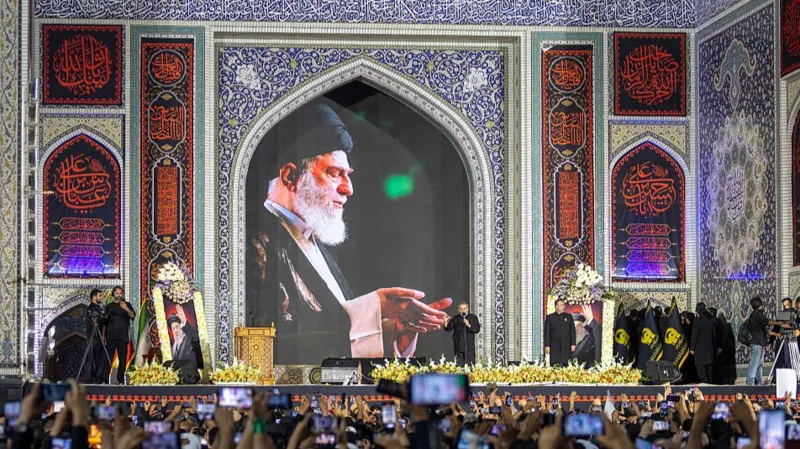
The US and Iran again traded strikes in exchanges that continued into Thursday, as observers reported a “dramatic” drop in the number of ships travelling through the Strait of Hormuz.
The US says it hit 90 military targets, some near the Strait. Iran says 14 people have been killed in the past two days.
State media also reported that targets near the Bushehr nuclear power plant were hit, citing the deputy governor of the province. The US has not commented on the latest strikes.
Iran said it targeted US assets in Kuwait, Bahrain and Qatar in response. Later on Thursday, Tehran launched more strikes on sites in Kuwait, Jordan and Iraq, state-linked media reported.
Separately, huge crowds gathered as Iran’s late supreme leader, Ayatollah Ali Khamenei, was buried after six days of funeral events.
Crowds massed on the streets of Mashhad in north-eastern Iran waving Iranian flags, while some were pictured holding signs carrying death threats directed at US President Donald Trump.
Khamenei was killed on 28 February during the first hours of US and Israeli strikes against Iran.

Iran’s foreign ministry denounced the latest US strikes as a “grave war crime”, describing the US administration as “evil and psychopathic”
Bridges and a railway route connecting Tehran to the city of Mashhad, where the late supreme leader’s funeral is being held, were also damaged, the foreign ministry said.
Iran’s health ministry said 14 people had been killed and 78 people injured across five provinces.
Gulf nations reported Iranian attacks following the US strikes, with explosions in Bahrain’s capital Manama, Kuwait intercepting missiles and drones, and Qatar issuing a security alert.
Later on Thursday, explosions were heard in Iran’s southern port of Konarak, with a local official telling Iran’s official news agency a navy site was attacked by an “enemy”.
However a US defence official told the BBC it had not carried out any strikes in Iran in recent hours.
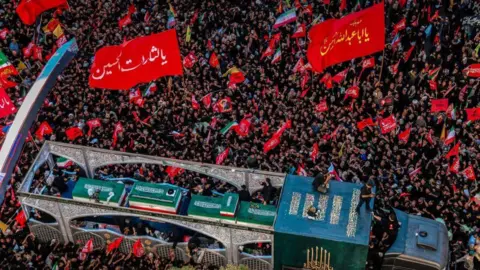
The funeral of Iran’s late supreme leader Ali Khamenei is being held in the city of Mashhad [BBC]
Iran’s parliamentary speaker Mohammad Bagher Ghalibaf, who is also the country’s chief negotiator with the US, said on X that America “still hasn’t learned that bullying and breaking promises are no longer cost-free”.
“Let me put it plainly: if you strike, you’ll get hit,” he wrote, adding that the Strait of Hormuz will only open under Iranian arrangements – not “American threats”.
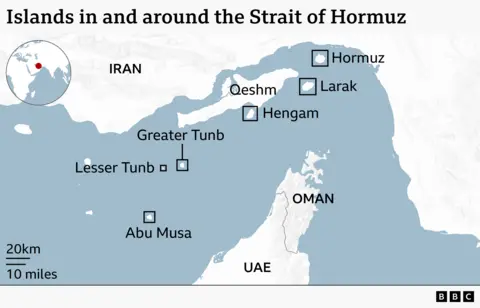
US Central Command (Centcom) said the most recent round of strikes was carried out to “further degrade Iran’s ability to attack commercial shipping and innocent civilian mariners” in the vital waterway.
In a statement, it said it had struck 90 Iranian military targets, which included air defense systems and military logistics infrastructure along Iran’s coastline.
“The latest strikes follow successful execution of offensive strikes in Iran the night before,” Centcom added.
Phil Belcher, marine director at Intertanko, an international organisation for independent tanker owners, said the number of ships travelling through the Strait via the southern route closer to Oman was now in “single figures” following the step up in hostilities.
Belcher added that the overall daily figure of about 30 ships was down from about 70 a week ago and well below the normal number of 130 ships that was seen before the Iran war began earlier this year.
He told BBC Radio 4’s Today programme that there had been an “exuberance of optimism” around shipping in the region following the signing of the SMemorandum Of Understanding between Iran and the US last month, but now the mood has changed.
“This cycle of violence, this cycle of up-and-down, positive-negative news, it’s having an enormous impact both on business and on the seafarers themselves,” he said.
On Wednesday night Iranian state TV reported eight explosions in Bandar Abbas, and said two missiles had hit the ports of both Sirik and Jask – also in southern Iran.
It added that two projectiles had hit the island of Abu Musa, which has been the subject of a longstanding ownership dispute between Iran and the United Arab Emirates.
The extent of damage from the US strikes is not yet known, but Iranian media have reported power cuts in Chabahar and a fire at an Islamic Revolutionary Guard Corps (IRGC) barracks in Bushehr. Images on social media showed damage to a marine control tower in Chabahar.
Earlier on Wednesday, Centcom wrote in a statement that it held Iran accountable for “recent unjustified aggression against commercial shipping and civilian crews freely navigating a vital international waterway.”
President Trump said late on Wednesday that Iran had “called a little while ago” and wanted to make a deal “so badly”.
Trump added: “I just don’t know if they’re worthy of making a deal – I don’t know that they’re going to honour the deal, that’s the problem.”
The current flare up has been the worst exchange of strikes between the US and Iran since the deal – known as a memorandum of understanding (MoU) – was signed on 17 June.
Trump said the ceasefire agreement signed last month with Iran was now “over”. He told reporters: “I don’t want to deal with them anymore, they’re scum. You know what scum is? They’re scum. They’re sick people.”
In response, Iran’s Foreign Minister Abbas Araghchi said in a post on X: “We do not answer vulgarity with vulgarity, but with action: fearlessly and with great valour.”
The deal between the US and Iran included 14 points, among them a 60-day period for a ceasefire during which negotiations should continue, the safe passage of vessels through the Strait of Hormuz and the US lifting sanctions on Iran.
The 60-day period for negotiations is not yet up, but Trump said he saw further talks as “a waste of time”.
[BBC]
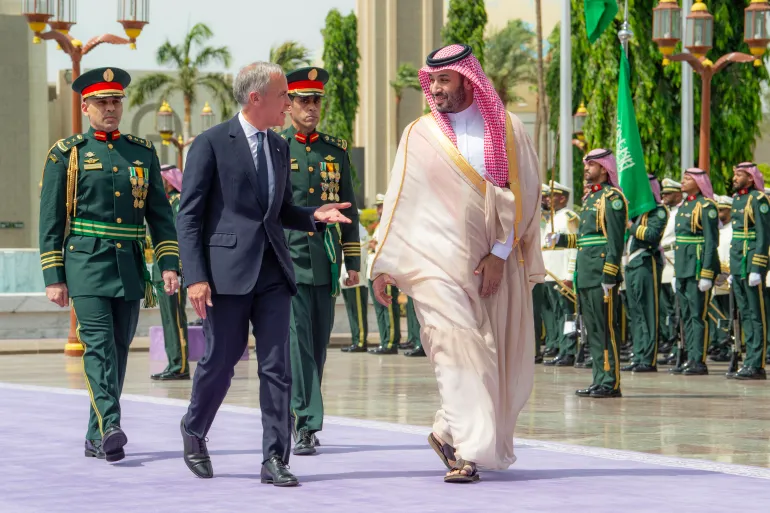
Canadian Prime Minister Mark Carney paid a visit to Saudi Arabia, marking the first state visit in more than a quarter-century as Ottawa and Riyadh explore deeper mining and energy ties.
Carney visited on Thursday, on the heels of the NATO summit in Turkiye, doubling down on calls to diversify trade relationships as United States President Donald Trump imposed tariffs that have weighed on the Canadian economy. The visit included agreements covering mining, energy and artificial intelligence, which Carney’s office said would be finalised next year.
The two countries signed 13 new agreements and memorandums of understanding (MoUs) covering areas including health and defence. The agreements are worth $1bn. Among the deals are agreements that would help Canadian companies develop mining and clean energy projects in Saudi Arabia.
During his visit, Carney also met with Amin Nasser, head of state oil giant Saudi Aramco. On energy, Carney’s office said the two countries are working together on agreements related to liquefied natural gas, hydrogen and carbon capture and storage.
Carney’s office also said he would lead “a delegation of Canada’s pension funds” as part of efforts to invest in Saudi Arabia’s energy and AI sectors.
In talks with Saudi Crown Prince Mohammed bin Salman, Carney signed agreements aimed at expanding several key partnerships between the two nations following years of strained relations under former Prime Minister Justin Trudeau.
Trudeau, Carney’s predecessor, had been critical of Saudi Arabia’s treatment of human rights activists, including Saudi writer Raif Badawi and his sister, Samar. In response, Saudi Arabia expelled the Canadian ambassador and cut trade and investment ties in 2018.
Ottawa and Riyadh began restoring diplomatic ties in 2023.
Carney was asked by reporters about the decision to re-engage with Saudi Arabia, to which he responded:
“Engaging with the country doesn’t mean that we agree with everything that a country is doing.”
“We are actively engaging with key partners around the world,” Carney said.
“Lecturing countries from afar is an ineffective strategy. It’s satisfying, but it’s ineffective.”
Carney was also asked about ongoing negotiations with the United States. Reporters pressed him on whether there had been any progress in trade negotiations with Trump amid tensions surrounding the North American Free Trade Agreement. “I’ll keep you posted,” Carney said.
[Aljazeera]

Sri Lankan singer Mariazelle Goonetilleke passes away at the age of 68

Tensions erupt in Indian state after 11-year-old raped and murdered

US and Iran trade attacks as Khamenei is buried

Several spells of showers will occur in the Western, Sabaragamuwa and North-western provinces and in Galle, Matara, Kandy and Nuwara-Eliya districts

Canadian PM visits Saudi Arabia to strengthen energy, mining partnerships

Mbappe and Dembele net as France beat Morocco to reach World Cup semifinal

‘Dates have the highest sugar content to fight Coronavirus’

Sunday Island 27 December – Headlines

#SundayIsland 17th December – Headlines

Sunday Island – 28th March

Sunday Island Headlines – 21 March

Sunday Island – 21st February – Headlines
-

 News5 days ago
Singapore-based Buddhist monk marks nearly four decades of humanitarian service
-

 News6 days ago
Freedom 250: US Embassy celebrates America’s 250th Independence Day through magic of American cinema
-

 News4 days ago
AI concerned over proposed SL military deployment in Haiti
-

 News7 days ago
UNEP support pledged to strengthen Sri Lanka’s Environmental Priorities
-

 Midweek Review2 days ago
Unexpected focus on ‘pieces of tin’ worn by military men
-

 Features5 days ago
The NPP’s New Challenge: Balancing Easter Lawfare and Economic Welfare
-
 Latest News3 days ago
Nyamhuri and Ngarava stun Bangladesh by defending 141
-

 Latest News6 days ago
Ukrainian suspect hunted by police after Monaco bomb attack was ‘disguised as a man’