
Business
NCHS-Swinburne graduation marks 10 years of partnership


Nawaloka College of Higher Studies (NCHS) and Swinburne University of Technology celebrated their decade-long partnership in Sri Lanka, a collaboration that has provided countless Sri Lankan students with pathways to global education and career opportunities. Held at the BMICH on the 23rd of October 2024, this milestone graduation ceremony saw over 400 students awarded qualifications, marking both a pivotal personal achievement and a testament to the lasting impact of the NCHS-Swinburne alliance.
The event opened with a recognition of NCHS’s journey in making quality, internationally recognized education accessible to students throughout Sri Lanka. With campuses in Colombo and Kandy, NCHS has built a reputation for providing a learning environment that meets the highest global standards while supporting the aspirations of students locally.
Dr. Jayantha Dharmadasa, Chairman of NCHS, highlighted the significance of the partnership, “This year is particularly special as we celebrate our decade-long partnership with Swinburne University of Technology, Australia, which has provided countless students with pathways to global opportunities. This collaboration, along with our other international partnerships, represents our commitment to providing Sri Lankan students with an education that transcends borders.”
Professor Pascale G. Quester, Vice-Chancellor and President of Swinburne University of Technology said, “The Swinburne qualification you hold is much more than a piece of paper. Swinburne has worked closely with industry and future employers to ensure it is relevant and future-proof. Whether you are about to enter the world of work or go on to undertake further study, your graduation today marks the closure of one chapter and the start of an exciting new one.”

By Sanath Nanayakkare
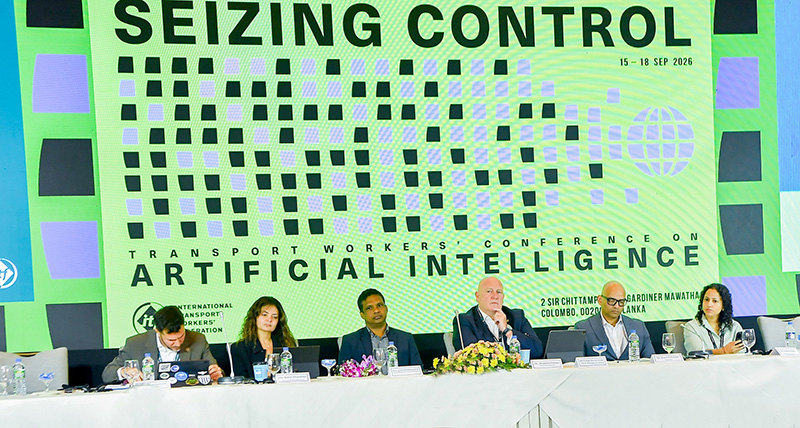
Artificial intelligence and automation present serious challenges for workers – such as job consequences seen in docks and rail systems – and emphasises that workers cannot simply stop technological progress. By gathering young trade unionists in Sri Lanka, the ITF aims to establish key principles for engaging with technology, ensuring workers have a strong voice at the bargaining table, and encouraging constructive social dialogue with corporations and governments.
These compelling words from ITF General Secretary Stephen Cotton underscored the urgent reality facing modern labor as rapid technological advancements sweep across global industries.
Confronting this shifting landscape head-on, the International Transport Workers’ Federation (ITF), in partnership with the National Union of Seafarers of Sri Lanka (NUSS), convened a ground-breaking conference on artificial intelligence in Colombo from September 15–17.
As the ITF’s first-ever AI-focused global conference and the first of its kind hosted in Sri Lanka, the landmark event marked a critical milestone in balancing technological innovation with worker-centered safeguards.
Representing over 16.6 million transport workers worldwide, the ITF designed the gathering to tackle the multifaceted impacts of AI on safety, operations, workforce development, and governance. Rather than resisting progress, the conference focused on proactive engagement, establishing guiding principles to protect workers’ rights and privacy both at sea and on land.
Key discussions centred on sharing best practices for upskilling and reskilling transport personnel, ensuring that human oversight remains central to AI-driven logistics, routing, and maintenance.
Reflecting on the historic nature of the event, Boa Athu, CEO of National Union of Seafarers Asia Pacific, noted that the conference represented a monumental moment as AI emerges as a permanent fixture of contemporary life.
Highlighting NUSS’s pride in hosting the event in Colombo, Athu emphasised that AI offers transformative potential when guided by strong social dialogue, equitable access to training, and robust governance safeguards.
Ultimately, the Colombo conference demonstrated that the future of transport must be shaped by those who keep the world moving. By uniting international labour leaders, affiliates, port operators, and regulators, the event laid a vital foundation for inclusive policy frameworks that champion fair labour standards, securing a powerful voice for workers in an automated tomorrow.

By Sanath Nanayakkare
As Sri Lanka experiences a surge in visitors from its largest tourist market, India, a modern administrative hurdle has emerged at Bandaranaike International Airport (BIA).
While nations like India and Pakistan have successfully transitioned to fully digital driving licences and cashless ecosystems, Sri Lanka’s Department of Motor Traffic counter still requires a physical card to issue temporary local permits, The Island Financial Review learns.
This mismatch creates significant friction for independent travelers who rely entirely on smartphones and cloud-stored credentials. Tourists turned away at the airport – and sometimes redirected to the Werahera office in vain – find themselves unable to legally rent and drive vehicles. Consequently, this policy gap harms local car rental operators, causes tourist frustration, and deprives the government of valuable permit revenue.
The situation highlights a distinct irony: Sri Lankan motorists easily travel abroad using International Driving Permits that are readily accepted in India and Pakistan, yet local infrastructure cannot reciprocate due to outdated verification systems.
Recognizing the problem, Department of Motor Traffic officials have noted that upgrades and new equipment are currently in the works to integrate foreign digital platforms.
For a nation aggressively pursuing a national digitalisation drive, rapidly modernising these transport protocols is essential to keeping pace with global travelers and unlocking the full potential of its tourism economy.
Business
International Afro-Latin Dance Festival in Colombo to grow into a larger regional tourism draw

ALIF-SL, Sri Lanka’s first-ever international Afro-Latin dance festival, returns for its 4th edition from 25 to 27 September 2026 at the Galle Face Hotel, Colombo. The festival will bring together over 30 international and national artists and 175–200 participants from more than 20 countries, reaffirming its place as the region’s leading platform for Salsa, Bachata and Kizomba.
This year’s edition is headlined by Tropical Gem, the world’s No. 1 salsa team, travelling from Italy to perform and teach alongside a stellar international line-up. Attendees can also look forward to the ALIF Cup Sri Lanka Open, a keenly contested competition judged by an international panel, giving local dancers a rare opportunity to compete and connect with world-class talent.
“Every year, ALIF connects Sri Lanka to the world. With this year’s artist line-up and the ALIF Cup competition, we’re not just hosting a festival, we’re putting Sri Lanka on the map as a top destination for dance,” said JD Ruban, Founder and Director of ALIF-SL
Beyond the dance floor, ALIF-SL continues to support Sri Lanka’s tourism sector, drawing dancers, judges and enthusiasts from across the globe to Colombo and positioning the capital as an emerging regional hub for social dance. Organizers plan to grow the festival into a larger regional tourism draw, introduce new competition categories, and bring in even bigger headline acts in future editions.

Trophy row unlikely to repeat in Japan

Powerful explosions at Syrian army site near Aleppo injure at least four

Government committed to ensuring the rights of children with disabilities and providing equal opportunities – PM

Ellis and Inglis break Zimbabwe hearts to secure one-wicket thriller

Kenya’s Ngetich breaks women-only half-marathon world record by a second

Showers about 100 mm are likely at times in the Western, Sabaragamuwa and North-western provinces and in Galle, Matara, Kandy and Nuwara-Eliya Districts

‘Dates have the highest sugar content to fight Coronavirus’

Sunday Island 27 December – Headlines

#SundayIsland 17th December – Headlines

Sunday Island – 28th March

Sunday Island Headlines – 21 March

Sunday Island – 21st February – Headlines
-

 News4 days ago
US embassy won’t comment on IGP’s probe into joint drug raid
-

 News3 days ago
Bid for Basil’s extradition nears final stage: Police
-

 Features6 days ago
The emptying university: why are academics leaving?
-

 Business5 days ago
All-new Bolero MaXX unveiled in Sri Lanka
-

 News2 days ago
Shanakiyan urges urgent action over reported death sentence for Lankan in Saudi Arabia
-
 Opinion6 days ago
Who committed genocide and created mass graves in Sri Lanka?
-

 Opinion4 days ago
A journalist who wrote across the divide
-

 News1 day ago
Namal Rajapaksa Buddhist gambit fails, bail denied