
Latest News
Nobel Prize in Physiology or Medicine goes to microRNA researchers


The Nobel Prize in Physiology or Medicine 2024 has been awarded to US scientists Victor Ambros and Gary Ruvkun for their work on microRNA.
Their discoveries help explain how complex life emerged on Earth and how the human body is made up of a wide variety of different tissues.
MicroRNAs influence how genes – the instructions for life – are controlled inside organisms, including us.
The winners share a prize fund worth 11m Swedish kronor (£810,000).
Every cell in the human body contains the same raw genetic information, locked in our DNA.
However, despite starting with the identical genetic information, the cells of the human body are wildly different in form and function.
The electrical impulses of nerve cells are distinct from the rhythmic beating of heart cells. The metabolic powerhouse that is a liver cell is distinct to a kidney cell, which filters urea out of the blood. The light-sensing abilities of cells in the retina are different in skillset to white blood cells that produce antibodies to fight infection.
So much variety can arise from the same starting material because of gene expression.
The US scientists were the first to discover microRNAs and how they exerted control on how genes are expressed differently in different tissues.
The medicine and physiology prize winners are selected by the Nobel Assembly of Sweden’s Karolinska Institute.
They said: “Their groundbreaking discovery revealed a completely new principle of gene regulation that turned out to be essential for multicellular organisms, including humans.
“It is now known that the human genome codes for over 1,000 microRNAs.”
Without the ability to control gene expression, every cell in an organism would be identical, so microRNAs helped enable the evolution of complex life forms.
Abnormal regulation by microRNAs can contribute to cancer and to some conditions, including congenital hearing loss and bone disorders.
A severe example is DICER1 syndrome, which leads to cancer in a variety of tissues, and is caused by mutations that affect microRNAs.

Prof Ambros, 70, works at the University of Massachusetts Medical School, and Prof Ruvkun, 72, is a professor at Harvard Medical School.
Both conducted their research on the nematode worm – C. elegans.
They experimented on a mutant form of the worm that failed to develop some cell types, and eventually homed in on tiny pieces of genetic material or microRNAs that were essential for the worms’ development.
This is how it works:
- A gene or genetic instruction is contained within our DNA
- Our cells make a copy, which is called messenger RNA or simply mRNA (you’ll remember this from Covid vaccines)
- This travels out of the cell’s nucleus and instructs the cell’s protein-making factories to start making a specific protein
- But microRNAs get in the way by sticking to the messenger RNA and stop it working
- In essence the mircoRNA has prevented the gene from being expressed in the cell
Further work showed this was not a process unique to worms, but was a core component of life on Earth.
Prof Janosch Heller, from Dublin City University, said he was “delighted” to hear the prize had gone to Profs Ambros and Ruvkun. “Their pioneering work into gene regulation by microRNAs paved the way for groundbreaking research into novel therapies for devastating diseases such as epilepsy, but also opened our eyes to the wonderful machinery that is tightly controlling what is happening in our cells.”
Previous winners
2023 – Katalin Kariko and Drew Weissman for developing the technology that led to the mRNA Covid vaccines.
2022 – Svante Paabo for his work on human evolution.
2021 – David Julius and Ardem Patapoutian for their work on how the body senses touch and temperature.
2020 – Michael Houghton, Harvey Alter and Charles Rice for the discovery of the virus Hepatitis C.
2019 – Sir Peter Ratcliffe, William Kaelin and Gregg Semenza for discovering how cells sense and adapt to oxygen levels.
2018 – James P Allison and Tasuku Honjo for discovering how to fight cancer using the body’s immune system.
2017- Jeffrey Hall, Michael Rosbash and Michael Young for unravelling how bodies keep a circadian rhythm on body clock.
2016 – Yoshinori Ohsumi for discovering how cells remain healthy by recycling waste.
[BBC]

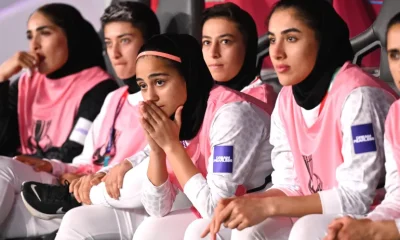



Australia has confirmed that two more members of the Iranian women’s football team have received humanitarian visas, after five players were earlier granted asylum over concerns for their safety should they return to Iran, following the team failing to simg their national anthem before a recent match.
A player and a member of the team’s support staff decided to stay in Australia after seeking asylum, Minister for Home Affairs Tony Burke told reporters on Wednesday.
The pair has now joined five other team members granted humanitarian visas on Tuesday, Burke told reporters.
He said the pair sought asylum before the team departed the country late on Tuesday night, adding that all the women were taken aside individually by Australian officials and interpreters, without Iranian minders present, and offered asylum as they passed through security at Sydney airport.
“They were given a choice,” said Burke, who later posted images of the players on social media.
“In that situation, what we made sure of was that there was no rushing, there was no pressure,” he said.
Burke also said that some people linked to the team were not offered asylum, without providing details. One member of the delegation delayed boarding the departing flight from Sydney while they contacted family members and deliberated about staying in Australia, Burke said.The team’s departure from their hotel in Australia’s Gold Coast and arrival at the domestic airport in Sydney before their international departure took place amid protests, as Iranian Australians sought to prevent the women from leaving the country, citing fears for their safety in Iran.
“We weren’t sure which way that person would go,” he said. “That individual ultimately made their own decision.”
The seven team members who had requested asylum have received temporary humanitarian visas, which is a pathway to permanent residency in Australia, Burke said.
According to the Australian Broadcasting Corporation (ABC), the visas offered to the team members are valid for 12 months and are similar to those granted to applicants from Ukraine, Palestine and Afghanistan.
The team’s departure from their hotel in Australia’s Gold Coast and arrival at the domestic airport in Sydney before their international departure took place amid protests, as Iranian Australians sought to prevent the women from leaving the country, citing fears for their safety in Iran.
Concerns about the players’ safety emerged after Iranian state television labelled the team “traitors” for refusing to sing the national anthem before their first Asia Cup match in Australia. The team later sang the anthem at other matches.
However, the office of Iran’s general prosecutor said on Tuesday that the remaining members of the team were invited home “with peace and confidence”, Iranian media reported.
“These loved ones are invited to return to their homeland with peace and confidence, and in addition to addressing the concerns of their families,” the general prosecutor’s office was quoted as saying by Iran’s Tasnim news agency.
Iran’s Ministry of Foreign Affairs spokesperson, Esmaeil Baghaei, also urged the players to “come home”.
“To Iran’s women’s football team: don’t worry – Iran awaits you with open arms,” Baghaei wrote on X on Tuesday.
The Iranian team joined the Women’s Asian Cup tournament in Australia, just as the US and Israel launched their war on Iran, killing the country’s supreme leader, Ayatollah Ali Khamenei, and many senior officials.
At least 1,255 people have been killed in the US-Israeli war on Iran, which has entered its 12th day and has seen devastating air strikes on the capital, Tehran, and other cities, as well as key infrastructure and civilian sites.
The high-profile offer of asylum to the football players also comes as the Australian government has moved to introduce legislation to ban people from certain countries traveling to Australia who authorities fear might overstay their visa due to the war in the Middle East.
According to the ABC, the proposed law would allow the government to stop people from nominated countries entering Australia for up to six months, even if they already have a valid temporary visa.
The Australian Greens party said on Tuesday that the law was “clearly aimed at preventing people from Iran from seeking safety in Australia”.
“We know who this is aimed at by Labor – it’s aimed at the people of Iran, the people of Lebanon, the people of Qatar and the entire Middle East. It is clearly designed to be a Trump-like mass visa freeze,” said Greens Senator David Shoebridge, referring to the governing Australian Labor Party and US President Donald Trump, who has also banned people from certain countries from entering the US.
The Iranian team joined the Women’s Asian Cup tournament in Australia, just as the US and Israel launched their war on Iran, killing the country’s supreme leader, Ayatollah Ali Khamenei, and many senior officials.
At least 1,255 people have been killed in the US-Israeli war on Iran, which has entered its 12th day and has seen devastating air strikes on the capital, Tehran, and other cities, as well as key infrastructure and civilian sites.
The high-profile offer of asylum to the football players also comes as the Australian government has moved to introduce legislation to ban people from certain countries traveling to Australia who authorities fear might overstay their visa due to the war in the Middle East.
According to the ABC, the proposed law would allow the government to stop people from nominated countries entering Australia for up to six months, even if they already have a valid temporary visa.
The Australian Greens party said on Tuesday that the law was “clearly aimed at preventing people from Iran from seeking safety in Australia”.
“We know who this is aimed at by Labor – it’s aimed at the people of Iran, the people of Lebanon, the people of Qatar and the entire Middle East. It is clearly designed to be a Trump-like mass visa freeze,” said Greens Senator David Shoebridge, referring to the governing Australian Labor Party and US President Donald Trump, who has also banned people from certain countries from entering the US.
(Aljazeera)
Latest News
Heat Index at Caution Level in the Western, Sabaragamuwa, Southern and North-western provinces and Monaragala district
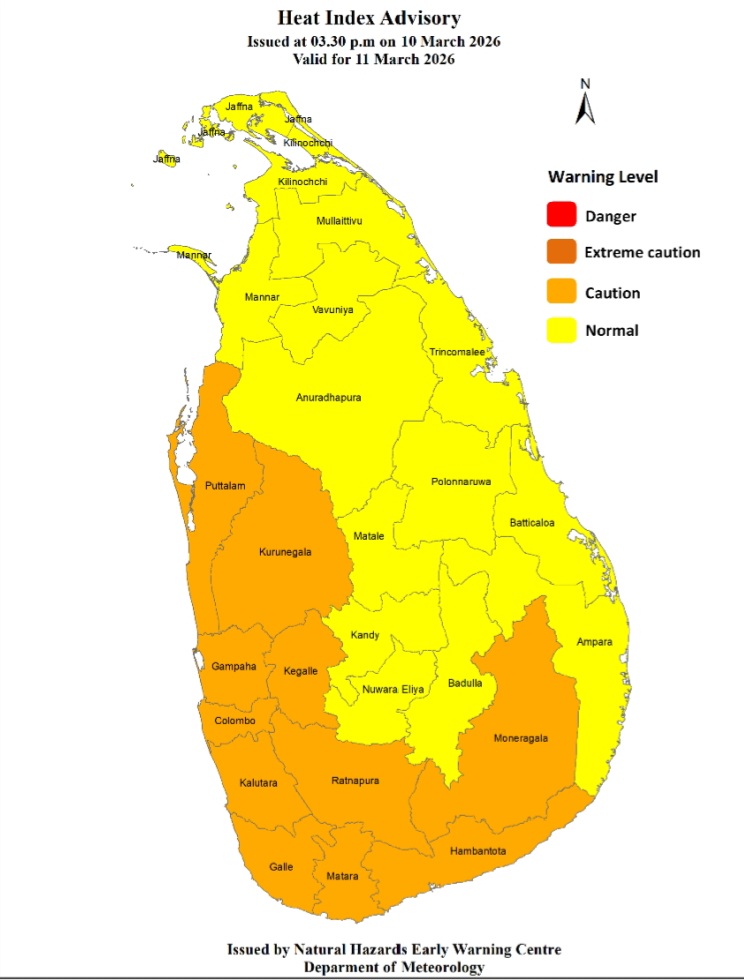
Warm Weather Advisory
Issued by the Natural Hazards Early Warning Centre of the Department of Meteorology at 3.30 p.m. on 10 March 2026, valid for 11 March 2026.
The public are warned that the Heat index, the temperature felt on the human body is likely to increase up to ‘Caution level’ at
some places in the Western, Sabaragamuwa, Southern and North-western provinces and in Monaragala district.
The Heat Index Forecast is calculated by using relative humidity and maximum temperature and this is the condition that is felt on your body. This is not the forecast of maximum temperature. It is generated by the Department of Meteorology for the next day period and prepared by using global numerical weather prediction model data.

Effect of the heat index on human body is mentioned in the above table and it is prepared on the advice of the Ministry of Health and Indigenous Medical Services.
ACTION REQUIRED
Job sites: Stay hydrated and takes breaks in the shade as often as possible.
Indoors: Check up on the elderly and the sick.
Vehicles: Never leave children unattended.
Outdoors: Limit strenuous outdoor activities, find shade and stay hydrated.
Dress: Wear lightweight and white or light-colored clothing.
Note:
In addition, please refer to advisories issued by the Disaster Preparedness & Response Division, Ministry of Health in this regard.
For further clarifications please contact 011-744649

Much of the centre of the German city of Dresden will be evacuated on Wednesday, after the discovery of a large unexploded British World War Two flying bomb.
The 250kg (551lb) device was discovered near the former Carola Bridge, which collapsed in the Elbe River in 2024.
The fire brigade in Dresden says this is the city’s largest evacuation to date for such an incident, affecting around 18,000 residents, tourists and commuters.
Much of the old town will be cordoned off by 09:00 (08:00 GMT), including some of the city’s most famous buildings – the iconic Frauenkirche Lutheran church, the Residenzschloss Palace and the Semper Opera.
The police headquarters, Saxony’s state parliament, several ministries, retirement and nursing homes, daycare centres and other social institutions are also located in the evacuated area.
The authorities are providing emergency accommodation at the Dresden Exhibition Centre from 07:00 (06:00 GMT), while additional buses and trams will be running to this location.
It is not clear how long it will take to defuse the bomb.
Dresden was attacked by British aircraft on 13 February 1945. In the days that followed, the British and their US allies dropped nearly 4,000 tons of bombs in the assault on the city.
The ensuing firestorm killed 25,000 people and ravaged the city centre, once known as the Jewel Box because of its Baroque and Rococo architecture.
Four other bombs were found during demolition work on the Carola Bridge last year.

(BBC)

Australia grants asylum to 2 more members of Iranian women’s football team

Showers are likely in the Northern, Eastern, Sabaragamuwa, Southern and Uva provinces and in Kandy and Nuwara-Eliya districts

CEBEU warns of operational disruptions amid uncertainty over CEB restructuring

Remittances up compared to last year before outbreak of war, but the economic picture is not rosy

The Netherlands alleges Russian Embassy interfering in World Press Photo Exhibition

Switzerland appreciates GoSL’s stand on ME situation

‘Dates have the highest sugar content to fight Coronavirus’

Sunday Island 27 December – Headlines

#SundayIsland 17th December – Headlines

Sunday Island – 28th March

Sunday Island Headlines – 21 March

Sunday Island – 21st February – Headlines
-
 News5 days ago
University of Wolverhampton confirms Ranil was officially invited
-

 News6 days ago
Legal experts decry move to demolish STC dining hall
-

 News5 days ago
Female lawyer given 12 years RI for preparing forged deeds for Borella land
-

 News4 days ago
Peradeniya Uni issues alert over leopards in its premises
-

 News2 days ago
Repatriation of Iranian naval personnel Sri Lanka’s call: Washington
-

 Business7 days ago
Cabinet nod for the removal of Cess tax imposed on imported good
-
 News5 days ago
Library crisis hits Pera university
-

 News4 days ago
Wife raises alarm over Sallay’s detention under PTA