
Latest News
At least 66 dead and dozens missing in Nepal floods

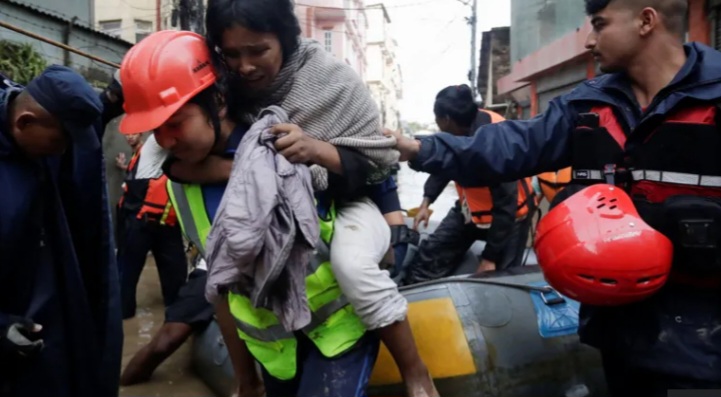
At least 66 people have died and 69 others are missing, officials say, after intense rainfall in Nepal caused flooding and landslides.
The death toll in the central Asian nation is likely to rise as the rains – which have predominantly affected the valley surrounding the capital, Kathmandu – are expected to persist through to Tuesday.
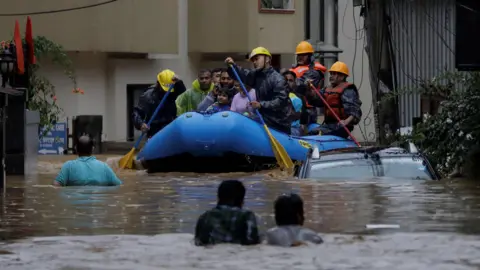
Thousands of homes situated near rivers have been flooded and most highways have been blocked, while video footage has emerged of people stranded on rooftops.
The volume of rainfall within a short timespan – over 200mm (7.9in) since Friday evening – has inundated almost all rivers in the Kathmandu valley, where many of the deaths have occurred.
Landslides have also caused a number of the fatalities.
Five people, including a pregnant woman and a four-year-old girl, died when a house collapsed due to a landslide in Bhaktapur, to the east of Kathmandu, state media reports.
Two bodies have been removed from a bus buried by a landslide in Dhading, west of Kathmandu. Twelve people, including the driver, were said to be onboard.
Six football players were also killed by a landslide at a training centre operated by the All Nepal Football Association in Makwanpur, to the south-west of the capital.
Others have been swept up in floodwaters.
In one dramatic scene, four people desperate to be rescued were washed away by the Nakkhu River in the southern Kathmandu valley.
“For hours, they kept on pleading for help,” Jitendra Bhandari, an eyewitness, told the BBC. “We could do nothing.”
Three of those people were rescued downstream, but one is still missing.
Hari Om Malla lost his truck after it was submerged by water in Kathmandu. He told the BBC that water had “gushed” into the cabin as the rain intensified on Friday night.
“We jumped out, swam, and got away from it – but my purse, bag and mobile have been swept away by the river. I have nothing now. We stayed the whole night in the cold.”
So far, more than 2,000 people have been rescued from floodwaters, while at least 200 houses have been damaged, according to the state-run Radio Nepal.
The Nepalese home affairs ministry said that as of Saturday, 60 people had been injured.
Private houses, offices, shopping centres, hospitals and police posts were seen inundated in videos posted in social media.
Government spokesperson Prithvi Subba Gurung told the state-run Nepal Television Corporation that the flooding had also broken waterpipes, and affected telephone and power lines.
According to state media, 10,000 police officers, as well as volunteers and members of the army, have been mobilised as part of search and rescue efforts.
The Nepalese government urged people to avoid unnecessary travel, and banned road travel at night in the Kathmandu valley to minimise road accidents.
Most highways – including the ones connecting Kathmandu valley with the rest of the country – have been blocked in several places.
Air travel was also affected on Friday and Saturday, with many domestic flights delayed or cancelled.
Monsoon season brings tragic floods and landslides every year in Nepal.
Scientists say, though, that rainfall events are becoming more intense due to climate change.
A warmer atmosphere can hold more moisture, while warmer ocean waters can energise storm systems, making them more erratic.
(BBC)


President Anura Kumara Dissanayake today (20) paid his last respects to the remains of Most Venerable Kappetiyagoda Siri Wimala Thera, Anunayake of the Sri Lanka Ramanna Maha Nikaya and Chief Incumbent of the Rajopawanaramaya Temple in Gatambe, Kandy, who passed away.
The President visited the Rajopawanaramaya Temple in Gatambe, Kandy, where the remains of the Thera are lying, and paid his last respects. He subsequently expressed his deepest condolences to the Maha Sangha and the temple’s Dayaka Sabha, who are mourning the passing of the Thera.
Central Province Governor and Consultant Physician Dr Harsha Suranga Fernando, Kandy District Secretary Indika Udawatta and several others were present.
President’s Media Division (PMD)

India opener Shafali Verma has received an official reprimand and a demerit point for breaching Level 1 of the ICC Code of Conduct during the second T20I against Zimbabwe on Sunday.
Shafali, an ICC release said, breached Article 2.2 of the ICC Code of Conduct for Players and Player Support Personnel, which relates to “abuse of cricket equipment or clothing, ground equipment or fixtures and fittings during an International Match.”
It was Shafali’s first offence in a 24-month period.
The incident occurred in the 12th over of Zimbabwe’s innings when Shafali threw the ball into the ground in frustration after dropping a chance at mid-off offered by Chipo Mugeri-Tiripano off Sree Charani.
Shafali admitted the offence and accepted the sanction proposed by match referee GS Lakshmi, which meant there was no need for a formal hearing.
Level 1 breaches carry a minimum penalty of an official reprimand, a maximum penalty of 50% of a player’s match fee, and one or two demerit points.
India currently lead the three-match series 2-0 with the third game to be played on Tuesday evening. The T20Is will be followed by three ODIs in Vadodara from October 23.
(Cricinfo)

A total of 146 players will be competing for 27 available slots in the WPL 2027 mini auction on October 28 in Kochi. Of these, England batter Sophia Dunkley and Australia captain Sophie Molineux are the only two players who have listed themselves at the maximum base price of INR 50 lakh.
The auction pool has 119 Indian players, including 22 capped and 97 uncapped players, with 20 slots available for Indian players. The overseas pool has 27 players – 14 capped and 13 uncapped – including six from Associate teams, with seven slots available.
G Kamalini (released by Mumbai Indians), Kiran Navigre (released by U P Warriorz), Heather Graham and Jess Jonassen have registered at the second-highest base price of INR 40 lakh, while a total of 30 players have registered at INR 30 lakh.
Among the notable absentees are West Indies allrounder Deandra Dottin, who was released by UPW, and Australia legspinner Alana King, who was released by Delhi Capitals. Lizelle Lee, who was DC’s highest run-scorer last season, has also not listed herself after being released by the franchise.
What the teams look like going into the auction
Only two English players – Dunkley and Kira Chathli (INR 10 lakh) – have registered for the auction, with several others, including Danni Wyatt-Hodge, Alice Capsey, Dani Gibson, Lauren Filer and Linsey Smith opting to skip the WPL next year.
Cricinfo has learned that England are likely to play three T20Is in Sri Lanka in early February, which will clash with the final week of the WPL. While the ECB is likely to allow players to stay in India to complete the tournament, most players have instead chosen to prioritise their international commitments ahead of the Champions Trophy later that month.
The relatively low salaries on offer at the WPL are also understood to be a factor in many English players deciding not to register, with most internationals earning significantly more to play in the Hundred (up to £190,000 last year) than the highest permitted base price in the WPL of INR 50 lakh (£40,000 approx).
Molineux was part of the Royal Challengers Bengaluru [RCB] title-winning squad in 2024, and had bagged 12 wickets in ten games at an economy rate of 7.31. She was retained by RCB for the 2025 season but a knee injury ruled her out of the season. Dunkley, meanwhile, played for Gujarat Giants [GT] in 2023 before opting not to register for the 2024 season. She went unsold in the 2025 auction.
Among the premier internationals who have listed themselves for INR 30 lakh are Australia allrounder Grace Harris (released by RCB), Sri Lanka captain Chamari Athapaththu, South Africa left-arm spinner Nonkululeko Mlaba and South Africa allrounder Chloe Tryon.
UPW, who released nine players, will go into the auction with the biggest purse of INR 3.75 crore.
[Cricinfo]

Import and Export (Control) Regulations No. 08 of 2026
Draft Bill of the Public Private Partnership Enterprises Act to be gazzetted
Amendment of the Ayurvedha Act No. 31 of 1961

Cabinet nod to amend the Sri Lanka Development Administration Institute Act No. 9 of 1982
Establishment of the National Higher Performance Centre
State patronage for the cremation ceremony of the late deputy prelate (Anu Nayaka Thero) of the Sri Laka Ramangya Maha Nikaya, Gatambe Rajopawanramadhipatha, Siri Chandawimala Wanshalankara, Chandrakeerthi Sri Amarawansha, Sadhdharmawageeshwara, Shasanashobhanna Most Venerable Keppetiyagoda Siriwimalabhidhana Thero

‘Dates have the highest sugar content to fight Coronavirus’

Sunday Island 27 December – Headlines

#SundayIsland 17th December – Headlines

Sunday Island – 28th March

Sunday Island Headlines – 21 March

Sunday Island – 21st February – Headlines
-

 Features3 days ago
Kotahena:A Small Enclave, An Extraordinary Legacy
-

 News7 days ago
Sri Lanka, India caught in US-Iran ship crisis
-

 News4 days ago
Asgiri Mahanayake calls for immediate release of Gnanasara Thera
-

 Latest News7 days ago
Missiles intercepted near Riyadh after Saudi coalition hits Yemen fuel depot
-

 Latest News7 days ago
Kusal Mendis’ unbeaten 87 hands Sri Lanka consolation win
-

 News3 days ago
Record 1,600 students take Russian Classical Ballet examination in Sri Lanka
-
 News6 days ago
AC President recuses himself from hearing prison attire case pertaining to Gnanasara Thera
-

 Latest News7 days ago
Heavy showers above 100 mm are likely at some places in the Western, Sabaragamuwa, Southern, Central, and North-western provinces and in Anuradhapura district.