
Editorial
Catching thieves


Thursday 29th August, 2024
The upcoming presidential race has reached feverish pitch, with the contestants therein hurling invectives and insults at one another, and making various promises. Some of them are seeking a mandate to have the corrupt thrown behind bars and usher in good governance.
The proverbial wisdom contained in the cliched saying, ‘It takes a thief to catch a thief’, is being questioned in Sri Lankan politics, where thieves co-operate to safeguard their interests.
The JVP/NPP as well as the SJB is contesting on an anti-corruption platform and vowing to bring the thieves of public resources to justice in case of being voted into office; the implication of this undertaking is that thieves are found only in the government camp. Shouldn’t the Opposition parties turn the searchlight inwards and put their own houses in order before embarking on chivalric missions to catch thieves?
The JVP/NPP never misses an opportunity to pillory the Rajapaksas for the theft of public funds and various malpractices. But it is the JVP that made their rise in national politics possible, thereby enabling them to gain access to the public purse and cut shady deals at the expense of the country. It spearheaded Mahinda Rajapaksa’s presidential election campaign in 2005, and if not for its all-out effort to ensure his victory vis-à-vis the then President Chandrika Bandaranaike Kumaratunga’s attempts to queer the pitch for him, he would not have won the presidency and his family would not have been able to do what the JVP accuses them of. The creator is responsible for what the creature does. It also had no qualms about closing ranks with the SLFP, which it condemned for corruption, to savour power in 2004. It inveighs against the UNP for abuse of power, Treasury bond scams, etc., but it defended Prime Minister Ranil Wickremesinghe’s government to the hilt in 2018 and supported that corrupt regime until the end of 2019 amidst the then President Maithripala Sirisena’s attempts to dislodge it.
The JVP committed armed robberies and various other crimes in the late 1980s. It staged numerous bank heists, robbed post offices, shops, etc., and plundered money, gold jewellery, and other valuables from the people it considered its enemies. Most of its gold and cash hoards have not been traced.
The SJB would have the public believe that catching the thieves of public wealth is at the top of its list of priorities, but it has among its ranks some former defenders of the Treasury bond racketeers. These shameless elements prevented the release of the first COPE (Committee on Public Enterprises) report on the Treasury bond scams, and watered down the second COPE report thereon with a slew of footnotes. Some of the SLPP crossovers currently backing the SJB have been accused of stock market rackets.
All the former UNP MPs in the SJB were in the corrupt Yahapalana administration, and they unflinchingly defended the UNP-led UNF government during what has come to be dubbed the 2018 constitutional coup. They too are facing various allegations of corruption. So much for the SJB’s report card!
It amounts to belabouring the obvious to say that the SLPP, the SLFP and the UNP are synonymous with abuse of power and corruption, and there is no gainsaying that the corrupt must be brought to justice.
Corruption has taken its toll on Sri Lanka’s economy, which is in crisis. The need to probe and prosecute the corrupt cannot be overstated; in fact, that task should be a top priority of the next government. But how advisable is it for the public to entrust a bunch of self-proclaimed anti-corruption campaigners, whose hands are not clean, with state power to rid the country of corruption, and make the corrupt pay for their sins?



Monday 8th June, 2026
Former Director of the State Intelligence Service Maj. Gen. (retd.) Suresh Sallay, currently being detained at the Criminal Investigation Department (CID) over the Easter Sunday terror attacks, has begun a hunger strike in protest against alleged inhumane treatment by CID officers. His wife has complained to Inspector General of Police (IGP) Priyantha Weerasuriya about the conditions of detention. She has told the media that Sallay is determined to continue his hunger strike. The police have denied mistreating Sallay.
Sallay has suffered physical and psychological abuse, at the hands of the CID, according to his lawyers. One of his counsel, Udaya Gammanpila, told the media on Saturday that Sallay was even denied proper meals, and the previous night the CID had served a small portion of rice with some gravy on a piece of newspaper placed on the floor of his cell. That had prompted Sallay to launch the hunger strike, Gammanpila said. Curiously, a notorious drug dealer, Nadun Chintaka alias Harak Kata, was allowed to consume food from the CID canteen while being detained at the CID.
Sri Lanka’s overcrowded, squalid remand prisons are hellholes, and even a brief stay there amounts to punishment, as is public knowledge. The same goes for the detention or holding cells at the CID headquarters. Degrading interrogation practices, including psychological coercion and physical abuse, aimed at breaking a suspect’s will, are antithetical to international good practices followed by modern crime investigators in civilised societies. Unfortunately, some officers of Sri Lanka police have used such cruel methods with impunity under successive governments. One may recall that a high-ranking police officer found guilty of having violated a suspect’s fundamental rights and the ban on torture was appointed IGP. Deshabandu Tennakoon is his name.
Allegations made by Sallay through his lawyers and family members against the police remind us of the horrors of the Spanish Inquisition, Nazi Straflager (punishment camps), Gestapo interrogation centres, the CIA black sites and the Batalanda torture chamber. Hence the need to do away with the draconian Prevention of Terrorism Act, which allows suspects to be detained indefinitely and made to undergo untold suffering in the name of interrogation.
A very serious allegation frequently levelled against Sri Lanka police is that they make arrests, detain suspects, and conduct investigations to support political motives rather than to establish facts impartially. Justice and public trust in the legal and judicial processes become the victims of the partiality, if not servility, of the police and some of the Attorney General’s Department personnel to the powers that be and their deplorable efforts to support popular political narratives about crimes.
The integrity of the ongoing CID investigation into the Easter Sunday terror attacks is severely compromised, for the JVP-NPP government has elevated a member of the NPP’s Retired Police Collective (NPPRPC), Shani Abeysekera, as the CID Director to probe the Easter Sunday terror attacks, which the CID itself failed to prevent while he was serving as its Director in 2019, when the current Public Security Ministry Secretary Ravi Seneviratne, also a member of the NPPRPC, was the Senior DIG in charge of the CID. All those who failed to prevent the carnage in spite of repeated warnings of the impending bomb attacks must be brought to justice. President Anura Kumara Dissanayake has caused quite a stir by making predictions about judgements to be delivered in court cases against his political opponents and drawn heavy criticism from the Bar Association of Sri Lanka and other lawyers’ associations for trying to raise the retirement ages of the superior court judges arbitrarily. How can the current dispensation be expected to uphold the rule of law, justice and fair play?
The denial of a suspect’s right to be heard, with the prosecutors, given to rehearsed, performative courtroom presentations, making various allegations designed to generate headlines and please the powers that be, violates the principle of natural justice. Justice must be served for the Easter Sunday terror victims, but without injustice to suspects in custody.

The US has acted decisively to rein in a runaway Executive, as it were. The House of Representatives has passed a resolution curbing President Donald Trump’s powers to attack Iran without congressional authorisation. Four Republicans joined Democrats to ensure the passage of the landmark bill in a vote of 215 to 208. However, the actual enforcement of this legislative measure will have to clear several hurdles, with the White House remaining determined to undermine it. But the Congress’s message to Trump is loud and clear. The War Powers resolution is bound to hang like the sword of Damocles above Trump’s head. The congressional action to keep the Executive in check is proof of institutional robustness, which helps safeguard the separation of powers, among other things, in the US.
Sadly, in Sri Lanka it is virtually impossible to restrain the Executive President, especially when his or her party has control over the legislature. The subservience of Parliament to the President largely owing to the numerical inferiority of the Opposition has created a situation where civil society organisations and professional associations have to lead a countervailing force against the Executive and help protect democracy.
The Bar Association of Sri Lanka (BASL) and the Colombo High Court Lawyers’ Association (CHCLA) have moved in to bolster the ongoing efforts to frustrate a questionable government bid to increase the retirement ages of the judges of the Superior Courts arbitrarily. They have issued well-reasoned statements opposing the proposed move.
Pointing out that the retirement ages of the judges of the Court of Appeal (CA) and the Supreme Court (SC) have been constitutionally fixed at 63 and 65, respectively, the two associations have very convincingly demolished all arguments for the proposed government move, stressing the need for the Executive to act with restraint. The Opposition has also put forth cogent arguments against the government bid at issue. Former Minister of Justice and Constitutional Affairs Prof. G. L. Peiris was perhaps the first to take up the issue and alert the public, and galvanise the lawyers’ associations, etc., into putting up stiff resistance.
The proposed move to extend the retirement ages of CA and SC judges has come as a surprise because there is no dearth of qualified judicial officers in this country. What the government ought to do urgently is to take action to fill all existing judicial vacancies, the CHCLA has said, pointing out that any attempt by the Executive or the Legislature to amend the constitutional provisions governing the retirement of judges, without a compelling rationale and without following the prescribed process, would constitute “an act of the gravest constitutional impropriety”.
It has warned that “the impact of an upward revision of the retirement ages of Judges of the Superior Courts will produce “immediate, concrete, and deeply unjust consequences for the dedicated officers of the Judicial Service of Sri Lanka, who have devoted their professional lives to the service of the administration of justice”. It goes on to argue that the proposed extension of the retirement ages of the Superior Court judges, in the absence of any transparent, constitutionally grounded, and publicly articulated justification could risk “the public perception that the Executive seeks to secure the continued service of particular Judges whose disposition may be regarded as favourable to the interests of the State in litigation before the Superior Courts”.
It is also deeply troubling that the proposed government move smacks of a sinister attempt to undermine the doctrine of the separation of powers. Having come to power, promising to abolish the executive presidency, the JVP/NPP should be ashamed of its deplorable attempts to enhance the executive powers of the President through questionable means. It has made a mockery of its commitment to upholding the independence of the judiciary and the separation of powers.
The government has chosen to remain silent on questions being raised about its deplorable move at issue. The only way President Anura Kumara Dissanayake can put the matter to rest is to do the following, as requested by the CHCLA: immediately withdraw and abandon the proposal to enhance the retirement age of the judges of the CA and the SC; direct the competent constitutional authorities to take immediate and decisive steps to fill all existing vacancies in the Superior Courts in accordance with the constitutional process and without further delay; affirm, by word and by deed, the government’s unequivocal commitment to the independence of the judiciary as guaranteed by the Constitution of Sri Lanka, and to the full and faithful observance of the constitutional provisions governing the tenure and conditions of service of the Judges of the Superior Courts, and engage the legal profession, the Judicial Service Commission, and other relevant stakeholders in any future discussion of matters affecting the judiciary, in a spirit of transparency, constitutionalism, and mutual respect for the rule of law. The BASL has also asked the President to deep-six any plan to raise the retirement ages of the judges of the Superior Courts and help preserve the integrity, independence and dignity of the judiciary and reinforce public confidence in the judicial service.
An immediate course correction, in line with the fervent appeals of legal professionals, is the least President Dissanayake can do to dispel the public perception that he too has failed to resist the autocratic tendencies embedded in the executive presidency.

Saturday 6th June, 2026
Tuesday’s tragedy at Anguruwatota, where a fire engulfed an elders’ home, claiming 13 lives and seriously injuring several others, has shaken the conscience of the nation. Equally shocking are the allegations that the residents of the care centre had been mistreated; among them were persons with disabilities, and some of them had been restrained with chains, according to eyewitnesses. The police have said they found the charred body of a resident in chains. It has now been revealed that the care home was not registered. The question is why the authorities did not take any legal action against it.
The Director of the gutted elders’ home has been remanded and the police will press charges against him. However, the Anguruwatota tragedy is not a problem that should be addressed in isolation. It should be examined in the context of a wider socio-economic issue.
There are other elders’ homes across the country, and they number about 250, according to media reports. They are run by a mix of government institutions, provincial councils, religious organisations, NGOs, and private operators. Some of them are reportedly under-resourced, and poorly-regulated. These institutions can accommodate only a fraction of the country’s elderly population needing assistance. Most of them, however, are basic residential care facilities rather than fully developed geriatric care centres, often functioning more as shelters than as medically supported long-term care institutions, which the country badly needs.
Sri Lanka has already reached a rapidly ageing phase of its demographic transition, with the proportion of citizens above 60 years increasing. About 18 out of every 100 Sri Lankans are aged 60 or above. This proportion has risen sharply from about 12.4% in 2012. It is doubtful whether successive governments have addressed this issue adequately, much less formulated a strategy to face challenges arising from an ageing population. This shift has placed increasing pressure on many families that are struggling to make ends meet and therefore cannot provide full-time care for their elderly members and relatives. Hence the need for policymakers to intensify their focus on structured elderly care for those without family support or social security.
While action is taken to ensure that the existing elders’ homes are run properly, it is incumbent upon policymakers to devise ways and means of facing the problems associated with an ageing population. Experts have pointed out that a national elderly care strategy to address these issues need to integrate several components. First, it should strengthen community-based care models that allow elders to remain in their homes for as long as possible, supported by home visits, mobile health services, and social workers. Second, it should develop a graded system of care homes, ranging from basic shelters to medically supported nursing facilities, all under proper regulatory supervision. It was a chronic lack of oversight and poor regulation that led to the Anguruwatota tragedy. Third, local government authorities should be formally involved in identifying vulnerable elders, coordinating welfare benefits, and ensuring minimum care standards at community level. Fourth, financial protection mechanisms such as social pensions, subsidised care, and public-private partnerships should be expanded to reduce the burden on low-income families.
It is hoped that Tuesday’s tragedy will jolt politicians and policymakers into addressing the long-felt need for a coherent national strategy to enable the elderly to spend their twilight years in comfort and dignity.

Confident Bangladesh pose Australia a fresh challenge after 15-year wait for an ODI series

Tehran calls off attacks on Israel; warns not to hit Lebanon

Philippines earthquake kills 15, prompts tsunami fears:

T20 World Cup: Heavyweights, hopefuls and a debutant headline Group 1

Showers in the Western, Sabaragamuwa and North-western provinces and in Galle, Matara, Kandy and Nuwara-Eliya districts

Diesel replacement costs up to Rs. 4.5 bn in April

‘Dates have the highest sugar content to fight Coronavirus’

Sunday Island 27 December – Headlines

#SundayIsland 17th December – Headlines

Sunday Island – 28th March

Sunday Island Headlines – 21 March

Sunday Island – 21st February – Headlines
-

 News7 days ago
Lankan duo emerge winners in Latin dance championship held in Blackpool, UK
-

 Latest News5 days ago
Kusal Mendis, Pathum Nissanka, bowlers put Sri Lanka 1-0 up
-

 News5 days ago
New US tariffs proposed on 60 countries, including Sri Lanka
-
 Features4 days ago
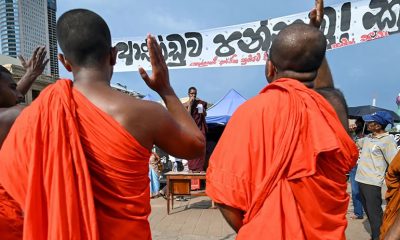
Power crept into the Sangha and is now tearing it apart
-

 News7 days ago
Sri Lankan teen killed in Chennai clash; three arrested
-

 Features4 days ago
Kondachchi wind farm and battery storage project to boost energy security, says Power Ministry Secretary
-

 Features4 days ago
Saudi Arabia sets new benchmark in Hajj management as 1.7 million pilgrims complete sacred journey
-

 News3 days ago
Asst. Manager, security officer arrested over Rs 30 mn snatch at Horana PB branch