
Foreign News
Pacific Islands leaders to meet as region faces ‘polycrisis’ of threats


The last time UN Secretary-General Antonio Guterres held a summit with the leaders of the Pacific Islands Forum, he made international news as he stood thigh-deep, dressed in a suit and tie, in the sea off the coast of Tuvalu.
“Our Sinking Planet”, read the headline on the cover of TIME magazine, as Guterres looked mournfully into the camera, warning of the existential threat facing the Pacific countries due to climate change.
Five years on, as the UN chief returns to the region for the 53rd Pacific Islands Forum (PIF) Leaders Meeting, the annual gathering of the region’s main political and economic grouping, there’s a growing sense of urgency as existential threats intensify on several fronts.
In June, Fiji Prime Minister Sitiveni Rabuka described the Pacific region as facing a “polycrisis”, saying climate change, human security, transnational drug trafficking, and geopolitical competition were reinforcing and exacerbating one another.
Pacific leaders will be expected to take action on these long-running issues at next week’s Leaders Meeting, as well as acute issues like the ongoing crisis in French overseas territory New Caledonia, when more than 1,000 international dignitaries descend on Nuku’alofa, Tonga’s tiny capital of 23,000, from August 26-30.
In April, Tonga’s Prime Minister Siaosi Sovaleni cautioned against inaction at the upcoming meeting, announcing that its theme would be “Build Better Now”. He also called for “tangible results and outcomes”, as well as for leaders to “move beyond policy deliberation to implementation”.
Sandra Tarte, an academic at the University of the South Pacific in Fiji who specialises in regional politics, said there were “a lot of ambitious things on the agenda” at the meeting.
“There’s a greater urgency around climate change, we also have a much deeper concern with the potential for escalating tensions between the US, China and other powers. Economically, countries are still recovering from COVID. There’s international drug trafficking too,” she told Al Jazeera.
If the region is to survive, it really needs something to drive their collective agenda and identity,” she added
That something, Pacific leaders wager, is the far-reaching 2050 Strategy for a Blue Pacific Continent
Endorsed by PIF members in 2022, the document, which tackles seven themes – including justice and equality, climate change, economic development, and geopolitical and security trends – has been touted as a master plan for the region. But it has also been questioned over its broad nature.
“It’s seen as the Pacific’s priorities that they want the rest of the world to recognise and engage with the region on,” Tarte said. “But, obviously, there are dangers with strategies like this that they become a bit of everything, and in the end mean nothing.”
With Prime Minister Sovaleni’s comments setting the tone, PIF leaders will be aiming to make tangible progress on implementing the Pacific 2050 strategy when they meet in Tonga.
The group’s 18 member states, mostly low-lying islands and atolls, sometimes just a few feet above sea level, are particularly vulnerable to climate change. Predicted rises in water levels are set to leave much of the region uninhabitable by the middle of this century.
Among their most ambitious mitigation efforts is the Pacific Resilience Facility (PRF), which aims to provide financial support to communities often overlooked by international donors. The “Pacific-owned and led” financial institution is scheduled to commence operations in 2025 and will help communities become more resilient to climate change and natural disasters.
The leaders will probably endorse an earlier recommendation to host the facility in Tonga at next week’s meeting, but raising the funding for the facility remains a major hurdle.
Pacific nations aim to raise $500m for the PRF by 2026 but have so far only secured $116m – $100m of which has been pledged by Australia, with the United States, China, Saudi Arabia and Turkey committing a total of $16m.

Guterres’s presence at PIF could help boost the fundraising campaign, according to Kerryn Baker, a research fellow in the Department of Pacific Affairs at the Australian National University.
“It’s a new approach to climate finance. It’s a Pacific-led approach, but it has been hampered by the fact that it hasn’t got the external funding it needs. The presence of Guterres will be important in drawing attention to that gap between ambition and capacity at the moment,” she told Al Jazeera.
Meg Keen, a senior fellow in the Pacific Islands programme at the Lowy Institute, also described Guterres’s attendance as “significant” in terms of drawing attention to the PRF on the international stage, saying “he has leverage”.
“The Pacific island countries have consistently said climate change is their biggest security issue. They’re now saying they want the PRF up and running,” Keen told Al Jazeera. “If you’ve got the UN secretary-general backing you up, that does build pressure for countries to put their money behind climate action.”
Also high on the summit agenda is drug trafficking. For decades, the vast and porous Pacific Islands have served as a stop on transnational narcotics smuggling routes from Asia and the Americas, the world’s largest producers of methamphetamine and cocaine, to Australia and New Zealand, the world’s highest-paying markets.
But excess supply and the development over time of lower-grade, cheaper drugs have fuelled local consumption. Countries such as Fiji have been especially badly hit, but it is an issue affecting the whole region, according to Keen.
“It’s on everybody’s mind, every country we go to is worried about drug trafficking. Police forces are really struggling to manage it,” she said.
“The Pacific is a transit place because it’s easy to move the drugs through. But it’s more than that now, because youth and local people are suffering from drug addiction. There’s an overflow from this drug trade and it takes a lot of collaboration. That’s where the Pacific Policing Initiative [PPI] could come in,” Keen added.

The PPI is a proposed Australian initiative to provide training and capacity-building to the Pacific island police forces. Its flagship programme would be the creation of a large training facility in Brisbane for Pacific officers who could then be deployed to regional crime hotspots.
Canberra has characterised the deal as a Pacific island-led operation set up in response to local needs in the face of rising crime. Its unofficial goal, analysts say, is to shore up Australia’s role as a key security partner at a time when Beijing is also developing bilateral law enforcement partnerships, with Chinese police training teams working in countries including the Solomon Islands and Kiribati.
Canberra will be hoping that Pacific leaders will give their political endorsement of the PPI, which carries a hefty price tag of more than 400 million Australian dollars (about $270m), at the Leader’s Meeting. But with concerns that it is covering the same ground as existing agreements, Tarte believes the PPI is “very much for show”.
“There’ll be some buy-in [at the Leaders Meeting], but I also know there’s a lot of tension about it as well,” Tarte said. “The criticism has been that it’s been developed without much consultation with the region, it may not be what the region needs, and it’s duplicating efforts already under way.”
Tarte said the PPI is “another example” of one of the Pacific’s major international partners “pushing something which is going to hugely suck up resources and may not have much benefit on the ground”.
“These projects are often driven by the wrong reasons. It’s about access, it’s about influence and it’s about control,” she said.
The Pacific region, long a place where major foreign powers have vied for influence, has only grown in strategic importance in recent years. Beijing has increased its engagement with Pacific island countries over the past decade, much to the chagrin of traditional security allies the US and Australia, who fear a Chinese military presence in the region.
Lamenting the Pacific’s growing role as a geostrategic arena, warning that the “chances of miscalculation are high” as a multitude of competing interests collide, Fiji’s Prime Minister Rabuka has announced his Oceans of Peace concept.
“An Ocean of Peace must reflect the Pacific way … Humility, quiet leadership, reconciliation and communication,” he said of his initiative. “Whoever enters the Pacific region will be compelled to tone down and tune in to the ways of the Pacific.”
Currently more aspirational idea than a solid plan, Rabuka has said he will bring his proposal for discussion at the summit with the hope it will eventually be adopted by Pacific countries. Baker of the Australian National University said the idea “seems to be getting quite significant traction”, but leaders will want “more clarity around what it means in practice”.
“If there’s any progress on developing this idea, it’ll have to come with specifics about what an Ocean of Peace might mean for the region, what issues are encompassed within that,” she said.
Fiji’s Oceans of Peace concept also speaks to a longstanding, but growing, desire among Pacific nations to escape a lens often imposed on the region, as merely a battleground for the great powers and assert some agency.
Keen said that Pacific leaders have raised concerns that an over-emphasis on geopolitics, particularly from outside parties, is “trumping development priorities”.
“In these forums, it has to be about Pacific Island development first, not about geopolitics,” she said. “They don’t want their region to be just a battlezone.”
One area in which the malign influence of external powers and the struggle for Pacific voices to be heard is still being acutely felt is the French overseas territory of New Caledonia, which has been a full member of the PIF since 2016.
Tensions there erupted in May over Paris’s plan to give the vote to more recent arrivals in a move Indigenous people fear will dilute their influence. The months of violence have resulted in deaths and billions of Euros in damage.
Keen says it is a regional security issue high on the agenda at next week’s meeting, but there are limits to what can actually be done. “They can express their concerns, but they can’t force action”, she says, as France claims it as a sovereign issue.
Pacific leaders won’t be silenced on it, they can really push that they have these concerns about colonisation and the desire for decolonisation sovereignty,” she said. “They want to know that the Pacific people will have a voice.”
(Aljazeera)

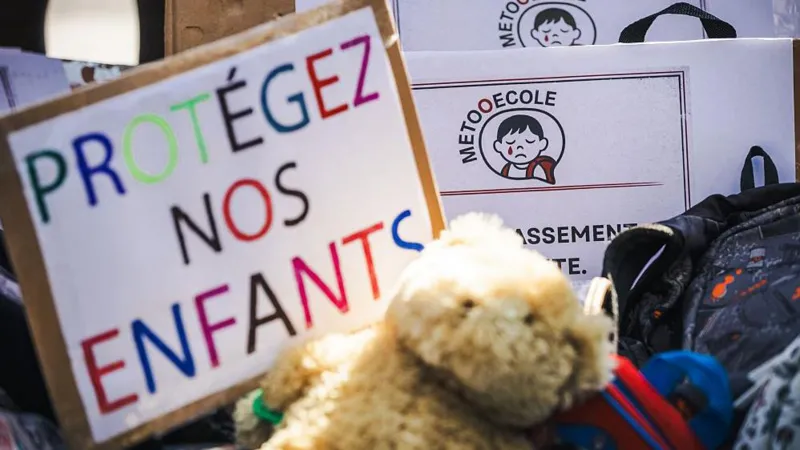
A school assistant was to go on trial in Paris on Tuesday accused of sexual mistreatment of young children in his care.
It is the latest case in a year-long scandal that has shaken the school system in the French capital, where some 15,000 such assistants – known as animateurs – are employed as non-teaching staff.
Currently enquiries are under way at nearly 100 Paris crèches, kindergartens and junior schools where animateurs have been accused of inappropriate, aggressive or sexualised behaviour.
Trials in three other cases are to take place over the summer, and a verdict is due in a fourth which was held earlier this month. More are likely to follow.
Last week police detained 16 people after a swoop at three schools in the 7th arrondissement or district. Three people were subsequently charged with sexually inappropriate behaviour to children.
Tuesday’s case centres on the Alphonse Baudin junior school in the 11th arrondissement, where the animateur is accused of sexualised touching with five children.
One man told the BBC that in April 2025 he had already spotted unusual signs in his four-year-old daughter when another parent reported that their child had been molested.
“My wife took our daughter into the garden and asked her if she had been touched in after-school time, and she said ‘Yes, David touches me and gives me cuddles.’
“My wife said, ‘Show me’, and my daughter started stroking her back in a bizarre way. That’s when we knew something was wrong.”

The scandal has created a climate of mistrust and fear among parents of young children in Paris, many of whom accuse the City Hall – which employs the animateurs – of failing initially to take the complaints seriously.
According to after-school association SOS-Périscolaire, the main problem has been the low quality of animateurs, who are poorly paid and at most need only a basic certificate in child management to get a job. Sometimes the pressure to recruit is so great that even that requirement is waived.
Elisabeth Guthmann, who founded the association in 2021, said it was in response to the growing number of stories circulating among parents about teasing, taunting and other types of low-level abuse by animateurs.
She cited a case of four animateurs at a junior school in the 16th arrondissement who “set up a fight-club with the other children standing around shouting ‘Hit him!'”.
The new mayor of Paris, Emmanuel Grégoire, has vowed to reform the recruitment system with €20m (£17.2m) for training and monitoring. He also said animateurs would be automatically suspended after a single complaint had been lodged. Since the start of the year nearly 80 have been suspended.
[BBC]
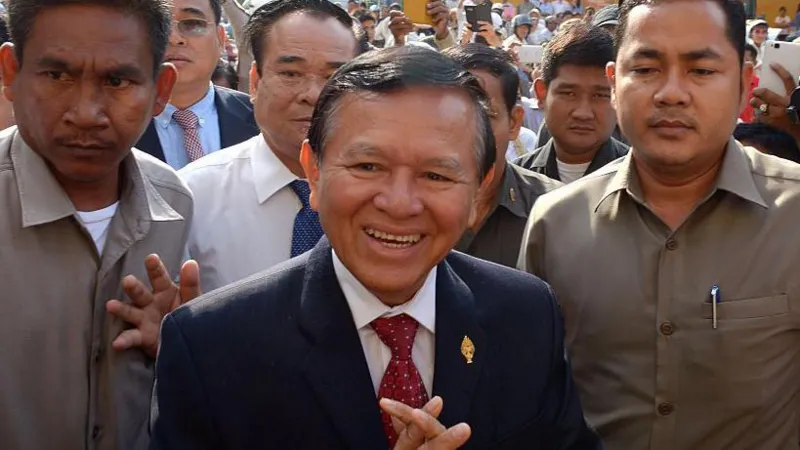
Cambodia’s former opposition leader Kem Sokha, who was serving a 27-year sentence for treason, has been pardoned, the country’s former prime minister said.
Hun Sen, who is currently Cambodia’s acting head of state, said he signed a decree pardoning Sokha on behalf of King Norodom Sihamoni.
Sokha, the former leader of the now-dissolved Cambodian National Rescue Party (CNRP), was first arrested in 2017 over a video where he said he had received support from US pro-democracy groups.
He has been held under house arrest since he was found guilty of treason in 2023. The charges have been widely derided as politically motivated by human rights groups.
Hun Sen posted on Facebook that Sokha had been “pardoned”, alongside a photo of the royal decree signed by him.
The pardon came after an appeal against Sokha’s sentence was rejected last month. But it did not include overturning a ban on the politician leaving Cambodia for five years.
Hun Sen, who ruled Cambodia for nearly four decades, has been accused of weaponising the country’s courts to target his opponents. He stepped down as prime minister in 2023 and handed power to his eldest son, Hun Manet.
However, Hun Sen still wields immense power in Cambodia and is acting head of state while King Norodom Sihamoni receives medical treatment abroad.
Sokha’s CNRP party came close to securing a shock victory in the 2013 general election victory over Hun Sen’s Cambodian People’s Party (CPP).
The opposition leader was arrested in 2017, less than a year ahead of the next general election, which the CNRP was banned from contesting.
[BBC]
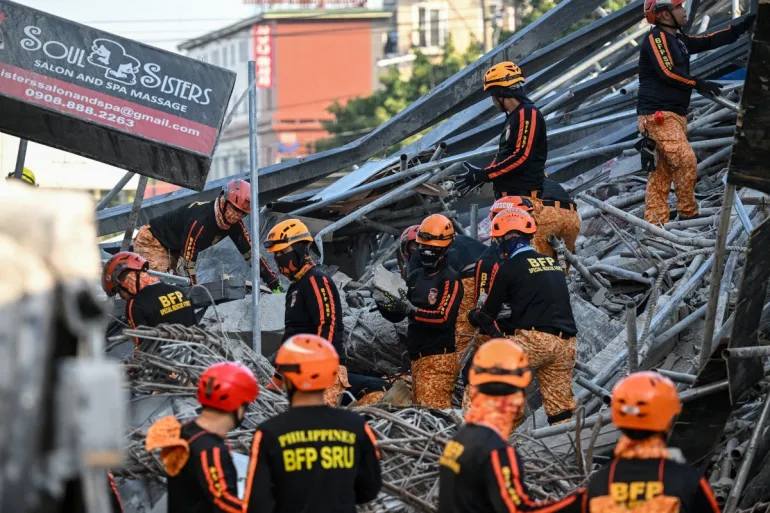
At least four people have been killed and 17 are missing after a building under construction collapsed in the Philippines, authorities say as search and rescue efforts are under way.
Rescuers retrieved at least three people on Monday from the rubble of the nine-storey building in the city of Angeles, north of the capital, Manila.
One of the victims had a pulse when he was retrieved but later died while another suffered cardiac arrest while still trapped, Maria Leah Sajili, an information officer at the Bureau of Fire Protection, said in a phone interview with the Reuters news agency.
Crews pulled the body of another person from the rubble, but it was not immediately clear if the unidentified body belonged to a person listed among the missing, rescuers said in an updated toll.
Due to that uncertainty, authorities said about 17 people were still considered missing, mostly construction workers who were sleeping at the building site when the disaster struck on Sunday.
The fourth person killed was a Malaysian tourist trapped in a budget inn, part of which was hit by an avalanche of debris from the collapsed building. Another guest at the inn was injured but managed to dash out, officials said.
At least 26 people have been rescued from the site.
Reporting from Angeles, Al Jazeera’s Barnaby Lo said hopes of finding more survivors were beginning to fade.
“Authorities are still saying the operation is a search and rescue. They will be using thermal detectors to try and find more signs of life, but if they don’t, they’re saying they will start using heavy equipment to clear the debris and retrieve people they believe are trapped under the rubble,” he said.
Officials said up to 70 people were employed at the construction site although most had gone home for the weekend.
[Aljazeera]

Patidar leads the way as Royal Challengers Bengaluru storm into second straight final

Kandy Royals sign Vijay Shankar for LPL 2026

Cabinet approves sale of Paddy stocks held by the Paddy Marketing Board
Amendment to the Promotion of Export Agriculture Act, No. 46 of 1992 to be gazatted
Ms. M.K.D.N. Madampe, appointed as Director General of the Department of Management Services

Cabinet approves collaboration agreement between Sri Lanka and Brazil for the implementation of the “Sugarcane Project in Sri Lanka”

‘Dates have the highest sugar content to fight Coronavirus’

Sunday Island 27 December – Headlines

#SundayIsland 17th December – Headlines

Sunday Island – 28th March

Sunday Island Headlines – 21 March

Sunday Island – 21st February – Headlines
-

 Features7 days ago
Octopus, Leech, and Snake: How Sri Lanka’s banks feast while the nation starves
-
 Sports7 days ago
Sri Lanka women’s volleyball team ready for Central Asian challenge
-
 Opinion6 days ago
Murder of Ehelepola family, Bogambara Wewa and Sightings of Wangediya
-

 Business5 days ago
Historic launch of CCWE Fashion Week & International Summit 2026
-
 News6 days ago
Steps underway to safeguard Sri Lanka’s maritime heritage
-
 News2 days ago
Police probe underway to ascertain links between criminals deported from UAE and local politicians
-

 Features3 days ago
The NPP’s pivot to the past
-

 News3 days ago
All-New GRAVITE launches at LKR 6.99 Mn