
Features
Snippets from Leonard Woolf’s Growing, with comments

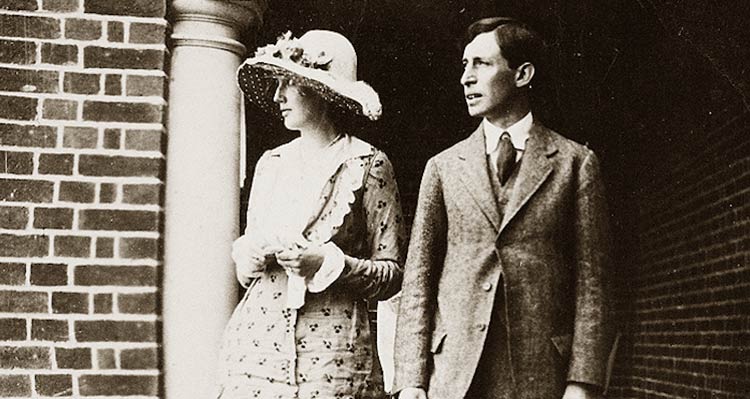
 I have been immersed and absorbed in the second volume of Leonard Sydney Woolf’s six volume autobiography from the first sentence onwards. Second time of reading but now with more discernment. Discussing this matter with Leelananda de Silva from whom I borrowed the book, I said I wonder whether it is because I admire this man and am a believer that British colonialism conferred more benefits to Ceylon than what we materially lost, unlike in India, or whether it is purely the writing skill of Woolf. Leelananda, who is of like opinion regards Brit governance of us, opined it was both.
It is apt to remember Woolf and his years as a British Civil Servant in Ceylon because he died on August 14, 1969, and we are now in the month of August. He was born November 25, 1880, to Jewish parents, his father being a barrister and Queens Counsel. Leonard is listed as political theorist, author, civil servant, publisher (his and Virginia’s Hogarth Press). He was of the Labour Party and Fabian Society. Studied in St Paul’s School and graduated from Trinity College, Cambridge.
After six years as an administrator of the British colony of Ceylon from 1905-11, he left the civil service, disillusioned by the way the British Raj governed its colony – Ceylon. He married Virginia Stephen who was a rising author in 1912 and last resided in Monk’s House, Rodmell, East Sussex, where she committed suicide in 1941.(Google Beautiful Simplicity and enjoy views of house and garden now within the National Trust). He was nominated Fellow of the Royal Society of Literature in 1965 but refused a Queen’s birthday honour.
To me, next to this marriage, in interest is the Bloomsbury Group of which he became a member. It was a gathering of writers, artistes and intelligent people formalized in 1905; meeting in the home of Vanessa, Virginia and brother Thoby Stephen, in Gordon Square, Bloomsbury. They shared ideas, supported each other’s creative activities and formed close friendships, even marriages as Vanessa married Clive Bell in 1907 and five years later Virginia. Woolf visited Sri Lanka in 1960 and expressed surprise and delight at the warm reception he received, and that he was remembered. It would have been then that he was invited as chief guest to the Trinity College, Kandy, prize giving.
Woolf has 19 publications to his credit: political treaties, journal articles, addresses and fiction – Village in the Jungle published 1913, which for long was considered the best novel in English of Ceylon/Sri Lanka. I mean here to only list the titles of the six volumes of his autobiography. Sowing (pub. 1960) which covers the period 1880 (birth) to 1904; Growing (1961) 1904 to 1911- his years in Ceylon; Diaries in Ceylon (1963) 1908 to 1911; Beginning Again (1964) 1911 to 1918; Downhill All the Way (1967) 1919 to 1939; and The Journey not the Arrival Matters (1969) 1939 to 1969.
Quotes and Comments from Growing
Woolf set sail in the P&O ship Syria in October 1904, at age 24: “I can remember the precise moment of my second birth. The umbilical cord by which I had been attached to my family, to St Paul’s, to Cambridge and Trinity was cut when, leaning over the ship’s taffrail, I watched… mother and sister waving goodbye …” The journey from Tilbury Docks to Colombo took three weeks. He describes other passengers and comments: “…we developed from a fortuitous concourse of isolated human atoms into a complex community with an elaborate system of castes and classes. The initial suspicions and reserve had soon given place to intimate friendships, intrigues, affairs, passionate loves and hates.”
He spent a fortnight in Colombo and on January 1, 1905, now a Cadet in the Ceylon Civil Service, was sent to Jaffna with a Sinhalese servant, his dog James brought over from UK and a wooden crate with his volumes of Voltaire, to Anuradhapura by train and then in a bullock cart called the ‘mail coach’ to Jaffna. This tedious stretch took two days and was through unending jungle. He began to love the solitude of the jungle. “One of the charms of the island is its infinite variety. In the north, east and south-east you get the flat, dry, hot low country … It is a land of silent, sinister scrub jungle or of great stretches of sand. Many dislike the arid sterility of this kind of Asiatic low country. But I lived in it for most of my time in Ceylon and it got into my heart and my bones, its austere beauty, its immobility and unchangeableness except of minute modulations of light and colour beneath the uncompromising sun; the silence, the emptiness, the melancholia, and so the purging of the passions by complete solitude.”
Writing about the people of his time he assesses them thus: “They (Tamils of Jaffna) have to work hard and they do work extraordinarily hard to make a living out of a stony, unsmiling and hot, not fertile soil. I came to like them and their country, though never as much as I like the lazy, smiling, well-mannered lovely Kandyans in their lovely mountain villages or the infinite variety of types among the Low Country Sinhalese in their large, flourishing villages or the poverty and starvation stricken villages in the jungle.”
He managed to catch the essence of the general personalities of the people who lived in the three major divisions of the country: northern peninsular and below, moving down the east coast to Hambantota; the Hill Country; and the western and southern wet zones. About the Kandyans he has nailed their characteristics; I would add naivete too! Not foolishness; though in my time in Kandy there was a village – Thumpané – known for its people’s imprudence or idiocy. Wasn’t the Mahadenamutta and/or his golayas from this village?
The Civil Service and Administration of then
The island was divided administratively to nine Provinces and each was divided into Districts, the number varying. Jaffna had two – Mannar and Mullaitivu. Each Province had its Government Agent – GA – very senior official with at least 20 years’ service. The head official in each district was the AGA, counting anything from six to 20 years. The GA had two directly under him: the Office Assistant and Cadet. In the main city of a Province the officers were divided into: administrative and judicial – Police Magistrate and District Judge, the former posts considered more prestigious. The GA reported to the Secretariat in Colombo which had the Second Assistant Colonial Secretary, the Second and the Principal Assistant Colonial Secy, all below the Colonial Secretary who reported to London.
I remember the structure was this in the 1940s when my brother was a first batch Divisional Revenue Officer, DRO, them having replaced the Rate Mahathayas. The DRO reported to the AGA of the District while being the administrative head of a Pathu. My brother wore many hats, even that of the police in the Demala Hath Pathu with his reporting Kachcheri in Puttalam. In Anamaduwa at that time the public servants were the DRO, Engineer and District Medical Officer – DMO. The system changed with independence and Parliament and Cabinet of Ministers. In 1957 though the nine Provinces remained as such, 21 Districts had GAs who reported to the Home Minister. The Ceylon/S L Administrative Service was established in 1962 replacing the Civil Service and saw the last of DROs.
People of then
In Growing, Woolf writes about the ‘imperialists’ in Jaffna; generalizing and also creating accurate word pictures of most. “Our society was exclusively white. In the conversations on the Jaffna tennis courts there was the same incongruous mixture of public school toughness, sentimentality and melancholy… Colonial government servants were displaced persons. People whose lives had suddenly been torn up by the roots, and, in a foreign country, had therefore become unreal, artificial, temporary and alien.” The officers in these Provinces had a daily routine of work, tennis, drinks (whiskey soda) and dinner at the club, or socially, mostly at the GA’s Residency or in their homes. A few succumbed to tuberculosis; many had warts in personality. But all had hard lives of privation. Woolf was rare in that he appreciated the country and its people, while most white administrators were disdainful and uncaring of the locals.
Speaking of the people who came to the kachcheri for various purposes, he writes: “I too, like everyone else, was at first irritated and contemptuous. But gradually these feelings began to evaporate.” He became fascinated watching the streams of locals walking along the corridors of kachcheries in Jaffna and Hambantota. He felt they were closer to primitive man. “They live so close to the jungle they retain something of the litheness and beauty of jungle animals. The Sinhalese seem to have subtle and supple minds. They do not conceal their individuality. Lastly, when you get to know them, you find beneath the surface in almost everyone a profound melancholy and fatalism which I find beautiful and sympathetic, extremely fascinating so that few things have ever given me greater pleasure than, when I had learned to speak Sinhala, sitting under a tree in a village or on the bund of a tank, discussing with them their interminable problems, disputes, grievances.”
Leonard Woolf was one white civil servant who empathized and even liked the locals he had to deal with officially. And thus his disillusionment of how the British ruled the colony Ceylon that grew and finally had him not return after his first furlough back home.



 Should Sri Lanka consider an 18th IMF programme? Some academicians exploring Sri Lanka’s development prospects in depth are raising this issue. It is yet to emerge as a hot topic among policy and decision-making circles in this country but common sense would sooner rather than later dictate that it be taken up for discussion by the wider public and a decision arrived at.
The issue of an 18th IMF programme was raised with some urgency locally by none other than Dr. Ganeshan Wignaraja,Visiting Senior Fellow, ODI Global London, one of whose presentations, made at the Regional Centre for Strategic Studies (RCSS), Colombo, was highlighted in this column last week, May 7th. An IMF programme is far from the ideal way out for a bankrupt country such as Sri Lanka but a policy of economic pragmatism would indicate that there is no other way out for Sri Lanka. Such a programme is the proverbial ‘Bird in the hand’ for Sri Lanka and it may be compelled to avail of it to get itself out of the morass of economic failures it is bogged down in currently.
While local economic growth possibilities are far from encouraging at present, such prospects globally are far from bright as well. Some of the more thought-provoking data in the latter regard were disclosed by Dr. Wignaraja. For example, ‘The IMF’s April 2026 World Economic Outlook projects global growth slowing to 3.1 percent in 2026; with downside risks dominating: prolonged conflict, geopolitical fragmentation, renewed trade tensions, bearing down hardest on emergent and developing economies.’
However, as is known, an ‘IMF bailout’ is fraught with huge risks for the people of a developing country. ‘The Silver Bullet’ brings hardships for the people usually and they would be required by their governments to increasingly ‘tighten their belts’ and brace for perhaps indefinite material hardships and discontent. For Sri Lanka, the cost of living is unsettlingly high and 20 percent of the population is languishing below the poverty line of $ 3.65 per day.
These statistics should help put the spotlight on the people of a country, who are theoretically the subjects and beneficiaries of development, and one of the main reasons, in so far as democracies are concerned, for the existence of governments. Placing people at the centre of the development process is urgently needed in the global South and shifting the focus to other considerations would be tantamount to governments dabbling in misplaced priorities.
Technocrats are needed for the propelling of economic growth but a Southern country’s main approach to development cannot be entirely technocratic in nature. The well being of the people and how it is affected by such growth strategies need to be prime focuses in discussions on development. Accordingly, discourses on how poverty alleviation could be facilitated need urgent initiation and perpetuation. There is no getting away from people’s empowerment.
In the South over the decades, the above themes have been, more or less, allowed to lapse in discussions on development. With economic liberalization and ‘market economics’ being allowed to eclipse development, correctly understood, people’s well being could be said to have been downplayed by Southern governments.
The development issues of Southern publics could be also said to have been compounded over the years as a result of the hemisphere lacking a single and effective ‘voice’ that could consistently and forcefully take up its questions with the global powers and institutions that matter. That is, the South lacks an all-embracing, umbrella organization that could bring together and muster the collective will of the South and work towards the realization of its best interests.
This columnist has time and again brought up the need for concerned Southern sections to explore the potential within the now virtually moribund Non-Aligned Movement to reactivate itself and fill the above lacuna in the South’s organizational and mobilization capability. In its heyday NAM not only possessed this institutional capability but had ample ‘voice power’ in the form of its founding fathers, with Jawaharlal Nehru of India, for example, proving a power to reckon with in this regard. The lack of such leaders at present needs to be factored in as well as accounting for the South’s lack of power and presence in the deliberative forums of the world that have a bearing on the hemisphere’s well being.
The Executive Director of the RCSS, Ambassador (Retd) Ravinatha Aryasinha, articulated some interesting thoughts on the above and related questions at a forum a couple of months back. Speaking at the launching of the book authored by Prof. Gamini Keerewella titled, ‘Reimagining International Relations from a Global South Perspective’, at the Bandaranaike Centre for International Studies, Colombo, Amb. Aryasinha said, among other things: ‘Historically, there is a precedent that has been realized by the Non-Aligned group of countries – unfortunately, rather than being reformed and modified at the end of the Cold War, it has been tossed away.’
The inability of the nominally existent NAM to come out of its state of veritable paralysis and voice and act in the name of the South in the current international crises lends credence to the view that the organization has allowed itself to be ‘tossed away.’ The challenge before NAM is to prove that it is by no means a spent force.
As indicted, NAM needs vibrant voices that could advocate value-based advancement for the global South. Moral principles need to triumph over Realpolitik. Such transformative changes could come to pass if there is a fresh meeting of enlightened minds within the South. Pakistan by offering to mediate in the ongoing conflict between the US and Iran, for instance, proved that there are still states within the South that could look beyond narrow self-interest and work towards some collective goals. Hopefully, Pakistan’s example will be emulated.
Along with Pakistan some Gulf states have shown willingness to work towards a de-escalation of the present hostilities in West Asia. This could be a beginning for the undertaking of more ambitious, collective projects by the South that have as their goals political solutions to current international crises. These developments prove that the South is not bereft of visionary thinking that could lay the basis for a measure of world peace. That is, there are grounds to be hopeful.
NAM needs to see it as its responsibility to make good use of these hopeful signs to bring the South together once again and work towards the realization of its founding principles, such as initiating value-based international politics and laying the basis for the collective economic betterment of Southern people.

 (The author is on X as @sasmester)
I have often been told by university colleagues how soulless and dangerous ‘artificial intelligence’ (AI) is to academia and humanity. They lament that students no longer read anything as they can now get various AI programmes to summarise what is recommended which is mostly in the English language to Sinhala or Tamil or get easier versions in English itself. They get their assignments and even dissertations fully or partially written by AI. And I am led to believe that universities do not have reliable detection software to assess plagiarism and academic fraud that have been committed using AI beyond the software freely available on the internet with their own limitations. This is due to financial restrictions in these institutions. Even these common malpractices have been done mostly with the aid of free AI programmes which are readily available, which means cheating in this sense is free and mostly safe. For teachers, this is a ‘menace’ in the same way ‘copying’ once was. But its implications are far worse.
But given the global investments made over AI, it cannot be wished away despite the enormous negative impact its use has on the environment, particularly due to its massive demand for energy. So, AI is with us to stay, and it has a considerable role to play in human civilisation even though like most innovations and inventions, this too carries its own burden of negativity. In this context, instead of demonising AI and lamenting its replacement of human agency and ingenuity, one needs to think seriously about how to deal with and engage with it reflectively and pragmatically as there is much it can offer if people are intelligent enough to make rational and sensible choices.
When I am making these observations, I am restricting myself to a handful of practices involving only writing both in university-based examination processes and in the fields of creative writing.
My initial introduction to AI was through the Research Methods class I used to teach in New Delhi. In 2022, this class was supposed to go to Dharmshala in Uttar Pradesh for fieldwork training, and we needed to write a funding proposal quickly. One of the students in the class, already familiar with ChatGPT introduced by OpenAI as a free programme in 2022, did the proposal with its help before the two-hour class was over. I edited it soon after and sent it off to the university administration for funding which we received. That stint of field work was completed in five days and was the most detailed work undertaken as a training programme up to that time in the university which had considerable output ranging from a documentary film to a detailed ethnography based on the findings.
While the technical details, the format of the proposal and its basic writing were done by AI due to the time constraints the class faced, its fine-tuning was done by me and a few students. AI could not then and even now cannot undertake that level of specificity without close human intervention. But the film, the ethnography and the actual process of research had nothing to do with AI. It was the result of human labour, thinking, planning and at times creativity and ingenuity. This was an early example of how AI could coexist in an academic environment if its technical usefulness was clearly understood and potential for excesses was also understood. But this was a time, easily accessible AI was just emerging, and we did not know much about it. But I was fortunate enough to have intelligent students in my class who gave me a crash course into this kind of AI use, which I followed up with my own reading and experimentation later on. As a result, I am keener now to see how it can be used for the betterment of academic practice rather than taking an uncritically demonising position, which I know will not lead anywhere.
But how is this possible? The lamentations of my colleagues about the abuse of AI in academic practice is not unfounded. It is a serious threat that remains mostly unaddressed not only in our country but almost everywhere else in the world too. This is mostly because the advancements of AI even in day-to-day free usage have far exceeded any thoughts for actionable codes of ethics to ensure its practice is sensible and ethical. At the same time, I cannot see why a student should not use AI to correct his spelling and grammar in assignments. I also cannot see why a student cannot seek AI’s help to secure research material from secondary sources available online which I have been doing for years. For instance, the originals of specific books and rare manuscripts might not be available in any repositories in our part of the world. In such situations, what AI might find us is all we have access to in a world where we are restricted in our mobility due to semi-racist visa regimes of failed empires and former superpowers as well as our own lack of ability to travel due to our own unenviable economic conditions. But unfortunately, the materials we need are often only available in research centers and libraries in those nations.
Similarly, when it comes to academic prose, it makes no sense now to take years to translate works from multiple languages to Sinhala and Tamil. This has always been a time-consuming, cumbersome and expensive process. Non-availability of Sinhala and English translations of core originals in languages such as English, French, German and so on has been a long-term problem for our country. But this can now be done well – at least from English to our languages – quite quickly and with a very low margin for error by using specific AI programmes which are meant to do precisely this. What this means is a quick expansion of knowledge in local languages which would have ordinarily taken years to achieve or might not have been possible at all. But still, this needs significant human intervention and time towards perfection. However, I do not think AI-based translations work as well for fiction and poetry or creative works more generally. But the ability for AI to emulate nuance and feeling in language is fast emerging. These are two clear examples of improving technical abilities in research and writing in which AI can be of help.
But looking for sources of information with help the help of AI or using it as a tool to undertake essential translations from one language to another is quite different from simply using it without ascertaining the accuracy of collected information, getting AI to do all your work without any reflection or without any hard work at all, including engaging AI to do the final product in a writing assignment — be that a term paper or a work of fiction. If one proceeds in this direction, as many unfortunately do nowadays, then, our ability to think and be creative as a species will become diminished over time and our sense of humanity itself will take a toll. This is what my colleagues worry about when they say AI is making younger generations soulless.
It is here that ethical practices on how to use AI responsibly without compromising our sense of humanity must play a central role. But these ethical practices must be formally written and taught, followed by viable programmes for detection and publication if unethical practices are followed. This needs to be the case particularly in teaching institutions as well as the broader domain of creative writing. After all, what is the fun in reading a novel or a collection of poetry written by AI?
It is time people began to think about what AI can do in their own fields without falling prey to its power and their own laziness. This brings to my mind Geoffrey Hinton’s words: “There is no chance of stopping AI’s development. But we need to ensure alignment; to ensure it is beneficial to us …” Similarly, as Yann LeCun observed, “AI is not just about replicating human intelligence; it’s about creating intelligent systems that can surpass human limitations.” In this sense, it is up to us to find our edge in creativity and common sense to find the most sensible way forward in using AI.
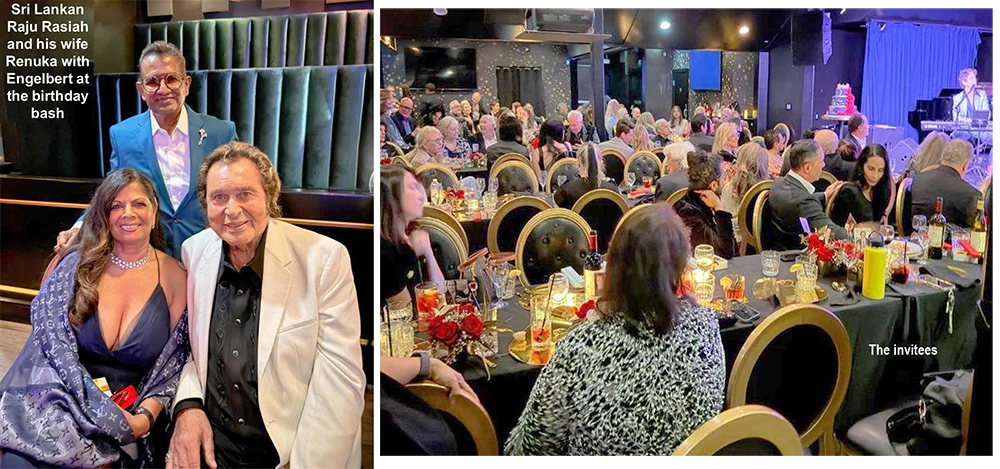
 The legendary Engelbert Humperdinck, who is known for his hit songs such as ‘A Man Without Love’, ‘Release Me’, ‘Spanish Eyes’, ‘The Last Waltz’, ‘Am I That Easy To Forget’, ‘Ten Guitars’ and ‘I Can’t Stop Loving You’, turned 90 on 02 May, 2026, and there were some lovely Hollywood-related celebrations.
Before his birthday, Engelbert’s new single ‘I’ve Got You’ was released – on 23 April – and Engelbert had this to say: “‘I’ve Got You’ is especially close to my heart. It speaks to love, loyalty, and the quiet strength we find in one another”.
The main birthday event was held at The Starlight Cabaret, in Los Angeles, California, and Sri Lankan Raju Rasiah, now based in the States, and his wife Renuka, who are personal friends of Engelbert, were invited to participate in the celebrations, along with Ingrid Melicon – also a Sri Lankan, now domiciled in America.
The invitation said “An evening of music, memories and celebration. Let’s make it a night to remember!” And it certainly turned out to be a night never ever to be forgotten!
Invitees experienced a “magical entrance” with Engelbert’s name lighting up the screen and showing him performing his hit songs.
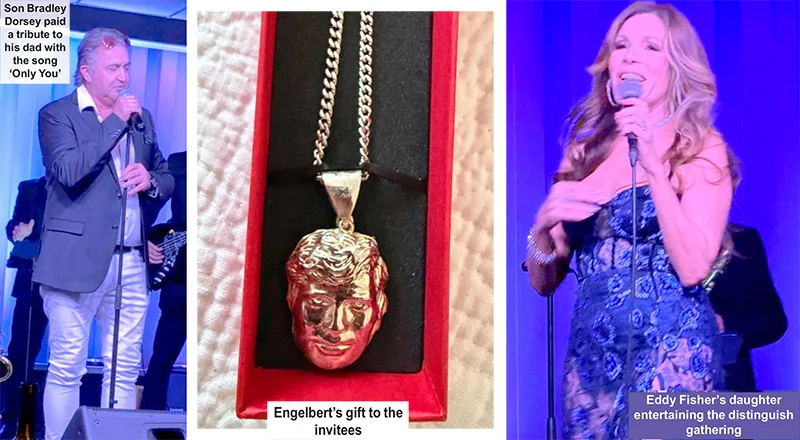
The invitees were also presented with a unique gift – a necklace with Engelbert’s face, engraved with the words “Remember, I Love You.”
Engelbert’s son, Bradley Dorsey, sang a tribute song ‘Only You’ for his dad, while Eddy Fisher’s daughters, Tricia and Joely, also got on stage to entertaining the distinguish gathering.
Engelbert didn’t perform but got on stage for the cutting of the birthday cake.
There was also a video compilation of birthday wishes from fellow celebrities, and the lineup included Gloria Gaynor, Micky Dolenz, Wayne Newton, Pat Boone, Lulu, Judy Collins, Deana Martin, Angélica María, Rupert Everett, Matt Goss, and more.

Birthday boy Engelbert Humperdinck
At 90, Engelbert is still performing. He’s on THE CELEBRATION TOUR for his 90th year, with over 50 international dates in 2026, including Australia, Germany, the US, and Canada. He’ll be at Massey Hall in, Toronto, on 06 October, 2026. He said: “The stage is my home… Canada has always been a highlight”.
He performed 60+ concerts, worldwide, in 2025, and says karaoke keeps his songs fresh: “Most of my songs are on karaoke because people love to sing them”.

‘Watermelon deaths’ in Mumbai puzzle investigators

Mass sex abuse allegations force closure of boarding school in Indonesia

Gunshots fired in Philippine Senate where lawmaker wanted by ICC is holed up

Kohli’s ninth IPL hundred powers Royal Challengers Bengaluru to the top

Special Coordination Committee meeting for Badulla District chaired by the President

Showers or thundershowers will occur at times in the Western, Sabaragamuwa, Central, Southern, North-western and Northern provinces

‘Dates have the highest sugar content to fight Coronavirus’

Sunday Island 27 December – Headlines

#SundayIsland 17th December – Headlines

Sunday Island – 28th March

Sunday Island Headlines – 21 March

Sunday Island – 21st February – Headlines
-

 News4 days ago
Lanka Port City officials to meet investors in Dubai
-
 News1 day ago
Ex-SriLankan CEO’s death: Controversy surrounds execution of bail bond
-

 News5 days ago
SLPP expresses concern over death of former SriLankan CEO
-

 Editorial6 days ago
The Vijay factor
-
 News5 days ago
Police inform Fort Magistrate’s Court of finding ex-CEO of SriLankan dead under suspicious circumstances
-
Features2 days ago
High Stakes in Pursuing corruption cases
-
 Features2 days ago
When University systems fail:Supreme Court’s landmark intervention in sexual harassment case
-
 Features6 days ago
Palm leaf manuscripts of Sri Lanka – 1