
News
Applications for TAGS awards now open

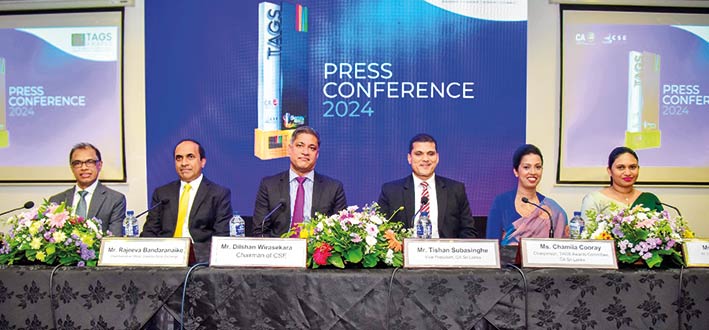
The Institute of Chartered Accountants of Sri Lanka (CA Sri Lanka) last week announced the commencement of the acceptance of applications for the prestigious TAGS Awards 2024, celebrating excellence in corporate reporting for the 59th year. A beacon of innovation and best practices in financial and non-financial reporting, the TAGS Awards will culminate in a grand ceremony on 12th December 2024 at the Shangri-La Hotel, Colombo.
The TAGS Awards, (which stand for Transparency, Accountability, Governance, and Sustainability), formerly known as the Annual Report Awards, held since 1964, continue their legacy in celebrating and recognizing organisations that excel in both financial and non-financial reporting. The competition is open to a wide range of entities, including multinationals, blue-chip companies, conglomerates, SMEs, NPOs, NGOs and other entities that produce annual reports.
“The Digital Edge – Enriching Corporate Reporting Excellence,” the theme for the 2024 TAGS Awards, underscores the transformative potential of AI and digital innovation in corporate reporting.
The official announcement was made at a press conference which was attended by CA Sri Lanka Vice President Tishan Subasinghe, Chairperson of the TAGS Awards Committee Chamila Cooray, and Alternate Chairperson of the TAGS Awards Committee Nishani Perera.
During the press conference, the Colombo Stock Exchange (CSE) officially joined as the Strategic Partner of the TAGS Awards 2024, in the presence of its Chief Executive Officer, Rajeeva Bandaranaike and Chairman, Dilshan Wirasekara.
The application period runs from 30th July 2024 to 31st August 2024. Eligible organisations include those producing annual reports for the financial year ending on 31st December 2023, or 31st March 2024. The competition will recognize companies across 29 industry sectors, plus a newly introduced category for non-listed companies with export revenue exceeding USD 50 million.
The top-performing annual reports will receive the prestigious OVERALL EXCELLENCE IN CORPORATE REPORTING awards – gold, silver, and bronze. Additionally, companies will be acknowledged in four special award categories: Corporate Governance Disclosure, Sustainability Reporting, Integrated Reporting, and Digital Transformation.
This year, an AI model supports the judging panel to increase the efficiency and the precision of the evaluation process. Please refer details by accessing www.ara.casrilanka.org.
The TAGS Compliance Badge, launched last year, will also be awarded to winners. It signifies an organization’s commitment to improving corporate reporting excellence. It can be viewed under company profiles www.cse.lk, promoting brand recognition and stakeholder engagement.
CA Sri Lanka Vice-President Tishan Subasinghe read out a statement by Heshana Kuruppu, President of CA Sri Lanka, that emphasized the strategic importance of corporate reporting, “In today’s data-driven world, corporate reporting transcends compliance, serving as a tool for communicating an organisation’s performance, impact, and vision. CA Sri Lanka remains committed to guiding businesses towards responsible practices that address broader societal and environmental impacts all while continuing to focus on digital innovation and transformation. From streamlining processes, to enhanced accuracy, and improved compliance, the financial world is embracing the AI revolution. It must be noted that corporates must be more mindful in establishing data ethics policies and IT governance frameworks to ensure responsible data management in finance reporting.



The Ministry of Industries and Entrepreneurship Development has recommended the establishment of Sri Lankan Standards, i.e. the import testing methodology for imported tires used for passenger cars and pneumatic tires for three-wheelers with the aim of ensuring a fair competitive environment for local
manufactures and ensuring consumer safety and security.
Taking into the said recommendations, “Import and Export (control regulations N0.08 of the 2026)” has been enacted to amend the existing regulations by means of the Extraordinary Gazette Notification No. 2508/27 dated 2026-10-01, prescribing Sri Lanka standard 1212 for the import of passenger types (HS Code 4011.10.90) and Sri Lanka standard 1347 for the import of
pneumatic tires for three – wheeled vehicles (HS Code 4011.90.10).
Accordingly, the Cabinet of Ministers has approved the resolution furnished by the President in his capacity as the Minister of Finance, Planning, and Economic Development to submit the aforementioned regulations to Parliament for approval.
Approval of the Cabinet of Ministers was granted at their meeting held on 02.06.2025 to introduce a new act to promote and providing legal provisions for facilitating the Public Private Joint Enterprises within Sri Lanka as well as the establishment of the National Agency for Public Private Partnership Joint Enterprises.
Accordingly, the Legal Draftsman has formulated the relevant draft bill and the Attorney General has given his clearance to the said draft bill.
The Cabinet of Ministers approved the resolution furnished by the President in his capacity as the Minister of Finance, Planning and Economic Development to publish the said
draft bill in the government gazette notification and thereby submit it to the Parliament for its concurrence.
Regulation, development and control of indigenous medical sector in Sri Lanka comprised of Ayurvedha, Sidhdha, Unani, Local Therapies are carried out under the provisions of Ayurvedha Act No. 31 of 1961.
Although amendments were made to the act from time to time as per the requirements, the necessity of further amending the Ayurvedha Act has been identified to enable efficiently maintaining all activities of local medical field productively, further formalizing the regulation of the sector, taking actions to providing licenses applicable to export of local medicines, and achieving the progress and sustainable development goals in the local medical sector.
Based on the said factors, the Cabinet of Ministers granted approval to the resolution furnished by the Minister of Health and Mass Media to direct the Legal Draftsman to formulate a draft bill to amend the Ayurvedha Act No. 31 of 1961.

Import and Export (Control) Regulations No. 08 of 2026
Draft Bill of the Public Private Partnership Enterprises Act to be gazzetted
Amendment of the Ayurvedha Act No. 31 of 1961

Cabinet nod to amend the Sri Lanka Development Administration Institute Act No. 9 of 1982
Establishment of the National Higher Performance Centre
State patronage for the cremation ceremony of the late deputy prelate (Anu Nayaka Thero) of the Sri Laka Ramangya Maha Nikaya, Gatambe Rajopawanramadhipatha, Siri Chandawimala Wanshalankara, Chandrakeerthi Sri Amarawansha, Sadhdharmawageeshwara, Shasanashobhanna Most Venerable Keppetiyagoda Siriwimalabhidhana Thero

‘Dates have the highest sugar content to fight Coronavirus’

Sunday Island 27 December – Headlines

#SundayIsland 17th December – Headlines

Sunday Island – 28th March

Sunday Island Headlines – 21 March

Sunday Island – 21st February – Headlines
-

 Features3 days ago
Kotahena:A Small Enclave, An Extraordinary Legacy
-

 News7 days ago
Sri Lanka, India caught in US-Iran ship crisis
-

 News4 days ago
Asgiri Mahanayake calls for immediate release of Gnanasara Thera
-

 Latest News7 days ago
Missiles intercepted near Riyadh after Saudi coalition hits Yemen fuel depot
-

 Latest News7 days ago
Kusal Mendis’ unbeaten 87 hands Sri Lanka consolation win
-

 News3 days ago
Record 1,600 students take Russian Classical Ballet examination in Sri Lanka
-

 News6 days ago
AC President recuses himself from hearing prison attire case pertaining to Gnanasara Thera
-

 Latest News7 days ago
Heavy showers above 100 mm are likely at some places in the Western, Sabaragamuwa, Southern, Central, and North-western provinces and in Anuradhapura district.