
Latest News
Biles wins all-around title for sixth Olympic gold

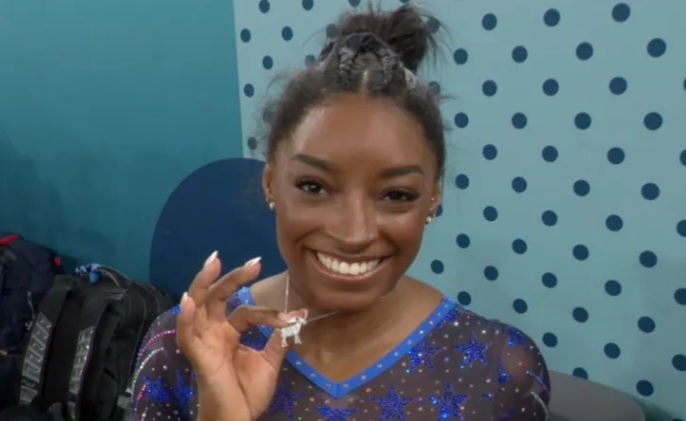
Simone Biles won the all-around gymnastics title for her second Olympic gold in Paris and sixth overall to cement her place back at the top of her sport with yet another sparkling slice of history.
The American, who won the title at Rio 2016 and had been favourite at Tokyo 2020 before she pulled out became the oldest winner of her sport’s blue-riband event for 72 years in front of another celebrity-studded crowd.
Brazil’s Rebeca Andrade claimed silver at the Bercy Arena, with defending champion Sunisa Lee taking bronze.
The world’s most decorated gymnast, Biles put on a sparkly goat necklace while celebrating – as if there was any doubt about her status as the GOAT (greatest of all time).
“It’s a little ode… a lot of people love it. They always call me the GOAT, so I thought it would be really special if I got one made,” she said.
“The haters hate it, but I like that even more. It’s just a special part of me that I have here.
“In the athletes’ village I have a stuffed goat. Just to get a reminder, like ‘You can go out there, you can do it. You’ve done it before. So let’s go’.”
At the age of 27, Biles is the first gymnast to win non-consecutive all-around Olympic titles – a demonstration of her longevity in a gruelling sport traditionally dominated by teenagers.
The past 12 Olympic all-around women’s champions were teenagers, and even the last non-teen, Ludmilla Tourischeva, had turned 20 only a few weeks before she won in 1972.
Biles’ intention was clear from the outset of Thursday’s session.
Starting with her ‘Biles II’ vault – the hardest in women’s gymnastics – proved a good decision as she needed that extra buffer of points when she made an uncharacteristic mistake on the uneven bars.
“Thank God we did the double pike today [on vault] as I wasn’t planning on it,” she said.
She was behind Andrade after two rotations but pulled off a difficulty-packed beam routine, fighting off gravity to stay on the 10cm-wide apparatus, to score 14.566 and bring the crowd to their feet as she went back to the top of the standings.
Taking a lead of 0.166 into the final rotation on floor, Biles was last to perform and delivered a flawless demonstration of some of her best skills to post a total of 59.131.
That meant she finished a comfortable 1.199 ahead of Andrade, who could only applaud and enjoy what her rival had done, as did everyone else in the packed arena.
Biles helped the United States reclaim the team title two days ago, but Thursday evening was about her trying to once again take the prize of world’s best gymnast after the turbulence of Tokyo.
The pressure of expectation she faced going into the Games three years ago, her struggles without her family there because of the pandemic restrictions and her withdrawal from several finals when she suffered the disorientating mental block that gymnasts call the ‘twisties’ are all well-documented.
Biles, who returned to the sport after a two-year break last summer, told reporters she had weekly therapy sessions for the past three years and at other times during these Games.
“It means the world to me,” she said of her victory.
“I’m super proud of my performance and the fight that I’ve had for the last three years – mentally and physically – just to get back.”
But she did not have the easiest ride to gold, saying: “I’ve never been so stressed before – thank you Rebeca.”
She went as far as to say she never wanted to compete against the Brazilian again, although that will be hard in Paris as they have both qualified for the vault, beam and floor finals.
“I’ve never had an athlete that close – it definitely put me on my toes and brought out the best athlete in myself,” she said of Andrade, who was also the silver medallist in Tokyo.
A huge gasp sounded round the arena – where Kendall Jenner and basketball star Stephen Curry were among those attending – when she made a mistake when making a transition to the lower bar, needing to bend both knees to avoid touching the ground, and missed a connection to score 13.733 on uneven bars.
But that is traditionally the ‘weakest’ of her four pieces – and after some quick reassurance from her husband that she could still win she made up ground and stretched ahead with 14.566 on beam and 15.066 on floor.
Biles has said she does not keep count of her statistics; instead saying it is all about going out there and doing what she loves.
It could be said, of course, that with so many records, it actually is genuinely hard to keep track. Although she did correct someone at the news conference who said she had nine Olympic golds rather than nine medals.
This final alone was historic; it was the first time two female Olympic all-around champions had gone head-to-head for a second title, with Biles facing team-mate Lee – the Tokyo 2020 gold medallist.
Biles was already the most decorated gymnast coming into the Paris Games.
Her tally of world and Olympic medals stood at 37 – and she has now taken that to 39, with chances to add to it in the floor, beam and vault finals in the coming days.
With the team gold on Tuesday that took her to eight Olympic medals, she overtook Shannon Miller as the most decorated American Olympic gymnast – and she has now made that nine.
Biles also holds the record for most women’s all-around world titles (six) and most World Championships medals (30).
She had the chance to set another record on Thursday – had she performed a new skill on bars that she had submitted to the International Gymnastics Federation she would have been the only active gymnast to have skills named after her on all four apparatus.
But she did not attempt it – and did not need to since her arsenal of other unique and high-value skills were more than enough to seal the gold.
When does Simone Biles compete next?
She is in the vault final on Saturday (15:20 BST), then the beam (11:38 BST) and floor (13:23 BST) finals on Monday.
(BBC)

Latest News
Showers above 100 mm are likely at some places in the Western, Sabaragamuwa, Central, Uva and Southern provinces and in Anuradhapura district

WEATHER FORECAST FOR 08 OCTOBER 2026
Issued at 05.30 a.m. on 08 October 2026 by the Department of Meteorology
Misty conditions can be expected at some places in the Western, Sabaragamuwa, Central and Uva provinces and in Galle and Matara districts during the early hours of the morning.
Showers or thundershowers will occur in the most part of the island after 1.00 p.m. Heavy showers above 100 mm are likely at some places in Western, Sabaragamuwa, Central, Uva and Southern provinces and in Anuradhapura district.
The general public is kindly requested to take adequate precautions to minimize damage caused by temporary localized strong winds and lightning during thundershowers.

Former first lady Shiranthi Rajapaksa, wife of former President Mahinda Rajapaksa was produced before the Hulftsdorp court, after being arrested by officers of the Commission to Investigate Allegations of Bribery or Corruption (CIABOC) and produce

Smriti Mandhana has been named India’s all-format women’s captain on the same day Harmanpreet Kaur stepped down from the role after nearly a decade since she first took over.
Mandhana – vice-captain to Harmanpreet for much of this period – has previously led India in four ODIs and 18 T20Is, apart from captaining Maharashtra in domestic cricket and Royal Challengers Bengaluru in the Women’s Premier League.
Mandhana’s first assignment will be the limited-overs series against Zimbabwe beginning with the three T20Is in Raipur from October 16. On Tuesday, Mandhana was part of the selection meeting chaired by Amita Sharma to pick the squad for the tour.
Terming the appointment a “special honour”, Mandhana also acknowledged the contributions of her predecessor in her welcome note.
“I would also like to acknowledge Harmanpreet and the contribution she has made as captain over the years,” she was quoted as saying by the BCCI. “She has led the team with great commitment and has been an important part of our journey.
“I understand the responsibility that comes with this role and look forward to working with the team, learning along the way and giving my best to take Indian cricket forward.”
Mandhana’s appointment comes on the back of a review meeting held on Monday in Guwahati. Chaired by secretary Devajit Saikia, the meeting was also attended by Mandhana, Harmanpreet and head coach Amol Muzumdar to chart a roadmap forward, with an eye on next year’s inaugural Women’s Champions Trophy in February as well as the T20 World Cup and Los Angeles Olympics in 2028.
Mandhana, India’s best all-format batter, has been knocking on the doors for a while. Earlier this year, she led RCB to their second WPL title, in which she also top-scored in the final.
In September, she overtook Mithali Raj to become the leading run-scorer in women’s international across formats. Her 18 international hundreds are also the most in women’s cricket. She is also the first Indian woman to score centuries in all formats.
[Cricinfo]

Showers above 100 mm are likely at some places in the Western, Sabaragamuwa, Central, Uva and Southern provinces and in Anuradhapura district

PSTA worse than PTA: FSP

Shiranthi R remanded until 13 Oct.

Former NSB Chairman Kariyawasam granted bail

Katchatheevu row: India SC urges fishermen to avoid Sri Lankan waters

Remembering Juvenal, Coke, Acton and Machiavelli

‘Dates have the highest sugar content to fight Coronavirus’

Sunday Island 27 December – Headlines

#SundayIsland 17th December – Headlines

Sunday Island – 28th March

Sunday Island Headlines – 21 March

Sunday Island – 21st February – Headlines
-

 Editorial7 days ago
Colombo Port drug bust: The plot thickens
-

 Features5 days ago
The first woman in the foreign service or Ceylon Overseas Service it was then called
-

 Editorial6 days ago
Fuelling discontent and protest
-

 News4 days ago
Geneva takes up Sallay’s case and govt. ignores opportunity to answer accusations
-

 Foreign News5 days ago
Ten injured after car crashes into rugby supporters in Australia
-

 Latest News6 days ago
Tharindu Rathnayake, bowlers secure Asian Games Bronze for Sri Lanka
-

 News5 days ago
Nearly 20 Iranian tankers stranded off Lanka amid US sanctions
-

 Features4 days ago
Sri Lanka Cricket Bill: Governance reform is not yet a cricket strategy