
Latest News
Paris set for its first Olympics in 100 years


It is the first time in 100 years that the French capital has hosted the summer Games, with the majority of the events taking place in or around the city’s most iconic areas.
Today’s opening ceremony will see boats carry athletes and dignitaries down 6km of the River Seine, with room for 300,000 spectators.
Few details are known about the event – though there has been speculation about Celine Dion and Lady Gaga performing – with the ceremony’s artistic director Thomas Jolly saying he wants to “show France in all its diversity”.
The Paris Games is the first to achieve gender parity among athletes,arn with 5,250 male and 5,250 female athletes set to compete.
With millions expected to attend the Games, Paris is making the final touches for a Games it hopes will be like no other.
French President Emmanuel Macron said earlier this week that the country was “ready and we will be ready throughout the Games”.
However, some Parisians have used social media to warn people about issues such as overcrowding, price inflation and difficulties in getting around the city.
There is a huge security operation in place, with up to 5,000 police, soldiers and hired guards on patrol at any one time. The Seine – the river than runs through the centre of Paris – has been fenced off for the opening ceremony, leaving residents needing QR codes to access certain areas.
That has affected local businesses along the Seine, leading to some criticism but. French authorities say the barricades will be removed after Friday’s event.
The cost of this year’s Games is expected to be about 9bn euros (£7.6bn), with the organising committee promising to make it the greenest Olympics in history.

Only two arenas are new and purpose-built – an aquatics centre and an arena for badminton and rhythmic gymnastics.
Other iconic venues such as the Stade de France – the national stadium – and French Open tennis venue Roland Garros will host events, alongside historic sites such as the Grand Palais and the Place de la Concorde.
One of the big concerns in the build-up was the water quality of the Seine, which will host the swimming leg of the triathlon and open-water events.
Swimming in the river was banned for a century because of the water quality, with tests in June still showing levels of E.coli above the upper limits imposed by sports federations.
However, Paris mayor Anne Hidalgo swam in the river on 17 July to try to prove it was safe.
The water will be tested regularly in different areas before the events.
(BBC)

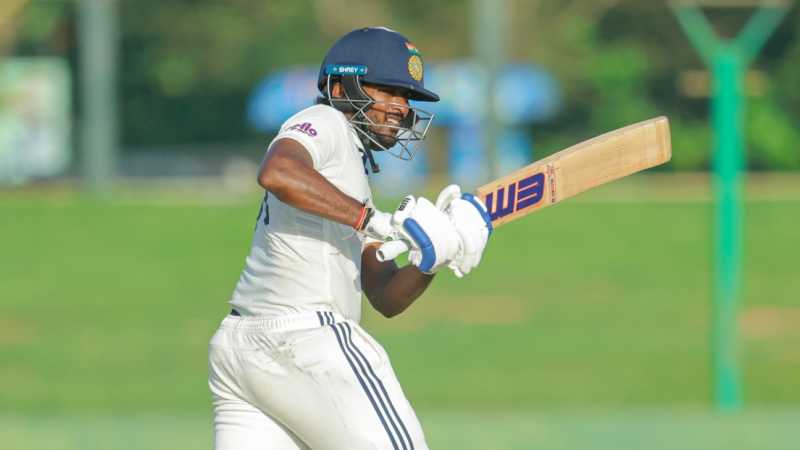
B Sai Sudarshan strengthened his case to retain the No.3 spot for the upcoming Test series in Sri Lanka, with his 168 for India A against Sri Lanka A in Galle. Sudharsan converted his overnight 104 not out into his career-best score for India A, helping his side stretch their lead to 175 by the end of the third day’s play. India A closed out the day on 541 for 8 in response to Sri Lanka A’s 366.
Devdutt Padikkal failed to add to his overnight 94 and Ruturaj Gaikwad retired hurt on 13, but India A zoomed ahead thanks to Sai Sudharsan, captain Dhruv Jurel (53), Shaik Rasheed (45) and Saransh Jain (68*).
Jurel’s innings was cut short when he was trapped lbw by left-arm spinner Dilum Sudeera, who also claimed the wicket of Sai Sudharsan. Allrounder Keshara Nuwantha, meanwhile, claimed the wickets of Padikkal and Shaik Rasheed, and Gurnoor Brar late in the day. Overall, he had figures of 4 for 158 in 50 overs.
Sri Lanka A toiled away, using as many as eight bowlers, but only Sudeera and Nuwantha were among the wickets until captain Sahan Arachchige struck late in the day.
India A’s bowling allrounders Saransh and Auqib Nabi (30) combined for an 81-run stand to take the visitors past 500.
Scores:
India A 541 for 8 in 142 overs (B Sai Sudharsan 168, Devdutt Padikkal 94, Druv Jurel 53, Saransh Jain 68*, Shaik Rasheed 45; Keshara Nuwantha 4-158, Dilum Sudeera 3-101) lead Sri Lanka A 366 in 110 overs (Sahan Arachchige 127; Gurnoor Brar 4-77, Saransh Jain 4-92) by 175 runs
(Cricinfo)

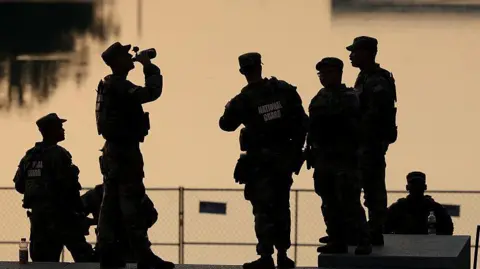
Extreme heat has disrupted Fourth of July celebrations across parts of the US, including the cancellation of a parade in Washington DC.
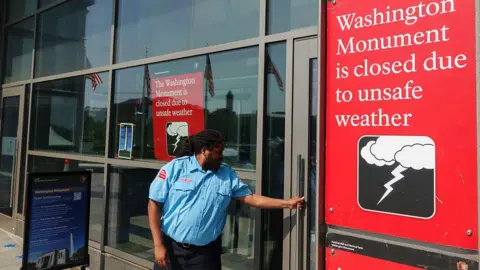
The Great American State Fair in the nation’s capital – marking the country’s 250th birthday – was also temporarily shut after multiple people were treated for heat-related illnesses.
More than 165 million people were sweltering on Friday under record temperatures along the US East Coast and Midwest, according to the US National Weather Service.
The heatwave is disrupting the holiday weekend as US President Donald Trump hosts a celebration marking America’s 250th birthday, while multiple World Cup matches take place outdoors.
The 4 July holiday is traditionally characterised by lots of outdoors activities – barbecues, community parades and fireworks at night.
But multiple events commemorating the US holiday – and the country’s 250th birthday – were cancelled due to the blistering heat, from New Jersey, Pennsylvania and Maryland to as far west as Colorado.
Among the cancelled events on Friday was Philadelphia’s Salute to Independence Semiquincentennial Parade, which was tipped to be one of the biggest events across the US.
“As much as this decision pains everyone inside our organisation, we simply cannot host an event of this size and scale under these dangerous heat conditions,” Michael DelBene, the CEO of parade organiser Wawa Welcome America, said in a statement to the BBC.

In Washington, an Independence Day morning was cancelled “after extensive and careful consideration of the safety of our participants, spectators and staff as the top priority”, organisers said.
The intense heat also led to the closure of the fair on the National Mall for several hours on Friday, one day before the holiday. The State Fair reopened at 17:00 local time (21:00 GMT) after conditions improved, organiser Freedom 250 said.
“The safety and wellbeing of our guests, volunteers, performers, vendors and staff is our highest priority,” it said.
The DC Fire and EMS Department treated several people for “heat-related illnesses” at the fair on Friday, a spokesperson for the department told the BBC. He said these were caused by “record-breaking temperatures” at the event.
At least 11 people were taken by ambulance from the fair, the spokesperson said, but did not elaborate on whether all had heat-related illnesses.
“It is going to be a very busy weekend,” a spokesperson for the DC Fire and EMS Department told the Washington Post.
“We know that there are going to be heat-related illnesses on and off the Mall, and we encourage our residents and visitors to take precautions if you’re going to be out in the heat.”
Robin Ardito, who attended the fair, said she saw a middle-aged woman who appeared to be suffering from a heat-related illness. The woman was being tended to by fair staff with both hands in buckets of ice, she said.
“It was too hot to be holding an event like this,” Ardito added.
Another event in Washington DC was affected when US Capitol Police delayed public entry for Friday evening’s outdoor A Capitol Fourth concert from 15:00 to 19:00 local time.
Trump is expected to speak outside at a 4 July celebration on Saturday, despite the predicted high temperatures. The president has maintained that he wanted to gather outside for the celebration.
“I’m gonna make a really long speech just to show that I can do anything,” he said.
The extreme heat was expected to continue through the weekend as the hottest spell of the year so far sends temperatures soaring to levels not seen, in some areas, in decades.
It follows an unprecedented spell of early summer heat across Europe, with record highs across the continent.
Searing heat and high humidity is not unusual across North America, but the widespread nature of this event, across central and eastern areas on Friday and then the east for the weekend, sets it apart as potentially dangerous.
Philadelphia and Washington DC are expected to reach 104F (40C) and 103F with the humidity making it feel like 112F and 111F, respectively, approaching their all-time record highs, according to the NWS.
[BBC]

Jhon Arias scored the only goal as Colombia beat Ghana 1-0 in sweltering conditions in Kansas City on Friday to reach the World Cup round of 16, continuing a quietly impressive campaign that has established them as dangerous outsiders.
Arias struck in the 14th minute, guiding home a cross from substitute Luis Suarez, and Colombia’s disciplined defence did the rest as Nestor Lorenzo’s side extended their unbeaten run and booked a meeting with Switzerland in the next round.
Colombia had largely flown under the radar at the tournament, despite going undefeated against Portugal, Uzbekistan and DR Congo to top Group K.

Their breakthrough on Friday came from two players who had not been expected to combine, as Suarez, thrust into action after Jhon Cordoba was forced off with an apparent groin injury in the eighth minute, delivered a pinpoint cross to the back post where Arias had somehow drifted unmarked.
With time and space to pick his spot, Arias calmly guided the ball into the bottom corner to hand his side a deserved lead.
The stadium felt more like Barranquilla than Kansas City as tens of thousands of Colombia supporters turned the clash with Ghana – a team ranked 60 places behind them – into a de facto home game, giving the South Americans a level of support rarely seen so far from home.

The stands were a writhing, dancing sea of yellow jerseys, twirling scarves and black-and-white sombrero vueltiao hats, that many used to fan their faces in the oppressive 30-degree Celsius (86-degree Fahrenheit) heat.
They bounced in unison, roared their team forward with every attack, and regularly broke into chants of “Vamos Colombia! Esta noche tenemos que ganar!” (Spanish for ‘Let’s go Colombia, tonight we have to win!’).
They need not have worried. Colombia were the better team by some distance.
Luis Diaz had numerous scoring chances. He fired into the side netting in the first half, then celebrated what he thought was the game’s second goal early in the second half when he slotted home Arias’s cross, but it was disallowed for offside.
Lorenzo’s men continued to push for a second goal, and Ghana goalkeeper Lawrence Ati-Zigi, who was excellent all night, made one terrific save after another in the dying minutes as Colombia’s fans cheered every one of their team’s touches of the ball.

Antoine Semenyo was Ghana’s biggest attacking threat, yet Colombia’s disciplined defence denied him a clear sight of goal.
Colombia became the fourth South American team to reach the last 16, joining surprise package Paraguay, who stunned Germany, along with Brazil and Argentina, both of whom survived scares of their own.
Colombia – whose best finish was reaching the quarterfinals in 2014 – play the Swiss on Tuesday in Vancouver.
[Aljazeera]

India A grow lead after Sai Sudharsan hits 168

Boys among men – Sooryavanshi joins Tendulkar, Aaqib and Hasan Raza

Brutal heat cancels Fourth of July events, from DC to Philadelphia

Arias sends Colombia into World Cup last-16 with 1-0 win over Ghana

Messi scores again but Argentina given World Cup upset fright by Cape Verde

Anguished families left to identify Venezuela quake victims at makeshift morgue

‘Dates have the highest sugar content to fight Coronavirus’

Sunday Island 27 December – Headlines

#SundayIsland 17th December – Headlines

Sunday Island – 28th March

Sunday Island Headlines – 21 March

Sunday Island – 21st February – Headlines
-

 News6 days ago
LAWASIA warns against ad hoc initiative to increase judges’ retirement ages
-
 Features5 days ago
Climate action to bring South Asia together
-

 News5 days ago
Chamuditha to seek removal of injunction on Youtube programme
-

 News20 hours ago
Freedom 250: US Embassy celebrates America’s 250th Independence Day through magic of American cinema
-

 Features7 days ago
People’s Bank expands digital banking network with 125th cheque deposit kiosk
-

 News2 days ago
CIABOC to question Harak Kata on Rs. 200 mn bribery allegation
-

 News2 days ago
SLAF conducts successful rescue mission under UN command in Central African Republic
-

 News5 days ago
CPRP alleges another death in custody, seeks protection for witness