
Business
Pathfinder Foundation and Ananta Aspen Centre lead India-Sri Lanka Physical & Digital Connectivity Dialogue

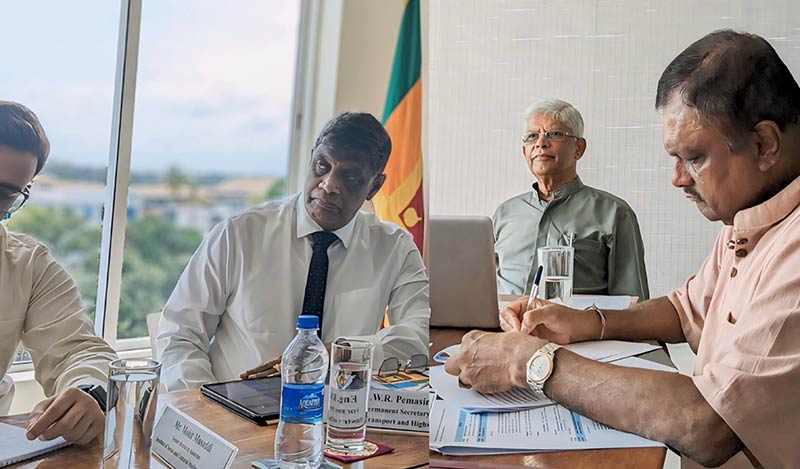
The Roundtable Discussion on “Bridging Borders: Enhancing Connectivity Between India and Sri Lanka,”, concluded successfully, fostering insightful dialogue and collaborative discussion on strengthening physical and digital connectivity between the two nations.
The event commenced with welcome and opening remarks by Amb. (Retd.) Bernard Goonetilleke, Chairman of Pathfinder Foundation, and Ms. Indrani Bagchi, Chief Executive Officer of Ananta Aspen Centre, set the tone for a productive session. The two sessions can be live on the Pathfinder Foundation web or YouTube link, https://rb.gy/11n635
Session 1 focused on the transformative potential of Digital Public Infrastructure (DPI) in driving development across emerging markets, bringing distinguished speakers and discussants to explore how DPI can catalyze economic growth and regional connectivity.
The speakers included Rahul Matthan, Partner at Trilegal, and Dr. Rudra Chaudhuri, Director of Carnegie India. Both experts provided insightful perspectives on the role of DPI in fostering development. In this session, speakers elaborated on India’s pioneering efforts in DPI, illustrating how digital infrastructure has empowered various sectors, enhanced service delivery, and stimulated economic progress.
The discussants, Prof. Rohan Samarajiva, Chairperson of LIRNEasia, and Mahesh Perera, CEO of the Information and Communication Technology Agency (ICTA), further enriched the dialogue by bringing in the Sri Lankan perspective. They discussed the potential benefits of adopting a robust DPI framework in Sri Lanka, highlighting how it could streamline government services, improve transparency, and boost economic activities.
The session highlighted India’s significant strides through DPI, demonstrating its capacity to drive economic progress, improve public service delivery, and foster innovation. It also delved into the potential advantages for Sri Lanka in adopting a similar approach. This session underscored the transformative power of DPI and set the stage for continued dialogue and collaboration between India and Sri Lanka in leveraging digital technologies for mutual growth and development.
Session 2 was dedicated to exploring the current state and future potential of physical connectivity between India and Sri Lanka. This session brought together leading experts to discuss the multifaceted aspects of physical and maritime connectivity, highlighting the challenges and opportunities for infrastructure development and regional cooperation.
The speakers for this session included Eng. R. W. R. Pemasiri, Convener of the Pathfinder Foundation Study Group on Envisioning India-Sri Lanka Physical Connectivity and Former Secretary of the Ministry of Transport and Highways, and Romesh David, CEO of South Asia Gateway Terminals, Port of Colombo. Eng. Pemasiri provided a comprehensive overview of the physical connectivity between the two countries, discussing the various modes of transport, including roads, railways, bridges, and ports. He outlined the key challenges that hinder seamless connectivity and emphasized the importance of strategic infrastructure projects to overcome these obstacles. David complemented this by focusing on maritime connectivity, elaborating on the critical role ports play in facilitating trade and economic integration. He highlighted ongoing and proposed projects that aim to enhance port infrastructure and improve the efficiency of maritime transport.
The discussants, Ms. Nirupama Subramanian, Former National Editor of The Indian Express, and Harikrishnan Sundaram, CEO of Adani Colombo West International Terminal (Pvt) Ltd, added depth to the discussion with their insights. They addressed enhanced connectivity’s broader geopolitical and economic implications, discussing how improved infrastructure can strengthen bilateral relations and promote regional stability. They provided a detailed analysis of the potential for public-private partnerships in financing and implementing these infrastructure projects, drawing on successful case studies and highlighting best practices.
This session thoroughly examined the strategic importance of strengthening physical and maritime connectivity between India and Sri Lanka. It discussed the findings from past feasibility studies on proposed projects, such as sea bridges for road and rail transport and energy infrastructure. It explored additional infrastructure initiatives that could further enhance cross-border connectivity.


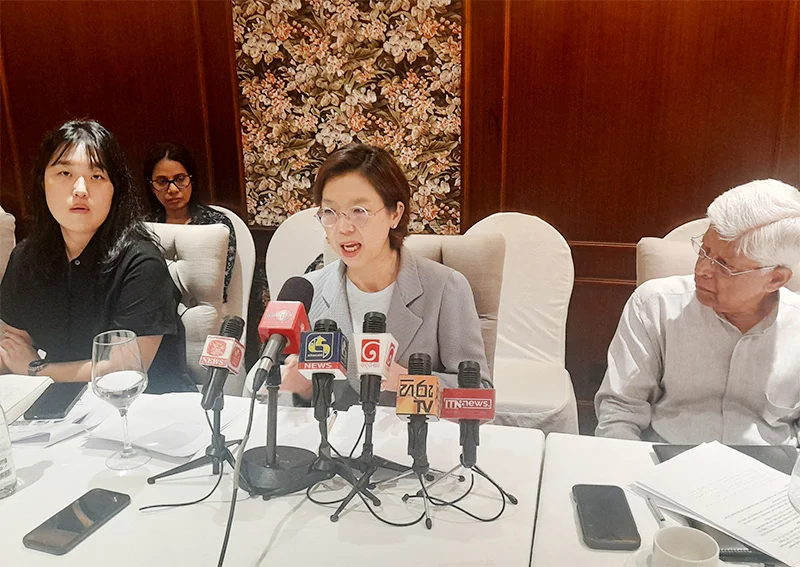
Sri Lanka should mainly focus on upgrading its trade and investment facilitation system while identifying the paramount importance of the issue, South Korean Ambassador to Sri Lanka Miyon Lee said.
The bureaucratic matters—from Customs clearance to tariff lines, licensing, and registration—should be streamlined, she said at a round table forum recently held at the Colombo Club of the Taj Samudra, Colombo. The forum was organized and conducted by the Pathfinder Foundation Sri Lanka and was presided over by its Chairman, Ambassador (Retd) Bernard Goonetilleke.
Ambassador Lee said that the Sri Lankan government and companies must focus on tourism sector development and also find businesses opportunities with Korea.
She also said that if Sri Lanka wants to attract Korean investment into Sri Lanka, Sri Lanka should highly develop its digital sector.
‘On top of that, If Sri Lankan is to sign a FTA or trade agreements, she should focus on niche markets to supply to Korean companies, she explained.
Ambassador Lee added: ‘Korea is highly digital and AI enabled and Sri Lanka needs to concentrate on that as well.
‘Further, it is going to be very important if you will be able to implement all the obligations that are laid out under a WTO agreement.
‘A single window is part of the overall trade architecture that Sri Lanka has to follow.
‘ I think that also follows with the FTA (Free Trade Agreement) negotiations. From Korea’s experience, when we had the financial crisis in 1997, we only pursued WTO negotiations. FTA negotiations came after the financial crisis.
‘The Asia-Pacific Trade Agreement (APTA) is important in this regard.
‘The APTA arrangement includes China, India, Korea, Nepal and Mongolia and 50 percent of Sri Lankan exports to South Korea benefit from the APTA.
‘But other than that, there is not much trade between the two countries. That’s why I think it is going to be very important for Sri Lanka to pursue the RCEP (Regional Comprehensive Economic Partnership) arrangement.
‘Unfortunately, there is not much appetite for upgrading the APTA because we already have separate FTAs with India and China.
‘ We have huge investments in India and in ASEAN countries. I think it would be very important that Sri Lanka uses that kind of opportunity to see if there is any initiative for Sri Lankan companies to provide supplies to Korean companies working in other countries.’
By Hiran H Senewiratne

USD 2.5 million Treasury cyber heist has escalated into a full-blown financial security crisis, with the government scrambling to contain international fallout amid growing fears that multiple foreign debt repayment channels may have been compromised.
In the strongest indication yet of the gravity of the breach, Deputy Finance Minister Dr. Anil Jayantha Fernando told Parliament that investigators had uncovered suspicious irregularities linked to other external payment transactions, including one involving India, suggesting that the cyber intrusion may have extended far beyond the original fraudulent transfer.
The revelation has sent shockwaves through financial and political circles at a time when Sri Lanka is struggling to restore credibility after its historic sovereign default and painful debt restructuring process.
The controversial transfer involved funds earmarked for a debt repayment to Australia Export Finance. However, the money was allegedly diverted into a fraudulent account after what authorities now believe was a sophisticated cyber infiltration targeting Treasury communication and payment authentication systems within the External Resources Department (ERD).
With international confidence hanging in the balance, the Government has moved swiftly to reassure creditors that the incident would not be treated as a sovereign debt default.
Fernando informed Parliament that international debt restructuring advisors had assessed the situation and concluded that the theft constituted a criminal financial breach rather than a deliberate failure by Sri Lanka to honour debt obligations.
Behind the scenes, however, the crisis has triggered an unprecedented multi-agency investigation involving the Criminal Investigation Department (CID), Sri Lanka Computer Emergency Readiness Team (SLCERT), Financial Intelligence Unit (FIU) and foreign law enforcement authorities, including Australian agencies.
Investigators are now carrying out forensic examinations of official email systems, payment authorisation trails, digital devices and Treasury transaction records amid mounting concerns that critical State financial infrastructure may have been exposed to external manipulation.
The scandal has also intensified political tensions, with opposition parties accusing the Government of attempting to downplay the seriousness of the breach while demanding an immediate parliamentary debate and an independent inquiry into Treasury security failures.
Pressure mounted further following the sudden death of an interdicted Finance Ministry official reportedly connected to the ongoing investigation.
Although authorities have not officially linked the death to the fraud probe, the incident has fuelled widespread speculation and heightened public suspicion surrounding the case.
The latest disclosures have raised troubling questions about the vulnerability of Sri Lanka’s public financial systems, particularly as billions of dollars in foreign debt repayments, aid flows and restructuring transactions continue to pass through Government channels under intense international scrutiny.
Financial analysts warn that while creditors may refrain from categorising the incident as a formal default, the cyber heist could still damage Sri Lanka’s credibility unless authorities demonstrate swift accountability, institutional transparency and robust corrective measures.
The Treasury breach is now being viewed not merely as an isolated fraud, but as a major national financial security threat with potentially far-reaching implications for Sri Lanka’s economic recovery and global standing.
By Ifham Nizam

John Keells CG Auto (JKCG Auto), the authorised distributor of BYD and DENZA in Sri Lanka, has launched a campaign in partnership with Bank of Ceylon (BOC) and Sri Lanka Insurance Corporation General Ltd. (SLIC) to accelerate New Energy Vehicles (NEV) adoption among government sector employees.
The initiative, which will run from 4 May to 31 July 2026, is designed to improve accessibility and affordability of NEVs for public servants through a structured set of financing, insurance and ownership support mechanisms.
Open to employees across the government sector, the programme reflects a coordinated effort between industry and national institutions to enable a gradual and practical transition towards cleaner transport options.
As part of the collaboration, JKCG Auto will extend a set of ownership support measures across its BYD and DENZA portfolio, including introductory price considerations, access to home charging infrastructure, and aftersales service support. These are complemented by preferential leasing arrangements facilitated by the Bank of Ceylon, alongside tailored insurance solutions and customer support services from Sri Lanka Insurance Corporation.

Death of infant at Trinco District General Hospital: Suspended docs were at private hospital performing operation: Govt.

Moves to strengthen environmental law after 24 years

US-supported GeoAI Exhibition on disaster resilience opens on 14 May

About 84% percent of Lankans willing to donate eyes

Special prison helps prevent jailed criminals from running crime syndicates

Sigera’s 189 powers Mahanama to major honours in drawn Big Match

‘Dates have the highest sugar content to fight Coronavirus’

Sunday Island 27 December – Headlines

#SundayIsland 17th December – Headlines

Sunday Island – 28th March

Sunday Island Headlines – 21 March

Sunday Island – 21st February – Headlines
-

 News5 days ago
MIT expert warns of catastrophic consequences of USD 2.5 mn Treasury heist
-

 News2 days ago
Lanka Port City officials to meet investors in Dubai
-

 Editorial5 days ago
Clean Sri Lanka and dirty politics
-

 Editorial4 days ago
The Vijay factor
-

 News3 days ago
SLPP expresses concern over death of former SriLankan CEO
-

 News6 days ago
Development Officer bids Rs. 48 mn for CPC’s V8 at auction
-
 News3 days ago
Police inform Fort Magistrate’s Court of finding ex-CEO of SriLankan dead under suspicious circumstances
-
 Opinion6 days ago
Postmortem reports and the pursuit of justice