
News
NJC says MoC signed by previous govt on ECT not binding, calls for its cancellation

The National Joint Committee (NJC) has urged the government not to lease the East Container Terminal (ECT) to India or any other country. The NJC, in a statement issued yesterday (29) warned the project would jeopardize national security, independence and political-economic sovereignty.
The NJC said that despicable practice of alienating strategic national assets could not be adopted by the incumbent administration because Gotabaya Rajapaksa and his Government were elected on an over-whelming patriotic mandate to protect our strategic assets.
The NJC drew the attention of the President, PM, the Cabinet of Ministers and also the parliamentarians, to the following facts, evolutions and risks associated with this proposal to lease a share of ECT:
1.
Sri Lanka cannot afford to become victim of international political power struggle among global and regional powers. Having already allowed China to occupy Hambantota Port, and India to occupy Trincomalee Oil Tanks, the country should not make the mistake of allowing India, any other nation or private party to occupy ECT.
2.
The ECT being the deep draft terminal the SLPA has and should be kept under full control and management of the SLPA, as also recommended by the Expert Committee appointed to study the development of ECT. Any alienation of the ECT would lead to devastating repercussions on SLPA in terms of losing control of modern shipping business and foregoing revenues.
3.
We learn that the SLPA has capital funds voted for the purpose of gradual development of the ECT by itself, and that it has few hundreds of millions of dollars in reserves.
Besides, the ECT could be operated as it is even now, and earn nearly 50 million dollars annually enabling SLPA to further develop ECT on a stage-by-stage basis using its own resources that would be earned through terminal operations. Therefore, the claim that the SLPA does not have resources to develop the ECT by itself is not only incorrect, but also misleading the public.
4.
While we are confident that the ECT could be gradually developed by the SLPA while operating it, the NJC is of the opinion that the Government’s apparent move to negotiate with a single foreign firm is against the national interest and is violating transparent procurement principles, even if one presumes that private local or foreign resource mobilization is necessary. If such external investment is needed, the Government with the utmost responsibility of upholding the citizen’s rights should have called for competitive bids from among potential investors, preferably from local private sector companies first and internationally thereafter.
5.
Firstly, the MOC dated 28th May 2019 is not a binding agreement but an arrangement to negotiate. In the opening paragraph of the MOC, the three parties confirm their “commitment to cooperate”. The Paragraph 2 of the MOC states that GOSL invites “Japanese participants concerned, and Indian participants concerned to take 49% stake collectively in the ‘Terminal Operations Company’ (TOC) that will be setup”. Thus the offer is made by Sri Lanka for India and Japan to “collectively take 49%” and not for any party to take the whole of 49% by itself. Unless a fresh offer is made by Sri Lanka to India to take 49% stake by itself, the latter cannot accept the offer made by the previous Government to both India and Japan collectively in as much as Japan has now withdrawn from the MOC.
6.
Therefore, it is not correct to state that the Government is obliged to consider the commitments made to India previously.Sri Lanka is not obliged by this agreement to make a fresh offer to India for the whole 49% stake in the TOC, and therefore there is no legal obligation to proceed with the earlier offer made. In any event the offer has now lapsed as India cannot possibly now collectively take 49% with Japan in view of Japan’s withdrawal.
7.
In paragraph 5 of the MOC it is stated that the three governments “will hold a joint working group meeting among authorities concerned from the three countries in a timely manner to discuss issues”. This statement itself demonstrates that there is no binding contract entered between Sri Lanka on the one hand and India and Japan on the other as it is only an agreement to discuss. In any event the agreement is for the three Governments to discuss and not for two Governments to discuss. It is interesting to note that in clause 5(iv) the parties had agreed to discuss “modification of this memorandum”. Justice Weeramantry, former judge of the Supreme Court of Sri Lanka, in his “Treaties on the Law of Contract prevailing in Ceylon”, states: “so long as the parties are in negotiation either party may retract”.
Therefore, the Government’s reluctance to drop the idea of alienating the South Port of Colombo is not justified. One wonders whether the provisions relating to the National Procurement Commission was removed from the Constitution of Sri Lanka to plunder the resources of this nation whilst making empty declarations to safeguard national interest prior to the election. On or about 22.10.2020 the Minister of Ports and Shipping Rohitha Abeygunawardena has submitted a Cabinet Memorandum disclosing the involvement of another investor by the name of ADANI Ports and Logistics Group. It appears that the government intends awarding the contract to this group.
The question is whether Sri Lanka could, without calling for tenders, part with the ECT to the ADANI Group when the ADANI Group was not a party to the MOC entered into by the previous government. This Cabinet Memorandum itself demonstrate that giving any part of the Colombo South Port to the ADANI Group is in itself a violation of the MOC in as much as there is nothing in the MOC which permits a partner government to abdicate its rights and interests under the MOC to a third party. Article 28(d) of the Constitution of Sri Lanka states that it is the duty of every person in Sri Lanka to preserve and protect public property. Both the Minister of Port and Shipping and the Chairman of the Ports Authority, Rohitha Abeygunawardane and Lt. Gen. Daya Rathnayake, would be violating the Constitution if the property entrusted to them is alienated without getting the best price after competitive bidding. This would be a fraud that might attract criminal prosecution if not by their own government by a future government.
8.
Surprisingly, there is no information made known to the public, the true owners of this strategic asset, as to the basis of selection of this single party for negotiations. Besides, the selected company with which the Government appears to be contemplating to negotiate is a direct competitor of Sri Lanka’s ports, and such an investor cannot be reasonably expected to make managerial decisions for the betterment of Colombo Port. It may be pertinent to note in this regard that the said firm is currently developing several competing ports in the South Asian region, it would be unwise to invite such a firm to take control of our strategic Port terminal, where a deliberate action to run down our Port cannot be excluded.
9.
Besides, the NJC learns that the said firm has been accused of many anti-social and anti-environmental practices both in India and Australia, and no socially prudent activity could be expected from such a managing partner, leading to serious risks pertaining to social economic and political ill effects on Sri Lanka.
10.
If an Indian firm occupies Colombo Port, the possibility of Indian labour being imported to operate the ECT will become significant, imposing threat to employee welfare both at Port and generally in the local economy. This would also pave the way for infamous ETCA attempted by the previous regime, and not proceeded because of the public and professional pressure. It is with dismay that we recall the protest against such moves launched by the then opposition politicians who appear to have forgotten all that now being in the Government.
11.
After this government came into power, they seem to proceed with the project on the basis that they are obliged to respect the previous agreement entered into with other governments and was attempting to justify the alienation of the Colombo South Port without calling for tenders.
12.
Ironically this matter has drawn public attention at a time when, the chapter dealing with the National Procurement Commission had been removed with the 20th Amendment.
13.
The question that most people raise today is whether the Government’s justification was correct and whether Sri Lanka could withdraw or not proceed with the MOC, Sri Lanka entered into with India and Japan. Subsequently Japan withdrew from this MOC. The question is, in the absence of Japan, whether there is a live and valid agreement between the Governments of India and Sri Lanka that could be enforced.
14.
Is the GoSL aware that Adani has been booked by the Central Bureau of Investigation in India for causing loss to Indian treasury as a result of being allowed to bid for airport contracts without experience? Adani Group has been fined by Australia for misinterpreting environmental approval conditions in mining operations. Back home in India, Indian farmers are on the road protesting against Adani Group exploiting them. There is a “Stop Adani Movement” formed in Sydney Australia. Australia’s Future Fund was forced to divest its holdings in “Adani Ports” due its corrupt connections with Myanmar’s Military and Adani’s role in the Carmichael mine project.
15.
Adani has a stated objective that it is setting up deep water ports to take away the transshipment cargo business model of Colombo Port. Adani is building just adjacent to Colombo Port “The Vizhinjam Port in Kerala” with 6.2 million TEU capacity and an investment in excess of US$10 bn and other deep water ports all over India and even in places like Andaman Nicobar Island with the stated objective of transferring the Indian Transshipment Cargo business of Colombo Port to these ports. It is common sense that a company making such huge capital investments in its motherland will invest in the Colombo Port in order to try to kill its transshipment cargo business model in the long term.

Latest News
Heat Index at Caution Level in the Northern, North-central, North-western, Western, Sabaragamuwa, Eastern and Southern provinces and in Monaragala district

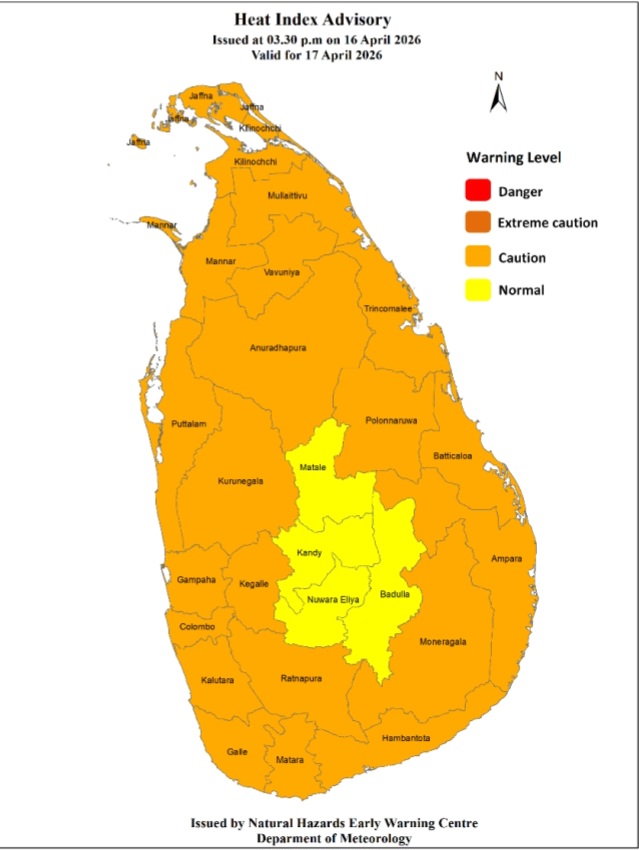
Warm Weather Advisory
Issued by the Natural Hazards Early Warning Centre
Issued at 3.30 p.m. on 16 April 2026, valid for 17 April 2026.
The Heat index, the temperature felt on human body is likely to increase up to ‘Caution level’ at some places in the Northern, North-central, North-western, Western, Sabaragamuwa, Eastern
and Southern provinces and in Monaragala district.
The Heat Index Forecast is calculated by using relative humidity and maximum temperature and this is the condition that is felt on your body. This is not the forecast of maximum temperature. It is generated by the Department of Meteorology for the next day period and prepared by using global numerical weather prediction model data.

Effect of the heat index on human body is mentioned in the above table and it is prepared on the advice of the Ministry of Health and Indigenous Medical Services.
ACTION REQUIRED
Job sites: Stay hydrated and takes breaks in the shade as often as possible.
Indoors: Check up on the elderly and the sick.
Vehicles: Never leave children unattended.
Outdoors: Limit strenuous outdoor activities, find shade and stay hydrated.
Dress: Wear lightweight and white or light-colored clothing.
Note:
In addition, please refer to advisories issued by the Disaster Preparedness & Response Division, Ministry of Health in this regard as well. For further clarifications please contact 011-7446491.

“Auditor General’s reports a matter for Legislature not the Executive”
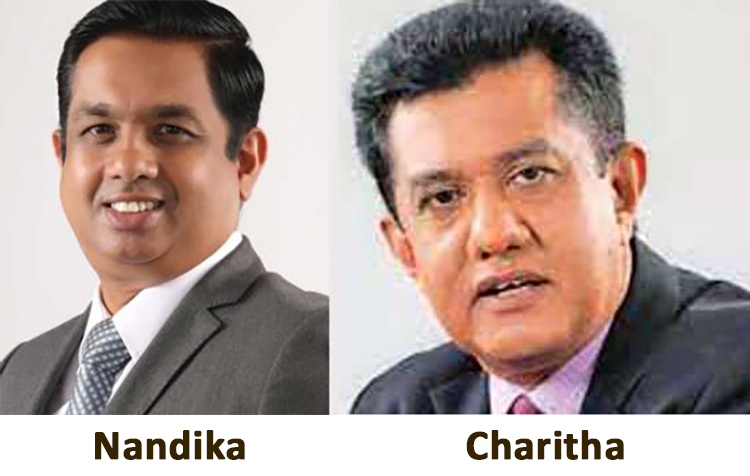
Former Chairman of the Committee on Public Enterprises (COPE) Charitha Herath has said it is the COPE, and not the Secretary to the President, that should have asked the CID to probe irregularities in the procurement of coal for the Lakvijaya power plant.
Dr. Nandika Sanath Kumanayake, who is the Secretary to the President, lodged a complaint with the CID last week seeking an investigation into coal procurement.
No previous Secretary to a President had done so, the former parliamentarian and the Samagi Jana Balawegaya (SJB) Working Committee member said. Herath said so responding to The Island query regarding Kumanayake calling for a probe into coal procurement, since 2009, following the National Audit Office (NAO) report on the controversial procurement process for the 2025/2-26 period.
Herath emphasised that COPE, taking into consideration the growing discontent over coal procurement, especially after the NAO exposed serious irregularities, should have initiated action. Herath cited the National System Operator’s (NSO) seeking an additional electricity tariff increase of 15%, in addition to 10% increase announced on 01 April, for the second quarter, to cover-up Rs 16 bn deficit in power generation, as a matter of grave concern. NSO has cited the prevailing dry weather, the continuing crisis in West Asia, and the low-grade coal that had been procured as primary reasons for the unanticipated shortfall in electricity generation.
Herath said that as the Secretary to the Ministry concerned was the Chief Accounting Officer, the actions of the Secretary to the President caused a technical issue. Prof. Udayanga Hemapala, now under a cloud over the violation of procurement procedures, as confirmed by the NAO, is the Secretary to the Energy Ministry. Herath emphasised the importance of the procedure adopted in appointing a Secretary to a Ministry. “President issues one letter making the appointment. Secretary to the Finance Ministry issues a second letter underscoring the responsibilities of a Ministry Secretary as the Chief Accounting Officer of a particular Ministry,” Herath said.
The second letter emphasised the accountability on the part of the Ministry Secretary regarding public finance and his direct answerability to Parliament.
The ex-COPE Chief pointed out that the Secretary to the President was part of the executive. He was not part of the legislature. If there had been a directive from COPE, that should have been issued to the Secretary to the Energy Ministry, Herath said, emphasising the entire process had to be led by the legislature not the executive. In this instance to make matters worse the finger is also pointed at the executive for being part of the alleged cover up.
The Auditor General, who heads the NAO, is answerable to Parliament, Herath said, pointing out that the AG never sent reports to the Secretary to the President, who, too, comes under the purview of the NAO. The intervention made by the Secretary to the President could set a very bad precedent and it was unfortunate that the NPP, having campaigned on an anti-corruption platform at national elections in 2024 was now struggling to cope up with the major post-Aragalaya coal scandal.
The NAO undertook the examination of the 2025/2-26 coal procurement on a request made by Dr. Nishantha Samaraweera, Galle District lawmaker, representing the ruling NPP.
Lakvijaya, the country’s sole coal power plant, situated at Norochcholai, requires approximately 2.25 mt million annually and is credited with generating 30% to 40% of the overall national electricity requirement.
According to the NAO report, the Energy Ministry had awarded the term tender for the supply of coal to India’s Trident Chemphar Ltd., though it wasn’t properly registered. The NAO also pointed out the failure on the part of the supplier to follow proper procedure in respect of loading and unloading at respective ports.
Herath said that intentionally, or inadvertently, the NPP had erred in handling the investigation. He said after receiving the NAO’s report, COPE could have averted unnecessary controversy by following the laid down procedures. The COPE Chairman could direct the Energy Secretary to inquire into the coal procurement within seven days and submit a report to Parliament. In addition, if there had been any wrongdoing on the part of officials, relevant documents/files should be sent to the CIABOC or the CID.
The COPE, in consultation with the Speaker, could also take up in Parliament as an urgent/emergency issue at the onset of the proceedings, Herath said, adding that an interim report could be presented. On the basis of that report, in terms of the Standing Orders the Parliament could immediately decide to send it to the CID.
In addition to the above mentioned procedures, the COPE could on its own initiate a fresh inquiry and submit a report to Parliament and the country, Herath said. Pointing out that the coal company comes under the purview of the executive and not the legislature, Herath said that actions of the executive could be investigated. Herath explained how the British and the US responded to such situations. Unfortunately, here in Sri Lanka apparently the COPE was being used to clear the Minister concerned while holding the officials responsible for the coal scandal.
In the wake of the NAO report signed by Auditor General Samudrika Jayarathne, the defeat of the no-confidence motion moved against Energy Minister Kumara Jayakody couldn’t be considered a victory for the government, the ex-MP said. In fact, the coal scam has challenged the NPP’s much propagated anti-corruption stance, Herath said, adding that the issue couldn’t be examined without discussing the Energy Minister being indicted over corruption by the Colombo High Court recently.
By Shamindra Ferdinando
The National Joint Committee (NJC) has urged the government to seek compensation for the environmental damage caused by the US sinking of the unarmed Iranian Frigate IRIS Dena just outside Sri Lanka’s territorial waters and within its Exclusive Economic Zone, on 4 March.
The following is the text of the NJC statement issued jointly by Lt Gen Jagath Dias (Retd) and Dr Anula Wijesundere, co-Presidents of the outfit: Sri Lanka’s economy, political landscape and social fabric was battered for too long due to man-made and natural disasters. This include two southern insurgencies, 30 years of terrorism, tsunami, Covid- 19 pandemic, Easter Sunday terrorist attack-related political instability, 2022 economic collapse, sovereign default announcement in 2022, IMF intervention, Cyclone Ditwah, numerous external shocks, with the latest being the West Asia conflict, could be named a few.
The sinking of the Iranian warship IRIS Dena on March 4, 2026, roughly 19 to 25 nautical miles off the coast of Galle, Sri Lanka, caused severe environmental pollution, and long-term economic concerns for local communities.
Comprehensive Damage Assessment
Cost of the recovery of dead and human casualties: Out of approximately 180 personnel of the Iranian warship, the Sri Lankan Navy recovered 84-87 bodies and rescued 32 survivors, with roughly 60 sailors of the ill-fated naval vessel still missing and/or presumed dead.
As of early April 2026, the total financial damage from the IRIS Dena explosion, and sinking, off Sri Lanka’s southern coast, has not yet been fully quantified, but preliminary assessments indicate severe ecological and socio-economic risks that may have to be borne by the taxpayer.
Environmental Impact Assessments
The Marine Environment Protection Authority (MEPA) and other experts have highlighted several critical concerns:
* Toxic Spills: The vessel released thousands of tonnes of hazardous materials, including heavy fuel oil and potentially specialised military chemicals, into a highly sensitive marine ecosystem.
* Shoreline Contamination: Oil barrels and debris, including burnt parts of support craft, have washed ashore in popular coastal areas like Hikkaduwa and Dodanduwa. Laboratory tests by MEPA confirmed the presence of lubricant oil in these areas.
* Threats to Marine Life: The southern coast is a vital habitat for whales, dolphins, and vibrant coral reefs. Experts warn of a “silent” impact on ichthyoplankton (fish eggs and larvae), which are particularly vulnerable during the March-April period.
Turtle Nesting: The incident coincided with the sea turtle nesting season. Oil spills and debris are expected to increase mortality rates for sea turtle hatchlings and impact adults coming ashore to breathe and feed.
Livelihood and Socio-Economic Damage
The explosion occurred near the international maritime boundary close to Galle, a major hub for tourism and fishing:
Fisheries: Concerned local fishermen were the first to report oil patches. While no immediate mass fish deaths were initially reported, authorities warn that long-term depletion of shallow-water fish stocks is likely with some reports suggesting up to 50% depletion of shallow-water fish in the affected area.
Tourism: Contamination at Hikkaduwa—a key tourist destination—faced disruption /threatened the local hospitality industry with oil staining the shore during the peak tourism season.
Rescue and Recovery: Sri Lanka deployed naval and air force units to rescue 30 out of approximately 180 personnel aboard torpedoed Iranian vessel. The ongoing monitoring and cleanup efforts add a significant administrative and operational burden to the state.
The Damage: While some experts draw parallels to the 2021 MV X-Press Pearl disaster (which cost over $6 billion in environmental damage), the specific “total damage” figure for the IRIS Dena is still being calculated as debris continues to wash ashore
Accountability and Response
Sri Lanka was left to manage the search-and-rescue (SAR) and environmental clean-up at its own cost, sparking debates regarding liability for damages caused to neutral third parties by warring nations.
A 2021 study on the natural resource damage assessment for oil spills in Sri Lanka states that 39 oil spills occurred in Sri Lanka between 1999 and 2021, including the MV X-Press Pearl. A previous study published in 2017 on oil spill events in marine waters in Sri Lanka showed the sea around Sri Lanka being highly vulnerable to oil spills, as approximately 25% of the world’s oil transportation passes through Sri Lanka’s exclusive economic zone.
In August 2025, the Sri Lankan Supreme Court ordered owners of the MV X-Press Pearl to pay $1 billion in compensation for the 2021 sinking that caused the country’s worst maritime pollution disaster.
Applying the “polluter pays principle,” the ruling mandates payments for extensive plastic pellet contamination and ecological damage.
Some experts are of the opinion that once the origin of the current oil spill is determined and is confirmed linking to the sunken Iranian warship, those who carried out the attack should be held responsible for any environmental damage.
“This should be then handled at a diplomatic level. Considering the already ailing economy and the financial burden Sri Lankan taxpayer is likely to bear short, medium and long term:
1. N. J. C urge the government to do a thorough and a comprehensive damage assessment involving appropriate experts in each subject matter. N. J. C also urge the government to make necessary early dialogue with parties / countries responsible for the incident in order to recover damage cost/compensation.
2. In the backdrop of continued global tensions, vulnerability of sea trade and maritime activities in the Indian Ocean, N.J.C urge the government to represent / engage appropriate bilateral / multilateral and world bodies to declare Indian Ocean a zone of peace.
3. N. J. C recognizes the need for the government to take proactive measures joined by other littoral states at international level to devise/project a protective package from likely future disasters in the Indian Ocean.

Showers expected in the Western, Sabaragamuwa, Southern and Uva provinces and in Kandy and Nuwara-Eliya districts after 1.00 pm

Israel and Lebanon agree 10-day ceasefire, Trump says

Heat Index at Caution Level in the Northern, North-central, North-western, Western, Sabaragamuwa, Eastern and Southern provinces and in Monaragala district

Ex-COPE head questions Prez Secy’s intervention in coal scam probe

NJC asks govt. to seek compensation for IRIS Dena sinking

Kathriarachchi arrested

‘Dates have the highest sugar content to fight Coronavirus’

Sunday Island 27 December – Headlines

#SundayIsland 17th December – Headlines

Sunday Island – 28th March

Sunday Island Headlines – 21 March

Sunday Island – 21st February – Headlines
-

 News5 days ago
CEB orders temporary shutdown of large rooftop solar systems
-
 Features5 days ago
From Royal College Platoon to National Cadet Corps: 145 years of discipline, leadership, and modern challenges
-
 Latest News4 days ago
PNS TAIMUR & ASLAT arrive in Colombo
-

 News6 days ago
Anura Solomons passes away
-

 Features5 days ago
CIA’s hidden weapon in Iran
-
 Latest News4 days ago
Prasidh, Buttler set up comfortable win for Gujarat Titans
-

 Business6 days ago
SL’s economic outlook for 2026 being shaped by M-E conflict
-

 Latest News5 days ago
Heat index likely to increase up to ‘Caution level’ at some places in the Northern, North-central, North-western, Western, Sabaragamuwa, Southern and Eastern provinces and Monaragala district