
Business
Deficit in merchandize trade account narrows in May 2024 on Y-O-Y basis

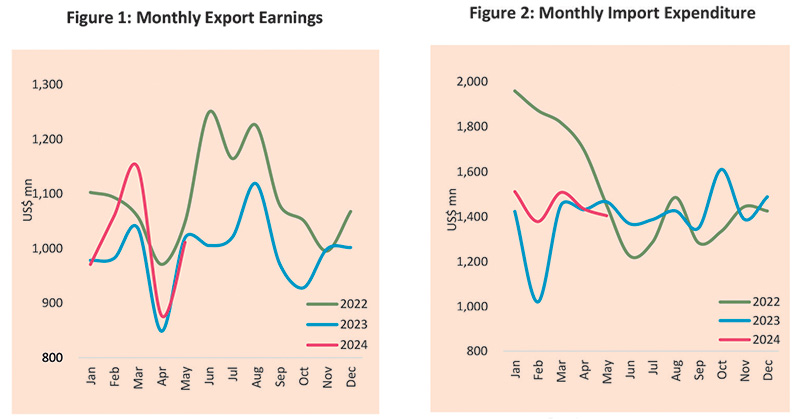
The deficit in the merchandise trade account narrowed to US dollars 393 million in May 2024 from US dollars 447 million recorded in May 2023, supported by a relatively larger contraction in import expenditure than that of export earnings. Similarly, the trade deficit in May 2024 narrowed compared to US dollars 558 million recorded in April 2024. Meanwhile, the cumulative deficit in the trade account during January to May 2024 widened to US dollars 2,170 million from US dollars 1,926 million recorded over the same period in 2023.
Performance of Merchandise Exports
Earnings from merchandise exports recorded a marginal decline of 0.8 per cent to US dollars 1,011 million in May 2024 compared to US dollars 1,019 million in May 2023. A decline in earnings was observed in agricultural exports, while industrial exports and mineral exports increased in May 2024.
The increase in industrial goods exports in May 2024 was mainly contributed by petroleum products due to the increase in volumes of bunkering and aviation fuel exports. Earnings from exports of agricultural goods declined in May 2024 mainly driven by lower exports of minor agricultural products (led by areca nuts) and seafood, while export earnings from spices and tea also declined to some extent. Earnings from mineral exports also increased in May 2024. Meanwhile, earnings from exports improved in May 2024, led by higher textiles and garment exports, compared to April 2024.
Performance of Merchandise Imports
Expenditure on merchandise imports declined by 4.2 per cent to US dollars 1,405 million in May 2024 compared to US dollars 1,466 million in May 2023. The expenditure of consumer and intermediate goods contributed to this decline in import expenditure, while an increase was recorded in the import of investment goods.
The decline in expenditure on consumer goods imports in May 2024 compared to a year ago was due to the broad-based decline in expenditure on food and beverages (led by lower sugar and dairy products imports), although there was an increase in non-food consumer goods imports. Meanwhile, expenditure on intermediate goods imports declined primarily due to lower fuel imports compared to May 2023. However, expenditure on wheat, textiles and textile articles and plastics and thereof increased to some extent in May 2024. Expenditure on investment goods recorded a broad-based increase, driven primarily by higher imports of machinery and equipment. Meanwhile, expenditure on imports in May 2024 declined compared to April 2024 primarily due to the decline in fuel expenditure.(CBSL)


Private taxi operators at Bandaranaike International Airport are calling for urgent rental relief, stating that they are struggling to sustain operations after paying nearly Rs. 19 million in monthly rental fees amid a sharp decline in tourist arrivals during the off-season.
The operators said tourist arrivals have dropped by nearly 80%, severely affecting their income and making it difficult to continue meeting high operational costs.
“Only a small number of tourists are now arriving at the airport, and a majority of them are being taken by metered taxi operators, who pay only around Rs. 700 per ride as fees to Airport and Aviation Services, an operator said.
According to the operators, the six long-standing private taxi service providers at the airport each pay monthly rentals ranging from approximately Rs. 2.9 million to Rs. 4 million. In addition, they are required to maintain a minimum a fleet of six vehicles along with dedicated airport staff.
“What we are requesting is a temporary reduction in monthly rental payments for around three to four months until tourist arrivals improve and the industry returns to normal, they said.
The operators noted that they have been operating at the airport for more than two decades, providing transport services to both local and international travelers, while metered taxi services entered the airport transport sector only about two years ago.
They also alleged that metered taxi operators have been granted more favourable operating conditions and questioned the process through which those operators were allowed to operate at the airport.
Operators argue that the present financial burden has become unsustainable, given the sharp drop in business volumes and what they describe as an uneven competitive environment within the airport transport system.
“What we are requesting is a 50% reduction in monthly rental fees for a period of at least three months, they said.
They also raised concerns about the quality and condition of some vehicles operated by metered taxi providers.
“Passengers are often unaware of the condition of some of these vehicles until they enter them, which can compromise safety standards, one operator claimed.
In contrast, the private airport taxi operators say they maintain newer vehicles and employ experienced, professionally trained drivers to ensure higher standards of passenger safety and service quality.
The operators warned that failure to address the issue could have wider economic and social consequences. The six service providers collectively employ around 250 staff, and continued financial pressure may lead to job losses and a reduction in organised airport transport services.
By Hiran H Senewiratne

The operation of Automobile Association of Ceylon(AAC) Call Boxes, in the past had provided yeoman service to many motorists including during the era of British planters. AAC services for members are a motoring security when they travel.
The Call Box in Nuwara Eliya was recently refurbished to provide a better and improved service to the Members in the area and the touring public. Now from this Call Box the motorists could get Road Side Assistance, Valuation Reports, Technical Advice and also issuance of International Driving Permits.
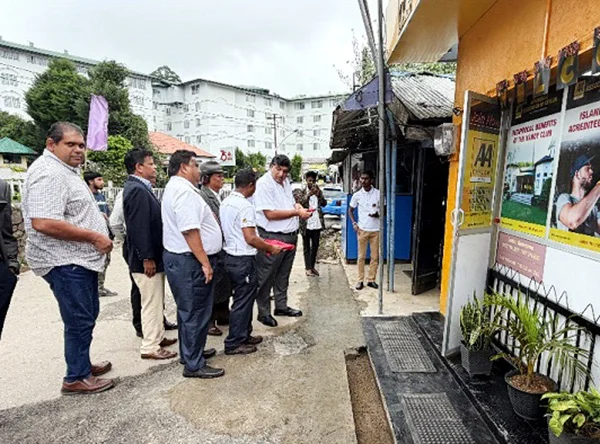
The refurbished Call Box at Nuwara Eliya was declared open by Dhammika Attygalle, President of the Association in the presence of S V Ganesh – Vice President, several Executive Committee members, Puthrasigamani, Life Member of the Association, Eng. C S Samarasekera of RDA- Nuwara Eliya, Devapriya Hettiarachchi, Secretary (AAC) and Eng. C L Liyanasuriya – Chief Engineer(AAC).
The services from the Nuwara Eliya Call Box are available from 8.00am to 5.00pm.
Call Technical Officer Sampath Madagama on 0767315696.

From Risk to Opportunity: Mainstreaming Climate Action into Sri Lanka’s Growth Story
As climate rules tighten globally and investor expectations shift from commitment to compliance, climate action is now directly tied to trade, competitiveness, and access to finance. Against this backdrop, The Ceylon Chamber of Commerce will host the second edition of the Sri Lanka Climate Summit on 9 June 2026 at the Taj Samudra Hotel, convening policymakers, industry leaders, financiers, and technical experts to focus on pathways for integrating climate action into Sri Lanka’s growth story.
Held as a biennial platform, the Summit returns this year under the theme “From Risk to Opportunity: Mainstreaming Climate Action into Sri Lanka’s Growth Story.” While the inaugural edition in 2024 focused on building awareness and advocacy, the 2026 Summit shifts the conversation toward implementation, technical readiness, and compliance as climate-related obligations begin to directly influence access to markets, finance, and investment.
Rather than treating sustainability as a standalone agenda, this year’s discussions will explore how climate considerations are becoming embedded across core areas of business and economic decision-making, from infrastructure and trade to finance, governance, digitalisation, agriculture, and supply chains.

At least 10 dead as huge floods sweep southern and central China

Ebola outbreak may be spreading faster than first thought, WHO doctor warns

Sooryavanshi’s stunning 93 takes Rajasthan Royals closer to IPL playoffs

Showers in the Western, Sabaragamuwa, Northern, North-western and Southern provinces and in Anuradhapura, Kandy and Nuwara-Eliya districts

Govt. committed to fulfilling aspirations of war heroes who liberated country: AKD

H’tota elephant management reserve essential to halt ecological destruction and rising human-elephant conflict – Minister Patabendi

‘Dates have the highest sugar content to fight Coronavirus’

Sunday Island 27 December – Headlines

#SundayIsland 17th December – Headlines

Sunday Island – 28th March

Sunday Island Headlines – 21 March

Sunday Island – 21st February – Headlines
-

 Features3 days ago
Sri Lankan Airlines Airbus Scandal and the Death of Kapila Chandrasena and my Brother Rajeewa
-

 News4 days ago
Lanka’s eligibility to draw next IMF tranche of USD 700 mn hinges on ‘restoration of cost-recovery pricing for electricity and fuel’
-

 News3 days ago
Kapila Chandrasena case: GN phone records under court scrutiny
-

 News3 days ago
Rupee slide rekindles 2022 crisis fears as inflation risks mount
-

 Opinion6 days ago
Electricity tariffs have skyrocketed: Can further increases be prevented?
-

 Business3 days ago
Expansion of PayPal services in Sri Lanka officially announced
-

 Features5 days ago
Mysterious Death of United Nations Secretary General Hammarskjöld
-

 News3 days ago
Court orders further arrests in alleged USD 42 Mn NDB fraud case