
Latest News
Bumrah and Hardik script stunning comeback to lead India to T20 World Cup glory

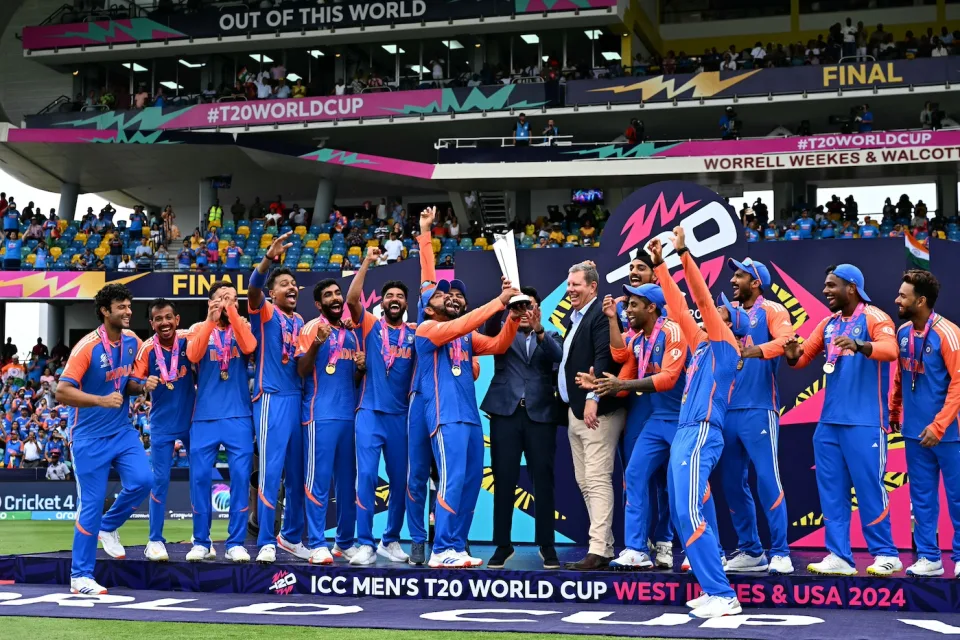
Suriyakumar Yadav snatched a boundary catch for the ages, Jasprit Bumrah snuck in two electric final overs, and Hardik Pandya pilfered the two big wickets as India pulled off one of their great heists to win a World Cup, finally.
With five overs to go, South Africa were rampant. Heirich Klassen one of the great hitters in the game, threatening to throw off decades of painful big-match history for his team with a hail of sixes. He and David Miller had clubbed 38 runs off the two previous overs, and with six wickets in hand South Africa needed only a run-a-ball off the last 30 balls.
Rohit Sharma was forced to go to the best bowler in the world, when he would have otherwise saved Bumrah for later overs. Bumrah didn’t quite break the partnership, the batters never daring to take him on. But he did break Klaasen and Miller’s stride. They scrambled only four runs off that over.
But the most telling blow, came at the start of the 17th over. After the flow of the game was further slowed due to an apparent knee complaint for Rishabh Pant, Hardik bowled a wide line outside off and took the edge of Klaasen, Pant snaffling the chance gleefully.
Still, Miller was there, though he couldn’t get a boundary away off the rest of that over.
Then Bumrah came back, bowled several ripsnorters in the last over of yet another tournament he has dominated. With one of those magic balls, a wicked in-seamer, he burst through the defenses of the last recognised South Africa batter, Marco Jansen, and grazed leg stump.
With Keshav Maharaj now in the middle, their batting line-up notably short, and 20 needed off 12 balls, South Africa were for the first time since the early overs of the chase in trouble. Arshdeep Singh delivered a nerveless 19th over, off which South Africa could muster only four.
The dream-killing blow came next. With 16 needed off the final over, bowled by Hardik. Miller tried to lift the first ball, a wide full toss, over the straight boundary. But he didn’t connect perfectly, and Suryakumar, running full tilt along the rope, his feet only centimetres inside, caught the ball, popped it up as he briefly stepped over the boundary, then completed the running catch as he hopped back into the field, sparking wild jubilation in the stands, and ecstatic celebrations from the India players.
South Africa batters No. 8, 9, and 10, did not manage to get Hardik away, aside from a single outside edge that flew for four.
When Hardik India completed the seven-run win, the bowler sank to his knees in relief, his team-mates exulted, and the crowd, largely supporting India, flew into euphoria. Their team had become World Champions again, after 13 years.
On a flat track in Barbados, Bumrah bowled two unplayable deliveries that brought him two wickets – both bowled. The first of these was the better one. It was one of the best in the tournament, and very arguably one of the best ever in finals. Angled in to Reeza Hendricks, it pitched and seamed away to hit the top of off, beating the batter’s outside edge.
He conceded five runs in that first over, eight runs in the next (one of only two boundaries off his bowling came here – a not fully-controlled steer through deep third).
But those last two overs went some distance to defining this match. Four runs off the 16th over, after the 15th had been clubbed for 24 runs. Two runs off the 17th. His figures were 2 for 18.
Arshdeep Singh was almost as outstanding, returning 2 for 20. His two powerplay overs cost only eight, and brought the important wicket of Aiden Markram, who edged him behind. In the middle overs, he dismissed Quinton de Kock, who was looking to raise the tempo after he had overseen the recover after two early blows.
And then that fantastic 19th over, in which he bowled two balls to Miller but conceded only three off them, otherwise keeping Maharaj on strike.
This, after India’s spinners had leaked 106 off their nine collective overs.
One of the best hits of the tournament was Klaasen crashing a wide, Kuldeep Yadav googly way over the cover boundary for six, with minimal foot movement. That was his third six (he’d banged Hardik and Ravindra Jadeja over the rope earlier).
But it was against Axar Patel that he really thumped South Africa into the ascendancy. First ball of the 15th over, he bullied down the ground off the back foot for four. Axar bowled two wides in fear. Then later, two massive hits down the ground – one of which pounded the roof of the stadium, then a four through wide long-off for good measure.
He completed his fifty off 23 balls, the fastest ever in a T20 World Cup final. After he was dismissed, South Africa could not manage a single intentional boundary, the only four coming off Kagiso Rabada’s outside edge.
The headlines will say Virat Kohli top scored with 76 off 59, but there were times when this knock was laboured.
Between the fourth and 18th over, Kohli faced 35 balls in which he scored 29 and hit no boundaries. When he got to fifty, he had used up 48 deliveries, and didn’t raise his bat, having batted for most of that time in ODI middle-overs mode. There was an obvious critique to make here: was this an innings so unambitious, it was actually doing India harm?
But the counter-argument is strong. Kohli had been 22 off 16 when the third wicket (Suryakumar Yadav) went down, in the fifth over. And the security he gave at one end, allowed Axar (pushed up the order No. 5) and Shivam Dube to prosper with their big-hitting.
His stands with those batters reaped 72 off 54 (Axar hit 47 off 31) and 57 off 33 (Dube hit 22 off 13), and formed the heft of India’s innings. Their 176 for 7 was the most any team has scored in a World Cup final.
For 35 overs of this game, you could not have possibly arrived at that conclusion. They were pumped up in the early overs, when Keshav Maharaj struck twice, and Rabada removed Suryakumar – India’s most-dangerous batter. They held their catches and were excellent in the outfield.
They overcame losing early wickets nicely too. But at one point, they needed 26 off 24 balls, had six wickets in hand, and only one over of Bumrah left to face. They tried to target Hardik, which was the smart play in that situation, but lost both their key batters to him.
There are simpler explanations too: India were battle-hardened and skilful; South Africa’s batting line-up was short.
Brief scores:
India 176 for 7 in 20 overs (Virat Kohli 76, Axar Patel 47, Shivam Dube 27; Marco Jansen 1-49, Keshav Maharaj 2-23, Kagiso Rabada 1-36, Anrich Nortje 2-26) beat South Africa 169 for 8 in 20 overs (Quinton de Kock 39, Tristan Stubbs 31, Heirich Klaasen 52, David Miller 21; Jasprit Bumrah 2-18, Arshdeep Singh 2-20, Axar Patel 1-49, Hardik Pandya 3-20) by seven runs
[Cricinfo]







The Memorandum of Understanding (MoU) relating to the project to provide technological solutions to prevent wild elephants from being hit by trains was signed yesterday (01) afternoon at the President’s Media Centre, under the patronage of Secretary to the President Dr Nandika Sanath Kumanayake.
Coordinated through the “Clean Sri Lanka” programme, the project is being implemented as a public-private partnership, with the Railway Department, the Department of Wildlife Conservation and the Forest Conservation Department working together, with full financial support from People’s Bank.
The system consists of three-beam detection, passive infrared (PIR) sensors, automatic temperature sensors and a tamper alarm system to detect animals weighing more than 20 kilogrammes and unauthorised interference. Signal lights (red/yellow/green) installed on either side of the railway tracks, together with a special screen installed inside the locomotive cab, will alert the driver in advance to the exact location of an elephant.
A demonstration test of the system was successfully conducted at the Pinnawala Elephant Orphanage premises in the presence of the relevant officials, following which a report on the system was prepared.
The system will be implemented as a pilot project from next month at 13 locations where wild elephant accidents are frequent. A newly developed website is also scheduled to be launched to enable the progress of the project to be viewed live.
Additional General Manager of Railways P.D.S.B. Chandrasena, Director General of Wildlife Conservation M.S.L.R.P. Marasinghe, Conservator General of Forests S.C. Palamakuumbura and Chairman of People’s Bank Chandana Guniyangoda signed the relevant MoU. Officials from the Clean Sri Lanka Secretariat, including Presidential Additional Secretary (Clean Sri Lanka) Engineer S.P.C. Sugeeshwara, as well as senior officials from the Railway Department, Department of Wildlife Conservation, Forest Conservation Department and People’s Bank, were also present.
[President’s Media Division]

The Commissioner General of Examinations has announced that the results of the 2026 Grade 5 Scholarship Examination have been released online, and can be viewed on the department’s official website: www.doenets.lk

Maia Bouchier’s century led England to their highest successful ODI run-chase to defeat Ireland by six wickets in the opening match of their three-game series in Leicester.
Bouchier initially played a supporting role to Sophia Dunkley’s 61-ball 73. But, after the duo had shared a 143-run opening stand off just 118 balls to set the foundations for England, Bouchier finished with an emphatic 104 off 95.
It was England’s older hands who saved the hosts after Ireland had posted an impressive 281 for 5 on a good batting track, with fifties to captain Gaby Lewis, Amy Hunter and Rebecca Stokell. But while Bouchier, Dunkley and Alice Capsey share more than 100 ODIs between them, in the context of the hosts’ developmental approach to this series, Bouchier’s performance was most on point.
On the eve of this first match, stand-in skipper Charlie Dean had emphasised the opportunities for players to establish themselves as top selection choices with five key players missing from the squad. Bouchier, who since the 2025 Ashes has only played a bit-part for her country, got the message and sent one right back.
With Tammy Beaumont and Heather Knight retired and Amy Jones rested for this series, England entered this match with a new top order, Dunkley promoted to open alongside Bouchier and Jodi Grewcock at No. 3, playing just her third international.
The new opening pair made light work of their task early on as Ireland’s bowlers struggled to make any impact, as England’s attack had earlier.
Bouchier crashed four fours in a row off Jane Maguire and, after 10 overs, they were 72 without loss, compared to Ireland’s 51 for 1.
Dunkley reached fifty first, off 40 balls with 10 fours, including the one that brought up the mark, crashed through the covers off Kia McCartney. Bouchier reached her half-century off 63.
Dunkley survived a stumping attempt while trying to drive legpsinner Cara Murray but she fell next ball, smashing one back for a sharp return catch.
Murray was finding appreciable turn and she bowled left-hander Grewcock through the gate with one that pitched on middle and hit the top of leg stump.
Bouchier raised her ton off 91 balls, driving McCartney through the covers for her 11th four. But she fell moments later, picking out Orla Prendergast at long-on off the bowling of Arlene Kelly.
That left Capsey to combine with another first-choice England player in Freya Kemp to take their side to the brink of victory with a 54-run partnership for the fourth wicket. With one shot needed for victort, Kemp holed out for a typically quickfire 36 off 22 balls, including four consecutive boundaries off Arlene Kelly, before Capsey struck the winning four to remain unbeaten on 41.
Earlier, the hosts had battled to crack a century stand for the second wicket between Hunter and Lewis, before Stokell fired off a 43-ball fifty.
Stand-in wicketkeeper Capsey, taking the gloves for Jones, took an excellent catch dive-rolling to her right to remove Alice Tector off an edge from Issy Wong to put Ireland at 13 for 1 in the fifth over.
But then Hunter and Lewis settled into their stubborn stand worth 136 runs off 152 balls, negating the hosts’ three-pronged spin attack with ease and showing little mercy to the seamers either.
The duo reached half-centuries within a few strokes of one another, Hunter first off 67 balls with a swept four over midwicket followed by a leg-side single off Mady Villiers, the off-spinner playing her first white-ball international in two years. Lewis raised her fifty off 66 balls by pulling a short ball from Lauren Filer for four.
Wong returned to the attack in the 30th over and struck with her third ball back, a fuller one which jagged in through the gate and clattered into Lewis’s stumps to break their union.
Tilly Corteen-Coleman was expensive in her fifth match for England, coming after she had warmed the bench in the shadow of fellow left-arm spinners Sophie Ecclestone and Linsey Smith during the T20 World Cup.
With Corteen-Coleman having conceded 53 runs off seven wicketless overs, England skipper Dean deployed her offspin to prise out Hunter, luring her down the pitch with one that slid past the inside edge and turned onto leg stump.
Stokell had raced to 46 off 37 balls when and was still on the cusp of her half-century when she overturned an lbw dismissal to Dean, with replays showing the ball pitched outside leg stump. Having already celebrated her fifty for a four that replays showed had actually come off her helmet, she brought up the milestone with a single back over the bowler’s head off Dean. who then bowled Leah Paul next ball to claim her second wicket.
Scores:
England Women 283 for 4 in 38.1 overs (Maia Bouchier 104, Sophia Dunkley 73, Alice Capsey 41*; Cara Murray 3-58) beat Ireland Women 281 for 5 in 50 overs (Gaby Lewis 69, Amy Hunter 62, Rebecca Stokell 54*; Issy Wong 2-57, Charlie Dean 2-44) by six wickets
[Cricinfo]

MoU signed for technology to prevent wild elephant-train collisions

Grade 5 scholarship exam results released

Prime Minister participates in Global Conscious Food Systems Summit in Bhutan

Bouchier century sets England up for record 282-run chase against Ireland

Muneeba, Pakistan’s spinners knock Thailand out of Asia Cup

Showers will occur in the Western and Sabaragamuwa provinces and in Galle, Matara, Kandy and Nuwara-Eliya districts

‘Dates have the highest sugar content to fight Coronavirus’

Sunday Island 27 December – Headlines

#SundayIsland 17th December – Headlines

Sunday Island – 28th March

Sunday Island Headlines – 21 March

Sunday Island – 21st February – Headlines
-

 News6 days ago
Eight politicians in drug kingpin probe
-

 Features4 days ago
“Wrap Me Up in My Blazer”— A Gentlemanly Bradby Reminiscence
-

 Business6 days ago
Sri Lanka opens up: A new season of direct connectivity
-

 Features6 days ago
Redefining ageing in Sri Lanka
-

 Latest News6 days ago
Nepal-Tibet floods: What happened, what caused them and who is missing?
-

 Features3 days ago
When Sri Lankan stories find their own voice
-

 Editorial7 days ago
Unfolding El Niño and burning issues
-

 Editorial6 days ago
The toxic legacy of two lakes