
Latest News
Millions start Hajj in shadow of Israel’s war on Gaza

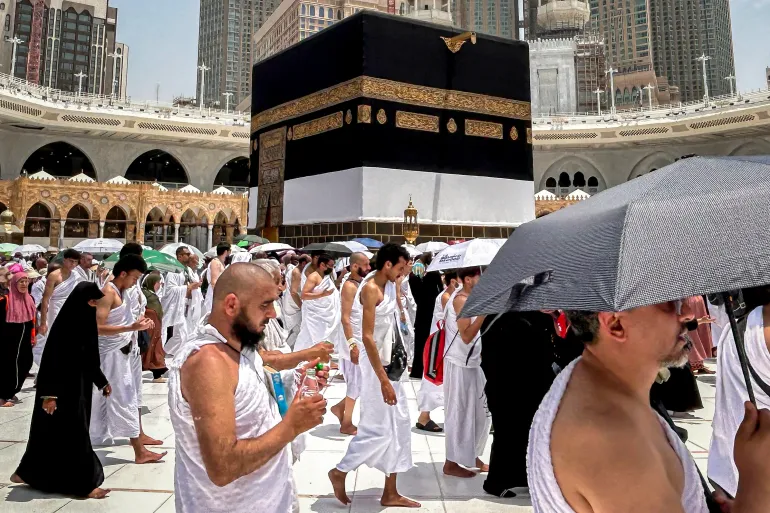
More than 1.5 million Muslim pilgrims have gathered in Saudi Arabia’s Mecca for the start of Hajj, taking place this year against the harrowing backdrop of Israel’s continued onslaught on the Gaza Strip.
The annual pilgrimage began on Friday with crowds of robed worshippers circling the Kaaba, the black cubic structure at Mecca’s Grand Mosque, many expressing sadness eight months into Israel’s war on Gaza.
“Our brothers are dying, and we can see it with our own eyes,” said 75-year-old Zahra Benizahra from Morocco.
Palestinians in Gaza were not able to travel to Mecca this year because of the closure of the Rafah crossing in May when Israel extended its ground offensive into the strip’s southern city of Rafah on the border with Egypt.
“We were deprived of Hajj because of the closure of the crossing and because of the war and destruction,” Amna Abu Mutlaq, 75, told Al Jazeera. “We are unable to leave and every time we try to leave, they tell us that the crossing is closed and we cannot leave. They deprived us of everything.”
Palestinian authorities said 4,200 people from the occupied West Bank had arrived in Mecca for the pilgrimage. One thousand more pilgrims, from the families of Palestinians killed or wounded in the war, who were already outside Gaza before Rafah was closed, were invited by King Salman of Saudi Arabia.
However, the Gulf kingdom’s minister in charge of religious pilgrimages, Tawfiq al-Rabiah, warned last week that “no political activity” would be tolerated during the event.
This year’s Hajj has also brought Syrian pilgrims to Mecca on direct flights from Damascus for the first time in more than a decade, part of an ongoing thaw in relations between Saudi Arabia and conflict stricken Syria Syria.
Syrians in rebel-held areas used to cross the border into neighbouring Turkey in their exhausting trip to Mecca for Hajj.
Saudi authorities expect the number of pilgrims attending Hajj to exceed two million this year.
One of the world’s largest religious gatherings, it involves a series of rituals in Mecca and its surroundings in western Saudi Arabia that take several days to complete.
Reporting from in front of the Great Mosque of Mecca, Al Jazeera’s Hashem Ahelbarra said: “We’re expecting pilgrims to perform the Friday prayers, to go to the plains of Mina to spend the night, and then tomorrow is going to be the very highlight of the Hajj with the day that they will spend in prayers, contemplation and incantations at the valley of Arafat.
“This is an extremely complex operation. The Saudis are deploying massive personnel throughout this journey to ensure smooth traffic and safety for all the pilgrims,” he said.
One of the five pillars of Islam, Hajj must be performed at least once by all Muslims who have the means to do so.
Some have waited for years for the chance to make the trip, with permits allocated by Saudi authorities on a quota basis for each country.
Nonaartina Hajipaoli, 50, told the AFP news agency she felt privileged to be among the 1,000 pilgrims who came this year from Brunei in Southeast Asia. “I’m speechless, I can’t describe what I feel,” she said.
The pilgrims will first perform the tawaf – circling seven times around the Kaaba. They will then head towards Mina, a valley surrounded by craggy mountains several kilometres outside Mecca, where they will spend the night in air-conditioned tents. The climax will come on Saturday with daylong prayers on Mount Arafat, where the Prophet Muhammad delivered his final sermon.
The pilgrimage is a moving spiritual experience for pilgrims who believe it absolves sins and brings them closer to God, while uniting the world’s more than two billion Muslims.
It is also a chance to pray for peace in many conflict-stricken Arab and Muslim countries, including Yemen and Sudan, where more than a year of war between rival generals has created the world’s largest displacement crisis.
As has been the case for several years, the gathering is taking place during the sweltering Saudi summer, with officials predicting average highs of 44 degrees Celsius (111 Fahrenheit).
Mohammed al-Abdulali, spokesman for the Saudi Ministry of Health, told the AFP news agency this week there were more than 10,000 documented cases of heat-related illnesses last year, 10 percent of which were heat stroke.
Mitigation measures this year include misting systems and heat-reflective road coverings.
“The authorities have been asking pilgrims to take precautionary measures amid high temperatures expected throughout the Hajj,” said Al Jazeera’s Ahelbarra.
A text message sent to pilgrims on Thursday instructed them to “drink water regularly, more than 2 litres daily” and to “always carry an umbrella”, warning that temperatures could climb to 48C (118F).
[Aljazeera]










Ireland Women 118/9 in 20 overs (Alana Dalzelle 14, Orla Prendergast 26, Leah Paul 10, Alice Tector 10, Louise Little 26*; Lauren Bell 1-39, Linsey Smith 1-20, Sophie Ecclestone 3-22, Charlie Dean 2-11, Dani Gibson 2-10) lost to England Women 119/6 in 17.3 overs (Dani Wyatt Hodge 16, Nat Sciver-Brunt 48, Heather Knight 26; Aimee Maguire 2-23, Orla Prendergast 2-17) by 4 wickets

Lionel Messi marked his record sixth World Cup appearance with his first hat-trick at a FIFA tournament as Argentina beat Algeria 3-0 to open the defence of their global crown, he also became the joint highest scorer at World Cups with the feat.
The former 38-year-old forward thought he had opened the scoring in the eighth minute in Kansas City on Tuesday when he slotted home from close range, but the offside flag was raised.
The dream start to his record-setting appearance, which will be matched by Cristiano Ronaldo for Portugal against DR Congo on Wednesday, was not to be denied for long though.
A trademark, mazy run was capped by a drive on the edge of the box from that famed left foot. The power too much for Algeria keeper Luca Zidane, son of World Cup winner with France, Zinidine.
Messi doubled his tally on the hour mark with a simple tap in from a rebound off the keeper following a drive from Alexis Mac Allister.
The moment that even a player as decorated as Messi came in the 76th minute when he drilled low past the keeper from just outside the box.
The strike took Messi level with former Germany striker Miroslav Klose on 16 World Cup goals.
His substitution came just three minutes later to a standard ovation, even old maestro seemed disappointed to be removed – and most likely rested for Argentina’s tilt at becoming only the third side to defend a World Cup title.
Algeria – the 2019 Africa Cup of Nations winners – offered little, but were themselves denied an early goal when Fares Chaibi’s ninth minute strike was ruled out for offside.
Messi saw to it that there was no opening game upset to be had tat this edition, having lost their opening game at Qatar 2022 to Saudi Arabia.
Messi, who spent the majority of his club career in Spain with Barcelona before moving to French giants Paris-Saint Germain, plys his trade in US football’s Major League Soccer with Inter Miami.
Jordan and Austria open their account in the group later on Tuesday in San Francisco.
[Aljazeera]

United States sprinter Noah Lyles has set the world’s best-ever time over the rarely-run 150 metres race, clocking 14.67 seconds at the Golden Spike meet in the eastern Czech city of Ostrava.
The 28-year-old Lyles on Tuesday beat the previous best of 14.72 set by Kishane Thompson of Jamaica in Florida in April.
At Ostrava, Lyles beat Sinesipho Dambile of South Africa with 14.78, while Australian teenager Gout Gout finished third in 14.96.
“Was there ever any doubt? Was there ever any doubt? We came for a show,” an elated Lyles told Czech TV.
Earlier this month, Lyles took a comfortable win at the Wanda Diamond League meet in Rome with a 9.88 in the 100m, his fastest since clinching gold at the Paris 2024 Olympics.
The high-energy, anime-loving showman has had strong indoor and outdoor performances throughout the year so far, and was named on this year’s Time100 list of the most influential people.
Dutch star Femke Broeders-Bol had to bow to in-form Swiss Audrey Werro in her outdoor debut in the 800m.
The 26-year-old Broeders-Bol has switched from 400m hurdles, in which she had won two world gold medals, and clocked an impressive 1 minute 57.13 seconds for second place.
“It was so cool, I love racing in Ostrava. It was tough, but I enjoyed it,” she said.
Broeders-Bol has also claimed multiple medals as the anchor leg in 4x400m relay teams, notably a gold in the mixed event in the Paris Olympics.
She ran her first 800m since 2017 in February, clocking a national record of 1 minute 59.07 seconds before withdrawing from the rest of the indoor season to nurse a foot injury.
The 22-year-old Werro won in 1 minute 54.45 seconds, half a second behind her personal best from March, after shedding Broeders-Bol with 200 metres to run.
“It was a really crazy run, but the time is very good, so I’m really happy,” Werro said.
Having set the eighth best time ever, she stayed over a second behind the oldest world record in athletics of 1:53.28 set in 1983 by Jarmila Kratochvilova of then-Czechoslovakia, who watched the race from the stands.
South Africa’s 20-year-old Bayanda Walaza won the men’s 100m as he equalled his personal best of 9.94 seconds, beating Emmanuel Eseme of Cameroon with 9.99 seconds.
US favourites Ronnie Baker and Jordan Anthony were demoted to the fourth and fifth spots, respectively, with times well over 10 seconds.
[Aljazeera]

Spinners make it two in two for England

Messi hat-trick fires holders Argentina to win over Algeria at World Cup

UNDP, Central Bank deepen financial literacy drive to build economic resilience

‘Dancing girl’s’ bare torso restored in Indian textbook after backlash

Tehran selling deal with US as victory – but for Iranians it was necessity

Plans to open underutilised state land for new investment opportunities

‘Dates have the highest sugar content to fight Coronavirus’

Sunday Island 27 December – Headlines

#SundayIsland 17th December – Headlines

Sunday Island – 28th March

Sunday Island Headlines – 21 March

Sunday Island – 21st February – Headlines
-

 News5 days ago
CIABOC summons Yoshitha over his participation in British Navy training programme
-

 Sports2 days ago
Tharanga set for high-profile javelin clash in Ostrava
-

 News5 days ago
Justice Minister responds to social media claims he represented Easter Sunday ringleader
-

 Features3 days ago
Politics of protected species
-

 News4 days ago
Commonwealth lawyers urge Lanka to uphold rule of law
-

 News2 days ago
Theft of USD 2.5 mn from Treasury: CoPF accused of complicity in NPP cover-up
-

 News2 days ago
Release of 2025 O/L results likely to be delayed
-

 News1 day ago
Beijing Capital Airlines to resume flights to Colombo signalling boost to tourism