
Latest News
Lucknow Super Giant’s playoff hopes all but gone as Capitals sign off with win


Delhi Capitals signed off the league stage with a 19-run win over Lucknow Super Giants in Delhi, and kept themselves in contention for a top-four finish, even if only mathematically. LSG, with one more game left against Mumbai Indians, aren’t out of the running either, but both teams will have to depend on other results to go their way if they are to make the top four.
From 44 for 4 in a chase of 209, LSG took the contest to the last over thanks to Nicholas Pooran’s 61 and Arshad Khan’s unbeaten 58 from No.8 . However, Rasikh Salam defended 22 off the final over to hand DC their seventh victory of IPL 2024.
On a high-scoring surface, DC had to post 200 or above to have a shot at collecting two points. After being asked to bat, Abishek Porel and Tristan Stubbs shone with fifties to power DC to 208 for 4. With the ball, Ishant Sharma ripped through LSG early on with three wickets and even though Pooran and Arshad tried their best, LSG kept losing wickets at the other end and eventually fell short.
DC lost their aggressive opener Jake Fraser-McGurk in the first over when he was caught at long-on off the left-arm quick Arshad. But Porel and Shai Hope didn’t let the wicket slow them down. After smashing six off Mohsin Khan, Porel pummeled three fours and a six in Arshad’s second over. In the following over, Hope targeted Yudhvir Singh and hit 4,4, and 6. By the end of four overs, DC had raced to 51 for 1. The duo didn’t spare Naveen-ul-Haq either as he ended up conceding 17 runs off his first over. DC ended the powerplay on 73 for 1, with Porel batting on 43 off 16.
Porel raced to his fifty in 21 balls but hit only eight runs off his next 12 balls, thanks to LSG’s spinners who exerted pressure in the middle overs. Rahul brought in Ravi Bishnoi immediately after the powerplay and bowled Krunal Pandya and Deepak Hooda from the other end. Bishnoi broke the 92-run second-wicket stand between Porel and Hope in the ninth over, when Hope thrashed a full-length wide delivery straight to cover, where Rahul took a stunning low catch to dismiss him for a 27-ball 38. After only 17 came off the next 15 balls, Porel fell to Naveen’s slower ball, trying to go big. Bishnoi finished with 1 for 26 from his four overs, as DC accumulated just 42 runs from overs 7 to 12.
After 15 overs, DC were 136 for 3 and the 200 mark looked far away. But they still had Stubbs. After scoring seven off his first nine deliveries, he took off, first smashing Arshad for two fours and a six in the 16th over and then Naveen for two sixes and a four in the 19th to get to his fifty in 22 balls. His unbeaten 57 off 25, and a quickfire 33 from Rishabh Pant, lifted DC to 208 for 4, with 72 runs coming off the final five overs.
Ishant, the Impact Player, made an impact straightaway, removing three big guns – Quinton de Kock, KL Rahul and Deepak Hooda – in his first three overs. Axar Patel’s dismissal of Marcus Stoinis – stumped by Pant – meant LSG were reeling at 44 for 4 in no time.
Despite the early blows, LSG were still in the game thanks to Pooran’s big hitting. He hit Axar for 4, 6, 4, 6 just after the left-arm spinner had removed Stoinis off his first ball. He went on to smash four more fours and two more sixes after that over – this included a reverse-sweep over extra cover for a six off Kuldeep Yadav. At the halfway stage, LSG were 97 for 5. Pooran, however, fell to Mukesh Kumar’s slower short ball, angled away from his hitting arc, slicing it to Axar at extra cover to depart for a 27-ball 61. At 101 for 6, it seemed like LSG had lost control of the chase.
There was more entertainment when Arshad came out all guns blazing. Striking at 175.5, the left-hand batter muscled five sixes and three fours to keep LSG in the game till the very end. His unbeaten knock brought down the equation to 29 off the last 12. But Mukesh and Rasikh finished with two excellent overs at the death, denying him any more boundaries, and LSG fell 19 short of DC’s total.
Brief Scores:
Delhi Capitals 208/4 in 20 overs (Abishek Porel 58, Tristan Stubbs 57*, Shai Hope 38, Rishabh Pant 33; Arshad Khan 1-45, Naveen Ul-Haq 2-51, Ravi Bishnoi 1-26) beat Lucknow Super Giants 189/9 in 20 overs (Nicholas Pooran 61, Arshad Khan 58*; Ishant Sharma 3-34, Khaleel Ahmed 1-22, Axar Patel 1-20, Mukesh Kumar 1-33, Kuldeep Yadav 1-33, Tristan Stubbs 1-04) by 19 runs
(Cricinfo)














On Wednesday, part of a glacier collapsed high in the Himalayas, triggering catastrophic flooding along the Nepal-Tibet border.
At least 160 people have been confirmed dead, while nearly 1,500 people are missing across Nepal and China’s Tibet.
In Nepal, 826 people are missing, including almost 600 foreign tourists, according to police and tourism officials. Across the border, Chinese state media reported that 558 people were missing in Tibet’s Gyirong County, including 260 foreign nationals.
Here is what we know about what triggered the disaster, where the floods struck, and the risks facing the rapidly warming Himalayan region.
What happened in Nepal?
At about 8:40am local time (02:55 GMT) on Wednesday, flash floods and mudslides swept through mountainous areas along the Nepal-Tibet border, killing at least 157 people in Nepal and three in Tibet and leaving nearly 1,500 people missing across the region.
A huge flood of water, mud and rocks swept through the Lhende Khola river valley, engulfing villages and destroying homes and critical infrastructure. At least 19 bridges and about 40km (25 miles) of roads were washed away.
Nepalese soldiers and rescue teams have been deployed with helicopters, drones and search dogs, but high river levels, damaged roads and mud have complicated efforts to reach some of the worst-hit areas.
Across the border in Tibet, deep sediment has also delayed Chinese rescue teams trying to reach the border zone.
Officials were caught off-guard by the floods on Wednesday because it was not raining, according to local news editors
The disaster appears to have begun high in the Himalayas, where part of a glacier collapsed, triggering a chain of events that caused a powerful surge of water and debris downstream
Satellite imagery showed that a substantial section of the lower end of the glacier broke away at an elevation of about 5,200 metres (17,000 feet), plunging about 1,200 metres (3,900ft) onto the valley floor, gathering rock and sediment as it fell.
The resulting ice-rock avalanche struck the Lhende River in Tibet, about 20km (12 miles) northeast of the Nepal-China border crossing. Debris temporarily blocked the river before the natural dam gave way, releasing a powerful flood downstream.
Early reports suggested that a magnitude 4.4 earthquake had triggered the collapse. However, the United States Geological Survey (USGS) later revised its assessment, saying the seismic signal had been generated by the landslide itself rather than an earthquake.
The landslide eventually registered as a magnitude 5.2 seismic event.
Where exactly did the floods happen?
The disaster struck the mountainous Nepal-Tibet border region, with some of the worst damage in Nepal’s Rasuwa district, immediately south of the Chinese border.
The initial surge entered the Lhende Khola, which feeds into the Bhote Koshi and then the Trishuli River, carrying floodwaters south through Nepal. Water levels in the Trishuli reportedly rose by as much as 9 metres (27 ft) in just 30 minutes.
In the Rasuwa district, Timure and Syapru Besi were among the affected settlements. Further downstream, flooding reached parts of Nepal’s Nuwakot and Dhading districts, damaging homes, roads and other infrastructure.
Across the border in Tibet, mud and debris hit Gyirong Port in the Shigatse region.
The Trishuli eventually joins the Narayani River, which crosses into India’s Bihar state, where it is known as the Gandak River.
What do we know about the victims?
At least 160 people have been confirmed dead, while nearly 1,500 remain missing on both sides of the Nepal-Tibet border.
- Nepal: Police have recovered at least 157 bodies.
- Tibet: Authorities have reported at least three deaths in Gyirong County, where 558 people are missing, including 260 foreign nationals.
“My brother-in-law had a liquor store here. I got a call from him this morning, and they were crying and said their entire house had been swept away,” Raju Bhadel, a local businessman in Nepal, told Al Jazeera.
Manoj Mishra, a teacher, described seeing vehicles and people being carried away by the floodwaters in Nepal. “I saw around nine trucks being swept away by the floods, including people. It’s a heartbreaking incident,” he said.

Who is missing?
Nearly 1,500 people are missing across Nepal and Tibet, including at least 800 foreign nationals.
In Nepal, 826 people were reported missing, including almost 600 foreign tourists, according to police and tourism officials. The missing tourists come from more than two dozen countries.
Among those reported missing in Nepal are:
- India: 177
- United States: 63
- Australia: 34
- United Kingdom: 33
- Canada: 25
Authorities have not yet provided a complete nationality breakdown for all the missing foreign nationals.
Across the border, Chinese state broadcaster CCTV said 558 people were missing in Tibet’s Gyirong County, including 260 foreign nationals.
Many of those caught up in the disaster were pilgrims travelling towards Kailash Mansarovar in Tibet. Tourism officials are working to account for groups that had been travelling through the region when the floods struck.
The injured and rescued
At least 65 people were being treated for injuries in local hospitals and in Kathmandu.
More than 5,000 Nepalese army and police personnel have been mobilised for the rescue operation, while helicopters are searching for survivors and delivering emergency supplies to communities cut off by damaged roads and flooding.
Survivors from badly affected areas have also been evacuated by military helicopter, including some taken to hospitals in Kathmandu.
Countries and international organisations have offered emergency assistance, funding and technical support as rescue operations continue in Nepal and Tibet.
Humanitarian and financial aid
India has sent a rescue aircraft carrying about 10 tonnes of emergency supplies to Nepal, including temporary shelters, blankets, hygiene kits, solar lamps and medicines.
Indian Prime Minister Narendra Modi spoke with Nepalese Prime Minister Balendra Shah and pledged India’s support.
The International Federation of Red Cross and Red Crescent Societies (IFRC) has released 1 million Swiss francs ($1.2m) in emergency funding to support the Nepal Red Cross Society’s relief operations and damage assessments.
The United Nations has deployed personnel in Nepal to support government-led relief efforts, while its office in China has said it is ready to assist rescue operations in Tibet.
UN Secretary-General Antonio Guterres expressed his condolences to those affected and said the organisation stood in solidarity with communities hit by the disaster.
The European Union has activated its Copernicus Emergency Management Service, which uses satellite imagery to map disaster zones and provide information that can help authorities assess damage and coordinate rescue operations.
South Korea has established a government task force after several South Korean nationals working at a hydropower project were reported missing. Seoul said it planned to send a rapid-response team involving government, fire and police personnel to Nepal to assist with the search.
The United States said it was sending a disaster response adviser and providing $500,000 in assistance.
Canadian Prime Minister Mark Carney said Canada was closely following the situation, describing the floods as “absolutely devastating”.
On the Chinese side, President Xi Jinping ordered an “all-out” search-and-rescue operation for people missing in Tibet and called for efforts to prevent further disasters.
Scientists are still investigating what triggered the glacier collapse, and it is too early to determine how much climate change contributed to this specific event.
However, the disaster comes against a backdrop of rapid warming and glacial loss across the Himalayas. Glaciers across the Hindu Kush Himalaya mountain range – which spans Afghanistan, Bangladesh, Bhutan, China, India, Myanmar, Nepal and Pakistan – lost ice 65 percent faster between 2011 and 2020 than during the previous decade. Nepal’s glaciers have lost close to one-third of their ice volume in roughly three decades.
As glaciers retreat, mountain slopes can become increasingly unstable, and meltwater can accumulate in or around glaciers, increasing the potential for sudden floods.
Satellite observations showed unusually warm conditions around the affected glacier before the collapse, with snow cover diminishing considerably and exposing more bare ice.
Researchers are investigating whether melting contributed to the glacier’s instability, but a direct link between climate change and this week’s collapse has not been established.
What is the situation now?
More than 5,000 Nepalese army and police personnel are searching for survivors and recovering bodies, while helicopters are delivering tents, food and other emergency supplies to communities cut off by the floods.
Officials have warned that the death toll is likely to rise as rescuers reach areas that remain inaccessible because of damaged roads, high water levels and thick layers of mud.
In Tibet, Chinese authorities are also monitoring a still-dammed lake upstream from the disaster zone in Gyirong that could complicate rescue efforts and pose a further flood risk.
[Aljazeera]
Latest News
UPDATE: Flash flood on Nepal-Tibet border kills more than 100, with hundreds of tourists missing
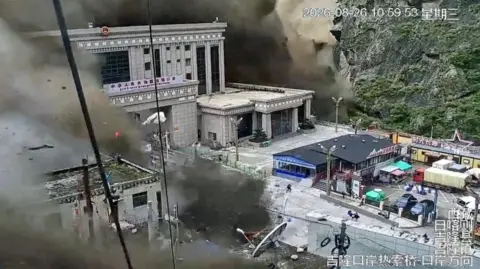
More than 100 people have been killed in Nepal and Tibet, and hundreds of tourists are missing, after a massive flash flood and mudslide
The missing tourists include more than 100 from India, 54 from the US, and 33 from the UK, as well as more than 100 from Nepal itself, according to Nepal’s tourist board. The area is popular with pilgrims and trekker.
Dozens of police officers and army prtxonnel are also missing, as well as power workers. My family was swept away in front of me, one woman tells us – she and her son survived by climbing to a rooftop
In Tibet, Chinese state media report three dead and 265 missing, CCTV from Tibet shows a wall of water and mud hitting buildings at a border crossing.
Authorities initially thought an earthquake may have triggered a landslide – the US Geological Survey now says the sesimic energy was instead generated by a landslide.
(BBC)

Nepal sent helicopters to the rescue after a huge flash flood swept away villages, killing at least eight people and damaging roads, bridges and power projects in areas near Tibet, authorities said.
Officials said 384 tourists, including 291 from countries including the United Kingdom, the United States, India and Malaysia were reported missing as a result of the flash flood on Wednesday.
The waters were too high for helicopters to land in Nepal’s affected areas of Syapru Besi and Timure in the mountainous district of Rasuwa, with a population of about 50,000, officials said.
“There could be heavy casualties or loss of property,” district administrator Narendra Pariyar told the Reuters news agency. “But I cannot say for sure now.”
Pariyar urged those living on the banks of the Bhote Koshi River in the area to seek higher ground, pointing to reports that nearby villages and infrastructure project sites were washed away.
Across the border, Tibet reported “major casualties” with people missing in the neighbouring county of Gyirong after a mudslide hit a land crossing between China and Nepal, the Xinhua official news agency said.
The mudslide hit China’s Gyirong port, cutting off roads, communications and power in the Shigatse region, Xinhua added, without giving details.
President Xi Jinping urged “all-out” efforts to search for the missing, and called for strengthening monitoring and early warning systems to prevent secondary disasters.
Prayash Adhikari, a climate justice activist in Nepal, said the “devastating” flood has wiped out “whole villages”
“Hundreds of people are missing,” Adhikari told Al Jazeera from Kathmandu, stating it wiped out buildings, schools, bridges and highways.
Videos shared by Nepal Police and others on social media showed torrents of muddy water crashing through mountain valleys.
Many people were caught off guard when the flash flood hit, as there was no heavy rainfall, said Kosh Raj Koirala, an editor of Republica Daily, an English newspaper in Nepal’s capital.
“People were at home … several houses have been washed away, swept away by the river,” Koirala told Al Jazeera.
Prime Minister Balendra Shah convened an emergency meeting of the National Disaster Risk Reduction and Management Authority to take stock of the situation.
“Work has started to take necessary steps in coordination with the medical team, scouts, and Red Cross,” Shah said in a social media post.

The Nepal Army said it had deployed helicopters and disaster response personnel to the affected area.
“The work of collecting details of the damage is under way,” it said in a statement.
The Nepal Electricity Authority said about 430 megawatts of production capacity, including from hydropower and solar facilities, have been damaged.
“The disaster has damaged the production, transmission and distribution facilities of the Authority … resulting in disruption of electricity supply,” it said.
Several highways were also closed, according to the authorities.
‘Glacial lake outburst’ could be underlying cause
Climate experts at the International Centre for Integrated Mountain Development in Nepal say an avalanche from a glacier likely caused the flash flood.
The Lhende Khola River, a tributary of the Bhote Koshi River, witnessed maximum flooding on Wednesday, they said.
“The Lhende Khola has flooded twice in 14 months, this time triggered by an ice rock avalanche from a glacier on the Nepal side that blocked the river and released a sudden surge downstream,” said Saswata Sanyal, a disaster risk reduction specialist at the climate research group.
Adhikari, the climate activist, told Al Jazeera that early warning systems are crucial to protect communities.
“This can’t be completely turned around because we are on the verge of climate catastrophe, but still we can protect our communities,” he said.
The Bhote Koshi River originates in Tibet and empties into Nepal’s Trishuli River, which eventually flows into India as the Gandak River.
A flood last year in the Bhote Koshi River killed nine people, with 24 missing, and washed away the “Friendship Bridge” linking Nepal and China, disrupting transport and trade for several months. That flood was triggered by the draining of a supraglacial lake in Tibet, a regional climate monitor said.
Monsoon rains from June to September regularly trigger deadly floods and landslides across South Asia.
Scientists say climate change is increasing the frequency and intensity of extreme weather events in the region.

Damaged houses stand precariously near the swollen, debris-choked banks of the Trishuli river after flash floods in Nepal’s Nuwakot district [Aljazeera]
[Aljazeera]

Nepal-Tibet floods: What happened, what caused them and who is missing?

Showers above 50 mm are likely in the Western, Sabaragamuwa and North-western provinces and in Kandy, Nuwara-Eliya, Galle and Matara districts

Patali alleges NPP conspiring to put off elections indefinitely

August 15 Super Dvora tragedy: Search continues for missing officer’s body

Tripartite MoU to expand free cardiothoracic surgeries at KDU Hospital

Jaffna to mark Int’l Day of the Disappeared

‘Dates have the highest sugar content to fight Coronavirus’

Sunday Island 27 December – Headlines

#SundayIsland 17th December – Headlines

Sunday Island – 28th March

Sunday Island Headlines – 21 March

Sunday Island – 21st February – Headlines
-

 News6 days ago
Country’s first woman Surveyor General appointed
-

 Business5 days ago
SriLankan Airlines makes ShakthiSAT Mission possible for talented Sri Lankan student
-

 Features6 days ago
Medical education in Sri Lanka: Then and now
-
 Latest News6 days ago
Imran Khan moved to private hospital amid deteriorating health
-

 Latest News6 days ago
Government has declared 21, 22 and 23 August 2026 as national days of mourning
-

 Features4 days ago
My secondary schooling after Royal Primary
-

 Latest News5 days ago
Tharanga edges out Chopra in 88m javelin battle
-

 News6 days ago
22A: Opp. demands all available SC judges hear petitions