
Latest News
Kohli keeps Royal Challengers Bengaluru alive in playoffs race; Punjab Kings knocked out


Virat Kohli’s breakneck 92 off 47, plus his spectacular direct hit to run Shabank Singh out, were the basis of Royal Challengers Bengaluru’s (RCB’s) fourth consecutive win, this time against Punjab Kings (PBKS) in Dharamsala. The result kept RCB’s hopes of making the IPL 2024 playoffs alive if only just, but knocked PBKS out of contention.
RCB batted first and blasted their way to 241 for 7, with Rajat Patidar smashing 55 off 23, and Cameron Green hitting 46 off 27. Both had productive partnerships with Kohli, worth 76 off 32 and 92 off 46 respectively.
In response, PBKS started strong, but RCB’s spinners – Karn Sharma and Swapnil Singh – were effective through the early middle overs, dismissing Rilee Rossouw in the ninth, Jitesh Sharma in the 11th, and Liam Livingstone in the 12th.
With the required rate now high above the run rate, it was curtains for PBKS. They ended 181 all out after 17 overs.
Kohli anyway started the match as the IPL’s highest run-scorer. But having been reprieved on zero, he went on to play one of his best innings of a stellar season, finding boundaries through the covers, through midwicket, and down the ground – his footwork often immaculate.
Though he opened the batting, he didn’t have a lot of the strike, facing only 14 balls in the powerplay. But before long he was striking at well over 150, as he found capable partners in Patidar (who was the more aggressive partner in their stand), and then Green.
It was a vintage Kohli innings, full of powerful wristy flicks and hard running, though towards the end he also got his six-hitting game going, finishing with six maximums overall.
He seemed poised to make his second triple-figure score of the season, but sliced a wide Arshdeep Singh delivery and was caught at deep cover in the 18th over.
Kohli’s wild gesticulations, it turns out, are not the only expenditure of his energy on the field.
Fourth ball of the 14th over into the PBKS innings, they needed 92 runs off 39 balls, and as long as Shashank was at the crease, they had an outside chance. But that’s when Sam Curran dropped one towards midwicket and called for two, and that was when Kohli took off from deep midwicket, speeding towards the ball, swooping on it, and skidding it mid-dive towards the one wicket he had to aim at, and found his target.
Shashank was not as committed to the run as Kohli was to this piece of fielding, and Shashank was centimetres short of his ground, not having put in a dive. He was out for 39 off 19 balls, leaving PBKS 151 for 6. They would end up losing their last five wickets for 30 runs.
Before that Kohli run out, however, legspinner Karn and left-arm spinner Swapnil had made vital strikes as well. Swapnil removed Prabhsimran Singh in the first over of the innings, before coming back in the middle overs to get Liam Livingstone tamely offer a leading edge into the covers.
Karn took two big wickets too. He first had the opposition’s best batter Rossouw caught at long-on in the ninth over, and then bowled a big, juicy legbreak that clattered into Jitesh’s stumps in the 11th over.
Although they would fall well short, PBKS did look capable of chasing down 242 at the start. They made 75 in the powerplay, thanks largely to Rossouw, who had clobbered seven fours and a six while the fielding restrictions were in place.
Rossouw continued to blast RCB’s seam bowlers in particular, motoring his way to a 21-ball half-century, before Karn eventually got him. Jonny Bairstow’s 27 off 16, and Shashank’s knock were the other serious contributors.
Brief scores:
Royal Challengers Bengaluru 241/7 in 20 overs (Virat Kohli 92, Rajat Patidar 55, Cameron Green 46; Harshal Patel 3-38, Vidwath Kaverappa 2-36, Arshdeep Singh 1-41, Sam Curran 1-50, ) beat Punjab Kings 181 in 17 overs (Rilee Rossouw 61, Shashank Singh 37, Jonny Bairstow 27, Sam Curran 22; Mohammed Siraj 3-37, Swapnil Singh 2-28, Lockie Ferguson 2-29, Karn Sharma 2-36) by 60 runs













Latest News
UPDATE: Flash flood on Nepal-Tibet border kills more than 100, with hundreds of tourists missing
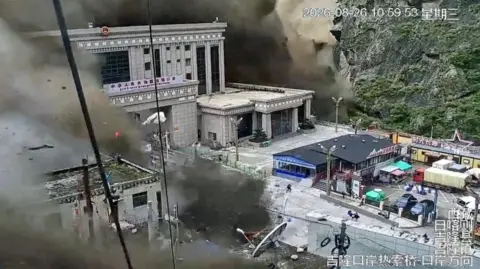
More than 100 people have been killed in Nepal and Tibet, and hundreds of tourists are missing, after a massive flash flood and mudslide
The missing tourists include more than 100 from India, 54 from the US, and 33 from the UK, as well as more than 100 from Nepal itself, according to Nepal’s tourist board. The area is popular with pilgrims and trekker.
Dozens of police officers and army prtxonnel are also missing, as well as power workers. My family was swept away in front of me, one woman tells us – she and her son survived by climbing to a rooftop
In Tibet, Chinese state media report three dead and 265 missing, CCTV from Tibet shows a wall of water and mud hitting buildings at a border crossing.
Authorities initially thought an earthquake may have triggered a landslide – the US Geological Survey now says the sesimic energy was instead generated by a landslide.
(BBC)

Nepal sent helicopters to the rescue after a huge flash flood swept away villages, killing at least eight people and damaging roads, bridges and power projects in areas near Tibet, authorities said.
Officials said 384 tourists, including 291 from countries including the United Kingdom, the United States, India and Malaysia were reported missing as a result of the flash flood on Wednesday.
The waters were too high for helicopters to land in Nepal’s affected areas of Syapru Besi and Timure in the mountainous district of Rasuwa, with a population of about 50,000, officials said.
“There could be heavy casualties or loss of property,” district administrator Narendra Pariyar told the Reuters news agency. “But I cannot say for sure now.”
Pariyar urged those living on the banks of the Bhote Koshi River in the area to seek higher ground, pointing to reports that nearby villages and infrastructure project sites were washed away.
Across the border, Tibet reported “major casualties” with people missing in the neighbouring county of Gyirong after a mudslide hit a land crossing between China and Nepal, the Xinhua official news agency said.
The mudslide hit China’s Gyirong port, cutting off roads, communications and power in the Shigatse region, Xinhua added, without giving details.
President Xi Jinping urged “all-out” efforts to search for the missing, and called for strengthening monitoring and early warning systems to prevent secondary disasters.
Prayash Adhikari, a climate justice activist in Nepal, said the “devastating” flood has wiped out “whole villages”
“Hundreds of people are missing,” Adhikari told Al Jazeera from Kathmandu, stating it wiped out buildings, schools, bridges and highways.
Videos shared by Nepal Police and others on social media showed torrents of muddy water crashing through mountain valleys.
Many people were caught off guard when the flash flood hit, as there was no heavy rainfall, said Kosh Raj Koirala, an editor of Republica Daily, an English newspaper in Nepal’s capital.
“People were at home … several houses have been washed away, swept away by the river,” Koirala told Al Jazeera.
Prime Minister Balendra Shah convened an emergency meeting of the National Disaster Risk Reduction and Management Authority to take stock of the situation.
“Work has started to take necessary steps in coordination with the medical team, scouts, and Red Cross,” Shah said in a social media post.

The Nepal Army said it had deployed helicopters and disaster response personnel to the affected area.
“The work of collecting details of the damage is under way,” it said in a statement.
The Nepal Electricity Authority said about 430 megawatts of production capacity, including from hydropower and solar facilities, have been damaged.
“The disaster has damaged the production, transmission and distribution facilities of the Authority … resulting in disruption of electricity supply,” it said.
Several highways were also closed, according to the authorities.
‘Glacial lake outburst’ could be underlying cause
Climate experts at the International Centre for Integrated Mountain Development in Nepal say an avalanche from a glacier likely caused the flash flood.
The Lhende Khola River, a tributary of the Bhote Koshi River, witnessed maximum flooding on Wednesday, they said.
“The Lhende Khola has flooded twice in 14 months, this time triggered by an ice rock avalanche from a glacier on the Nepal side that blocked the river and released a sudden surge downstream,” said Saswata Sanyal, a disaster risk reduction specialist at the climate research group.
Adhikari, the climate activist, told Al Jazeera that early warning systems are crucial to protect communities.
“This can’t be completely turned around because we are on the verge of climate catastrophe, but still we can protect our communities,” he said.
The Bhote Koshi River originates in Tibet and empties into Nepal’s Trishuli River, which eventually flows into India as the Gandak River.
A flood last year in the Bhote Koshi River killed nine people, with 24 missing, and washed away the “Friendship Bridge” linking Nepal and China, disrupting transport and trade for several months. That flood was triggered by the draining of a supraglacial lake in Tibet, a regional climate monitor said.
Monsoon rains from June to September regularly trigger deadly floods and landslides across South Asia.
Scientists say climate change is increasing the frequency and intensity of extreme weather events in the region.

Damaged houses stand precariously near the swollen, debris-choked banks of the Trishuli river after flash floods in Nepal’s Nuwakot district [Aljazeera]
[Aljazeera]
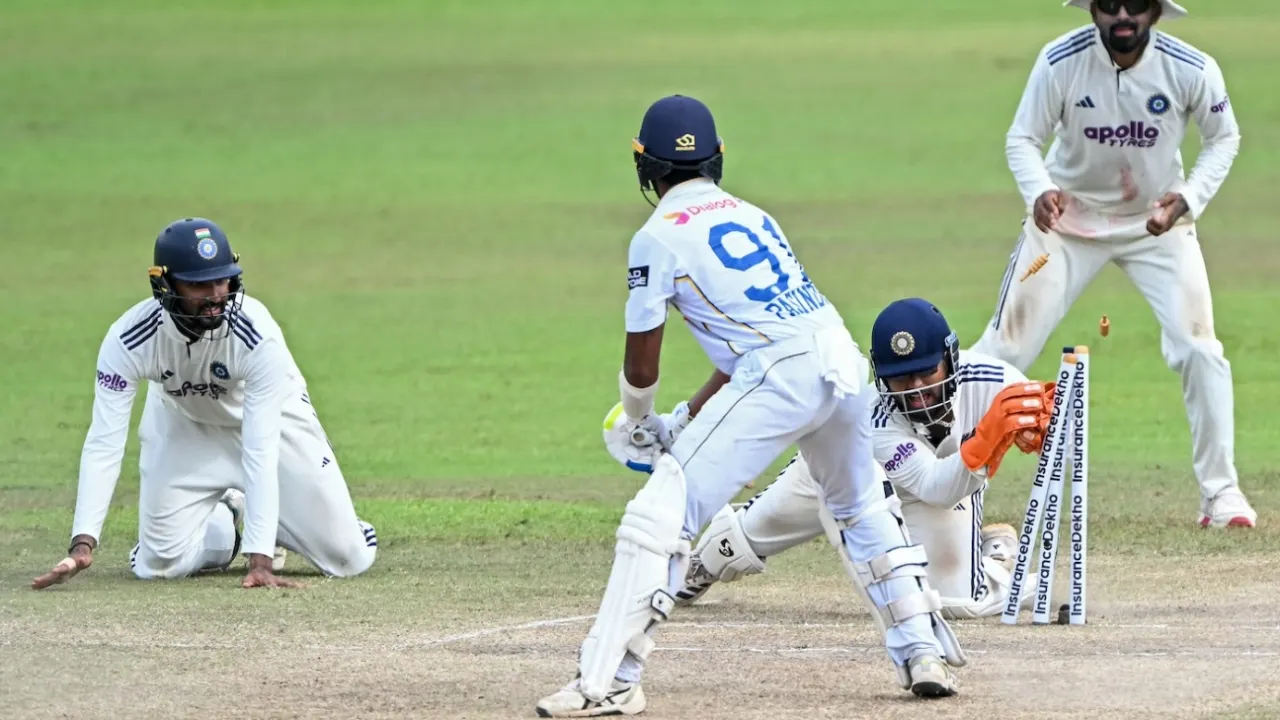
Playing just his second Test and the first in his team’s starting XI, Pasindu Sooriyabandara made Sri Lanka dream of the rarest of possibilities, but reality imposed itself on the SSC late on day four as India regained their grip on a Test match that had seemed to spiral out of control after the threat of bad weather led them to enforce the follow-on.
After Sooriyabandara put on 58 with Kamil Mishara for the second wicket and 115 with Kamindu Mendis for the third, Sri Lanka were at one stage 209 for 3, or just four runs behind with seven second-innings wickets in hand, on a day-four pitch that was still looking excellent for batting. India’s bowlers were into their 149th over across two consecutive innings, and looking short of both penetration and inspiration against a top order that had never allowed them to settle into their lengths.
Just then, however, Manav Suthar, who had borne the brunt of Sri Lanka’s positive intent, dismissed Dhananjaya de Silva and then Sooriyabandara in the space of two overs, the latter out eight short of a maiden Test hundred. Soon after, Saransh Jain trapped Niroshan Dickwella lbw, and Sri Lanka were effectively 5 for 6. By the time rain arrived to bring an early end to the day, Sri Lanka’s seventh-wicket pair had only added a further 11 runs to their tally.
If Sri Lanka still retain any hope going into the final day of this series, it will rest on the shoulders of Sonal Dinusha, batting on 7 in his final innings of a remarkable series. Earlier in the day, he had converted his overnight 85 into his second century of the series, with his only other completed innings bringing him 84.
Scores:
Sri Lanka 290 in 89.4 overs (Pasindu Sooriyabandara 80, Sonal Dinusha 103; Prasidh Krishna 3-52, Manav Suthar 3-85) and 229 for 6 in 72.4 overs (f/o) (Pasindu Sooriyabandara 92, Kamindu Mendis 55, Sonal Dinusha 7*; Manav Suthar 2-81) lead India 503 for 9 dec by 16 runs
[Cricinfo]

UPDATE: Flash flood on Nepal-Tibet border kills more than 100, with hundreds of tourists missing

At least eight killed, hundreds missing after Nepal flash flood

India close in despite Sooriyabandara, Kamindu fifties

Advisory for High Waves for the sea areas extending from Colombo to Pottuvil via Galle, Matara and Hambantota

We must create social awareness to ensure the physical and mental well-being of children with disabilities – PM

BCCI AGM set for September 18 in Mumbai

‘Dates have the highest sugar content to fight Coronavirus’

Sunday Island 27 December – Headlines

#SundayIsland 17th December – Headlines

Sunday Island – 28th March

Sunday Island Headlines – 21 March

Sunday Island – 21st February – Headlines
-

 News6 days ago
Country’s first woman Surveyor General appointed
-

 Business5 days ago
SriLankan Airlines makes ShakthiSAT Mission possible for talented Sri Lankan student
-

 Sports7 days ago
Tharanga, Weber headline stellar Lausanne javelin field
-

 Features6 days ago
Medical education in Sri Lanka: Then and now
-

 Business7 days ago
Mannar’s offshore opportunity: the dollar question behind Sri Lanka’s oil and gas search
-
 Latest News6 days ago
Imran Khan moved to private hospital amid deteriorating health
-

 Latest News6 days ago
Government has declared 21, 22 and 23 August 2026 as national days of mourning
-

 Features4 days ago
My secondary schooling after Royal Primary