
News
Jackal population has decreased 60% during last 20 yrs in SL


By Rathindra Kuruwita
The population of Sri Lankan jackals has dropped by about 60 percent during the last two decades and this is an indication of serious problems in the Sri Lankan environment, Prof. Sampath S. Seneviratne, of the Department of Zoology and Environment Sciences, University of Colombo has said.
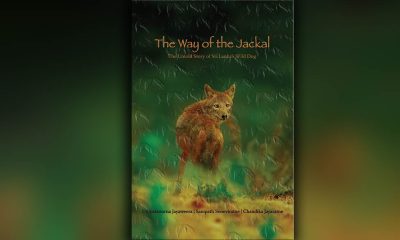
Prof. Seneviratne, one of the authors of the research study, titled ‘The Way of the Jackal’, said that jackals and their cousins, the fox and the wolf, were spreading rapidly in other parts of the world, especially in Western Europe.
Prof. Seneviratne said Sri Lankans did not hunt the jackal for meat or its fur/skin. There are hardly any negative interactions between humans and jackals in Sri Lanka, he added.
“We have been conducting research on jackals. We have looked at their population across the country. We found that the jackal population has dropped by about 60 percent in the last 20 years. What’s going on? Are they the canaries in the mine who tell us that something awful is taking place in our environment?”
Prof. Seneviratne said farmers in some parts of the country told them that the jackal population has dropped, following the widespread use of pesticides.
“Humans live about 70 years and a jackal usually lives for about 10 years. They eat things that are identical to what we eat. The jackal eats rice, jackfruit, coconuts, etc. If you give your plate of rice and curries to a jackal, he or she will eat it. They also eat mice, frogs and small animals that are found in the forest and agricultural lands. When animals die after being exposed to pesticides, the jackals often eat the carcasses because he is a scavenger.”
Prof. Seneviratne said they had also carried out autopsies of many dead jackals. It is possible that eating small animals that have been killed by pesticides might be leading to the deaths of jackals.
“A lot of veterinarians told us that in the wet zone, they encounter jackals with distemper. This virus initially attacks the cells of the immune system, weakening an animal’s immune response and putting it at higher risk of other infections. Later their hind legs become paralyzed and then they die. The veterinarians think domestic dogs develop distemper and this is then spread to jackals,” he said.
On the other hand the ‘ovitas’ in the paddy fields, the chenas, the shrubland and the rubber lands in the wet zone are being cleared. The jackals dig burrows and raise their pups in them. They also keep away from dogs, who usually attack them. Thus, they usually have burrows in a semi-cleared area close to the village and with the gradual destruction of such areas, the habitat of jackals are being destroyed.
“The jackals and farmers are not in conflict. Jackals eat the animals that are a nuisance to farmers. They eat serpents, rodents, peacock eggs, small pigs, etc. He is a great balancer of the ecosystem. When the jackal population drops, we can assume the balance in the ecosystem has collapsed. In parallel, we see a spike in peacock population.”
Prof. Seneviratne said the proliferation of peacocks in the wet zone was quite recent and Sri Lankans must realise that it was the jackals that had kept the peacock population in check and had relegated them to the dry zone.
Prof. Seneviratne said that peacock eggs were vulnerable to other animals, but adult peacocks were without any threats from other animals. “The jackal eats peacock eggs and kill their young. Since the jackal population has dropped, the peacock population has exploded,” he said, adding that they were now conducting a research to determine if the Sri Lankan jackal (canis aureus nariya) was an indigenous species.
Prof. Seneviratne said that the tiger was the animal with most tourist attraction. It is followed by the panda, elephant, lion and the leopard.
“A lot of tourists come to Sri Lanka to see leopards and the value of a leopard in Yala has been estimated at 43 million rupees. In the United States the tourism value of the wolf, the big brother of the jackal, is estimated at 171,000 dollars. The jackal is the little brother of the wolf, but we have not marketed this animal at all,” he said, adding that there were only a few instances where the Sri Lankan jackal had attacked humans. That happens especially when jackals contract rabies from domesticated dogs.
“In 2020, the anti-rabies campaign came to a standstill. In 2019, it was also affected due to the Easter Sunday attacks. Thus, cases of rabies increased and in Horana some jackals got infected by domestic dogs. Those jackals came to the village and bit a few villagers. Two people died and 32 jackals were killed by village dogs when they strayed into the village,” he said.


News
The government is implementing a comprehensive programme to restore the livelihoods of fishermen and businesses affected by Cyclone Ditwah – PM


Prime Minister Dr. Harini Amarasuriya stated that the Government has implemented a comprehensive programme to assist the fishing community and micro, small, medium, and large-scale entrepreneurs affected by Cyclone Ditwah in rebuilding their livelihoods.
The Prime Minister made these remarks while responding to questions in Parliament on Tuesday (09) regarding the relief measures introduced for those affected by the disaster.
Prime Minister Dr. Harini Amarasuriya stated:
“The Ministry of Fisheries, Aquatic and Ocean Resources has initiated a special assistance programme for both marine and inland fishermen affected by Cyclone Ditwah. Under this programme, new fishing vessels will be provided to replace those that were completely destroyed, while partially damaged vessels will be repaired. The distribution of fishing nets to eligible fishermen has also commenced.
To support the recovery of businesses damaged by the cyclone, the Government has introduced a concessional loan scheme carrying an annual interest rate of 3 per cent. The programme, with a total allocation of Rs. 10,000 million, is being implemented through 15 banks. As at 28 April 2026, loans amounting to Rs. 3,812 million had been disbursed to 2,800 entrepreneurs. The scheme offers a repayment period of up to three years, including a six-month grace period, with the objective of enabling businesses to resume operations without delay. Applicants are required to obtain recommendations from the Grama Niladhari and the Divisional Secretary certifying that the business was operational before the cyclone and that it was affected by the disaster.
The Prime Minister further stated that, on the instructions of the Central Bank of Sri Lanka, licensed banks have granted a moratorium on loan repayments and waived penalty interest until 31 January 2026. The Prime Minister also emphasized that compensation payments to affected entrepreneurs are continuing in accordance with the relevant ministerial circulars and disaster relief guidelines.
[Prime Minister’s Media Division]
News
Formulation of a Draft Economic Development Bill to expedite the process of Digital Transformation and Digital Economic Development

It is essential to establish an institutional framework with legal powers to ensure the effective implementation of national digital policy and guidelines.
Quality human capital should be attracted to this institutional framework for the compilation of policies, implementation of policies, regulation, and empowerment of operations. The continuous participation of the private sector should also be considered in establishing a strong institutional framework.
It has been further identified that attention should also be
drawn to new fields of digital innovation, including support for artificial intelligence and related activities.
Taking into consideration the aforementioned matters, a concept paper has been formulated to prepare a Draft Economic Development Bill for the establishment of a new institutional framework.
Accordingly, the Cabinet of Ministers has approved the resolution furnished by the President in his capacity as the Minister of Digital Economy to instruct legal draftsman to formulate a Draft Economic Development Bill based on the aforementioned concept paper.
The Sri Lanka Community and Health Survey is the main data source for obtaining necessary information for reviewing progress toward achieving the national health development goals, as well as the expected sustainable development goals by 2030.
The last survey was conducted in the year 2016, and the Sri Lanka Community and Health Survey should be conducted to obtain updated data to enable the collection of related data and indicators concerning the health and well-being targets of the Global Sustainable Development Objectives.
Accordingly, the Cabinet of Ministers has approved the resolution furnished by the President in his capacity as the Minister of Finance, Planning, and Economic Development to take necessary steps to conduct the aforementioned survey.

India’s Sri Lanka Test tour set to begin in Galle on August 15

US strikes Iran in response to downing of military helicopter

The government is implementing a comprehensive programme to restore the livelihoods of fishermen and businesses affected by Cyclone Ditwah – PM

Air Canada pilot accused of flying for 17 years without proper licence

Rana and Mosaddek star as Bangladesh end 21-year wait with crushing win

Formulation of a Draft Economic Development Bill to expedite the process of Digital Transformation and Digital Economic Development

‘Dates have the highest sugar content to fight Coronavirus’

Sunday Island 27 December – Headlines

#SundayIsland 17th December – Headlines

Sunday Island – 28th March

Sunday Island Headlines – 21 March

Sunday Island – 21st February – Headlines
-

 Latest News7 days ago
Kusal Mendis, Pathum Nissanka, bowlers put Sri Lanka 1-0 up
-

 News7 days ago
New US tariffs proposed on 60 countries, including Sri Lanka
-

 Features6 days ago
Power crept into the Sangha and is now tearing it apart
-

 Features6 days ago
Kondachchi wind farm and battery storage project to boost energy security, says Power Ministry Secretary
-

 News4 days ago
Women’s T20 World Cup 2026 warm-up: Chamari Athapaththu’s 94 helps Sri Lanka beat Pakistan
-

 Features6 days ago
Saudi Arabia sets new benchmark in Hajj management as 1.7 million pilgrims complete sacred journey
-

 News5 days ago
Asst. Manager, security officer arrested over Rs 30 mn snatch at Horana PB branch
-

 Editorial3 days ago
Probe Sallay’s complaint