
News
May Day: Further divisions emerge within political parties, new alliances, while some lawmakers stay at home

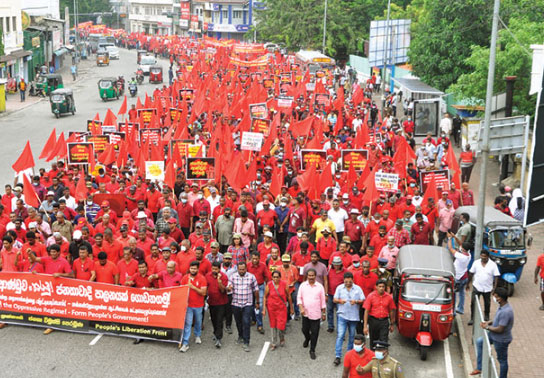
By Shamindra Ferdinando
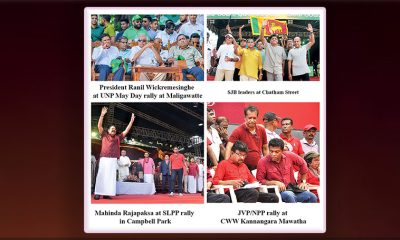
In spite of determined UNP’s efforts, it couldn’t convince SJB MPs to switch their allegiance to President Ranil Wickremesinghe in time for yesterday’s May Day rally, presided over by the green leader at Maligawatte, Colombo, the main Opposition party said.
Gampaha District SJB lawmaker Kavinda Jayawardena told The Island that regardless of the UNP’s repeated appeals, the party was sure none in its parliamentary group would join President Wickremesinghe in the run-up to the presidential poll.
UNP General Secretary Palitha Range Bandara, on several occasions, invited the breakaway SJB group to extend their support to Wickremesinghe, thereby strengthened the party.
The SJB secured 54 seats, including seven National List slots – the second largest group elected at the last parliamentary polls, conducted in August 2020, whereas the UNP was able to scrape just one National List slot.
MP Jayawardena said that as the UNP hadn’t been so far able to propose a tangible plan of action to overcome the continuing economic-political-social crisis, it couldn’t expect political parties to extend their support to the UNP leader.
Two SJB MPs Manusha Nanayakkara and Harin Fernando, during Ranil Wickremesinghe’s tenure as Premier, joined the government in May 2022, but since he received the presidency in July 2023, no SJB MP switched his or her allegiance to the President.
Earlier in the day, President Wickremesinghe and yet the formidable party among plantation workers, the Ceylon Workers Congress, held a May Day rally at the Kotagala public grounds. The single largest political party, representing the Upcountry Tamils, extended an invitation to President Wickremesinghe as it quit the ruling SLPP. The CWC contested the last parliamentary election on the SLPP ticket. Jeevan Thondaman represents the CWC in Wickremesinghe’s Cabinet.
The EPDP, represented in Cabinet by Jaffna District MP Douglas Devananda, joined the ruling SLPP’s rally at the Campbell Park, while his spokesperson Nelson Edirisinghe told The Island that the party would support President Wickremesinghe at the forthcoming presidential poll. Responding to another query, Edirisinghe said that the EPDP contested the last parliamentary election on the SLPP ticket and won two seats in Jaffna and Vanni.
The ruling SLPP held its rally, sans some of its members, as well as key constituent parties. The SLPP that had won 145 seats, including 17 National List slots, lost nearly 30 MPs since the last general election. Of them, six led by former External Affairs Minister Prof. G. L. Peiris joined the SJB rally held at Chatham Street, Colombo. Other members of Prof. Peiris’s group were Dilan Perera, Dr. Nalaka Godahewa, Wasantha Yapa Bandara, K.P.S. Kumarasiri and Dr. Upul Galappaththy.
The other original members of that group, including Matara District MP Dullas Alahapperuma, hadn’t been able to reach a consensus regarding future course of action, sources said. Therefore, they refrained from either joining any other political party or organizing an event of their own to mark the May Day. That group included Dullas Alahapperuma, Prof. Channa Jayasumana, Charitha Herath, Ratnapala Ratnasekera, Lalith Ellawela and Thilak Rajapaksha.
Patali Champika Ranawaka, who entered Parliament on the SJB ticket, didn’t organize a May Day event, while a senior spokesman said that they were preparing for the convention of the party. Former minister Ranawaka leads the Eksath Janaraja Peramuna that received the Election Commission’s recognition last year. Another elected on the SJB to skip May Day was Kumara Welgama, leader of New Lanka Freedom Party.
Uththara Lanka Sabhagaya (ULS), consisting of another active SLPP rebel group, held its rally at the Lalith Athulathmudali playground, Kirulapone. National Freedom Front (NFF) leader and former Minister Wimal Weerawansa chaired the meeting, in his capacity as the Chairman of the alliance, comprising Communist Party (represented by Dr. G. Weerasinghe and Weerasemana Weerasinghe, MP), Pivithuru Hela Urumaya (MP Udaya Gammanpila), Our Power of People Party (Ven. Atureliye Rathana, MP, in his capacity as the leader of Dharani Jathika Sabhawa) and civil society group Yuthukama (Gevindu Cumaratunga) joined the rally.
The ULS declared in unison at its May Day rally that it was the only grouping genuinely opposed to President Wickremesinghe’s agenda inimical to national interests.
Gampaha District MP Nimal Lana’s ‘New Alliance’, consisting of SLPP MPs, too, kept away from the Campbell Park rally. That group has pledged its support to President Wickremesinghe but decided not to join the rally until the official declaration of Wickremesinghe candidature.
State Minister Lasantha Alagiyawanna said that the majority of the SLFPers, who had been elected on the SLPP ticket, decided to keep away from May Day rallies. This group included the majority of the 14-member SLFP group in Parliament now.
Responding to The Island query, MP Alagiyawanna said that a May Day meeting that had been organized in Gampaha by Maithripala Sirisena faction of the party was meant to boost the image of Justice Minister Dr. Wijeyadasa Rajapakshe, PC, whose appointment as Acting Chairman of the SLFP didn’t receive the approval of Court.
However, the SLFP rally that was attended by only two MPs – Maithripala Sirisena and Dushmantha Mithrapala -attracted just a fraction of the crowds the party used to attract over the years. Minister Mahinda Amaraweera, another key member of the group opposed to Sirisena’s leadership, was away from the country.
MP Dayasiri Jayasekera said that he didn’t organize any event as a member of the SLFP but addressed a gathering organized by Prabha Ganeshan, a member of a political grouping recently set up by the SLFPer.
The JVP held four rallies, including one in Colombo, whereas two breakaway factions, the NFF and Peratugaami Pakshaya, addressed supporters separately. The NFF is a member of the ULS.
****
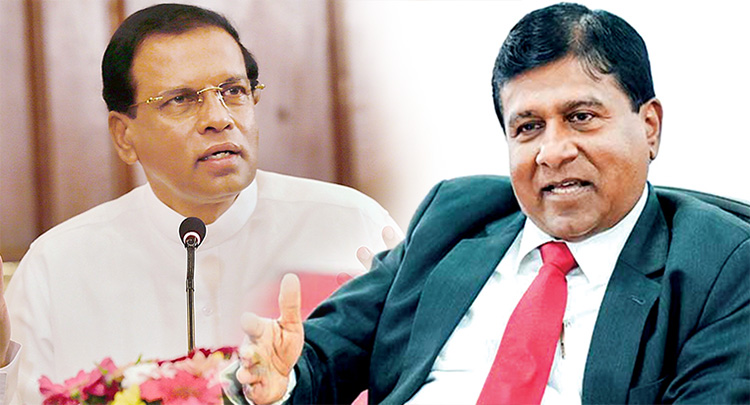
Sirisena announces WR’s presidential candidature
Amidst continuing turmoil in the SLFP, its suspended Chairman Maithripala Sirisena on May Day announced that Justice Minister Dr. Wijeyadasa Rajapakshe, PC, would contest the forthcoming presidential election.
Former President Sirisena pledged SLFP’s backing for Rajapakshe’s candidature at the election scheduled to be held later this year at the commemoration ceremony of the late T.B. Ilangaratne in Colombo.
The former President said that Wijeyadasa Rajapakshe has the support of the majority of party members.
“Wijayadasa Rajapakshe will run for the upcoming Presidential election and we will offer him our full support,” he said. The unexpected public announcement was made ahead of the SLFP May Day rally in Gampaha and Sirisena himself was suspension from all internal functions of the party on a court order.






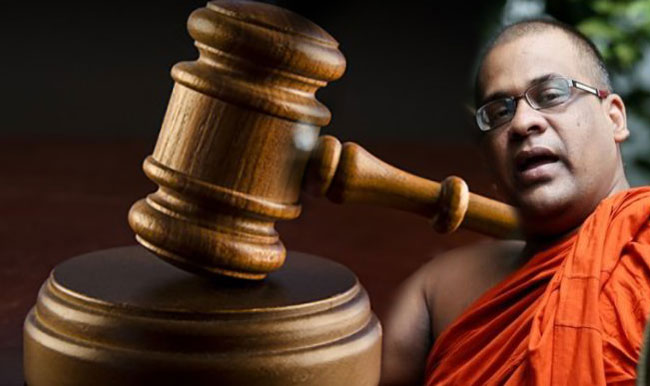
Ven. Galagoda Aththe Gnanasara Thero was not at his temple in Rajagiriya when prison officials visited the premises yesterday to take steps following the Supreme Court ruling that nullified the presidential pardon granted to him, police sources said.
Prison officials who visited the temple on Nawala Road, Rajagiriya, were reportedly informed by those present that the Thero’s whereabouts were unknown. The development comes a day after the Supreme Court declared former President Maithripala Sirisena’s 2019 pardon of Gnanasara Thero null and void.
The three-member Supreme Court bench comprising Justices Janak De Silva, Dr. Sobhitha Rajakaruna and Sampath B. Abayakoon held that the pardon was arbitrary, violated the public trust and principles of natural justice, and was made beyond the proper exercise of the President’s constitutional discretion.
The case arose from Gnanasara Thero’s conduct at the Homagama Magistrate’s Court in January 2016 during proceedings relating to the disappearance of journalist and political cartoonist Prageeth Eknaligoda.
The Court of Appeal convicted him on four counts of contempt of court in 2018 and imposed concurrent prison terms amounting to six years. He had served about nine months when Sirisena granted him a presidential pardon on May 23, 2019.
The Supreme Court found that although Article 34 empowers the President to grant pardons, that power is held in trust for the people and is subject to constitutional limitations and judicial review. The Court concluded that Sirisena had effectively acted on the recommendation of the Additional Secretary (Legal) without demonstrating that he had independently considered the relevant material.
Justice De Silva held that the pardon was “arbitrary”, violated public trust and the rules of natural justice, and was ultra vires the President’s powers. The Court consequently found that the decision violated the fundamental right to equality guaranteed by Article 12(1) of the Constitution.
The ruling effectively restores the legal position under the original conviction, leaving Gnanasara Thero without the benefit of the 2019 pardon. The Supreme Court also clarified that a pardon does not erase a conviction or sentence, but merely relieves an offender from serving the sentence to the extent specified in the pardon.
Gnanasara Thero, the General Secretary of the Bodu Bala Sena, had been convicted over his conduct during proceedings concerning the disappearance of Eknaligoda, who went missing in January 2010 and has not been located.
Sandhya Eknaligoda, Prageeth Eknaligoda’s wife, was among those who challenged the presidential pardon before the Supreme Court, alongside the Centre for Policy Alternatives and its Executive Director Dr. Paikiasothy Saravanamuttu.
The detailed account of the judgment indicates that the Court’s ruling primarily nullified the pardon and restored the legal effect of the original sentence, with the implementation of the sentence falling to the relevant authorities.
Police sources said that the Supreme Court, however, did not permanently close the door on executive clemency. It held that a future President could grant Gnanasara Thero another pardon, provided the power is exercised lawfully and after proper consideration of all relevant material.
The Supreme Court has so far overturned three presidential pardons granted to two former Presidents. In January 2024, the Court declared former President Gotabaya Rajapaksa’s pardon of former MP Duminda Silva unlawful and invalid. In June 2024, it invalidated two pardons granted by former President Maithripala Sirisena to Royal Park murder convict Jude Shramantha Anthony Jayamaha — the first in May 2016, which commuted his death sentence to life imprisonment, and the second in October 2019, which released him from prison. Jayamaha, who was convicted of the murder of 19-year-old Yvonne Johnson, remains at large. Most recently, on September 10, 2026, the Supreme Court declared Sirisena’s 2019 pardon of Ven. Galagoda Aththe Gnanasara Thero null and void, ruling that it was arbitrary and inconsistent with the Constitution.

Parliament is scheduled to debate the Twenty-Second Amendment to the Constitution Bill and the Judicature (Amendment) Bill on September 24 and 25, subject to the Speaker’s announcement following the delivery of the Supreme Court determination on petitions filed against the Bills.
The programme for the Parliamentary Week from September 22 to 25 was decided at a meeting of the Committee on Parliamentary Business held on Thursday (10) under the chairmanship of Speaker Dr. Jagath Wickramaratne.
On each sitting day, Parliamentary Business under Standing Orders 22(1) to 22(6) will be taken up from 9.30 am to 10 am, followed by Questions for Oral Answers from 10 am to 11 am Questions under Standing Order 27(2) will be taken up from 11 am to 11.30 am.
On Tuesday (22), the Orders published in Extraordinary Gazette No. 2497/37 under the Petroleum Resources Act and the Promotion of Export Agriculture (Amendment) Bill will be debated from 11.30 am to 5 pm.
The Tredso Development Foundation (Incorporation) Bill, a Private Member’s Bill, will then be taken up for Second Reading before being referred to the Legislative Standing Committee.
An Opposition motion at the Adjournment Time will follow.
On Wednesday (23), the Chartered Institute of Media Professionals of Sri Lanka Bill will be debated from 11.30 am to 5 pm, followed by Questions at the Adjournment Time.
The Second Reading debate on the 22nd Amendment Bill and the Judicature (Amendment) Bill is scheduled for 11.30 am to 7 pm on Thursday (24) and Friday (25).

Two children aged 11 and 17 were mistakenly killed and their 55-year-old father injured in an early morning hand grenade attack on Sirisangabo Mawatha on Friday. Police investigations later revealed that the attackers targeted the wrong house during an ongoing underworld clash.
Three police teams have been deployed to investigate the attack, which occurred at around 3 am.
According to police, a man who arrived near the house in a three-wheeler knocked on the front door before throwing a grenade into the premises and fleeing.
The victims were identified as 17-year-old Kasun Rashmika and 11-year-old Duminda Gihan. Their 56-year-old father, Nalin Thusantha Perera, was seriously injured and admitted to the Kalubowila Teaching Hospital.
Police said the injured man’s brother was allegedly a close associate of a drug trafficker known as ‘Sando’ and had also been accused of involvement in drug trafficking.
The brother lives in a house adjoining the one targeted in the attack, and police suspect the grenade may have been thrown at the wrong house.
Police are also investigating information that the attack was allegedly carried out at the direction of several overseas-based drug traffickers, identified as Pandithage Shantha Kumara alias ‘Kos Malli’, Samantha Perera alias ‘Chuwa Samantha’, ‘Kudu Avishka’ and ‘I.D.’
Police said the attack was believed to be linked to an ongoing conflict between two underworld factions, which have targeted each other’s associates in shootings and grenade attacks. More than 20 people have reportedly been killed in such attacks.
Security agencies are also investigating alleged links between one faction and overseas-based criminals including Kanjipani Imran, Unakuruwe Shantha, Dubai Gagana and Handaya.
Security agencies have also received information that overseas-based criminals identified as Kanjipani Imran, Unakuruwe Shantha, Dubai Gagana and Handaya are allegedly behind the supply of firearms and drugs to the faction associated with Kos Malli and Chuwa Samantha.

Death toll from Philippines ferry fire rises to 76, with more still missing

Anthropic boss Dario Amodei calls for AI development to slow down

It’s spin vs spin as India and Sri Lanka battle for Asia Cup title

Atmospheric conditions are favorable for afternoon thundershowers in most parts of the Island today [13]

Gnanasara Thero absconding after SC ruling

House to debate 22A, Judicature Bill next week

‘Dates have the highest sugar content to fight Coronavirus’

Sunday Island 27 December – Headlines

#SundayIsland 17th December – Headlines

Sunday Island – 28th March

Sunday Island Headlines – 21 March

Sunday Island – 21st February – Headlines
-

 Sports3 days ago
DDS set to lose Test captaincy
-

 Features7 days ago
After the parade: What a traffic OIC’s walk-out tells us
-

 Editorial7 days ago
Arrests as theatre
-
 News6 days ago
Thailand shuts door on undesirables from Sri Lanka
-

 Latest News7 days ago
Harshitha’s composed knock seals Sri Lanka’s semi-final berth
-

 News3 days ago
Sri Lanka faces new grid challenge as rooftop solar surges: former CEB GM
-
 Business6 days ago
CEB successor company breaks into top three in competitive BESS tender
-

 News7 days ago
‘Choka Malli’ slips out of country before travel ban