
News
SJB demands to know who occupied rooms 616 and 623 while Zahran was on 6th floor


Shangri-La Hotel in Easter Sunday mystery:
By Shamindra Ferdinando
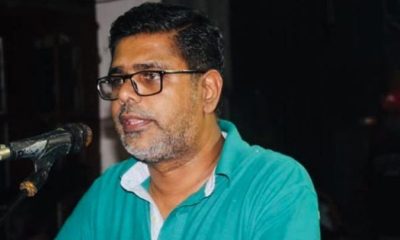
SJB spokesperson Mujibur Rahman on Sunday (21) alleged that attempts were being made to hide the identities of persons whom two Easter Sunday suicide bombers–– ringleader Zahran Hashim and his accomplice Ilham Ahamed, who blasted themselves at the Shangri-La Colombo on the morning of April 21, 2019––had met in the same hotel the previous day.
Addressing the media at the Opposition Leader’s Office, the former Colombo District UNP MP said that the two suicide bombers had stayed at a room on the sixth floor, on the night of 20 April.
At the time of the suicide blasts, Rahman was a member of the ruling UNP-led Yahapalana administration (2015-2019).
Rahman, who previously represented the UNP in Parliament, said he had got to know that the hotel refrained from disclosing the identities of those who occupied the room before Hashim and Ahamed moved in on the night of April 20, 2019.
The SJB official said that they got to know about the hotel’s failure to reveal the names of the guests after having examined the proceedings of the ongoing High Court of Colombo case that dealt with the Easter Sunday carnage.
Ilham Ahamed’s brother Mohamed Ibrahim Inshaf Ahamed carried out the suicide blast in the Cinnamon Grand hotel. Responding to The Island queries, Rahman said that comparison of Hashim’s DNA samples with that of his wife and daughter, apprehended a week later, following a confrontation with the Army at Sainthamaruthu, proved beyond any doubt that the ringleader had been killed in the Shangri-La blast.
According to Rahman, a comprehensive list of those who had stayed at the Shangri-La Colombo, during the period of two weeks before the day of the blasts, had been submitted to the Colombo High Court, sans information pertaining to room number 616.
Spice merchant Mohamed Yusuf Ibrahim is the father of Ilham Ahamed and Mohamed Ibrahim Inshaf Ahamed. His daughter-in-law detonated herself, killing three police personnel during a raid on their luxurious Dematagoda residence.
Rahman told the media briefing at the Opposition Leader’s Office that the identities of those who had stayed in another room, also on the sixth floor of Shangri-La hadn’t been revealed to the Colombo High Court.
Emphasising the responsibility on the part of the Wickremesinghe-Rajapaksa government to reveal the truth, the ex-lawmaker said that those who stayed at room numbered 623, too, seemed to have been involved with the Zahran Hashim’s group. Rahman later told The Island that the Shangri-La management had prepared a comprehensive list of all guests at the hotel at the time of the blasts leaving out those who had stayed at 616 and 623 on the night of April 20, 2019. “We believe that there were some foreigners in room 623 whereas Zahran Hashim’s accomplices in Room 616 were a mystery,” the ex-MP said.
Rahman said that the government or perhaps the Attorney General’s Department owed the public an explanation as to why two senior retired police officers, Senior DIG Ravi Seneviratne and SSP Shani Abeysekera, who the spearheaded investigations into the Easter Sunday carnage, had not been listed as witnesses. Similarly, DIG Nalaka de Silva, who headed the Terrorist Investigation Division (TID), which had been tasked with inquiring into the clandestine activities of the National Thowheed Jamaath (NTJ), during Yahapalana regime, in the run-up to the Easter Sunday blasts, had also been left out of the list of witnesses, Rahman said.
The former lawmaker recalled the circumstances under which the CID arrested de Silva over unsubstantiated allegations pertaining to an alleged conspiracy to assassinate the then President Maithripala Sirisena and wartime Defence Secretary Gotabaya Rajapaksa, on Oct 25, 2018, the day before President Sirisena sacked the then Premier Ranil Wickremesinghe.
At the time of the Easter Sunday blasts, de Silva had been behind bars; he was granted bail in May 2019.
The former TID head now serves as DIG Puttalam.
The ex-MP urged the government to come out clean during a three-day parliamentary debate on the Easter Sunday attacks, scheduled to be held this week (Wednesday to Friday).
Ex-MP Rahman claimed that inquiries made by his party revealed that there was a certain category of people who could have booked hotel rooms without being registered. Among them were diplomats, their security contingents, Defence personnel and members of intelligence services. It would be the responsibility of the government to set the record straight. The ex-MP said that the government could correct him if he was wrong.
Rahman said that the desperate bid to hide the identities of those who met the suicide bombers at Shangri-La underscored their belief that there was an influential and very powerful hand behind the Easter Sunday attacks.
Rahman reiterated SJB and Opposition Leader Sajith Premadasa’s recent declaration that a through investigation would be conducted into the Easter Sunday carnage if the SJB won the upcoming presidential election.






The Ministry of Industries and Entrepreneurship Development has recommended the establishment of Sri Lankan Standards, i.e. the import testing methodology for imported tires used for passenger cars and pneumatic tires for three-wheelers with the aim of ensuring a fair competitive environment for local
manufactures and ensuring consumer safety and security.
Taking into the said recommendations, “Import and Export (control regulations N0.08 of the 2026)” has been enacted to amend the existing regulations by means of the Extraordinary Gazette Notification No. 2508/27 dated 2026-10-01, prescribing Sri Lanka standard 1212 for the import of passenger types (HS Code 4011.10.90) and Sri Lanka standard 1347 for the import of
pneumatic tires for three – wheeled vehicles (HS Code 4011.90.10).
Accordingly, the Cabinet of Ministers has approved the resolution furnished by the President in his capacity as the Minister of Finance, Planning, and Economic Development to submit the aforementioned regulations to Parliament for approval.
Approval of the Cabinet of Ministers was granted at their meeting held on 02.06.2025 to introduce a new act to promote and providing legal provisions for facilitating the Public Private Joint Enterprises within Sri Lanka as well as the establishment of the National Agency for Public Private Partnership Joint Enterprises.
Accordingly, the Legal Draftsman has formulated the relevant draft bill and the Attorney General has given his clearance to the said draft bill.
The Cabinet of Ministers approved the resolution furnished by the President in his capacity as the Minister of Finance, Planning and Economic Development to publish the said
draft bill in the government gazette notification and thereby submit it to the Parliament for its concurrence.
Regulation, development and control of indigenous medical sector in Sri Lanka comprised of Ayurvedha, Sidhdha, Unani, Local Therapies are carried out under the provisions of Ayurvedha Act No. 31 of 1961.
Although amendments were made to the act from time to time as per the requirements, the necessity of further amending the Ayurvedha Act has been identified to enable efficiently maintaining all activities of local medical field productively, further formalizing the regulation of the sector, taking actions to providing licenses applicable to export of local medicines, and achieving the progress and sustainable development goals in the local medical sector.
Based on the said factors, the Cabinet of Ministers granted approval to the resolution furnished by the Minister of Health and Mass Media to direct the Legal Draftsman to formulate a draft bill to amend the Ayurvedha Act No. 31 of 1961.

Import and Export (Control) Regulations No. 08 of 2026
Draft Bill of the Public Private Partnership Enterprises Act to be gazzetted
Amendment of the Ayurvedha Act No. 31 of 1961

Cabinet nod to amend the Sri Lanka Development Administration Institute Act No. 9 of 1982
Establishment of the National Higher Performance Centre
State patronage for the cremation ceremony of the late deputy prelate (Anu Nayaka Thero) of the Sri Laka Ramangya Maha Nikaya, Gatambe Rajopawanramadhipatha, Siri Chandawimala Wanshalankara, Chandrakeerthi Sri Amarawansha, Sadhdharmawageeshwara, Shasanashobhanna Most Venerable Keppetiyagoda Siriwimalabhidhana Thero

‘Dates have the highest sugar content to fight Coronavirus’

Sunday Island 27 December – Headlines

#SundayIsland 17th December – Headlines

Sunday Island – 28th March

Sunday Island Headlines – 21 March

Sunday Island – 21st February – Headlines
-

 Features3 days ago
Kotahena:A Small Enclave, An Extraordinary Legacy
-

 News7 days ago
Sri Lanka, India caught in US-Iran ship crisis
-
 News4 days ago
Asgiri Mahanayake calls for immediate release of Gnanasara Thera
-

 Latest News7 days ago
Missiles intercepted near Riyadh after Saudi coalition hits Yemen fuel depot
-
 Latest News7 days ago
Kusal Mendis’ unbeaten 87 hands Sri Lanka consolation win
-

 News2 days ago
Record 1,600 students take Russian Classical Ballet examination in Sri Lanka
-
 News6 days ago
AC President recuses himself from hearing prison attire case pertaining to Gnanasara Thera
-
 News5 days ago
Naval officer testifies Yoshitha received Rs. 5.15 mn in salaries during SLN service