
Business
Arpico Insurance launches COVIDCARE insurance solution

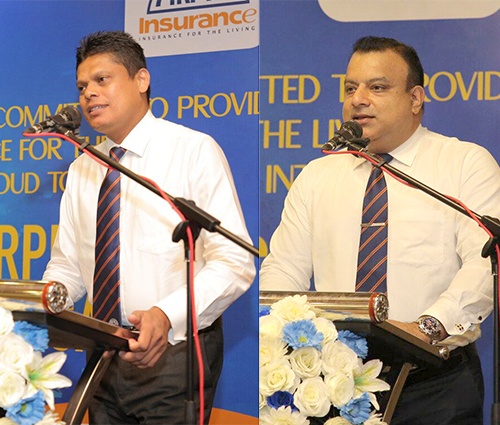
Arpico Insurance PLC, recently introduced a specialised insurance policy for CoVid19 – ARPICO COVIDCARE – further solidifying the Company’s commitment to provide ‘Insurance for the Living’ as envisioned by Company founder and Group Chairman of Richard Peiris – Dr. Sena Yaddehige.
Under this specialized policy, three distinct policy options will be availed to suit the customers’ requirements & budget. Some of the benefits offered via this insurance cover include up to Rs. 1,500,000 in the event of death due to CoVid19 or accident, daily hospitalization benefit up to Rs. 5,000 per day for quarantine in a Government approved facility, reimbursement of ICU medical costs of up to Rs. 200,000 due to CoVid19, reimbursement of up to Rs. 5,000 for CoVid19 vaccination as well as funeral expenses up to Rs. 50,000 for death due to CoVid 19 or accident.
Commenting at the launch of ARPICO COVIDCARE, Dr. Sena Yaddehige mentioned that Arpico Insurance PLC is one of the first Insurance providers in both Sri Lanka and in the region to have promptly responded with a creative solution to the raging pandemic: “This is very much in line with our corporate philosophy of providing ‘Insurance for the Living’. We have designed this policy to include maximum benefits for a reasonable premium which also aligns with our commitment to making insurance accessible to all citizens without exception.”
“We noticed a void as well as a need in the market for a specialized plan as what is already available is not designed specifically to cater to a pandemic outbreak, such as what we are currently experiencing”, he said.
Creating a new product in a short span of time, under challenging circumstances, is no easy feat and credit goes out to our exceptionally talented team at Arpico Insurance PLC for rising to the occasion as always,” he added.



Sri Lanka Insurance Corporation General Limited (SLICGL) unveiled Beechat, the country’s first generative AI‑powered insurance assistant, heralding a milestone for Sri Lanka’s insurance industry and move towards digital services.
Beechat is designed to transform the customer experience. Available through the SLICGL website (https://www.slicgeneral.com/) and customer portal, the Assistant offers customers instant access to policy information, real-time claim status updates, and insurance-related help 24 hours a day, seven days a week.
For customers, Beechat makes insurance simpler and always available. Instead of waiting in queues, calling hotlines, or being limited to business hours, customers can check policies, track claims, and receive instant answers in Sinhala, Tamil, or English, empowering every customer, whatever their language, to manage their insurance with ease.
The inclusivity ensures every customer, regardless of language preference, can engage with insurance services seamlessly. The AI‑driven platform reduces complexity, eliminates delays, and builds trust. Ultimately, Beechat transforms insurance from a process often seen as slow and complicated into a smooth digital journey that fits modern lifestyles.
The launch of SLICGL Beechat is strategically important for the organization because it strengthens its position as a leader in innovation within Sri Lanka’s insurance industry. Introducing the country’s first generative AI‑powered, trilingual insurance assistant, SLICGL demonstrates a commitment to digital transformation and technology‑driven service excellence.
The initiative reaffirms the company as forward‑thinking and customer‑centric and differentiating from competitors who still rely on traditional service models. It signals to industry stakeholders that SLICGL is setting new standards for accessibility, efficiency, and convenience in insurance.
Pioneering AI‑driven customer engagement, the company sets a new benchmark. Beechat demonstrates how technology can elevate insurance from a traditional service into a dynamic, futuristic experience, strengthening SLICGL’s relationship with the people it services. (SLICGL)
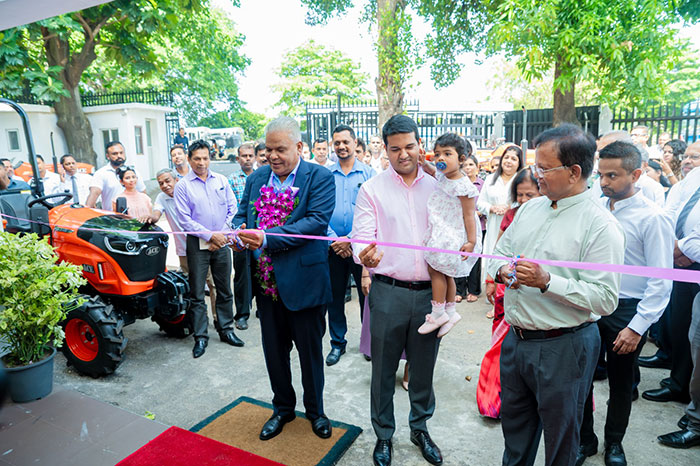
Lanka Tractors Limited officially reopened its original showroom in Colombo 11, marking the return of one of Sri Lanka’s most recognised agricultural machinery companies and the official launch of the ACE Tractor brand in the country.
Located at 343 Olcott Mawatha, Colombo 11, the showroom was ceremonially declared open by Chief Guest Dudley Sirisena, Chairman of the Araliya Group of Companies, in the presence of Upul Jayasuriya, Chairman of Lanka Tractors Limited, Thilina Abeysuriya, Managing Director, Nishantha Yapa, Head of Business, and Rajiv Gunawardena, CEO of Asia Asset Finance PLC.
Originally established in 1971 as the State Trading (Tractor) Corporation, Lanka Tractors was restructured in 1991 and became one of Sri Lanka’s largest importers and distributors of agricultural machinery. Over the decades, the company represented internationally renowned brands including Massey Ferguson, Kubota and TAFE, earning the trust of generations of Sri Lankan farmers through quality products, technical expertise and dependable after-sales support. The reopening of its original Colombo 11 showroom, first established in 1982, marks the revival of an institution that has played a pivotal role in the mechanisation of Sri Lankan agriculture for more than five decades.
The company’s revival commenced in late 2025 through an exclusive partnership with ACE Tractors, the agricultural division of Action Construction Equipment (ACE) Limited, one of India’s leading engineering and manufacturing companies. ACE manufactures tractors, agricultural machinery, construction equipment and industrial equipment, with annual production capacity exceeding 9,000 tractors, exports to more than 37 countries, and a dealer and service network spanning over 100 locations worldwide.
Prior to the commercial launch, Lanka Tractors adopted an extensive validation programme to ensure the products were ideally suited to Sri Lankan farming conditions. Three introductory models—the ACE VEER 3000 (26 HP 4WD), ACE DI 350 NG (40 HP 2WD) and ACE DI 450 NG (45 HP 4WD)—underwent rigorous field testing across multiple agricultural regions under the supervision of ACE technical specialists. Following several product refinements based on local operating conditions, the tractors were introduced to the market in April 2026.
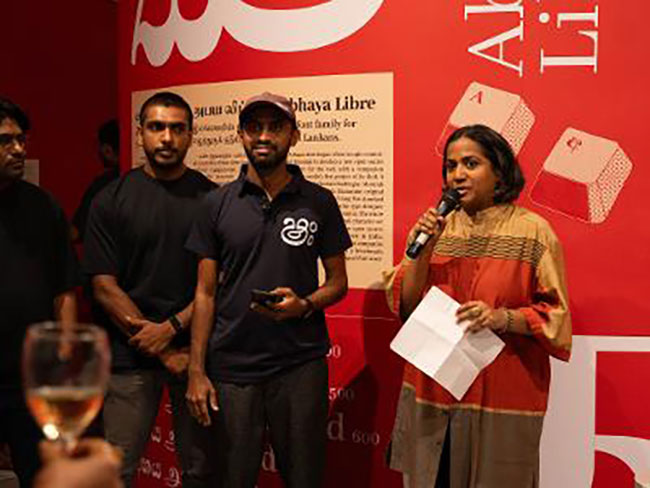
The desire to communicate and be understood is at the heart of what it is to be human. In contemporary life, digital infrastructure underpins how we work, live, and share information, but the letterforms that carry our languages are rarely neutral.
Arkurugraphy, a new exhibition at the Geoffrey Bawa Space, explores the history, culture, and future of letterforms across Sri Lanka’s three official languages. Presenting the decade-long practice of Colombo-based type foundry Mooniak, it examines how decisions about the digitisation of Sinhala, Tamil, and Latin scripts impact legibility and carry deep consequences for who is seen, who is heard, and whose language endures.
Writing systems carry human thought and knowledge across time and space. Letterforms can become a form of cultural artefact, unique graphic symbols representing identity and belonging. Today, these inherited letterforms often take shape as digital fonts, their design demanding fluency across history, aesthetics, linguistics, and technical standards. Akurugraphy asks audiences to look at letterforms beyond the act of reading: to appreciate their form, trace their past, and consider the decisions that impact their future.
Akurugraphy brings together typographic specimens, archival material, and software development spanning Mooniak’s full body of practice. It is a celebration of letterforms as art and an examination of the technical and political stakes of designing scripts for the digital age. As part of the exhibition, the Geoffrey Bawa Space will host a programme of monthly talks, curatorial tours, workshops, and children’s programmes.
Akurugraphy is open Wednesday through Sunday, 10:30 a.m. – 5:30 p.m., and will be on view until 8 November 2026. The exhibition is designed to be accessible and welcoming to all visitors. The Geoffrey Bawa Space offers step-free access and wheelchair accessible facilities. Tactile elements are available throughout the exhibition. More information is available at geoffreybawa.com/akurugraphy .

Dharmaraja and Kingswood set for historic rugby clash on Saturday

Sri Lankan singer Mariazelle Goonetilleke passes away at the age of 68

Tensions erupt in Indian state after 11-year-old raped and murdered

US and Iran trade attacks as Khamenei is buried

Several spells of showers will occur in the Western, Sabaragamuwa and North-western provinces and in Galle, Matara, Kandy and Nuwara-Eliya districts

Canadian PM visits Saudi Arabia to strengthen energy, mining partnerships

‘Dates have the highest sugar content to fight Coronavirus’

Sunday Island 27 December – Headlines

#SundayIsland 17th December – Headlines

Sunday Island – 28th March

Sunday Island Headlines – 21 March

Sunday Island – 21st February – Headlines
-
 News6 days ago
Singapore-based Buddhist monk marks nearly four decades of humanitarian service
-

 News7 days ago
Freedom 250: US Embassy celebrates America’s 250th Independence Day through magic of American cinema
-
 News19 hours ago
Herath warns prospective migrant workers not to get fleeced by racketeers
-

 News5 days ago
AI concerned over proposed SL military deployment in Haiti
-

 Midweek Review3 days ago
Unexpected focus on ‘pieces of tin’ worn by military men
-

 Latest News4 days ago
Nyamhuri and Ngarava stun Bangladesh by defending 141
-

 Features6 days ago
The NPP’s New Challenge: Balancing Easter Lawfare and Economic Welfare
-

 News2 days ago
Negombo Prison riot: Ensuring protection of prisoners fundamental responsibility of the state – UN