
News
India’s new Parliament Building can last 150 years, seat 150% more


bY S VENKAT NARAYAN,
Our Special Correspondent
NEW DELHI: India will celebrate 75 years of its independence in 2022 with a new triangular Parliament Building in place. Prime Minister Narendra Modi laid its foundation stone on December 10. The present circular Parliament House is a century-old beauty, designed by Sir Edwin Lutyens.
The new building will have a life of more than 150 years with more than 150% increase in seating capacity, the government said. While the interior of the new Lok Sabha will have the theme of peacock, the national bird, Rajya Sabha will have national flower lotus as its theme.
Besides the two Houses, the building will have a Constitution Hall that will exhibit an original Constitution and a digital form for people to read page-by-page. This will be the only portion of the building that will have no storeys.
The rest of the complex will have four floors. Each floor will have offices of ministers and committee rooms. The first floor will have dining space for member of Parliament, VVIPs and visitors.
It will also have a central lounge. Besides being earthquake proof, the new building will be eco-friendly and consume significantly less power. “The project will be completed in time in 2022 and the winter session will be held here,” says Housing and Urban Affairs Minister Hardeep Singh Puri.
The building will be earthquake-resistant, and adaptable to the most modern digital technology.
Provisions will be made in the furniture for smart displays, biometrics for ease of voting, digital language interpretation or translation systems, and recording infrastructure to produce real-time metadata and programmable microphones.
Interiors of the halls will be fitted with virtual sound simulations to set the right levels of reverberation sound and limit the echo.
It will incorporate indigenous architecture from different parts of the country, and showcase the cultural diversity.
Around 2,000 people will be directly involved in its construction, while another 9,000 will be there indirectly.
More than 200 artistes from various parts of the country will also work for the building.
The existing Parliament building will be conserved as an archaeological asset of the country.
The project of building the new Parliament Building has been given to Tata Projects Ltd.
The design has been prepared by HCP Design, Planning and Management Pvt Ltd. The building is to come up on a 64,500-square-metre area. The total cost is estimated at INR9.71 billion.
The building will have six entrances: A ceremonial entrance for the President and Prime Minister; one for the Speaker of the Lok Sabha, Chairperson of the Rajya Sabha, and MPs; a ceremonial entrance in general; another entrance for MPs; and two public entrances.
The new Parliament complex will have four floors — lower ground, upper ground, first and second floors.
A total of 120 office spaces, including committee rooms, major offices of the ministry of Parliamentary Affairs, Lok Sabha Secretariat, Rajya Sabha secretariat, offices of the Prime Minister, some MPs and offices for staff and security personnel will be housed in the new Parliament. It will also have a reading room for MPs. It will not have a Central Hall.
The Lok Sabha chamber, which will come up on a 3,015-square-metre area, will have 888 seats instead of present 543 seats, spread over an area of 1,145 square metres.
The Rajya Sabha chamber, spread over an area of 3,220 square metres, will have 384 seats against its current strength of 245 seats on a 1,232-square-metre area.
During a joint session, the new Lok Sabha chamber will be able to accommodate 1,224 members. The MPs will be seated in two-seater benches, which can accommodate three in case of joint sessions, in a horseshoe pattern in front of the Speaker.
An adjacent building, which will come up on the site of Shram Shakti Bhavan, will have rooms for all MPs, and will be connected via an underpass.
The building will be earthquake-resistant, and adaptable to the most modern digital technology. It will incorporate indigenous architecture from different parts of the country, and showcase the cultural diversity.
Officials said the building will have the most modern security and surveillance system. “The security check will be mostly non-intrusive,” said Bimal Patel, the designer of Central Vista redevelopment project. Dholpur and red stone from Rajasthan will be largely used.



The 59th Anniversary Academic Sessions of the Ceylon College of Physicians will be held from 16th to 19th of September 2026 at Shangri-La, Colombo. Professor Namal Wijesinghe, the president of the college and the council of the Ceylon College of physicians said that the sessions bring together experienced physicians, academics, researchers, postgraduate trainees and other healthcare professionals from all over the globe. The programme provides opportunities to discuss recent advances in medicine, emerging challenges in healthcare and developments that have the potential to improve patient care.
An important feature of the College’s academic vision is the strengthening of relationships with international professional colleges and medical institutions. The Royal College of Physicians of London, Royal College of Physicians of Edinburgh, Royal College of Physicians and Surgeons of Glasgow, European Federation of Internal Medicine, College of Physicians of Malaysia, Association of Physicians of India, Pakistan Society of Internal Medicine, Association of Physicians of Bangladesh and Society of Internal Medicine of Nepal are officially collaborating with the Ceylon College of Physicians in organising 59th Anniversary Academic Sessions.
These international collaborations provide opportunities for the exchange of expertise, collaborative research, professional development and exposure to different approaches to healthcare and medical education. Interaction with international colleagues can broaden professional perspectives, encourage research collaboration and create opportunities for academic and career development.
At the same time, Sri Lankan physicians have much to contribute to the international medical community through their clinical experience, research and expertise.
The Anniversary Academic Sessions also highlight the importance of research in advancing healthcare. The presentation and discussion of research findings encourage evidence-based practice and provide researchers with opportunities to establish new academic collaborations. Encouraging young physicians to engage in research and scholarship remains an important investment in the future of the profession.

Five Air Force personnel, including a junior officer, have been arrested for allegedly killing a deer in the Mattala area. Air Force headquarters confirmed the arrest of the group attached to the Mattala detachment.
According to Mattala Police, the Airmen allegedly shot the deer, within the premises of the Mattala Rajapaksa International Airport, and sold the meat to civilians in the area. Police have also arrested two civilians who allegedly bought the venison.
An Air Force vehicle, allegedly used to transport the meat, and a motorcycle used by the officer, have also been taken into police custody. Police have reportedly recovered the venison, a deer skull and firearms allegedly used in the shooting.
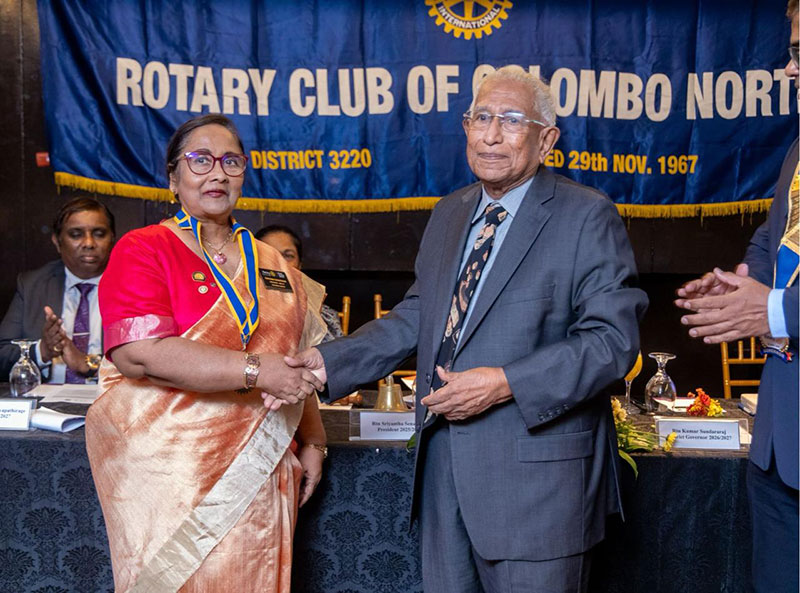
President Chathuri Ranasinghe, and members of the Board are: Sriyantha Senaratne, Lasika Jayamaha, Shanta Gunaratne, Jayendra Pinidiyapathirag, Anjali Walisundara, Amjath Yusoof, Ranjini Goonetilleke, Asif Shukri Asoka Peiris, Justin Meegod Dayani Panagoda, Anthea Senaratne, Ariya Wcirema, Shewantha Rodrigo, Tusitha Kumarakulasinhm, Marshad Barry, Lucien Pereira, Haneekah Rahil, Dahara de Costa.

Hettich celebrates a decade in Sri Lanka with partner meet in Colombo

The mirror of our discontent: Is our electorate the root cause?

Maris Stella Thimbirigaskatuwa, Lyceum Wattala clinch Western Province Schools Games athletics titles

GS Evo Motors launches all-new JMEV EWIND

People’s Bank powers inter-school Basketball Championship 2026

Muscle flexing, astroturfing and dog-and-pony shows

‘Dates have the highest sugar content to fight Coronavirus’

Sunday Island 27 December – Headlines

#SundayIsland 17th December – Headlines

Sunday Island – 28th March

Sunday Island Headlines – 21 March

Sunday Island – 21st February – Headlines
-

 Sports3 days ago
DDS set to lose Test captaincy
-

 Editorial7 days ago
Arrests as theatre
-
 News6 days ago
Thailand shuts door on undesirables from Sri Lanka
-

 News3 days ago
Sri Lanka faces new grid challenge as rooftop solar surges: former CEB GM
-

 Latest News7 days ago
Harshitha’s composed knock seals Sri Lanka’s semi-final berth
-
 Business6 days ago
CEB successor company breaks into top three in competitive BESS tender
-

 Latest News3 days ago
Shafali, Deepti power India into sixth T20 Asia Cup final
-

 News7 days ago
‘Choka Malli’ slips out of country before travel ban