
Features
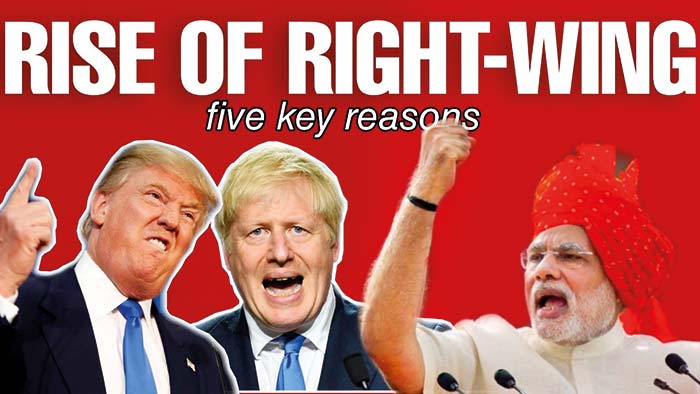
Globally, a rightward political shift is visible

by Kumar David
The global political scene was very left-inclined from about the mid-1960s to say 10 or 15 years ago. The sweeping trend to social democracy in post-war Europe, a surge to the left throughout Asia (Chinese Revolution, defeat of US Imperialism in Vietnam, post-war USSR, our own JVP) and a little later in Africa (Patrice Lumumba, revolution in Mozambique, Nelson Mandela etc), signposted what may be loosely called a period of global shift to the left. That ended about 10 years ago. The last spurt was perhaps Obama’s re-election. The reverse trend became prominent in the US with Trump and internationally a dynamic that began with the collapse of the Soviet Union in December 1991.
What are the five critical signs for the rise of the right in this decade? They are: (i) The emergence of Trump and his kind of obnoxious politics and personal and criminal conduct about 15 years ago, (ii) the war in Ukraine which will end in the devastation of that country, (iii) Modi’s Hindutva movement which will eventually be defeated because the roots of liberal democracy are deep-rooted in India, (iv) the border conflict in US south – the Texas border – and the rising tension between Federal and 15 state level military forces and (v) most serious and what could trigger a major regional war or global military conflict is what for brevity I will call Netanyahu’s ethnic cleansing of Palestine and unrepentant genocide of the non-Jewish people of Palestine. For example, Republican Congressman Andy Ogles of Tennessee replied to a question about the slaughter of Palestinian children in Gaza by asserting: “We should kill ‘em all!”. Nevertheless, I grant these are contingent events, that is, of relatively short-term consequence measured in months and years.
Then there are factors rooted in objective historical trends that are beyond the power of individuals to transform and whose influence has to be measured in periods stretching over several decades. My leftist buddies will call such things historical-materialist. Let me enumerate them: (i) There is a decline in the global hegemony of the USA though it may be decades or half a century before it comes to completion in different spheres (military, diplomatic, financial and $-displacement).
(ii) for the first time in over a century (110 years) there is no left party (social democratic, Soviet style or left-revolutionary) holding government power anywhere wheresoever in Europe – Western, Eastern or the Balkans. (iii) the Thucydides Trap (the displacement of one dominant state by another) has been sprung; the global dominance of the West will give way to the so-called Asian Century. (iv) the BRICS+ grouping, already representing about half the world’s population and economic output, is growing in size and strength.
It will inevitably become the world’s leading economic forum; a multipolar world is unstoppable. (v) A China-Russia economic, political and military axis with other states (N Korea, Vietnam, Mongolia, possibly a future democratic Palestine, Iran, Saudi Arabia and NATO member Turkey tagging along) is emerging. These are fundamental but contradictory trends – don’t blame me, that’s reality.
While BRICS+ is an organisation building strategy Beijing’s alternative strategy is to capitalise on ties with the “global south” through its $1tn Belt and Road Initiative (BRI), an investment programme launched in 2013 that counts more than 140 countries in Asia, Africa, Latin America and elsewhere.
An interesting point that is not well known is that Putin is not a Leninist (nor, of course, a Marxist) and has explicitly disavowed Lenin. Putin rejects “The right of nations to self-determination” the offer that Lenin extended to the different provinces or ‘states’ of Tsarist Russia to win them over to his revolutionary cause. Second and of more fundamental importance is that Putin is essentially a Russian nationalist not an internationalist. His goal is “Making Russia Great” not socialism, locally or internationally. Putin is also religious and belongs to the Russian Orthodox Church whose conventions and practices he adheres to.
Of course, the Russian State and the State in China are qualitatively different because of the role of the Communist Party in the latter. States of a different character can cooperate in big events such as economic activity (Saudi Arabia and the West) and in war (WW-2 of course). I expect China and Russia to collaborate closely in economics (gas, timber, project investment and defeating Western sanctions on Russian and Chinese personages, state or business) and militarily of course in order to snarl up US global hegemony.
Let me now turn to liberal democracy in the present phase of world history. I agree that competitive markets are useful in efficient resource allocation. Even non-capitalist systems recognise and use them as economic tools. We know that the methods of a prior economic order persist after that economic order ceases to be hegemonic.
For example, practices from the feudal period – land tenure practices for example – are still in use in the “global south” and in parts of the “global north”. Unsurprisingly, in investment decision making, management and acquisitions, and navigating issues of rising interest rates and inflation, the morphology – form and structure of things – of capitalism, is needed though market capitalism and the urge to profit “wears man’s smudge and shares man’s smell”. That the benefits of market mechanisms – capitalist rationality – will be useful in resource allocation is not disputed. That is to say capitalistic tools will serve even when capitalism is no more.
Nevertheless, the important question for us at this point is whether setting aside strategic-political concerns is wise. Relying on liberal democracy (that is profit maximising capitalism) as an arrangement necessary during a period when there is undeniably a global swing to the right is unavoidable but I strongly advice against ideological compromise.
Using capitalist tools for economic purposes is one thing, letting one’s political guard down and becoming sloppy is another matter. Imperialism does not hesitate to overthrow politically unfriendly regimes. See Wikipedia “US involvement in Regime Change” for details of several dozen foreign governments that the US has overthrown. It has been involved in over 400 instances of regime change in other countries since 1776.
I like to sign off with a few remarks about the home turf. I am thinking of the Presidential Election that may be held later this year. The Parliamentary Elections are a different bag of tricks, so I will focus on the former. The next presidency is going to be a tussle between Anura Kumara and a UNP-outfit if the latter gets its act together in some sort of alliance between Ranil, Sajith and widely distributed traditional UNPers.
The Rajapaksa circus (say Namal) will be wiped out, and there is talk of various outliers such as Fonseka and Patali trying their luck but all will be to no avail. An Anura defeat that allows some in the UNP bandwagon to creep into office would be a major setback. The main task ahead is the revision of the Constitution to abolish the Executive Presidency and the UNP will scuttle this.
In this context a short, say two- or three-year, a Karu Jayasuriya presidency becomes interesting. KJ (born Sept. 1940) is too old to hang on for a full five-year term and I think not interested in hanging on for too long. He has the support of the ‘Sangha for a Better Sri Lanka’ Movement and the Global Tamil Forum. A Constitution-Revising presidency will require careful planning of a constitutional agenda by experts like Nihal Jayawickrema, Jumpy Wickremaratne, Lal Wijenayake and political coordination with the NPP (Harini et. al.). For now, I will leave it at that; more will need to be said in the coming months.
ASIDE
It is necessary and important to pause at this point to ponder the relationship between liberal democracy (bourgeoise or market or capitalist democracy) and democracy in the fuller socialist sense of real human freedom (“from the domain of necessity to the domain of freedom”) “The realm of freedom actually begins only where labour which is determined by necessity and mundane considerations ceases; thus, in the very nature of things it lies beyond the sphere of actual material production: Kapital-III, Ch-48. And “In place of the old bourgeois society, with its classes and class antagonisms, we shall have an association, in which the free development of each is the condition for the free development of all”: Manifesto. In these two quotes Marx says that socialism in the true sense of the term (“From each according to his ability, to each according to his needs” – Critique of the Gota Programme – belongs to a future when human material production exceeds its material needs. Interestingly, Marx may have known of “each according to his needs” from early Christian communities. The Acts of the Apostles documents them.








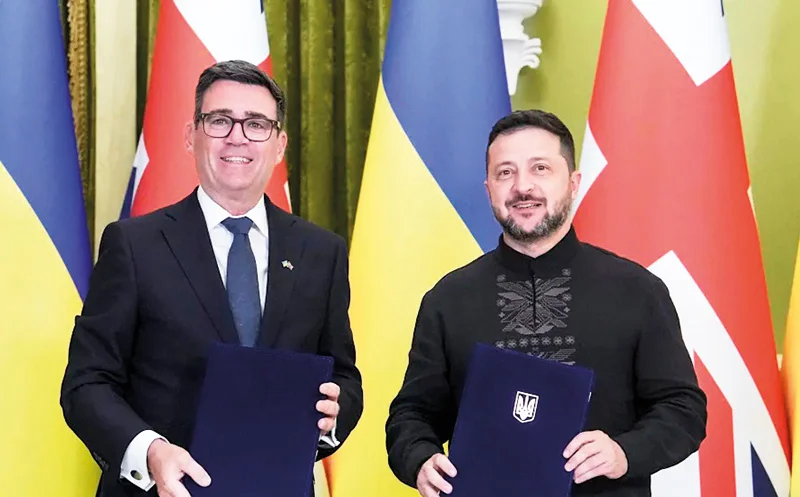
 The present offer by the UK to strengthen Ukraine’s defense capabilities in the missile technology field in particular comes as ‘a stitch in time’ and the initiative is also likely to be appreciated considerably by democratic opinion world wide for the possible morale-boosting effect it would have on Ukraine. Besides continuous arms support, the conviction that the world’s frontline democracies are behind it would prove a huge plus in Ukraine’s eyes in its grinding fightback against the Russian invasion.
While continued US support for Ukraine could not be considered ‘a given’ any more, British Prime Minister Andy Burnham’s words during a recent visit to Kyiv that the UK would stand by Ukraine ‘for as long as it takes’ is the kind of assurance that Ukraine needs at present. For, the conflict in Ukraine is essentially a war of liberation conducted by the latter against an invader and deeply at issue here is the upholding of International Law and its foundational concepts, such as national sovereignty and a nation’s right to political self-determination. The world of democracy is of the firm view that the latter ideals cannot be compromised, come what may.
The UK has its work cut out in this connection. It would find it difficult to convince the Trump administration that it should staunchly stand by Ukraine but it could campaign vigorously with the rest of the West and the EU fold in particular to unflaggingly support the embattled and over-run country.
Ukraine has shown an impressive adeptness in using drone technology in particular against her enemy and has even manufactured her own hardware in this respect but using the relevant blueprints handed over by the UK for the manufacture of more sophisticated cruise missiles, for instance, may prove financially difficult, going forward. It is left to be seen whether the UK and the rest of the West who are with Ukraine will continue to be with her, considering their own rising financial constraints.
The latter impediments could only multiply in the future. Oil, gas and energy prices are on the rise and the latter costs are glaringly reflected in kitchens and meal tables the world over. As we go along consumer discontent would steadily intensify and governments, East and West, would need to figure out with considerable rigour and foresight how such disaffection could be ably managed. Failing which, in most democratic societies, the chances are that publics would be out on the streets demanding that their grievances be redressed forthwith.
These rising concerns are reflected in a recent move by some EU governments to consider imposing what is described as ‘a windfall tax’ on the profits specified major oil companies operating within their shores have made in the wake of the US-Israel war on Iran. The rationale apparently is to use such tax earnings to cushion the rising cost of living of their publics and bolster the respective countries’ social expenditure.
In a recent letter to the president of the EU Council the EU governments referred to said, among other things, while drawing attention to the ‘discontent that is growing over the rising cost of living’: ‘A common approach’ is needed that ‘ensures those who profit from the crisis contribute their share to reducing the burden on the general population.’ Meanwhile, Oxfam with reference to the above development is on record as calling for a ‘permanent windfall tax of at least 50% on profits exceeding a 10% return on investment.’
Such are the rising economic pressures on the majority of Western governments. The question to be posed is how consistent they would be in their assistance to Ukraine if they decide consensually to stand by her. The soaring cost of living in the West compels the conclusion that there could be no guarantee that Western assistance to Ukraine, particularly in the defense and security fields, would be of a longstanding kind.
Of particular concern would be the fact that the weapons systems on offer from the UK to Ukraine could be increasingly costly to manufacture going forward. Besides they would need to be manufactured and put into action without delay.
However, these considerations should in no way deflect Ukraine’s supporters from the principled policy stance of defending her to the extent possible. Because at issue is the defense of International Law and the democratic system of government from their enemies; fascism and authoritarian rule.
While during World Wars 1 and 2 the US was with the major democracies of the West, this time around with regard to Ukraine, the US has chosen to be at cross-purposes with them. For instance, in relation to tariff matters and defense expenditure, in the NATO context, the US is pursuing a hard line which puts it at polar opposites with the West. Thus it is no longer possible to talk unreservedly of a ‘Western democratic alliance’. Put plainly, the cause of democratic development has been weakened.
A measure of relief for the supporters of Ukraine in the West could come by way of the upcoming mid-term polls in the US. If the Democratic Party fares well in them the pressure would be on the Trump administration to defer to opposition opinion at home, accommodate the best interests of Ukraine in its West European policy and perhaps even work towards a diplomatic solution to the Ukraine crisis in cooperation with Russia. Accordingly, the Democratic Party would need to put the Trump administration on the defensive, so to speak.
Until such time Ukraine’s Western supporters have no choice but to remain committed to it, ensure its steadfast defense against the invasion and work judiciously towards keeping the economic pressures at home in check.
Interestingly, at the present juncture in international politics the US could be said to be more weak than strong. For example, it has to some extent been militarily humbled by Iran; so much so it is resorting to economic means to keep Iran in check.
In keeping with this strategy, the US has launched ‘a new big wave of anti-Iran economic sanctions’ at the time of writing, aimed at cutting Iran away from all its major income sources. Some of these relate to digital assets, technology, gold, aviation and shipping. The hoped for result is the complete severance of Iran from the US dollar system.
However, while the UK and EU have no choice but to adhere to their policy of backing Ukraine, going forward they would need to dialogue more closely with the US and ensure that it cooperates with them on outstanding questions, such as Ukraine and the strengthening of democracy. The well being of the world is served when the latter aim is pursued.
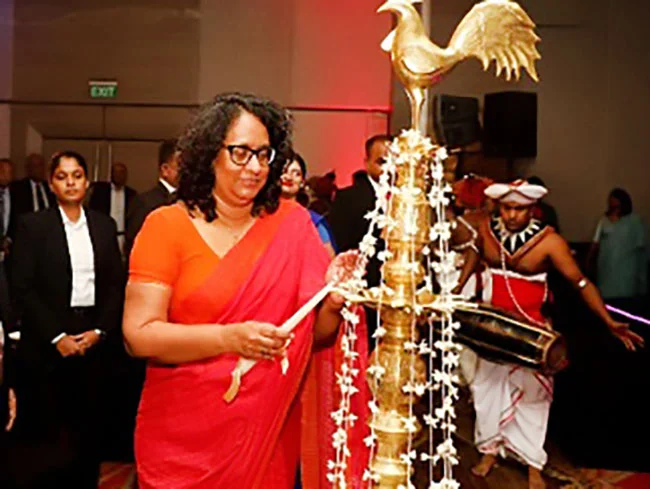
OPA 39th Annual Conference calls for Sri Lanka to move Beyond Recovery towards Sustainable Transformation
The Orgnisation of Professional Associations (OPA) successfully concluded its 39th Annual Conference, held recently at the Cinnamon Grand Colombo, under the theme “Envisioning Sri Lanka: Beyond Recovery”.
Held under the patronage of Jayantha Gallehewa, President of the OPA, with the leadership and guidance of Tisara De Silva, President-Elect and Chairman of the 39th Annual Conference, the Conference brought together leading professionals, academics, business leaders and representatives of the public and private sectors to deliberate on Sri Lanka’s next phase of national development.
The Inaugural Session, on August 2026, was graced by Prime Minister Dr. Harini Amarasuriya, as the Chief Guest; Andrew Patrick, British High Commissioner to Sri Lanka, as the Guest of Honour; and Murtaza Jafferjee, Chairman of the Advocata Institute, Sri Lanka, as the Keynote Speaker.
In her address, Prime Minister Dr. Harini Amarasuriya emphasised that overcoming the economic crisis alone should not be Sri Lanka’s ultimate objective, stressing that recovery must serve as the foundation for a broader economic and institutional transformation necessary for sustainable national progress. Reflecting on the difficult period experienced by the country, the Prime Minister noted that Sri Lanka had faced significant economic, social and institutional challenges, which had weakened public confidence and created uncertainty about the country’s future.
She stressed that “recovery only provides the foundation” and that Sri Lanka can move forward sustainably only by using that foundation to bring about meaningful transformation.
The Prime Minister observed that the theme of the OPA’s 39th Annual Conference, “Envisioning Sri Lanka: Beyond Recovery,” aptly encapsulated these national aspirations. She emphasised that Sri Lanka’s objective should not merely be to return to the conditions that existed before the crisis, but to forge a stronger national foundation characterised by robust institutions, a resilient economy, high-quality public services and an enabling environment in which every citizen has the opportunity to thrive.
She further underscored that Sri Lanka’s future development cannot be secured through economic growth and physical development alone. She emphasised that the effective mobilisation of the country’s knowledge, skills and professional expertise, is equally essential to achieving sustainable and inclusive national progress
The Technical Sessions held on 12 August 2026 brought together 19 distinguished experts and professionals representing academia, industry, banking and finance, public health, technology, management and business leadership. Their diverse expertise provided a multidisciplinary platform to examine the critical challenges, emerging opportunities and strategic choices that will shape Sri Lanka’s next phase of development, with particular emphasis on economic transformation, institutional strengthening, digitalisation, private-sector growth, human capital and sustainable development.
The deliberations were structured around four principal sub-themes: “Resilient Recovery and Sustainable Economic Development”; “Future Readiness: Innovation & Transformation”; “Policy for Impact: Advancing Equity, Sustainable Living, and National Well-Being”; and “Leadership, Governance and National Responsibility.”
Across these thematic areas, the sessions explored the structural reforms, institutional requirements and policy choices necessary to move Sri Lanka beyond economic stabilisation towards a more productive, competitive, resilient and inclusive economy. The discussions brought together diverse professional perspectives, enabling participants to examine national priorities through economic, technological, industrial, financial, social and governance lenses.
Particular emphasis was placed on the need to move beyond the diagnosis of problems towards pragmatic, evidence-based and implementable solutions. The deliberations recognised that sustainable national progress requires not only sound policies, but also effective institutions, professional competence, innovation, responsible leadership and the capacity to translate policy into tangible outcomes.
The sessions further underscored the importance of collaboration across sectors, recognising that Sri Lanka’s complex development challenges cannot be addressed in isolation. Stronger engagement among Government, private sector, professional associations, academia and civil society was identified as essential to fostering a coherent national response and ensuring that professional knowledge and expertise are effectively translated into policy and action.
Collectively, the Technical Sessions provided a substantive platform for knowledge exchange, critical reflection and forward-looking dialogue, reinforcing the OPA’s commitment to bringing the country’s professional expertise to bear on the task of building a resilient, innovative, equitable and prosperous Sri Lanka.
The OPA expressed its sincere appreciation to Prime Minister Dr. Harini Amarasuriya, the Chief Guest; Andrew Patrick, British High Commissioner to Sri Lanka and Guest of Honour; and Murtaza Jafferjee, Chairman of the Advocata Institute, Sri Lanka and Keynote Speaker, for their distinguished contributions to the Conference.
Much of what the 39th Annual Conference achieved would not have been possible without the leadership, commitment and generous contributions of Jayantha Gallehewa, President of the OPA; Tisara De Silva, President-Elect and Chairman of the 39th Annual Conference; Eng. Ravi Rupasinghe, General Secretary; Dharshana Wijemanne, Treasurer; Bhanu Wijayaratne, Convener & the Chairman of the Session Planning Committee of the 39th Annual Conference Committee, Past Presidents and Office Bearers; Presidents and representatives of Member Associations; members of the Executive Councils and General Forum; and the distinguished Session Chairmen, Resource Persons and professionals who shared their time, expertise and insights in pursuit of the Conference’s shared vision. The OPA remains immensely grateful to all those whose collective contributions enriched the 39th Annual Conference and strengthened its role as a meaningful platform for professional exchange, informed dialogue and national reflection.
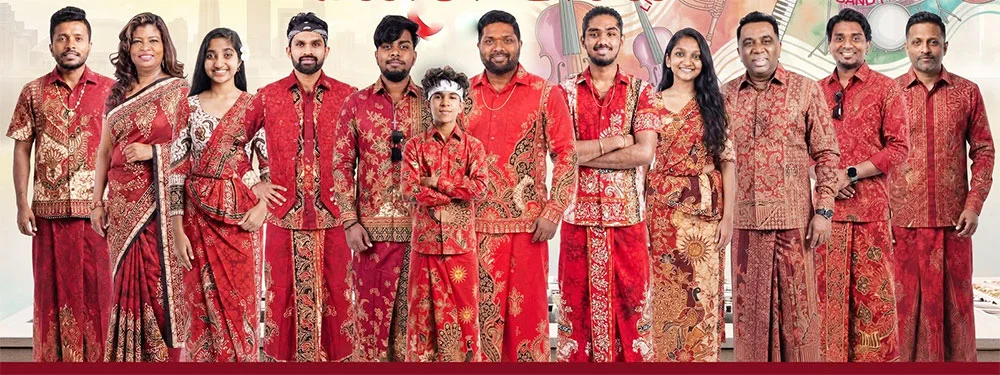
 For Sri Lankans living 14,000 kilometres from home, the sound of home has never felt closer — and that’s thanks to one man and his band.
Since stepping into the spotlight, Gamini Hemalal and the Ceymphony Band have turned into the heartbeat of the Sri Lankan community in Toronto.
Their mission is simple: bring the music, bring the memories, bring the people together. And it’s working.
What turned out to be the talk-of-the-town was their intimate musical evening with Sri Lanka’s legendary crooner Sohan Weerasinghe.

Sohan Weerasinghe: Had
everyone on their feet at the
Angus Glen Golf Club, in
Toronto, Canada
It was a ‘full house’ long before the big date. Tickets vanished within days — demand was that overwhelming.
According to those who were there, it was a truly amazing evening. The hall was packed, the energy electric. Sohan didn’t just sing — he owned the stage.
With his velvet vocals, his charm, and that signature style, he had everyone on their feet. The ladies, especially, couldn’t get enough. No wonder they call him “The Ladies’ Man!”
One attendee summed it up perfectly:
“We had so much fun. It is truly a blessing to have our kids around us, enjoying these beautiful moments together. Thank you, Gamini Hemalal, for such a wonderful evening, with an amazing crowd and an incredible atmosphere. Your hard work and dedication truly made it a special night.
“We also need to say a big thank you to the Ceymphony Band for delivering such an outstanding performance. You all were absolutely amazing! Our entire family had a fantastic time, and we truly enjoyed every moment.

Ceymphony Band: Extremely popular in the scene in Toronto
“Wishing you all continued success. Keep up the amazing work, we can’t wait for the next.”
And the next is already on the cards: ‘Halloween Pissu Baila Party 2026,’ on Friday, 30th October, at the famous Angus Glen Golf Club.
Gamini promises a crazy night of baila, music, dancing and Halloween vibes with the Ceymphony Band. Action runs from 8:00 PM to 12:00 midnight, with plenty of prizes to be won.

Gamini Hemalal: Amazing work for the Sri Lankan community,
in Toronto, Canada
Gamini is also putting together a special event, connected with the 2027 Avurudu celebrations — ‘Avurudu Musical Show 2027,’ a uniquely styled musical Avurudu celebration … Ceymphony Band style.
It’s scheduled to be held on Saturday, 10th April, 2027, also at the Angus Glen Golf Club.
Through music, Gamini Hemalal and Ceymphony are doing what diaspora bands do best — they’re shrinking the distance between two worlds.
One baila beat at a time, one full house at a time, they’re making sure that even in Canada, Sri Lankans feel like home.
Yes, there is plenty of action, indeed, for the Sri Lankan community in Toronto, Canada.

Showers above 50 mm are likely in the Western, Sabaragamuwa and North-western provinces and in Kandy, Nuwara-Eliya, Galle and Matara districts

Patali alleges NPP conspiring to put off elections indefinitely

August 15 Super Dvora tragedy: Search continues for missing officer’s body

Tripartite MoU to expand free cardiothoracic surgeries at KDU Hospital

Jaffna to mark Int’l Day of the Disappeared

Unfolding El Niño and burning issues

‘Dates have the highest sugar content to fight Coronavirus’

Sunday Island 27 December – Headlines

#SundayIsland 17th December – Headlines

Sunday Island – 28th March

Sunday Island Headlines – 21 March

Sunday Island – 21st February – Headlines
-
 News6 days ago
Country’s first woman Surveyor General appointed
-

 Business5 days ago
SriLankan Airlines makes ShakthiSAT Mission possible for talented Sri Lankan student
-
 Features6 days ago
Medical education in Sri Lanka: Then and now
-
 Latest News6 days ago
Imran Khan moved to private hospital amid deteriorating health
-
 Latest News6 days ago
Government has declared 21, 22 and 23 August 2026 as national days of mourning
-
 Features4 days ago
My secondary schooling after Royal Primary
-

 Latest News5 days ago
Tharanga edges out Chopra in 88m javelin battle
-
 News6 days ago
22A: Opp. demands all available SC judges hear petitions