
Latest News
Saharan, Dhas score centuries as unbeaten India march on


Nepal had India 62 for 3 after 14 overs, but India ended with 297 for 5. During the chase, Nepal were 65 for 1, but by then, 21.4 overs had already elapsed. Six overs later, that score read 77 for 7. Eventually, Nepal limped to 165 for 9 despite batting out their entire 50-over quota. That difference in the scoreline highlighted the gulf between the sides during their Group 1 meeting. Unbeaten India entered the semi-finals while Nepal headed home.
Nepal’s slide of 6 for 14 was fashioned by Saumy Pandev, who took three of those wickets, before finishing with 4 for 29. During that spell, Pandey seemed to have found just enough turn – or, at times, the lack of it – to bamboozle the batters. His third four-wicket haul of the tournament took his tally to 16 wickets at a staggering average of 6.62.
India’s win was set up with the bat by centurions Sachin Dhas and Uday Sahran. India were in a bit of bother after losing three early wickets, before the fourth-wicket pair got together in a 215-run fourth-wicket stand. Dhas dominated that partnership, smashing 116 off 101 balls in what turned out to be the highest stand for that wicket or lower in all Youth ODIs.
Saharan and Dhas were both on 11 off 15 balls at the 19-over mark, and from then onwards Dhas went on the attack. Promoted to No. 5, he got to a run-a-ball fifty in the 29th over, and finished with 11 fours and three sixes before falling in the 48th over. Saharan carried on and got to his century off from 107 deliveries.
Nepal dried up India’s boundaries in the death overs, conceding just 81 in the last 10 despite India going into the final powerplay with seven wickets in hand. They hit only five fours and a six in that period. One of them, midway through the 49th over, was expertly guided by Saharan between point and short third – it took him to 98, but he took his helmet off and began celebrating in the mistaken assumption that he had reached triple figures.
The milestone eventually came in the final over of the innings, as he ended the day as the World Cup’s second-highest run-getter.
Brief scores:
India Under 19s 297/5 in 50 overs (Adarsh Singh 21, Uday Saharan 100, Sachin Dhas 116;Gulshan Jha 3-56) beat Nepal Under 19s 165/9 in 50 overs (Arjun Kumal 26, Dev Khanal 33, Durgesh Gupta 29*; Saumy Pandev 4-29, Arshi Kulkarni 2-18) by 132 runs













Latest News
Progress reviewed on the implementation of the circular issued to curb the Dengue Epidemic threat

A progress review meeting on the implementation of the circular issued to address the prevailing dengue epidemic threat was held this afternoon (03) at the Presidential Secretariat under the chairmanship of Secretary to the President Dr Nandika Sanath Kumanayake.
The discussion examined the progress of programmes implemented by all State institutions in accordance with the circular issued on 23 June 2026 on dengue prevention, as well as measures taken thus far to control the current dengue situation and the plans and strategies to be pursued in the future.
Attention was also focused on sustainable solutions that could be adopted through greater coordination among all State institutions to prevent the spread of dengue in high-risk areas, while discussions were held on further intensifying fumigation activities in such locations.
The meeting further reviewed the action taken in response to information received by the Dengue Control Operations Centre.
Pointing out that high-risk areas could only be freed from dengue through innovative approaches that move beyond conventional methods, the President’s Secretary stressed that controlling the disease could not be achieved by the Government alone and that the public also bore a significant responsibility in this regard.
The importance of strengthening the contribution of Public Health Inspectors, continuing household cleaning initiatives on a sustained basis, and implementing programmes based on accurate data to eliminate high-risk zones was also emphasised.
Those present at the meeting included Chief of Staff to the President Prabath Chandrakeerthi; Secretary to the Ministry of Health and Mass Media Dr Anil Jasinghe; Senior Additional Secretary to the President Russell Aponsu; Additional Secretary to the President (Clean Sri Lanka) Engineer S. P. C. Sugeeshwara; Additional Secretary (Provincial Councils and Local Government) M. Kodippiliarachchi; Director of the National Dengue Control Unit Dr Kapila Kannangara; Additional Director General (Information Technology and Media) P. G. I. Gamage; Director (Social Affairs) Kapila Senarath; Director (Volunteer Services) H. P. S. Shantha; officials of the Clean Sri Lanka Secretariat; heads of the health sector; public officials; senior representatives of the security forces; and several others.
President’s Media Division (PMD)

Right-wing candidate Keiko Fujimori has been declared the winner of Peru’s presidential race by the country’s electoral court, the National Jury of Elections (JNE).
Friday’s announcement comes weeks after the June 7 run-offtion against her left-wing rival, Congress member Roberto Sanchez.
Fujimori had a slight lead after the vote count ended earlier this week, and the official tally released on Friday shows a razor-thin victory. She took 9,223,000 votes to Sanchez’s 9,173,000.
“A new stage begins,” Fujimori wrote on the social media platform X on Friday.
“We assume it with responsibility, humility, and a deep sense of duty. Each day of this transition process is an opportunity to listen, engage in dialogue, and arrive prepared at the start of the new government.”
Fujimori is the daughter of the late former President Alberto Fujimori, who had been jailed for human rights abuses.
After running on a platform of cracking down on crime, she has promised to “unite the country”, which has dealt with years of political turmoil and a stagnating economy.
Fujimori and Sanchez reached the run-off vote after defeating 33 other candidates, a record-large field, in April’s general election.
But delays in April’s ballot distributions — and lengthy vote counts after both rounds of voting — have dogged the election, prompting different political interests to cry foul.
Sanchez, who had strong support among rural and Indigenous voters, alleged irregularities and fraud in the vote count, but he has not provided any evidence.
Instead, he has pointed to a change in election procedures as a sign of malfeasance. A new policy came into effect during the election that loosened the mandates around digitising overseas vote tallies.
Election monitors, however, caution that no proof of vote irregularities has emerged so far.
Reporting from the Peruvian capital Lima, Al Jazeera correspondent Mariana Sanchez pointed out that Fujimori’s victory was aided by a boost of overseas support.
“He [Roberto Sanchez] won the most amount of votes in Peru, but the votes from abroad took the balance in favour of Fujimori,” Al Jazeera’s Sanchez said.
She added that Sanchez may seek to rally his base in the coming weeks to have Fujimori swiftly impeached once she is sworn in.
Such impeachments have been common in Peru, where the constitution permits removing a president on broad grounds like “moral incapacity”.
Fujimori is set to become Peru’s ninth president in 10 years when she takes office in late July, on Peru’s independence day.
(Aljazeera)
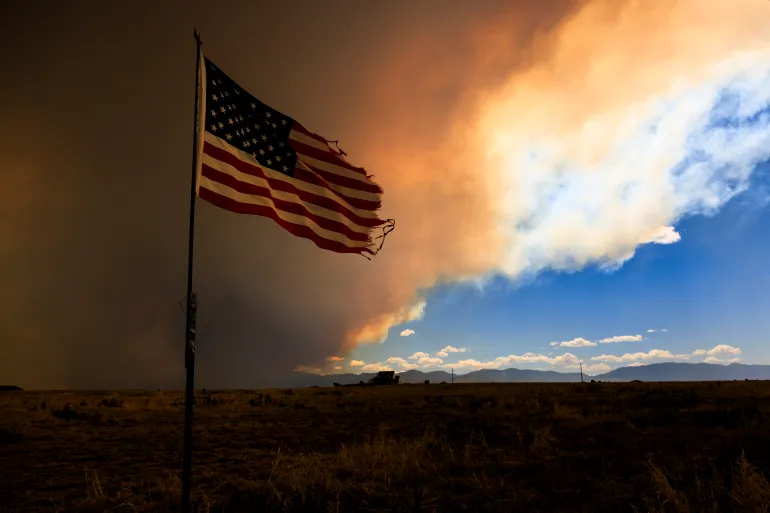
A fast-moving wildfire burning southwest of Denver has forced thousands of people to flee, as strong winds continue to drive flames across southern Colorado.
The blaze is one of about 40 large fires currently burning across the western United States.
Dubbed the Aspen Acres Fire, the conflagration exploded in size, growing by 44 square kilometres (17 square miles) overnight to reach a total of 272sq kilometres (105sq miles) by Friday.
More than 160 structures have been destroyed in the fire. Experts say that months of dry weather and record-low snowfall in parts of the region – exacerbated by climate change – have created dangerous wildfire conditions.
Authorities have ordered the evacuation of about 2,200 people in Colorado City, along with residents of the nearby communities of Beulah, Rye and San Isabel.
Smoke from the fire has also disrupted travel, with Colorado emergency officials warning that visibility in parts along Interstate 25 has dropped to as little as a half a mile – or 0.8 kilometres.
As the fire continues to spread, about 50 Colorado National Guard soldiers were deployed to staff road checkpoints in Pueblo and Custer counties and help keep boats away from the Pueblo Reservoir, where crews were scooping water to battle the blaze.
Investigators have said the Aspen Acres Fire was caused by humans, but they have not yet released any other details.
The Aspen Acres Fire is only one of the blazes currently ravaging Colorado and its neighbouring states.
Firefighters, for instance, have contained only about 65 percent of the Snyder Fire on the western side of the Rocky Mountains, along the border between Colorado and Utah.
As the fire continues to spread, about 50 Colorado National Guard soldiers were deployed to staff road checkpoints in Pueblo and Custer counties and help keep boats away from the Pueblo Reservoir, where crews were scooping water to battle the blaze.
Investigators have said the Aspen Acres Fire was caused by humans, but they have not yet released any other details.
The Aspen Acres Fire is only one of the blazes currently ravaging Colorado and its neighbouring states.
Firefighters, for instance, have contained only about 65 percent of the Snyder Fire on the western side of the Rocky Mountains, along the border between Colorado and Utah.
As the fire continues to spread, about 50 Colorado National Guard soldiers were deployed to staff road checkpoints in Pueblo and Custer counties and help keep boats away from the Pueblo Reservoir, where crews were scooping water to battle the blaze.
Investigators have said the Aspen Acres Fire was caused by humans, but they have not yet released any other details.
The Aspen Acres Fire is only one of the blazes currently ravaging Colorado and its neighbouring states.
Firefighters, for instance, have contained only about 65 percent of the Snyder Fire on the western side of the Rocky Mountains, along the border between Colorado and Utah.
In Utah itself, another blaze — the Cottonwood Fire — had grown to more than 380sq kilometres (147sq miles) by Friday, while the Babylon Fire had reached 344sq kilometres (133sq miles).

The latest fires come less than a week after three firefighters were killed, and two others were injured after they were overtaken by flames while battling two fires, part of the Snyder complex.
Wildfire smoke advisories are in effect for parts of Colorado, and concerns about wildfires are also beginning to reshape local Fourth of July celebrations.
Colorado’s Division of Fire Prevention and Control said several professional firework displays have already been cancelled because of the extreme fire risk, with many counties now under fire restrictions.
The National Weather Service kept Red Flag Warnings in place across much of the state on Friday, saying that hot, dry conditions, low humidity and gusty winds would continue to create critical fire conditions.
While forecasters said moister weather over the weekend should help lessen the risks, they also warned that heavier rain could increase the possibility of flash flooding in recently burned areas.
(Aljazeera)

Progress reviewed on the implementation of the circular issued to curb the Dengue Epidemic threat

Keiko Fujimori officially declared winner of Peru presidential race

Thousands forced to evacuate in Colorado as wildfire spreads

Salah awaits Messi as Egypt beat Australia on penalties at World Cup

Lahiru Udara 188 carries the fight for Sri Lanka

Sai Sudharsan century, Padikkal 94* put India A in command

‘Dates have the highest sugar content to fight Coronavirus’

Sunday Island 27 December – Headlines

#SundayIsland 17th December – Headlines

Sunday Island – 28th March

Sunday Island Headlines – 21 March

Sunday Island – 21st February – Headlines
-

 News5 days ago
LAWASIA warns against ad hoc initiative to increase judges’ retirement ages
-

 News7 days ago
Another 1,132 Sri Lankan Personnel to be deployed for United Nations Peacekeeping Missions
-

 News4 days ago
Chamuditha to seek removal of injunction on Youtube programme
-
 Features4 days ago
Climate action to bring South Asia together
-

 Business7 days ago
Month-end profit-takings drive stock trading; indices up
-

 Features6 days ago
People’s Bank expands digital banking network with 125th cheque deposit kiosk
-

 News4 days ago
CPRP alleges another death in custody, seeks protection for witness
-

 News7 days ago
FSP complains of irregularities in a Guinness World Record event held in Sri Lanka