
News
‘Develop a clear mind by overcoming the ego’

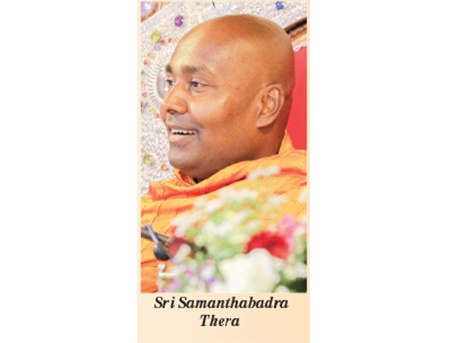
Though a tree is cut from its base, there is a tendency for it to grow again because of the roots underneath. Likewise, one’s defilements can also sprout until they are completely eliminated. That is because one doesn’t understand the cause and effect method properly. The effect is the thought, that appears in the mind. Explore the cause of the thought. Then your mind becomes clear and radiant.
When exploring the mind, one realizes there’s an attachment and further an ego behind everything. There are only two reasons behind the non-realization of the cause and effect method; ego (clinging to things as myself and mine) and attachment to worldly possessions. We remain attached to many things in our life because the concept of ego has deeply existed in our mind.
If someone doesn’t see the cause and effect method clearly, the reason behind is the concept of ego. The idea of ego. Until the ego exists in the mind, no one can see the truth, the path to the enlightenment. If you need to realize the pathway, explore the effects of your thoughts with a clear and lucid mind.
For example, while having a cup of tea, we feel there’s not enough sugar in the tea. A thought then comes to our mind about insufficient sugar. Why did it come to the mind? Because, we have a past memory of tea with enough sugar. Now think, the effect here is the thought of insufficient sugar. The cause is the past memory of sufficient sugar. Every effect is born until there’s a cause. The cause and effect method should be explored mentally because the Dhamma is based on the mind.
The Buddhist teaching is based on the mind. When you understand the cause, the effect disappears. The anger comes to the mind as we cannot fulfill the various needs the mind expects. The desire comes to the mind as we expect a repetition of the past memory. The effect is the desire. The cause is the thought of desire. Likewise, develop a clear mind by overcoming the ego. That is ‘Chiththaanupassanaawa’ (seeking the cause mindfully).
When you apply this to life, you will realize the cause and effect method. Buddhism is a Dhamma, which is realized by yourself, not a knowledge gained by referring to books. But, nowadays, there is a tendency in society to convert Buddhism into a ‘knowledge’. No one practices or explores it.
Explore the Dhamma which calms your mind. Always seek the cause behind, not the effect. If someone practices this deep observation which has been preached in Buddhism, he can attain noble stages and ultimately attain enlightenment. Do an impartial observation on why thoughts appear in the mind and why desire and anger comes to the mind. When you start that observation, you get the noble path clear, the reverse thinking. You should be diligent to realize this pathway. Keep your mind attentive in the deep observation. Making the mind clearer is compulsory to develop it. If someone’s mind is confused, he will never realize the Dhamma.
A person’s mind becomes confused due to the ‘Panchaneewarana’ (five factors which cover the enlightenment) such as desire, anger lethargy, restlessness and doubt. When the mind is trapped by these factors, the pathway becomes obscure. It is, therefore, important to have an understanding of these when walking through this pathway.


A United Nations Human Rights report published earlier this week has called on the Sri Lankan government to strengthen accountability for human rights violations and implement legal and institutional reforms.
The report by the Office of the United Nations High Commissioner for Human Rights (OHCHR) criticised the government’s continued use of the Prevention of Terrorism Act (PTA), underlined patterns of surveillance against civil society actors, activists, and journalists, and highlighted tensions over land and religious sites on the island.
‘This Government still has an opportunity to turn the tide on decades of abuse of executive power, repressive laws and custodial violence, and entrenched impunity,’ said UN High Commissioner for Human Rights Volker Türk in an accompanying press release.
‘While it is encouraging that the Sri Lankan authorities have taken action to address corruption cases and some crimes linked to the post-war period, more needs to be done to end the long legacy of impunity in the country,’ he said.
Amongst the recommendations, Türk urged the Sri Lankan government to release military-occupied lands and prevent further land acquisitions, repeal the PTA and release long-term detainees held under the draconian legislation, support memorialisation initiatives, and strengthen the independence and credibility of the Office of the Missing Persons.
The UN body concluded that ‘the momentum for change has not yet translated into legal and institutional reforms, and efforts for truth seeking and reconciliation have largely stalled.’
The annual report of the OHCHR covers the human rights situation in Sri Lanka between October 2025 and July 2026, with reference to events of previous years.
Civil society actors, activists and victims threatened, particularly in the North-East
‘Activists and victims of decades-long civil war continue to face surveillance, questioning, and intimidation by state intelligence services, particularly in northern and eastern Sri Lanka, undermining conditions for genuine reconciliation,’ the report stated.
There were 16 allegations of surveillance, intimidation, and harassment received directly by OHCHR, indicating a ‘clear and continuing pattern of state surveillance, intimidation and reprisals by military and civilian intelligence officials’ against civil society actors, activists, and journalists.
The report also noted harassment and intimidation by law enforcement officials against women human rights defenders (WHRDs) in the North-East. It was noted that WHRDs faced multiple obstacles, including gender-based violence, social stigma, and mistreatment due to increased interventions by the Criminal Investigations Department (CID) and the Counter Terrorism Investigation Division (CTID).
OHCHR noted that organisations and individuals involved in human rights and memorialisation activities in the North-East faced surveillance, intimidation and threats, including explicit death threats and fabricated criminal charges, as well as coercive questioning and arbitrary visits to their homes.
Peaceful protests against the expansion of Buddhist religious sites, large-scale infrastructure projects, and enforced disappearances are common in the North-East. However, the UN body noted that these peaceful protests are unreasonably restricted through court orders, arrests, surveillance, and intimidation, while memorialisation events are closely monitored, restricted or disrupted as authorities photograph participants and pressure organisers.
‘Such measures undermine reconciliation efforts, particularly in the northern and eastern regions,’ stated the report.
Accountability for wartime crimes and violations
‘It is crucial that there is decisive and meaningful action toward accountability for crimes and violations by all parties during the more than two-decade armed conflict,’ said High Commissioner Türk.
The report said that the newly elected government is ‘yet to present a clear vision or roadmap to deliver long-overdue justice and accountability for past abuses.’
The government has declined to engage with the OHCHR on its Sri Lanka accountability project and has continued to reject accountability-related resolutions of the Human Rights Council.
On enforced disappearances, the UN body said the Office on Missing Persons (OMP) has yet to establish the fates of the disappeared, and that ‘trust in domestic truth and accountability mechanisms remains low.’
OHCHR reiterated the need for legislative reforms to strengthen the OMP’s independence, capacity and investigative powers so it can credibly fulfil its mandate.
The Geneva-based body also urged the government to seek international forensic and technical support to ensure exhumations meet international standards, as 583 sets of human remains have been found to date in mass graves in Chemmani.
The report also noted that conflict-related sexual violence has been particularly under-acknowledged and insufficiently addressed, and that the government rejected a UN brief on accountability for conflict-related sexual violence in Sri Lanka.
Arbitrary arrests, deaths in custody
OHCHR denounced the continued use of the PTA as well as a newly proposed version of the legislation, the Protection of the State from Terrorism Act (PSTA).
In February 2026, the UN body said the new legislation ‘reproduces and expands concerns arising from implementation of the PTA, including risks of overbroad criminalisation, restrictions on fundamental freedoms, extensive executive powers with limited safeguards, arbitrary detention, exposure to torture and enforced disappearance, and insufficient due process and fair trial protections.’
OHCHR was notified of 46 PTA-related detention cases in 2025 and 12 cases as of March 2026.
The report also highlights continued cases of torture and deaths in custody, as the Human Rights Commission of Sri Lanka documented 602 cases of torture and ill-treatment in 2025 and 138 cases as of April 2026. There were 18 deaths in custody last year and three until April this year.
Arbitrary arrests and detention were prevalent during the reporting period, with 1,125 cases in 2025 and 351 of such cases during the first quarter of 2026.
Human Rights Commissioner urges government and UN members to act
Other recommendations by the UN body include urging the government to implement its commitment to devolution of political and administrative power, noting that Provincial Council elections have not been held since 2014.
OHCHR also recommended that the government establish a public prosecutorial body and remove individuals credibly accused of committing human rights violations from senior positions in the government, the security sector, or diplomatic service.
The UN body also asked the Human Rights Council and member states to support efforts to advance legal and institutional reforms, apply extraterritorial or universal jurisdiction to prosecute individuals who committed crimes under international law, and impose targeted sanctions against these individuals.
News
Australia’s MDF and Thema Collection convene industry to explore way forward for wellness tourism
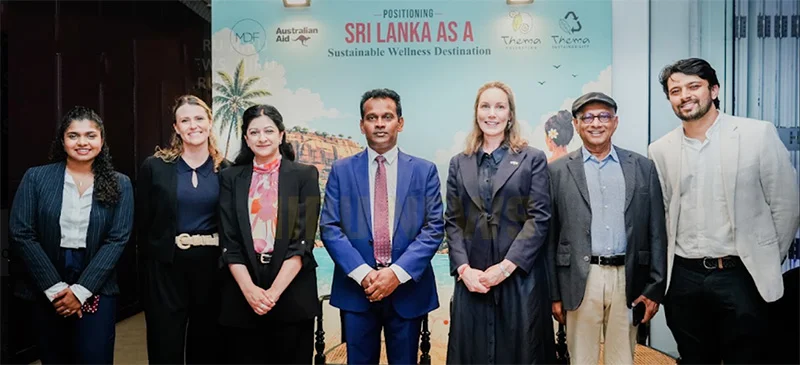
Australia’s Market Development Facility (MDF) recently partnered with leading hotel chain Thema Collection to host “Positioning Sri Lanka as a Sustainable Wellness Destination” forum, exploring strategies to strengthen Sri Lanka’s wellness tourism offering and expand into new source markets. Deputy Minister of Tourism (Prof.) Ruwan Ranasinghe and Australia’s Deputy High Commissioner to Sri Lanka Ruth Baird joined government representatives, industry leaders and academia to discuss how Sri Lanka could best leverage wellness tourism for greater competitiveness. MDF also shared insights from its study on Japan’s outbound wellness tourism market.
Global trends point to travellers increasingly seeking destinations offering authentic experiences centred around wellbeing, nature, culture and sustainability. Ayurvedic practices have been part of Sri Lanka’s indigenous wellbeing and medical heritage for over 2,000 years. Travellers are increasingly drawn to this, with Sri Lanka coming in first in the 2026 BookRetreats Wellness Destination Index.
Delivering the keynote address at the event Deputy Minister of Tourism (Prof.) Ruwan Ranasinghe, emphasised the government’s commitment:
“Sri Lanka has all the elements to become a globally recognised wellness destination, from our Ayurvedic heritage to our culture and hospitality. Our focus is on creating the right policy environment and strengthening collaboration between government and industry so that wellness tourism becomes an important driver of investment, market diversification and sustainable economic growth.”
Thema Collection, which currently has 17 properties in its chain, including two Ayurvedic properties, shared insights from its sustainability journey, focusing on how responsible business practices can enhance guest experience and contribute to long-term business resilience and destination competitiveness.
Chandra Wickramasinghe, Chairman of Thema Collection, noted that,
“At Thema Collection, we believe wellness and sustainability are inseparable. Authentic wellness experiences begin with healthy ecosystems, thriving communities, and respect for local heritage. By embedding sustainability into every aspect of our operations, we are not only creating meaningful experiences for our guests, but also contributing to Sri Lanka’s position as a world-class wellness destination.”
MDF launched the findings from its recent assessment of Japan’s outbound wellness tourism market, highlighting traveller motivations and emerging opportunities to tap into the growing wellness-conscious segment. Participants also heard from industry experts on the role of sustainability in shaping wellness tourism experiences and then joined a high-level panel discussion on the role of collaboration – among government, industry and development partners – in unlocking opportunities.
Australia, through MDF, has been working with tourism partners to strengthen sustainable tourism as a pathway to competitiveness and resilience. MDF has identified wellness tourism as an avenue to diversify beyond traditional source markets and attract higher-value visitors, shifting Sri Lanka from a seasonal destination to a year-round one. This has included supporting partners to target wellness travellers from new source markets such as Japan, Australia and the Middle East.
MDF has invested with Thema Collection to assess its carbon footprint, and Thema is now one of the first hotel chains in Sri Lanka to complete independently verified, portfolio-wide carbon calculations. Thema also operates sustainability programmes focused on environmental protection, community support and responsible tourism. It is now looking at new ways to develop wellness experiences that build on Sri Lanka’s natural and cultural strengths.
Speaking at the event, Australian Deputy High Commissioner Ruth Baird shared that,
“Global travellers are increasingly choosing destinations that combine authenticity, wellbeing and sustainability. Australia has been a steadfast partner in supporting Sri Lanka’s economic development, particularly in the tourism sector. Through MDF, we are working with businesses to build on their sustainable practices, improve competitiveness, and respond to changing global demand. Wellness tourism offers an opportunity to attract visitors to Sri Lanka, generating economic opportunities while still protecting the natural and cultural assets that make Sri Lanka truly unique. Forums such as today provide an important platform to exchange ideas, build partnerships, and identify practical actions that will help create solutions that are locally driven and sustainable over the long term.”
As Sri Lanka seeks to diversify its tourism offering and compete in an evolving global marketplace, the dialogue reinforced that wellness tourism represents more than a niche market. It is an opportunity to showcase Sri Lanka’s unique identity, attract high-value visitors, and create sustainable economic growth that benefits businesses and communities. (HG)
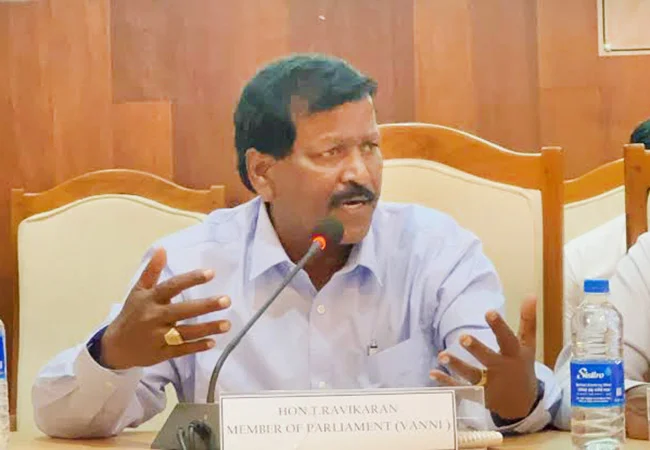
Vanni District NPP lawmaker Thurairasa Ravikaran has alleged that the Forest Department functions like a “gang of thieves” engaged in the unlawful seizure of northern and eastern lands.
Ravikaran alleged that only 222,006 acres of dense forest were under the Forest Department’s control in Mullaitivu in the past, whereas following the end of the war, 432,141 acres were now under its control.
The MP said so during the Vavuniya–Settikulam Divisional Development Coordinating Committee meeting held recently, while discussions were underway regarding the release of lands currently under the control of the Forest Department.
Ravikaran claimed that the Forest Department, along with the Archaeological Department, Department of Wildlife Conservation and the Mahaweli Authority, was actively involved in occupying lands belonging to the Tamil people.
The MP said he had previously warned Deputy Minister Samarasinghe and government MPs from the Vanni District that institutions involved in taking people’s lands would ultimately undermine the National People’s Power government.
Ravikaran urged Deputy Minister and Development Committee Chairman Upali Samarasinghe to take firm action against what he described as the Forest Department’s aggressive and unlawful activities
He alleged that the Department had encroached on people’s lands by placing boundary markers, including paddy fields and lands used for subsidiary food crops.
“If people’s agricultural lands are taken over in this manner, what are the farmers, who depend on those lands, supposed to do?” he questioned.
Ravikaran called on Deputy Minister Samarasinghe to take appropriate action against the alleged encroachment and return agricultural lands to their rightful owners.
He also alleged that the Forest Department takes legal action against villagers for cutting small trees for agricultural purposes, while complaints have been received alleging that the Department facilitates the destruction of large forest areas in exchange for bribes.
“We are only asking you to protect our Vanni region,” Ravikaran said, urging the authorities to demonstrate action against the Forest Department’s activities rather than merely expressing opposition.
“What does the Forest Department need the people’s agricultural lands for? Return our farmers’ lands to them and enable them to cultivate their own land and sustain their livelihoods,” he said.
Ravikaran concluded by describing the Forest Department as a “gang stealing people’s lands” and called for firm action against its alleged encroachment.

Hundred farming elders witness Sacred Dalada Perahera

Accountability must not be limited to bribery and corruption

UNHRC urges GoSL to repeal PTA

Sonal Dinusha and the epic draw

Big scene for JAYASRI at One Love Festival

Australia’s MDF and Thema Collection convene industry to explore way forward for wellness tourism

‘Dates have the highest sugar content to fight Coronavirus’

Sunday Island 27 December – Headlines

#SundayIsland 17th December – Headlines

Sunday Island – 28th March

Sunday Island Headlines – 21 March

Sunday Island – 21st February – Headlines
-

 News5 days ago
Denied of promotion to SC despite vacancies, justice Gurusinghe retires
-

 Latest News6 days ago
Grade 5 scholarship exam results released
-

 News5 days ago
22A: SC urged to suspend hearing, appoint full bench
-

 Midweek Review6 days ago
The local and global dynamics of Sri Lanka’s 22nd Amendment
-

 News3 days ago
Namal remanded until Sept. 18 over Airbus deal investigation
-
 News5 days ago
Govt. seeks NATO assistance
-

 Latest News2 days ago
Tharanga creates history with Diamond League crown in Brussels
-

 News6 days ago
40 professional organisations and TU oppose proposed 22A