
Foreign News
Russia confirms damage to warship in Black Sea

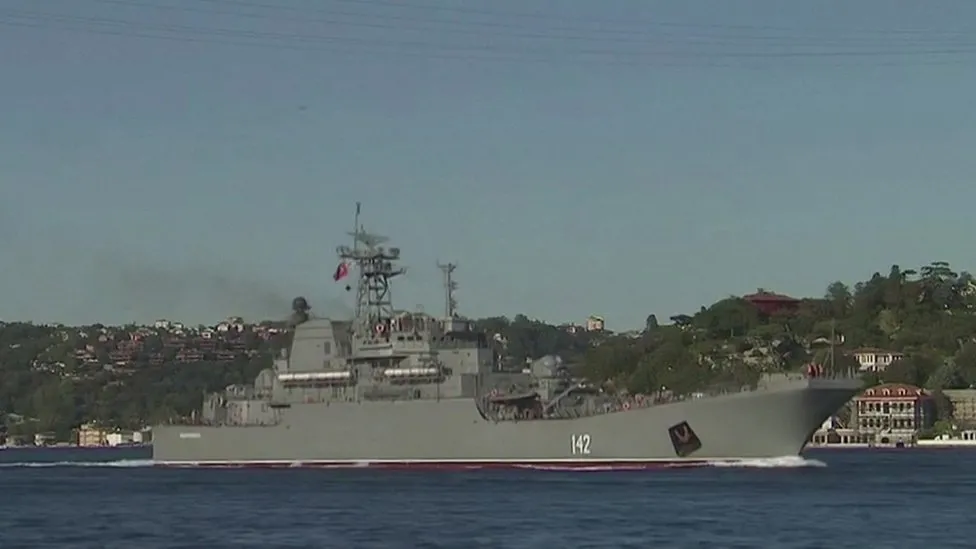
Russia has confirmed one of its warships has been damaged in a Ukrainian attack on a Black Sea port.
The airstrike took place at Feodosiya in Russian-occupied Crimea early on Tuesday morning.
Russia’s Ministry of Defence said the large landing ship Novocherkassk was struck by Ukrainian aircraft carrying guided missiles. The head of the Ukrainian Air Force said earlier its warplanes had destroyed the ship.
One person was killed in the attack, according to the Russian-installed head of Crimea, Sergei Aksyonov. Several others were reportedly hurt. Six buildings were damaged and a small number of people had to be taken to temporary accommodation centres, Aksyonov added.
The port’s transport operations are said to be functioning as normal after the area was cordoned off, while a fire caused by the attack was contained.
Footage purportedly showing a huge explosion in the port was shared by Ukrainian air force commander Lt Gen Mykola Oleshchuk.
The images have not been independently verified. However, satellite imagery from 24 December shows a ship at port in Feodosiya that appears to be the same length as the Novocherkassk – a landing ship designed to transport troops, weapons and cargo to shore.
Any significant damage to the ship will be a welcome bit of good news for Ukraine, with waning Western support now affecting its front-line operations. Given that the Novocherkassk was in dock, it is highly likely it was being loaded with soldiers, equipment or both.
Taking it out of action, even if only temporarily, will no doubt hamper Russia’s ability to supply troops in territory it occupies further north. What is less clear is how long its operations will be disrupted for and what impact this strike will have on the front lines.
Meanwhile, a spokesman for Ukraine’s air force has denied that Russia shot down two of its Su-24 bombers about 125km (77 miles) from the occupied Ukrainian city of Mykolaiv. It has also recently denied a claim by Russian Defence Minister Sergei Shoigu that his troops have seized the key town of Mariinka in eastern Ukraine.
The area has been used by Ukraine as a defensive barrier since 2014, when Russian-backed fighters seized large swathes of the Donetsk and Luhansk regions.
Tuesday’s attack on Feodosiya is not the first time that the Novocherkassk has been targeted by Ukrainian forces.
In March 2022, Ukraine’s defence ministry reported that the ship had been damaged in an attack on the occupied Ukrainian port of Berdyansk in which another amphibious assault ship, the Saratov, was sunk.
In a post on Telegram, Lt Gen Oleshchuk wrote that the Novocherkassk had gone the way of the Moskva – the flagship of Russia’s Black Sea Fleet, which sank in the Black Sea last year.
Ukrainian President Volodymyr Zelensky quipped that he was “grateful” to the country’s air force “for the impressive replenishment of the Russian submarine Black Sea fleet with another vessel,” in reference to other Russian ships that have been sunk during the war.
“The occupiers will not have a single peaceful place in Ukraine,” he said.
Russia seized and annexed the Crimean Peninsula from Ukraine in 2014 and its forces based there played a key part in the full-scale invasion of Ukraine in February 2022. Russian forces in Crimea have since come under repeated Ukrainian attack. Last month, Ukraine’s military said it had destroyed 15 Russian navy ships and damaged another 12 in the Black Sea since the start of Russia’s war.
After a missile strike on the headquarters of the Black Sea fleet in Sevastopol last September, satellite images showed that the Russian navy had moved much of its Black Sea fleet away from Crimea to the Russian Black Sea port of Novorossiysk.
The dominance of the Russian navy has been diminished to an extent as result of such attacks, but this year has seen Moscow keep hold of the territory it occupies, despite a Ukrainian counteroffensive.

((BBC)












Nepal sent helicopters to the rescue after a huge flash flood swept away villages, killing at least eight people and damaging roads, bridges and power projects in areas near Tibet, authorities said.
Officials said 384 tourists, including 291 from countries including the United Kingdom, the United States, India and Malaysia were reported missing as a result of the flash flood on Wednesday.
The waters were too high for helicopters to land in Nepal’s affected areas of Syapru Besi and Timure in the mountainous district of Rasuwa, with a population of about 50,000, officials said.
“There could be heavy casualties or loss of property,” district administrator Narendra Pariyar told the Reuters news agency. “But I cannot say for sure now.”
Pariyar urged those living on the banks of the Bhote Koshi River in the area to seek higher ground, pointing to reports that nearby villages and infrastructure project sites were washed away.
Across the border, Tibet reported “major casualties” with people missing in the neighbouring county of Gyirong after a mudslide hit a land crossing between China and Nepal, the Xinhua official news agency said.
The mudslide hit China’s Gyirong port, cutting off roads, communications and power in the Shigatse region, Xinhua added, without giving details.
President Xi Jinping urged “all-out” efforts to search for the missing, and called for strengthening monitoring and early warning systems to prevent secondary disasters.
Prayash Adhikari, a climate justice activist in Nepal, said the “devastating” flood has wiped out “whole villages”
“Hundreds of people are missing,” Adhikari told Al Jazeera from Kathmandu, stating it wiped out buildings, schools, bridges and highways.
Videos shared by Nepal Police and others on social media showed torrents of muddy water crashing through mountain valleys.
Many people were caught off guard when the flash flood hit, as there was no heavy rainfall, said Kosh Raj Koirala, an editor of Republica Daily, an English newspaper in Nepal’s capital.
“People were at home … several houses have been washed away, swept away by the river,” Koirala told Al Jazeera.
Prime Minister Balendra Shah convened an emergency meeting of the National Disaster Risk Reduction and Management Authority to take stock of the situation.
“Work has started to take necessary steps in coordination with the medical team, scouts, and Red Cross,” Shah said in a social media post.

The Nepal Army said it had deployed helicopters and disaster response personnel to the affected area.
“The work of collecting details of the damage is under way,” it said in a statement.
The Nepal Electricity Authority said about 430 megawatts of production capacity, including from hydropower and solar facilities, have been damaged.
“The disaster has damaged the production, transmission and distribution facilities of the Authority … resulting in disruption of electricity supply,” it said.
Several highways were also closed, according to the authorities.
‘Glacial lake outburst’ could be underlying cause
Climate experts at the International Centre for Integrated Mountain Development in Nepal say an avalanche from a glacier likely caused the flash flood.
The Lhende Khola River, a tributary of the Bhote Koshi River, witnessed maximum flooding on Wednesday, they said.
“The Lhende Khola has flooded twice in 14 months, this time triggered by an ice rock avalanche from a glacier on the Nepal side that blocked the river and released a sudden surge downstream,” said Saswata Sanyal, a disaster risk reduction specialist at the climate research group.
Adhikari, the climate activist, told Al Jazeera that early warning systems are crucial to protect communities.
“This can’t be completely turned around because we are on the verge of climate catastrophe, but still we can protect our communities,” he said.
The Bhote Koshi River originates in Tibet and empties into Nepal’s Trishuli River, which eventually flows into India as the Gandak River.
A flood last year in the Bhote Koshi River killed nine people, with 24 missing, and washed away the “Friendship Bridge” linking Nepal and China, disrupting transport and trade for several months. That flood was triggered by the draining of a supraglacial lake in Tibet, a regional climate monitor said.
Monsoon rains from June to September regularly trigger deadly floods and landslides across South Asia.
Scientists say climate change is increasing the frequency and intensity of extreme weather events in the region.

Damaged houses stand precariously near the swollen, debris-choked banks of the Trishuli river after flash floods in Nepal’s Nuwakot district [Aljazeera]
[Aljazeera]

New Zealand is to introduce a bill seeking to ban under-16s from using social media.
Under the latest proposals, platforms including TikTok, Instagram, Snapchat and Facebook, will have to take steps to check users are over 16 and platforms that fail to meet their obligations could face fines of up to 10% of their global revenue.
Prime Minister Christopher Luxon said social media was exposing children to “harmful content, addictive technology and pressures they are not equipped to deal with”. But several political parties have said they will vote against the bill.
The move follows a similar ban in Australia, while countries including the UK and Greece are set to introduce restrictions next year.
Luxon said social media was affecting children’s family life, mental health, sleep and education.
“We have protections to keep children safe in the real world and we need them in the virtual world too,” he said.
New Zealand’s government has not outlined which other “high risk” platforms could be impacted.
A statement said that under the Online Safety Bill, which is being introduced to parliament on Monday, social media companies would be required to “take reasonable steps” to check users are over the age of 16 by using methods including existing account information, facial age estimation and digital identity checks.
Platforms regularly used by children would also be required to regularly assess the risks they pose and report on how they are being identified and reduced.
No penalties are proposed for children, parents or caregivers for breaches of the ban, but fines for social media companies could be substantially higher than in Australia, where the maximum penalty is $99m.
It is unclear if the bill will get enough votes to pass however, after both the Act and New Zealand First (NZF) parties – which are coalition partners in the government – said they would oppose it.
David Seymour, New Zealand’s deputy prime minister and leader of Act, said the ban would not work.
Foreign affairs minister Winston Peters, who leads the NZF party, said: “We have been concerned with the proposed legislation and the direction and slippery slope that legislation like this will inevitably take our country.”
Peters also described a ban introduced in Australia in December as a “colossal failure”.
The ban has been difficult for Australia to enforce, and it has been widely acknowledged that many children under the age of 16 have still been able to access and use banned apps.
Earlier this month, France’s top court struck down a similar proposed social media ban, saying it infringed upon freedom of expression.
[BBC]
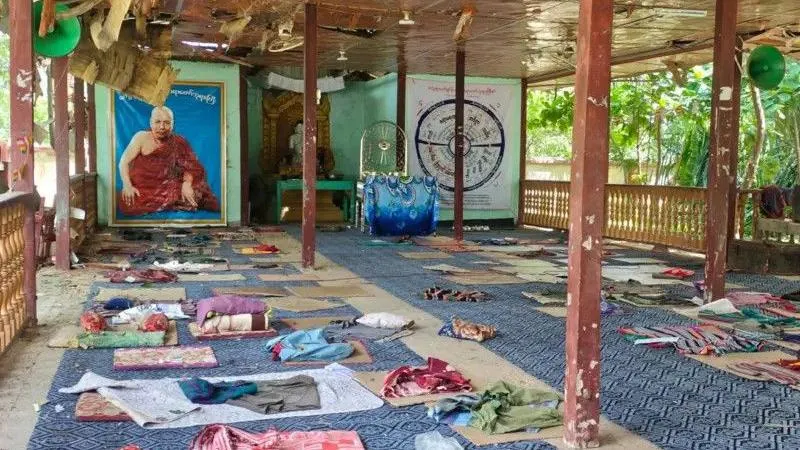
Fourteen people were killed in military air strikes at a monastery in Myanmar early on Friday, opposition fighters and a local rescue worker have said.
All of those killed were elderly and a number of monks were also injured, the rescue worker told BBC Burmese, adding that the site was struck twice.
The attack happened at around 09:00 local time (02:30 GMT) in Myaung township in the central Sagaing region, some 70km (47 miles) west of Mandalay, the news agency AFP reported.
Civilians had reportedly gathered at the site for a meditation retreat to mark Buddhist Lent. Myanmar’s military has not commented.
Nway Oo Myaung, a pro-democracy rebel, told AFP that the victims included 11 men and three women. Five of the victims were said to be from one village, while the remaining nine were from a neighbouring township.
“Older people had entered the meditation centres,” Myaung added, saying the dead were aged between 50 and 70.
A second, unnamed opposition fighter said he had been among those searching for survivors of the attacks.
“While we were trying to rescue people, the aircraft came to bomb a second time,” he said.
Myanmar has been locked in civil war since the military staged a 2021 coup ousting Aung San Suu Kyi, and has been under martial rule since. The military, which is frequently accused of carrying out strikes on public buildings, has previously said it only strikes legitimate targets.
[BBC]

More than 360 dead, 1,400 missing in Nepal and Tibet after Himalayan floods

Bosnian Serb convicted war criminal Ratko Mladic dies

Prince of Wales to celebrate 150th anniversary with six-a-side cricket

Unyielding Dinusha, spirited tail hold off India to save Colombo Test

US golfer Gogel gets six-month ban for betting

UAE’s Asif Khan handed 15-month ban for using a banned substance

‘Dates have the highest sugar content to fight Coronavirus’

Sunday Island 27 December – Headlines

#SundayIsland 17th December – Headlines

Sunday Island – 28th March

Sunday Island Headlines – 21 March

Sunday Island – 21st February – Headlines
-

 News7 days ago
Country’s first woman Surveyor General appointed
-

 Business6 days ago
SriLankan Airlines makes ShakthiSAT Mission possible for talented Sri Lankan student
-

 Features7 days ago
Medical education in Sri Lanka: Then and now
-
 Latest News7 days ago
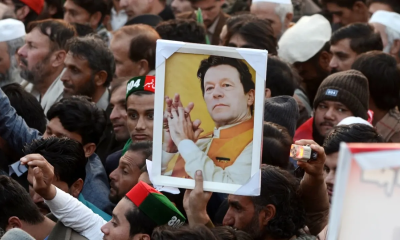
Imran Khan moved to private hospital amid deteriorating health
-

 Latest News7 days ago
Government has declared 21, 22 and 23 August 2026 as national days of mourning
-

 Features5 days ago
My secondary schooling after Royal Primary
-

 Features5 days ago
From the First to the 22nd: A short history of Amendment Politics and Reform Frustrations
-

 News7 days ago
22A: Opp. demands all available SC judges hear petitions