
Business
High out-of-pocket expenditure seen as affecting healthcare access of local households

By Ifham Nizam
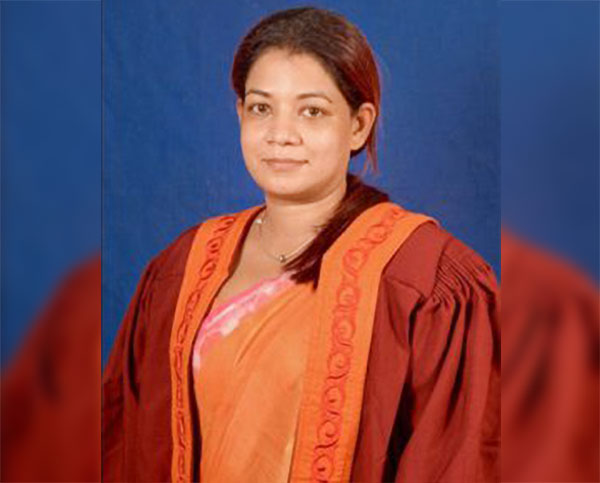
Although the general understanding is that universal health coverage (UHC) could be achieved only through publicly- funded healthcare systems, high out-of-pocket expenditure (OOPE) is a tax on health and leaves many a local household behind with regard to availing substantial healthcare, General Sir John Kotelawala Defense University’s, Senior Lecturer, Dr. Anuji Gamage said.
Speaking at a recent symposium held at the BMICH titled ‘Poverty Alleviation in an Era of Economic Crisis; Impact of Socioeconomic Disparities on Vulnerabilities’ under the specific topic, `Unravelling the Facts Influencing Health Care Access Outcomes’, she said that OOPE accounts for about 50 percent of total health expenditures in Sri Lanka.
Dr. Gamage added: ‘Sri Lankan households spend private money on healthcare services due to various reasons. Considering NCD care, monthly household expenditure is approximately Rs. 5000.00. The direct health and non-health costs incurred on regular clinic follow-up for NCD (Non-communicable diseases care) at public and private healthcare facilities lead to high Catastrophic Health Expenditure (25%).
‘Patients incur high OOPE on direct medical costs. There are sector-wise variations in OOPE. Costs incurred for vehicle hiring are higher for the estate sector, whereas by-stander cost was very high for urban dwellers. These sectoral determinants should be studied. When we analyze for direct non-health reasons for OOPE, it was for by-standers and transport-related costs.
‘High out-of-pocket expenditures by families to obtain medical care can impoverish them and affect their healthcare-seeking decisions, ultimately hindering Sri Lanka from achieving universal health coverage (UHC).
‘Sri Lanka is a welfare state that provides free healthcare and education. The assumption is that a healthy human would contribute to growth by being economically active. Hence, these have high returns on investments (ROI). The understanding is that UHC can only be achieved through publicly funded healthcare systems.
‘Recent studies have revealed that the proportion of chronic diseases and complications are high in Sri Lanka. Patients with chronic conditions incur high OOPE for hospital admission and are prone to catastrophic health expenses. Studies have repeatedly found that services rendered to patients with chronic conditions warrant a more integrative approach to reduce the burden of costs and that essential services need to be delivered uninterruptedly.’



Sri Lanka has one of the most educated female populations in South Asia, yet only about one in three women participates in the labour force, making female workforce participation among the lowest in the region and leaving a significant source of economic growth untapped.
That paradox took centre stage at a knowledge forum organised by the Asian Development Bank (ADB) in Colombo on June 3, where government officials, labour authorities, academics and private-sector leaders examined the deep-rooted barriers preventing women from fully participating in the economy and explored reforms needed to unlock their economic potential.
Opening the event, ADB Country Director for Sri Lanka Shannon Cowlin said the issue extends beyond gender equality and has become a critical economic challenge for a country seeking sustained growth and inclusive development.
“Empowering women to participate fully in the labour force is not only a matter of equality; it is essential for inclusive economic growth and poverty reduction in Sri Lanka,” she said.
The forum, held under ADB’s Serendipity Knowledge Programme (SKOP), focused on findings from a recent ADB-supported study exploring the factors behind Sri Lanka’s persistently low female labour force participation.
Cowlin noted that despite notable progress in education and human development, Sri Lanka continues to lag behind on measures of gender equality and women’s economic participation. She said multiple studies have shown that the factors shaping women’s labour force participation are layered, interconnected and multidimensional.
According to the study, many women remain concentrated in informal, low-paid and insecure employment with limited access to social protection and few opportunities for career advancement. Social and cultural expectations continue to place primary caregiving responsibilities on women, often restricting their ability to pursue careers or remain in full-time employment.
The lack of affordable childcare services, unequal access to digital skills and technology, concerns over workplace safety, sexual harassment and inadequate transport options were identified as major obstacles preventing women from entering or remaining in the workforce.
“These are complex challenges that require action from all stakeholders – government, development partners, the private sector, civil society and academia,” Cowlin said.
She stressed that improving women’s labour force participation would require more than isolated policy interventions, calling instead for structural transformation, stronger infrastructure and care services, progressive workplace practices and broader societal changes that improve women’s mobility, safety and economic agency.
The event featured a presentation by Professor Dileni Gunawardena of the University of Peradeniya, who shared findings from ADB’s study on female labour force participation, followed by a panel discussion involving representatives from the International Labour Organisation, the Department of Labour, MAS Holdings and John Keells Holdings.
Panelists discussed measures to improve the enabling environment for women, including greater investment in the care economy, expanded childcare facilities, enhanced skills development, creating safe, supportive workplaces and career pathways for upward mobility.
Participants agreed that increasing women’s participation in the workforce is not merely ‘a nice to have’ but an economic necessity, particularly as Sri Lanka seeks to accelerate recovery, boost productivity and achieve more inclusive growth.
The ADB said Sri Lanka’s economic recovery presents a unique opportunity to address long-standing structural barriers facing women and to build a more inclusive labour market that fully utilises the country’s human capital.
By Sanath Nanayakkare
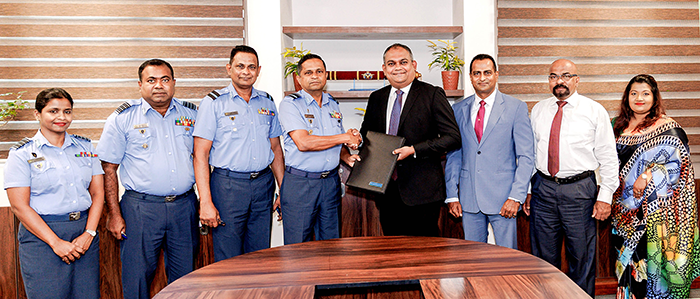
Reinforcing its commitment to those who serve the nation, the Commercial Bank of Ceylon has entered into a Memorandum of Understanding with the Sri Lanka Air Force (SLAF) to introduce a comprehensive suite of concessionary financial facilities for its officers and other ranks.
The partnership, unveiled in a year that marks the 75th anniversary of the Air Force, which was founded in March 1951 as the Royal Ceylon Air Force, reflects a shared recognition of the critical role played by the SLAF as the steadfast ‘Guardians of the skies,’ entrusted with safeguarding the country’s security and sovereignty.
Under the terms of the agreement, Commercial Bank will extend a range of specially tailored financial products to SLAF personnel, including personal loans, leasing facilities, housing loans and credit cards. These facilities will be offered at concessionary interest rates, alongside concessions on documentation charges, enabling Air Force personnel to access financial support on more favourable terms.
The Bank said the initiative is part of its continuing efforts to deliver best-in-class lending solutions that are both accessible and responsive to the diverse needs of its customers. By offering attractive and affordable repayment structures, the scheme is designed to empower SLAF officers and other ranks to meet their personal financial requirements with greater ease and flexibility.
A key feature of the programme is the ability for beneficiaries to align repayments with their income patterns, ensuring that the facilities remain practical and sustainable over the long term. This flexibility, combined with preferential pricing, is expected to make a meaningful difference to the financial wellbeing of Air Force personnel and their families.

The CSE was extremely volatile yesterday mainly due to external and internal negative factors.
‘The escalation of the war situation in West Asia and the proposed tariff hike on Sri Lanka’s exports to the US by the Trump administration are worsening Sri Lanka’s economic woes. Further, the government’s decision to increase the Treasury Bill rate has also created some uncertainty in the market, stock analysts said.
The All Share Price Index was up by 249.83 points, while the S and P SL20 rose by 67.61 points. Turnover stood at Rs 2.79 billion with 11 crossings.
Companies that mainly contributed to the turnover by way of crossings were: Chevron Lubricants 1.5 million shares crossed to the tune of Rs 294 million and its shares traded at Rs 196, TJ Lanka 2.9 million shares crossed for Rs 90.8 million; its shares traded at Rs 31, Citizens Development Business Finance 2.5 million shares crossed to the tune of Rs 80.2 million; its shares traded at Rs 32.50.
ACL Cables 634,248 shares crossed for Rs 60.9 million; its shares traded at Rs 96, CCS 438,000 shares crossed to the tune of Rs 57.4 million; its shares traded at Rs 131, Overseas Realties 991,500 shares crossed for Rs 49.6 million; its shares traded at Rs 50 and Access Engineering 653,000 shares crossed to the tune of Rs 49.3 million; its shares sold at Rs 75.50.
In the retail market companies that mainly contributed to the turnover were; Dialog Rs 133 million (3.2 million shares traded), Seylan Bank (Non-Voting) Rs 110 million (1.7 million shares traded), Colombo Dockyard Rs 96.8 million (751,548 shares traded), Ceylinco Holdings (Non-Voting) Rs 77.5 million (516,000 shares traded), Sampath Bank Rs 74.2 million (530,000 shares traded), JKH Rs 74 million (3.7 million shares traded) and LMF Rs 65 million (781,000 shares traded). During the day 123 million share volumes changed hands in 26272 transactions.
It is said that the manufacturing sector, especially Chevron Lubricants and several other firms performed well, while the banking and financial sector performed too.
Yesterday the rupee was quoted flat at Rs 334.50/335.50 to the US dollar in the spot market on, unchanged from the previous day’s close, dealers said, while bond yields were broadly steady.
The telegraphic transfer rate for Sri Lanka’s rupee against the US dollar was Rs 330.50 buying, Rs 339.50 selling; euro was Rs 381.1884 selling, Rs 395.1054 buying; and the pound Rs 442.6620 buying Rs 456.7076 selling.
A bond maturing on 01.08.2030 was quoted at 12.12/20 percent, down from 12.15.25 percent.
A bond maturing on 15.06.2034 was quoted at 13.12/20 percent, down from 13.15/25 percent.
A bond maturing on 15.03.2035 was quoted flat at 13.15/25 percent.
By Hiran H Senewiratne

Pakistan hold their nerve to take series in low-scoring scrap

Robinson routs New Zealand top-order as England hit back on 16-wicket day

Rumesh Tharanga shatters Rome Diamond League record

Showers about 100 mm are likely at some places in the Western and Sabaragamuwa provinces and in Galle, Matara, Kandy and Nuwara-Eliya districts

Elders’ home devastated by fire was a ‘house of horror’: Witnesses

CERT : AI-generated videos depicting Prez, PM lure public into financial scams

‘Dates have the highest sugar content to fight Coronavirus’

Sunday Island 27 December – Headlines

#SundayIsland 17th December – Headlines

Sunday Island – 28th March

Sunday Island Headlines – 21 March

Sunday Island – 21st February – Headlines
-

 News6 days ago
IMF urges Lanka not to meddle with exchange rate
-

 News3 days ago
Lankan duo emerge winners in Latin dance championship held in Blackpool, UK
-

 Business4 days ago
IMF’s unstated rate:Sri Lanka’s $695m loan costs about 5.33% per annum
-
 News6 days ago
State of emergency extended
-

 Features5 days ago
Are threats to Buddha Sasana external or from within?
-

 News4 days ago
UNP challenges NPP move to amend Vihara – Devalagam Act
-

 Business4 days ago
Sri Lankan scientist-innovator Milinda Edirisinghe introduces AI-integrated gem testing system to gemological world
-

 News3 days ago
Sri Lankan teen killed in Chennai clash; three arrested