
Latest News
Ryan O’Neal, Oscar-nominated star of Love Story, dead at 82


American actor Ryan O’Neal, best known for his Oscar-nominated role in 1970 romance Love Story, has died at the age of 82, his son said.
His family did not share a cause of death, but O’Neal was diagnosed with chronic leukaemia in 2001 and prostate cancer in 2012.
He also starred in 1970s hits What’s Up, Doc?, Paper Moon and A Bridge Too Far.
His son said his father was “a Hollywood legend. My dad passed away peacefully today, with his loving team by his side supporting him,” Patrick O’Neal wrote on Instagram on Friday. He added that his father had always been his hero.
O’Neal’s rugged good looks catapulted him from television soap to movie stardom in tearjerker Love Story. He starred as an upper-crust Harvard undergraduate who falls in love with a working class student, played by Ali MacGraw.
The movie is considered by the American Film Institute to be among the top 10 most romantic of all time.
He went on to star in 1972 screwball comedy What’s Up, Doc?, alongside Barbra Streisand. He acted with her again in The Main Event in 1979.
“So sad to hear the news of Ryan O’Neal’s passing,” Streisand posted on X, formerly Twitter. “He was funny and charming, and he will be remembered,” she added.
He played a Depression-era conman in road comedy-drama Paper Moon (1973), alongside his nine-year-old daughter, Tatum O’Neal, who won an Oscar for her show-stealing supporting role.
O’Neal also appeared with an all-star cast in 1977 war epic A Bridge Too Far and in Barry Lyndon (1975), Stanley Kubrick’s highly anticipated follow-up to A Clockwork Orange.
But his star faded at the end of the 1970s and only his turbulent personal life kept him in the headlines.
He was born in Los Angeles in 1941 to a mother who was a stage actress and a father who was a novelist and screenwriter. O’Neal took up boxing in school and developed an impressive physique before landing small television roles.
He was cast in Peyton Place, known as America’s first prime-time soap opera. That role made him a household name, and like his co-star Mia Farrow, he was able to make the leap to the big screen.
He was married twice: first to American actress Joanna Moore, with whom he had two children, including Tatum, and then to Emmy-winning actress Leigh Taylor-Young, with whom he had one son, Patrick.
But O’Neal was also known for his long-term, tumultuous romance with actress Farrah Fawcett. That relationship lasted from 1979 to 1997, and then from 2001 until Fawcett’s death in 2009.
In an interview with Piers Morgan in 2011, O’Neal said that re-watching his film Love Story “upsets me, actually”. “I lost Farrah to cancer, and I just wonder why that played out that way for me,” O’Neal said.
In the tribute to his father, Patrick O’Neal said that he was “skilled at his craft, worked so hard, and just loved acting plain and simple. As a human being, my father was as generous as they come,” he added. “And the funniest person in any room. And the most handsome clearly, but also the most charming. Lethal combo.”
Patrick also paid tribute to Fawcett, his father’s long-time love.”Now they meet again. Farrah and Ryan. He has missed her terribly. What an embrace that must be. Together again.”
(BBC)

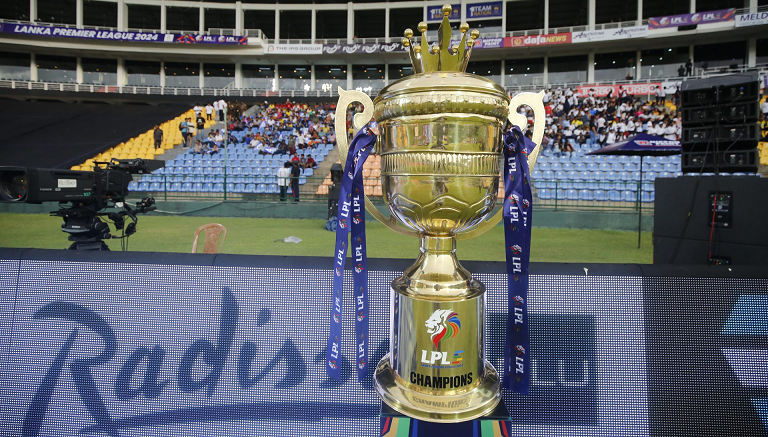
The inaugural game of the Lanka Premier League 2026 will be played between the Jaffna and Galle teams, who emerged as the Champions and Runners-up respectively in the 2024 season.
The opening game is scheduled to be played on 17th July at the SSC Grounds, commencing at 7.30 p.m.
Prior to the start of the tournament opener, a spectacular opening ceremony will be held at the SSC Grounds in Colombo.
The Lanka Premier League 2026 will be played from 17th July to 8th August across four venues: SSC, Colombo; RDICS, Dambulla; PICS, Pallekele; and RPICS, Colombo.
The tournament is conducted by Sri Lanka Cricket (SLC), the owner of the LPL, in partnership with The IPG Group, the event rights holder.
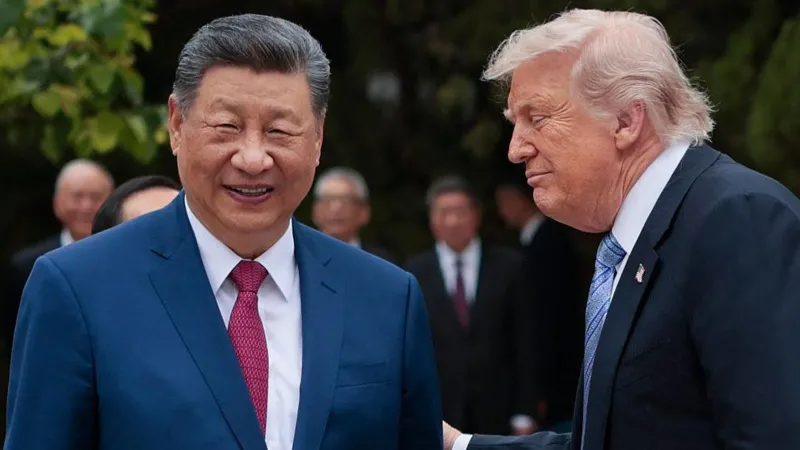
US President Donald Trump left Beijing after a two-day summit saying he had struck “fantastic trade deals, great for both countries”, but few details have emerged on what the two superpowers agreed.
Trump arrived for a high-stakes summit with Chinese leader Xi Jinping on Wednesday, accompanied by several CEOs: a high profile business delegation spanning agriculture, aviation, electric vehicles and artificial intelligence (AI) chips.
Trade was near the top of the agenda despite recent tensions over the Iran war, and businesses hoped for key deals as well as an extension of the tariff truce that is due to expire in November.
The visit was defined by warm rhetoric and symbolism. Trump was wooed with a packed itinerary that included an honour guard, a state banquet, and an invitation to the exclusive compound where China’s Communist Party leaders live and work.
The US President seemed impressed and invited Xi to the White House in September. He said talks had been “very successful”, while Xi called it a “historic and landmark” visit.
But neither side has announced trade breakthroughs or significant business deals.
President Trump, however, spoke to reporters aboard Air Force One and said that China has agreed to buy 200 Boeing jets, with a potential commitment to buy an additional 750 planes. The BBC has contacted Boeing for comment.
Trump also said American farmers will be happy with his trade deals because China would be buying “billions of dollars” of soybeans.
But there has been no confirmation of any deals or purchases from the Chinese.
If the Boeing orders are finalised, this would be the planemaker’s first major Chinese deal in nearly a decade. It was largely shut out of the world’s second-largest aviation market because of trade tensions between Beijing and Washington.
Asked about Trump’s earlier comments to Fox News in which he said deals had been made, Chinese foreign ministry spokesperson Guo Jiakun only said that the “essence of China-US economic and trade relations is mutual benefit and win-win co-operation”.
He added that both sides should work to implement the “important consensus” reached by the two leaders and bring greater stability to bilateral trade ties and the global economy.
There are still questions over the trade truce agreed in October, when Washington suspended steep tariff increases on Chinese goods while Beijing eased back from restricting rare earth exports critical for manufacturing.
Suprisingly Trump told reporters on Air Force One that he and Xi did not discuss tariffs at all.
The White House however said both leaders agreed to establish a “Board of Trade” to manage the relationship without having to reopen tariff negotiations.
US Treasury Secretary Scott Bessent, who had been leading trade talks for Washington, said in a pre-recorded interview with CNBC that he expected progress on a mechanism to support future investment.
US officials have cautioned, however, that there is a lot of work to be done before these announcements can go into effect.
One of the most closely watched moments came as Air Force One touched down in Beijing on Wednesday night.
Tesla CEO Elon Musk stepped off the plane ahead of senior officials including Pete Hegseth, Marco Rubio and Greer – a sign of the crucial economic agenda that lay ahead.
And Musk and US chipmaker Nvidia’s boss Jensen Huang stayed close to Trump during the welcome ceremony, and were prominent during the banquet.
Huang’s appearance was notable because he was not meant to be part of the delegation originally – but when he joined the trip, it fuelled speculation that AI and access to chips was a bigger part of the talks than previously thought.
With electric vehicles, AI and semiconductors becoming key battlegrounds in the US-China rivalry, both Tesla and Nvidia are very exposed to China.
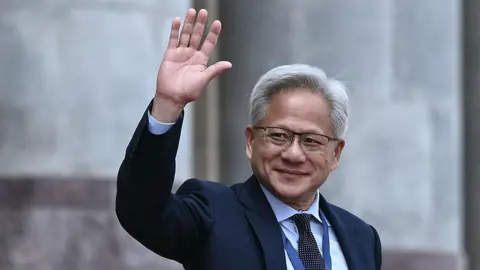
Tesla relies heavily on its Shanghai gigafactory and Chinese consumers, while Nvidia wants to be able to start selling advanced chips to China again, which is currently prohibited by US export controls.
US export controls are aimed at limiting China’s access to frontier AI capabilities, but Greer said they were not a major talking point at the summit.
Beijing, however, continues to push for greater access to advanced tech, while criticising what it sees as efforts to constrain its industrial development.
AI was expected to be a big part of conversations but there was no mention of it in readouts from the summit.
Last year’s tit-for-tat tariff war also hit American farmers, who want to export more soybeans, beef and poultry to China.
According to US trade representative Jamieson Greer, deals on Chinese purchases of US agricultural products have been firmed up. But China’s foreign ministry did not confirm any such new deals, saying only that both sides had agreed to maintain stable trade ties and expand co-operation based on “equality, mutual respect and mutual benefit”.
The White House said the talks also touched on expanding Chinese market access for US companies and increasing Chinese investment in US industries.
While China is a major market for US companies, it is also a difficult operating environment because of regulation, red tape and geopolitical uncertainty.
But Beijing seemed to strike a positive note on this issue. Xi told US business leaders that China’s “doors will open wider” and that American firms would have “broader prospects” in the Chinese market, according to news site Xinhua.
He also called for expanded co-operation in trade, agriculture, healthcare, tourism and law enforcement, describing bilateral ties as “mutually beneficial” and delivering “win-win results”.
Taiwan, the US ally and self-governed island that Beijing claims, has largely been treated as one of several friction points between the US and China during trade talks over the past year.
But this time Beijing linked Taiwan to the broader economic relationship with the United States.
According to Beijing’s readout, Xi said the two sides had agreed to a “new positioning” for relations based on “constructive strategic stability”, but issued the now-familiar warning that Taiwan remained the most sensitive issue.
“The Taiwan question is the most important issue in China-US relations,” Xi warned during the talks, according to Chinese state media.
“If mishandled, the two nations could collide or even come into conflict,” he said.
Taipei would be watching closely but it’s hard to say yet if and how this will affect US collaboration with semiconductor companies in Taiwan, or its long-standing close relationship with the island.
The war against Iran and the resulting blockade of the Hormuz Strait was a key part of the agenda, and Trump entered the talks hoping for Chinese co-operation on the Iran conflict and the oil market.
Trump has said that China could use its influence to encourage Iran to stabilise flows through the Strait of Hormuz, a key global energy artery.
“[Xi would] like to see the Hormuz Strait open, and said ‘if I can be of any help whatsoever, I would like to help,'” Trump told Fox News.
The Chinese foreign ministry was more vague, and released a statement on Friday calling for “a comprehensive and lasting ceasefire”.
“Shipping lanes should be reopened as soon as possible in response to the calls of the international community,” it added.
Chinese readouts indicated that while the Middle East was discussed, details were limited.
The conflict is a challenge for the Chinese economy too. Oil price volatility and repeated disruptions to supply routes have increased China’s import costs and pushed up prices across the world.
Trump has already invited Xi to the White House in September for a second summit.
Discussions between the two sides are expected to continue ahead of that summit, with the hope that the world’s two biggest economies can deliver a major breakthrough on trade that proved elusive this time around.
[BBC]

India has raised fuel prices by about 3 percent as the energy crisis driven by the Iran war and closure of the Strait of Hormuz starts to bite on the economy.
The government in New Delhi announced the 3 rupees ($0.03) per litre price hike on Friday, as it moved to offset losses triggered by the shortage of supply. Gasoline prices rose to 97.77 rupees ($1.02) a litre, while diesel climbed to 90.67 rupees ($0.94).
India is the world’s third-largest oil importer, with 90 percent of the oil it consumes coming from overseas, and about half of its usual crude supplies transiting the Strait of Hormuz.
This has seen the country heavily impacted by rising energy prices and supply disruptions from the US-Israel war on Iran.
However, New Delhi had been avoiding hiking retail fuel prices, making it one of the last major economies to pass higher crude prices on to consumers.
The increases come days after Prime Minister Narendra Modi urged Indians to adopt voluntary austerity measures, calling on them to work from home whenever possible, limit travelling abroad, and reduce purchases of gold.
Modi described saving fuel as an act of “patriotism” and encouraged greater use of public transport, carpooling, and lower fertiliser consumption.
Opposition leaders noted that Modi’s appeal came after the conclusion of a key round of state elections and that fuel prices were kept unchanged during the campaign. The polls ended this month, with Modi’s BJP winning two of four states and expanding its influence.
[Aljazeera]

LPL 2026 Opening Game between Jaffna and Galle

New Zealand’s Māori Queen meets King Charles at Buckingham Palace

Trump and Xi conclude ‘very successful’ talks but no deals announced

India hikes fuel prices as Iran crisis bites

Kuldip Yadav in for Khaleel; Gleeson for Thushara

Eyman Fatima powers Pakistan to series victory

‘Dates have the highest sugar content to fight Coronavirus’

Sunday Island 27 December – Headlines

#SundayIsland 17th December – Headlines

Sunday Island – 28th March

Sunday Island Headlines – 21 March

Sunday Island – 21st February – Headlines
-
 News6 days ago
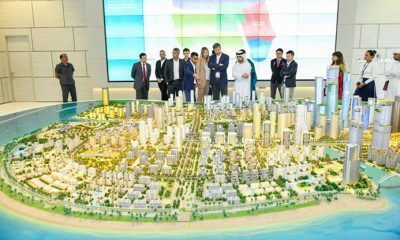
Lanka Port City officials to meet investors in Dubai
-
 News3 days ago
Ex-SriLankan CEO’s death: Controversy surrounds execution of bail bond
-
 News7 days ago
SLPP expresses concern over death of former SriLankan CEO
-
 News7 days ago
Police inform Fort Magistrate’s Court of finding ex-CEO of SriLankan dead under suspicious circumstances
-
 Features4 days ago
When University systems fail:Supreme Court’s landmark intervention in sexual harassment case
-
Features4 days ago
High Stakes in Pursuing corruption cases
-
 Midweek Review3 days ago
A victory that can never be forgotten
-

 News7 days ago
President of Vietnam and delegation departs Sri Lanka