
News
UN International Day of Solidarity with the Palestinian people

November 29 has been named as the International Day of Solidarity with the Palestinian people by the United Nations.
In drawing attention to the struggle of the Palestinian people we cannot but remember the firm stand that the United Nations took against racism, against the evil of Apartheid and supported the liberation struggle of the people of South Africa, Imthiaz Bakeer Markar, MP, Co-chairman Sri Lanka – Palestine Solidarity Committee, said in a statement to mark the occasion.
At the time his people were liberated, the celebrated leader of the liberation struggle for South Africa Nelson Mandela made a profound statement, which resonates around the world to this day, he noted.
He further said: “For many years, the United Nations stood firm against racism. Because of that a worldwide consensus was built against this unfair system. We know too well that our freedom is incomplete without the freedom of the Palestinians.
“The Palestinian conflict is a complex one and it is a mistake for us to make judgements by viewing it on the surface with pre-conceived notions. Instead, I urge everyone to understand the underlying deep reasons why the Palestinian conflict has not been resolved after all these years. We have to take a humane view of their issues, their status and problems, and understand the realities. In short, we need to address these issues in a correct and just manner.
“The Palestinian struggle has gone on for seven long decades and we are disturbed to note that currently moves are afoot so that the Palestinians will lose their motherland forever.
“The world has failed to implement the international consensus sought by the United Nations to find a fair and just solution to the Palestinian issue because the Superpowers in the United Nations Security Council have used their veto powers to stop important UN Resolutions aimed at actualizing the broader view of the majority of the countries around the world. It is with sadness that we observe that the UN has been powerless to do the right thing for the Palestinians.
“At this time I remember the statement made by President Barack Obama, who lit up the hopes of all those who sought a solution to the Palestinian issue when he made the famous “Cairo declaration.”
In that statement Obama said: “It is also undeniable that the Palestinian people — Muslims and Christians — have suffered in pursuit of a homeland. For more than 60 years they’ve endured the pain of dislocation. Many wait in refugee camps in the West Bank, Gaza, and neighbouring lands for a life of peace and security that they have never been able to lead. They endure the daily humiliations — large and small — that come with occupation. So let there be no doubt: The situation for the Palestinian people is intolerable. And America will not turn our backs on the legitimate Palestinian aspiration for dignity, opportunity, and a state of their own.”
Little has happened since and unfortunately we have to add Obama to the list of US Presidents who have historically been unable to fulfil its promise to provide a just solution to the Palestinian question, Bakeer Markar said.
He added: President Bush also asked once “why do these people hate us so much?” It is also said that a US President who was there before Bush, Eisenhower, in a discussion with his staff asked the same question: “Why does the Arab world look at us in such a wrong way?”
“Actually the question arises not from the governments but from the ordinary people of the Arab world. The people rightly accuse the United States of safeguarding corrupt and autocratic regimes in the Middle East preventing the dawn of democracy in the region. The actual actions of the United States in the Middle East is contrary to its claim of being the “watchdog of democracy” in the region.
“The initiatives made by Washington to bring peace to the Palestinians from the Camp David Accords to the Oslo Accords have been rendered useless by Israel.
“In January 1976 the United Nations, backed by a wide global consensus, passed a Resolution granting Palestine political sovereignty. This Resolution received the support of the Palestine Liberation Organisation, the Arab countries, the European Bloc and the Soviet Bloc. However this UN effort was also stopped by the exercise of a veto from the United States. The 1981 initiative from Saudi Arabia called the FAHAD peace deal was also rejected by Israel.
“For decades the world has been helplessly watching the Palestinian tragedy unfold as the people of this land are being driven out of their homes which are being destroyed. They are forced to wander as they are constantly harassed and deprived of the very basic necessities such as water. “They have no freedom of movement, as they are being arrested arbitrarily, even little children and women have been detained.
“In the year 2020 alone 684 homes and other buildings in the West Bank were completely destroyed by Israelis.
“In October 2000, the UN Security Council resolved with a 14 to 0 vote that Israel should act according to the obligations and agreements contained in the Fourth Geneva Convention and return all Palestinian lands that have been occupied. At that time the US abstained from voting.
“In addition, in 2001 when Israeli troops clashed with Palestinians, attempts by the United Nations to send in international observers to minimize violence under the so-called Michael plan was opposed by Israel and the United States.
“These actions of the US has damaged its credentials as a neutral player in resolving issues in the Middle East and has ruined its reputation as a champion of democracy and global justice.
“Under President Donald Trump the US Middle East policy has been very one-sided. However under the new Democratic President it is hoped that the policy towards this region will be fairer and more progressive. If that does not happen then it will be a big blow against America’s boast of being a country that is a proponent of peace and democracy across the world.
“We wish all the peoples in the region a secure peace, in which they may live with dignity and mutual respect”.


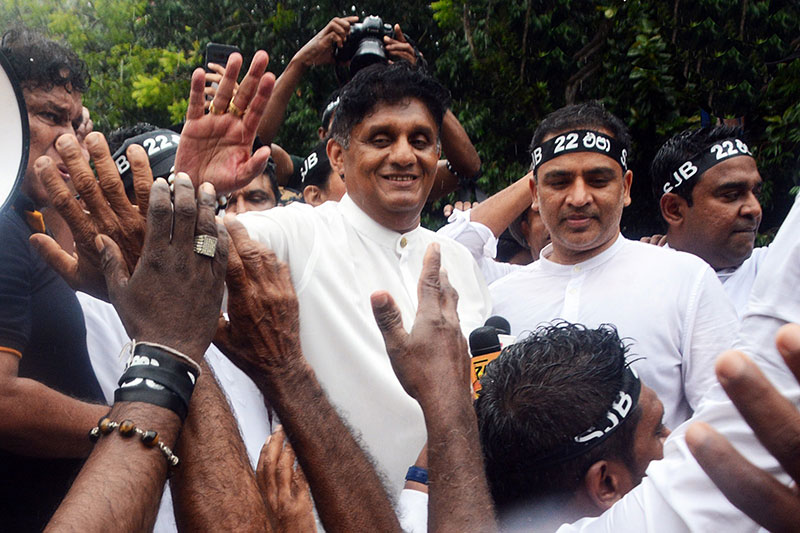
Opposition and SJB Leader Sajith Premadasa yesterday vowed that an SJB government would repeal the 22nd Amendment (22A) to the Constitution.Premadasa made the pledge while addressing thousands of SJB supporters who gathered near Parliament to protest against 22A.
Addressing the rally at Polduwa Junction, Battaramulla, Premadasa said the proposed constitutional amendment would undermine democracy and judicial independence and enable the concentration of political power in the Executive.
“Even if they pass it, under an SJB government we will scrap it,” Premadasa told the gathering, claiming that 22A was aimed at paving the way for a one-party state and placing the State under the control of a single political party.
Braving the rain, Premadasa said they had gathered there peacefully and had no intention of resorting to violence.
“We have gathered here to protect democracy,” he said, challenging the government to hold Provincial Council elections if it was confident of facing the people.
Premadasa said the SJB was prepared to work with any democratic and clean political force committed to the country’s progress and public welfare, amid ongoing discussions on cooperation among Opposition parties, including the United National Party.
Premadasa also accused groups aligned with the government of attempting to discourage people from attending the protest through statements and other measures.
SJB General Secretary Ranjith Madduma Bandara said the protest had been organised against the proposed amendment, which the party had opposed on the grounds that it could pave the way for authoritarianism.
The demonstration began around 9 a.m. at Polduwa Junction and coincided with Parliament taking up the proposed 22nd Amendment for debate. Proceedings on the Bill are scheduled to continue today (25).
The Supreme Court has determined that the proposed amendment does not require approval at a referendum and could be passed with a special majority in Parliament.
Meanwhile, traffic congestion was reported on roads surrounding Parliament and Polduwa Junction following the demonstration.
Security was also tightened in and around the Parliamentary complex, with a heavy police presence observed at Polduwa Junction and near the main entrance to Parliament.
Two retired female Navy petty officers were ordered to be remanded until October 5 over their alleged involvement in the abduction and disappearance of two women in Trincomalee during the war.
Trincomalee Chief Magistrate M.S.M. Samsudeen yesterday ordered that the two suspects be remanded and directed that they be produced for an identification parade on October 5.
The suspects, residents of Chilaw and Haputale, were arrested after appearing before the CID in connection with another court case. They were subsequently produced before the Trincomalee Magistrate’s Court.
The court was informed that the investigation concerned the alleged abduction of Sasikumar Thenmoli and Mary Delsia, residents of Paalaiyootru, Trincomalee, on or around May 13, 2008.
The CID told court that information uncovered during its investigations indicated that the two women had allegedly been detained at an underground location known as the “Gun Site” at the Trincomalee Naval Base while the two suspects were serving in the Navy. The women were subsequently reported missing.
Further investigations into the alleged abduction and disappearance of the two women are continuing.
The Frontline Socialist party through its People’s Struggle Alliance (Janatha Aragala Sandhanaya) yesterday accused the government of seeking to introduce a new anti-terror law containing provisions that could restrict fundamental rights and suppress dissent.
Speaking at a media briefing in Nugegoda yesterday (24), Janatha Aragala Sandhanaya National Executive Council member Duminda Nagamuwa said the government had gazetted the Protection of the State from Terrorism Bill, despite the NPP’s previous pledge to repeal repressive laws, including the Prevention of Terrorism (Temporary Provisions) Act (PTA).
Nagamuwa alleged that while the government claimed the new Bill was intended to replace the PTA, several provisions were more repressive than those contained in the existing legislation.
He said the proposed definition of terrorism was broad enough to potentially cover attempts to pressure the government or an international organisation to take or refrain from taking certain action.
“For example, if someone asks the government to reduce taxes, that could become a terrorist act. If we say or do something against the IMF, that could also become a terrorist act,” he alleged.
Nagamuwa also questioned the inclusion of offences relating to public property and protests within the proposed terrorism-related offences, arguing that such matters were already covered by existing laws.
He expressed concern over a provision that would empower the Secretary to the Ministry of Defence to issue detention orders, saying such authority had previously been vested in the President.
He also alleged that Section 51 of the proposed Bill would enable the police to obtain orders restricting protests if they believed a demonstration could exceed prescribed limits.
“This would undermine the fundamental right to protest,” he said.
Nagamuwa further claimed that the proposed legislation would expand the powers of the police, military and Coast Guard to conduct searches and that Section 66 would treat such actions and prosecutions as having been carried out in good faith.
He also criticised a provision under which the Attorney General could, in certain circumstances, refer a person who admitted an offence for rehabilitation and release the person from the proceedings.
Another concern, he said, was the proposed power of the President to designate organisations as prohibited organisations. According to Nagamuwa, acts carried out in support of such organisations could subsequently be treated as terrorist acts.
He alleged that the government was abandoning its earlier commitments to dismantle repressive laws and was instead preparing legislation that could be used against dissent.
Nagamuwa alleged that the government was implementing an economic programme favouring the wealthy while increasing the tax and economic burden on the public, and claimed that repressive laws were being introduced to suppress opposition to that programme.
He called on the public to oppose the proposed legislation, saying the Bill should not even be presented to Parliament.

Sajith vows to scrap 22A under future govt.

Two retired female Navy officers remanded over disappearance of two women during war

FSP: Govt. moving to introduce far more sinister legislation to replace PTA

Habeebu Lebbe sworn in as MP

Banks tighten online security as fraudsters outpace safeguards

ITAK seeks India, US intervention to save Lankan on Saudi death row

‘Dates have the highest sugar content to fight Coronavirus’

Sunday Island 27 December – Headlines

#SundayIsland 17th December – Headlines

Sunday Island – 28th March

Sunday Island Headlines – 21 March

Sunday Island – 21st February – Headlines
-

 News6 days ago
Shanakiyan urges urgent action over reported death sentence for Lankan in Saudi Arabia
-

 News5 days ago
Namal Rajapaksa Buddhist gambit fails, bail denied
-

 Features5 days ago
Why the spelling Sri Lankan names in English vary
-

 Features5 days ago
Three bands, a new identity: Sri Lankan wolf snake recognised as distinct species
-

 Business5 days ago
SLIIT holds largest-ever convocation
-
 News5 days ago
Govt monitors reported Saudi death sentence – Foreign Ministry
-

 News5 days ago
Vehicle prices drop by up to Rs. 1 mn, says importers’ body
-

 Business5 days ago
All-new Bolero MaXX Pik-Up unveiled in Lanka