
News
Reducing workplace sexual harassment: Three barriers and solutions identified


Verité Research’s Law and Governance Division hands over new report to Labour Ministry
Victims of workplace sexual harassment face three main barriers when seeking justice in Sri Lanka, according to a new study conducted by the Law and Governance Division of Verité Research. The report, titled ‘Sexual Harassment at the Workplace: Overcoming Barriers to Justice’, was handed over to the Minister of Labour and Foreign Employment Manusha Nanayakkara on Friday (01 Dec.).
Verité Research discussed the report’s findings with the Minister, emphasising issues in the legal framework and suggesting recommendations to address workplace sexual harassment. The think-tank also recommended enhancing and expanding protections against workplace sexual harassment by incorporating them into the ongoing draft Employment Bill, as part of efforts to expedite legislative reform.
The report draws from the diverse approaches taken by countries such as the Philippines, Peru, Japan, Mexico and Iraq to reduce sexual harassment in the workplace.
It identifies three barriers that need to be overcome:
1. The lack of an adequate legal definition on sexual harassment, despite disparate legislative provisions scattered across different laws.
2. Institutional barriers such as legal delays and high burdens of proof within the criminal justice system.
3. Entrenched cultural barriers and a lack of awareness, which further compounds the plight of victims.
The solutions recommended by the report include:
1. To adopt the internationally recognised definition of ‘violence and harassment’ at the workplace – this includes criminalising voyeurism and providing broader protections against sexual harassment that involves the use of digital or electronic media or images, audio, or videos that have sexual content.
2. To adopt civil legislative changes regarding employer liability for sexual harassment as a complimentary mechanism to the current criminal offense. Employers should be responsible for implementing a minimum set of measures to mitigate and address workplace sexual harassment – this includes internal complaint and inquiry mechanisms, as well as facilitating access to alternative dispute resolution.
3. To enhance education, training and awareness, for law enforcement agencies, in larger workplaces, through school curricula, and for the general public – the report outlines specific approaches that can be adopted for each of these categories.
Not only female victims
The report by Verité Research law and governance division also underscores that workplace sexual harassment extends beyond conventional gender boundaries in Sri Lanka. While women are particularly vulnerable, men as well as individuals with diverse gender identities are also vulnerable. Persons with disabilities, youth, migrant workers, and members of the LGBTQI (Lesbian, Gay, Bisexual, Transgender, Queer, and Intersex) community in Sri Lanka, identified as minority groups, face a higher likelihood of victimisation in this regard.
The full report is available at: www.veriteresearch.org/wp-content/uploads/2023/10/20231031SexualHarassmentat TheWorkPlaceFinal.pdf











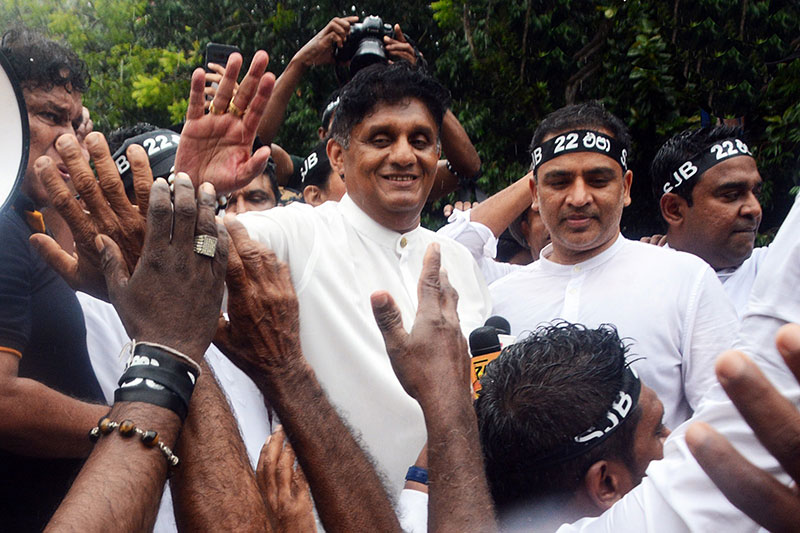
Opposition and SJB Leader Sajith Premadasa yesterday vowed that an SJB government would repeal the 22nd Amendment (22A) to the Constitution.Premadasa made the pledge while addressing thousands of SJB supporters who gathered near Parliament to protest against 22A.
Addressing the rally at Polduwa Junction, Battaramulla, Premadasa said the proposed constitutional amendment would undermine democracy and judicial independence and enable the concentration of political power in the Executive.
“Even if they pass it, under an SJB government we will scrap it,” Premadasa told the gathering, claiming that 22A was aimed at paving the way for a one-party state and placing the State under the control of a single political party.
Braving the rain, Premadasa said they had gathered there peacefully and had no intention of resorting to violence.
“We have gathered here to protect democracy,” he said, challenging the government to hold Provincial Council elections if it was confident of facing the people.
Premadasa said the SJB was prepared to work with any democratic and clean political force committed to the country’s progress and public welfare, amid ongoing discussions on cooperation among Opposition parties, including the United National Party.
Premadasa also accused groups aligned with the government of attempting to discourage people from attending the protest through statements and other measures.
SJB General Secretary Ranjith Madduma Bandara said the protest had been organised against the proposed amendment, which the party had opposed on the grounds that it could pave the way for authoritarianism.
The demonstration began around 9 a.m. at Polduwa Junction and coincided with Parliament taking up the proposed 22nd Amendment for debate. Proceedings on the Bill are scheduled to continue today (25).
The Supreme Court has determined that the proposed amendment does not require approval at a referendum and could be passed with a special majority in Parliament.
Meanwhile, traffic congestion was reported on roads surrounding Parliament and Polduwa Junction following the demonstration.
Security was also tightened in and around the Parliamentary complex, with a heavy police presence observed at Polduwa Junction and near the main entrance to Parliament.
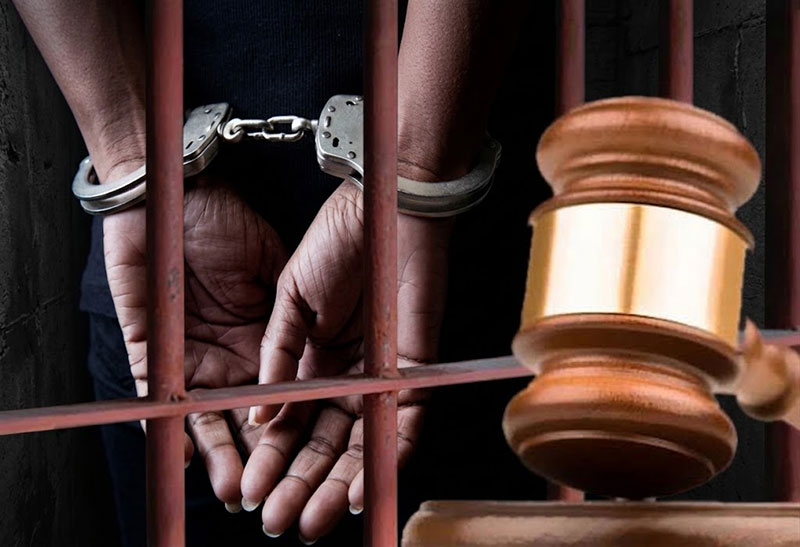
Two retired female Navy petty officers were ordered to be remanded until October 5 over their alleged involvement in the abduction and disappearance of two women in Trincomalee during the war.
Trincomalee Chief Magistrate M.S.M. Samsudeen yesterday ordered that the two suspects be remanded and directed that they be produced for an identification parade on October 5.
The suspects, residents of Chilaw and Haputale, were arrested after appearing before the CID in connection with another court case. They were subsequently produced before the Trincomalee Magistrate’s Court.
The court was informed that the investigation concerned the alleged abduction of Sasikumar Thenmoli and Mary Delsia, residents of Paalaiyootru, Trincomalee, on or around May 13, 2008.
The CID told court that information uncovered during its investigations indicated that the two women had allegedly been detained at an underground location known as the “Gun Site” at the Trincomalee Naval Base while the two suspects were serving in the Navy. The women were subsequently reported missing.
Further investigations into the alleged abduction and disappearance of the two women are continuing.

The Frontline Socialist party through its People’s Struggle Alliance (Janatha Aragala Sandhanaya) yesterday accused the government of seeking to introduce a new anti-terror law containing provisions that could restrict fundamental rights and suppress dissent.
Speaking at a media briefing in Nugegoda yesterday (24), Janatha Aragala Sandhanaya National Executive Council member Duminda Nagamuwa said the government had gazetted the Protection of the State from Terrorism Bill, despite the NPP’s previous pledge to repeal repressive laws, including the Prevention of Terrorism (Temporary Provisions) Act (PTA).
Nagamuwa alleged that while the government claimed the new Bill was intended to replace the PTA, several provisions were more repressive than those contained in the existing legislation.
He said the proposed definition of terrorism was broad enough to potentially cover attempts to pressure the government or an international organisation to take or refrain from taking certain action.
“For example, if someone asks the government to reduce taxes, that could become a terrorist act. If we say or do something against the IMF, that could also become a terrorist act,” he alleged.
Nagamuwa also questioned the inclusion of offences relating to public property and protests within the proposed terrorism-related offences, arguing that such matters were already covered by existing laws.
He expressed concern over a provision that would empower the Secretary to the Ministry of Defence to issue detention orders, saying such authority had previously been vested in the President.
He also alleged that Section 51 of the proposed Bill would enable the police to obtain orders restricting protests if they believed a demonstration could exceed prescribed limits.
“This would undermine the fundamental right to protest,” he said.
Nagamuwa further claimed that the proposed legislation would expand the powers of the police, military and Coast Guard to conduct searches and that Section 66 would treat such actions and prosecutions as having been carried out in good faith.
He also criticised a provision under which the Attorney General could, in certain circumstances, refer a person who admitted an offence for rehabilitation and release the person from the proceedings.
Another concern, he said, was the proposed power of the President to designate organisations as prohibited organisations. According to Nagamuwa, acts carried out in support of such organisations could subsequently be treated as terrorist acts.
He alleged that the government was abandoning its earlier commitments to dismantle repressive laws and was instead preparing legislation that could be used against dissent.
Nagamuwa alleged that the government was implementing an economic programme favouring the wealthy while increasing the tax and economic burden on the public, and claimed that repressive laws were being introduced to suppress opposition to that programme.
He called on the public to oppose the proposed legislation, saying the Bill should not even be presented to Parliament.

Costa Rica minister fired for unapproved meeting with Trump in US

At least 41 die as boat capsizes in DRC’s Lake Tanganyika

Showers will occur at times in the Western, Sabaragamuwa, Southern, Central and North-western provinces

Sajith vows to scrap 22A under future govt.

Two retired female Navy officers remanded over disappearance of two women during war

FSP: Govt. moving to introduce far more sinister legislation to replace PTA

‘Dates have the highest sugar content to fight Coronavirus’

Sunday Island 27 December – Headlines

#SundayIsland 17th December – Headlines

Sunday Island – 28th March

Sunday Island Headlines – 21 March

Sunday Island – 21st February – Headlines
-

 News6 days ago
Shanakiyan urges urgent action over reported death sentence for Lankan in Saudi Arabia
-

 News5 days ago
Namal Rajapaksa Buddhist gambit fails, bail denied
-

 Features5 days ago
Why the spelling Sri Lankan names in English vary
-

 Features5 days ago
Three bands, a new identity: Sri Lankan wolf snake recognised as distinct species
-

 Business5 days ago
SLIIT holds largest-ever convocation
-

 News5 days ago
Govt monitors reported Saudi death sentence – Foreign Ministry
-

 News5 days ago
Vehicle prices drop by up to Rs. 1 mn, says importers’ body
-

 Business5 days ago
All-new Bolero MaXX Pik-Up unveiled in Lanka