
Features
A collective identity as human beings a must for ending global ethno-religious conflicts

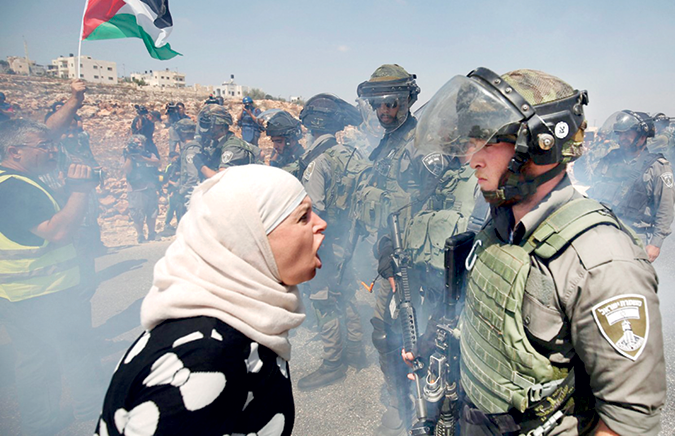
by Bedgar Perera
I am quoting below, from a video clip where an unidentified person speaks about the Israeli-Palestinian conflict in brief and what he sees as a humanitarian solution for it, which would be applicable to any such conflicts world over.
Let me quote:
“If you identify as Jewish, you feel more sympathy for the Israeli deaths. If you identify as Muslim you feel more for the Palestinians.
“Albert Einstein said nationalism is an infantile disease and the truth in that statement explains not only conflict in Israel, but all over the world.
“The moment you adopt a country, religion or set of beliefs as your primary identity, is the moment dehumanization begins in your own mind. You automatically feel more love for those who belong to your identity calling them ‘my people’ , even though we all are one people.
Identified groups usually claim to be in sole possession of the truth, and therefore killing others in pursuit of the truth is justified. War is a symptom of the disease of being too attached to an identity, but it starts in here (brain), the moment you lose connection with humanity as a whole
.WE CAN KEEP OUR BELIEFS AND FLAGS, BUT IF WE WANT PEACE, WE HAVE TO BUILD A COLLECTIVE IDENTITY AS HUMAN BEINGS (emphasis added).”
I shared the aforesaid video with some friends and two comments I received are quoted below, because of their high relevance here.
“This has been the universal truth. He puts it very succinctly” – Dr.Asoka Marasinghe, Texas,USA
“Human race is yet to understand the simple truth, although fluent in so called advanced technologies” – Dr.Sarath Weerasena, Peradeniya
The foregoing indicates the futility of ethno-religious conflicts world over and that nationalism which gets inbuilt in the human mind owing to identification with a particular country, religion or set of beliefs, mostly from the time of birth of an individual. This has been termed an “infantile disease” by none other than Albert Einstein, meaning that it is inborn from birth. This so called disease explains not only the current Palestinian-Israeli conflict, but also such conflicts all over the world. War is a symptom of this disease “of being too attached to an identity”, and in the process losing connection with humanity, with the human mind getting dehumanized along with the exit of the humane touch.
These conflicts have been going on over the past decades and centuries in this world as recorded in history, with millions getting killed, in spite of the world advancing technologically to the extent of even having developed artificial intelligence. The sheer killing of thousands of innocent humans in the midst of all material advances continues even now, at the push of a button by a fighter/bomber pilot which has the potential to blow into bits even big apartment buildings with hundreds or thousands of people sleeping at times, as shown on TV screens nowadays.
This happens in spite of the noble religions of people, all of which advocate living according to principles of natural justice, with love of one another, and absolutely no hatred to all and refraining from all crimes including murder which is the most heinous crime that a man could commit which has now become a very common day to day occurrence.
Through sheer interest, I have talked to quite a number of people of many levels, about their views on bringing about a solution to these senseless wars based on ethnic and religious issues, as Sri Lanka too has gone through such episodes which have not yet found any lasting solution with embers glowing within doused fires waiting to ignite any moment.
While some people are not bothered to talk about these issues saying it is a waste of time to do so, there are many including academics, who say that ” these are very complex issues which cannot be solved easily and that they will go on, so long as the humans exist.”. Worst is that even top diplomats with conflict resolution a major mandate, have been heard or seen referring to the so called complexity of these conflicts and the serious problems involved in arriving at a solution without ever giving a possible lasting remedy to the whole issue.
Perhaps they, including UN diplomats thrive on these issues with all their perks, high emoluments, attractive life pensions on retirement, while attending hi fi conferences, writing lengthy reports and last but not least attending diplomatic parties in plush hotels, at no cost to themselves, with all expenses being indirectly taken care of through the public purse of somebody somewhere or other.
Many issues in life some people blindly consider are too complex to solve and are hence pushed under the carpet may have unconsidered solutions that are not rocket science. Such tendencies of indecisiveness can move up the ladder from the individual level to communities in villages, cities, provinces , countries and the whole world.
In such a scenario, the anonymous speaker referred to above has a point worth pondering when he says: “We can keep our beliefs and flags, but it we want peace, we have to build a collective identity as human beings.”
The solution appears to be lying in building a “collective identity as human beings”. Of course even though the solution lies there, as it involves an attitudinal change in the human mind on a mass scale, it cannot be achieved overnight. But a start has to be made and thinking aloud, it can be realized that the best world forum to effectively start discussion about this will be the United Nations Organization (UNO), which was formally established for conflict resolution. But conflicts and wars rage the world over even while the UN sessions are ongoing.
There is no reason why the UNO which has its General Assembly (UNGA) annually with many world leaders gathering to discuss burning global issues, cannot focus on a theme like this and start the ball rolling for a universal move towards a “collective identity as human beings.”
If we want peace, as keeping peace is one of the UNO’s key mandates, this noble idea can be further discussed and adopted in due course as a UN Resolution. All member countries should concur as there is no logical reasoning for any member country to oppose such a Resolution.
The next step is for the political leaders of UN member countries to give an undertaking to abide by and spread the message to their citizen at large for acceptance, and actual implementation, since in some countries ethnic and religious considerations are included in their constitutions, giving more rights to some groups than others. All this, of course, would take time and is easier said that done. There are many adopted UN resolutions that remain unimplemented. Lip service alone will not do.
One could speculate that the aforesaid simplistic strategy is too ambitious and far-fetched to achieve worldwide acceptance, leave alone implementation, of adopting the proposed premise of a collective identity as human beings if we want peace. It is surely a long haul But a start must be made somewhere.
In order to add weight to the futility of ethno religious conflicts stressed in the foregoing, I quote from a well written article by Susantha Hewa, published in The Island of October 30, 2023, titled “Insanity of identity”, questioning the very basis of killing so many people based on ethno religious conflict during the current Israeli-Palestinian war.
“Isn’t this an ideal moment to look at our toxic identities that are mere cultural constructs? Almost all instances of plain butchery of one group by another group of humans are triggered by the fake identities imposed on us by tradition and culture, and the two most tenacious labels we carry throughout our life are our fake identities of ‘ethnicity ‘ and ‘religion’. It is the feelings of ‘self’ and ‘other’ created and nurtured in us by the socially sanctioned imposition of an ethnicity and a religion that has poisoned all human minds and engendered cruelty.”
It is hoped that the views expressed here will motivate those with interest to interact among one another regarding this vital issue for human survival, in order that useful ideas on tackling this grave problem, without letting conflicts take their course, killing thousands, will eventually reach where it matters. This is only a small attempt towards that end.
Email – bedgarperera@gmail.com




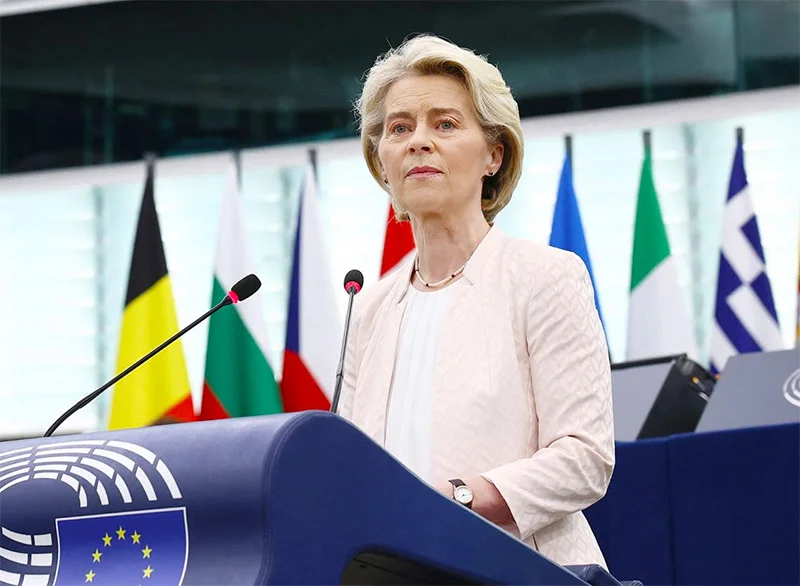
 European Commission President Ursula von der Leyen addressing the World Economic Forum in Davos, Switzerland on Tuesday put forward the EU’s viewpoint on current questions in international politics with a clarity, coherence and eloquence that was noteworthy. Essentially, she aimed to leave no one in doubt that a ‘new form of European independence’ had emerged and that European solidarity was at a peak.
These comments emerge against the backdrop of speculation in some international quarters that the Post-World War Two global political and economic order is unraveling. For example, if there was a general tacit presumption that US- Western European ties in particular were more or less rock-solid, that proposition apparently could no longer be taken for granted.
For instance, while US President Donald Trump is on record that he would bring Greenland under US administrative control even by using force against any opposition, if necessary, the EU Commission President was forthright that the EU stood for Greenland’s continued sovereignty and independence.
In fact at the time of writing, small military contingents from France, Germany, Sweden, Norway and the Netherlands are reportedly already in Greenland’s capital of Nook for what are described as limited reconnaissance operations. Such moves acquire added importance in view of a further comment by von der Leyen to the effect that the EU would be acting ‘in full solidarity with Greenland and Denmark’; the latter being the current governing entity of Greenland.
It is also of note that the EU Commission President went on to say that the ‘EU has an unwavering commitment to UK’s independence.’ The immediate backdrop to this observation was a UK decision to hand over administrative control over the strategically important Indian Ocean island of Diego Garcia to Mauritius in the face of opposition by the Trump administration. That is, European unity in the face of present controversial moves by the US with regard to Greenland and other matters of contention is an unshakable ‘given’.
It is probably the fact that some prominent EU members, who also hold membership of NATO, are firmly behind the EU in its current stand-offs with the US that is prompting the view that the Post-World War Two order is beginning to unravel. This is, however, a matter for the future. It will be in the interests of the contending quarters concerned and probably the world to ensure that the present tensions do not degenerate into an armed confrontation which would have implications for world peace.
However, it is quite some time since the Post-World War Two order began to face challenges. Observers need to take their minds back to the Balkan crisis and the subsequent US invasions of Afghanistan and Iraq in the immediate Post-Cold War years, for example, to trace the basic historic contours of how the challenges emerged. In the above developments the seeds of global ‘disorder’ were sown.
Such ‘disorder’ was further aggravated by the Russian invasion of Ukraine four years ago. Now it may seem that the world is reaping the proverbial whirlwind. It is relevant to also note that the EU Commission President was on record as pledging to extend material and financial support to Ukraine in its travails.
Currently, the international law and order situation is such that sections of the world cannot be faulted for seeing the Post World War Two international order as relentlessly unraveling, as it were. It will be in the interests of all concerned for negotiated solutions to be found to these global tangles. In fact von der Leyen has committed the EU to finding diplomatic solutions to the issues at hand, including the US-inspired tariff-related squabbles.
Given the apparent helplessness of the UN system, a pre-World War Two situation seems to be unfolding, with those states wielding the most armed might trying to mould international power relations in their favour. In the lead-up to the Second World War, the Hitlerian regime in Germany invaded unopposed one Eastern European country after another as the League of Nations stood idly by. World War Two was the result of the Allied Powers finally jerking themselves out of their complacency and taking on Germany and its allies in a full-blown world war.
However, unlike in the late thirties of the last century, the seeming number one aggressor, which is the US this time around, is not going unchallenged. The EU which has within its fold the foremost of Western democracies has done well to indicate to the US that its power games in Europe are not going unmonitored and unchecked. If the US’ designs to take control of Greenland and Denmark, for instance, are not defeated the world could very well be having on its hands, sooner rather than later, a pre-World War Two type situation.
Ironically, it is the ‘World’s Mightiest Democracy’ which is today allowing itself to be seen as the prime aggressor in the present round of global tensions. In the current confrontations, democratic opinion the world over is obliged to back the EU, since it has emerged as the principal opponent of the US, which is allowing itself to be seen as a fascist power.
Hopefully sane counsel would prevail among the chief antagonists in the present standoff growing, once again, out of uncontainable territorial ambitions. The EU is obliged to lead from the front in resolving the current crisis by diplomatic means since a region-wide armed conflict, for instance, could lead to unbearable ill-consequences for the world.
It does not follow that the UN has no role to play currently. Given the existing power realities within the UN Security Council, the UN cannot be faulted for coming to be seen as helpless in the face of the present tensions. However, it will need to continue with and build on its worldwide development activities since the global South in particular needs them very badly.
The UN needs to strive in the latter directions more than ever before since multi-billionaires are now in the seats of power in the principle state of the global North, the US. As the charity Oxfam has pointed out, such financially all-powerful persons and allied institutions are multiplying virtually incalculably. It follows from these realities that the poor of the world would suffer continuous neglect. The UN would need to redouble its efforts to help these needy sections before widespread poverty leads to hemispheric discontent.

 Hi! This week I’ve come up with tips to brighten up your skin.
* Turmeric and Yoghurt Face Pack:
You will need 01 teaspoon of turmeric powder and 02 tablespoons of fresh yoghurt.
Mix the turmeric and yoghurt into a smooth paste and apply evenly on clean skin. Leave it for 15–20 minutes and then rinse with lukewarm water
Benefits:
Reduces pigmentation, brightens dull skin and fights acne-causing bacteria.
* Lemon and Honey Glow Pack:
Mix 01teaspoon lemon juice and 01 tablespoon honey and apply it gently to the face. Leave for 10–15 minutes and then wash off with cool water.
Benefits:
Lightens dark spots, improves skin tone and deeply moisturises. By the way, use only 01–02 times a week and avoid sun exposure after use.
* Aloe Vera Gel Treatment:
All you need is fresh aloe vera gel which you can extract from an aloe leaf. Apply a thin layer, before bedtime, leave it overnight, and then wash face in the morning.
Benefits:
Repairs damaged skin, lightens pigmentation and adds natural glow.
* Rice Flour and Milk Scrub:
You will need 01 tablespoon rice flour and 02 tablespoons fresh milk.
Mix the rice flour and milk into a thick paste and then massage gently in circular motions. Leave for 10 minutes and then rinse with water.
Benefits:
Removes dead skin cells, improves complexion, and smoothens skin.
* Tomato Pulp Mask:
Apply the tomato pulp directly, leave for 15 minutes, and then rinse with cool water
Benefits:
Controls excess oil, reduces tan, and brightens skin naturally.
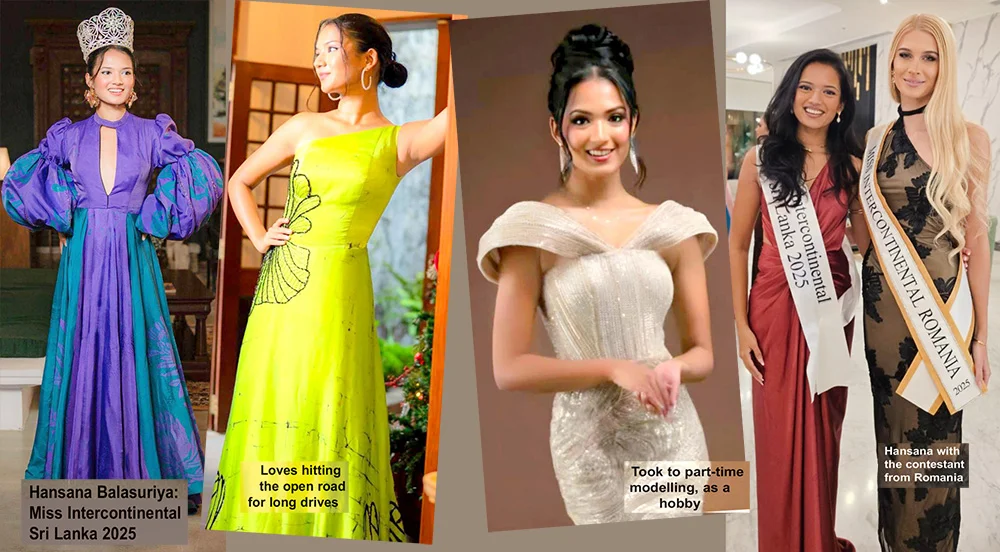
 That’s precisely what 25-year-old Hansana Balasuriya has in mind – shooting for the stars – when she was selected to represent Sri Lanka on the international stage at Miss Intercontinental 2025, in Sahl Hasheesh, Egypt.
The grand finale is next Thursday, 29th January, and Hansana is all geared up to make her presence felt in a big way.
Her journey is a testament to her fearless spirit and multifaceted talents … yes, her life is a whirlwind of passion, purpose, and pageantry.
Raised in a family of water babies (Director of The Deep End and Glory Swim Shop), Hansana’s love affair with swimming began in childhood and then she branched out to master the “art of 8 limbs” as a Muay Thai fighter, nailed Karate and Kickboxing (3-time black belt holder), and even threw herself into athletics (literally!), especially throwing events, and netball, as well.
A proud Bishop’s College alumna, Hansana’s leadership skills also shone bright as Senior Choir Leader.
She earned a BA (Hons) in Business Administration from Esoft Metropolitan University, and then the world became her playground.
Before long, modelling and pageantry also came into her scene.
She says she took to part-time modelling, as a hobby, and that led to pageants, grabbing 2nd Runner-up titles at Miss Nature Queen and Miss World Sri Lanka 2025.
When she’s not ruling the stage, or pool, Hansana’s belting tunes with Soul Sounds, Sri Lanka’s largest female ensemble.
What’s more, her artistry extends to drawing, and she loves hitting the open road for long drives, she says.
This water warrior is also on a mission – as Founder of Wave of Safety,
Hansana happens to be the youngest Executive Committee Member of the Sri Lanka Aquatic Sports Union (SLASU) and, as founder of Wave of Safety, she’s spreading water safety awareness and saving lives.
Today is Hansana’s ninth day in Egypt and the itinerary for today, says National Director for Sri Lanka, Brian Kerkoven, is ‘Jeep Safari and Sunset at the Desert.’
And … the all-important day at Miss Intercontinental 2025 is next Thursday, 29th January.
Well, good luck to Hansana.

Mendis’ 93 not out lifts Sri Lanka to 271 for 6, despite Rashid three-for

We didn’t get justice from ICC: Bangladesh sports advisor

Indonesian Naval Ship ‘KRI SULTAN ISKANDAR MUDA – 367’ arrives in Colombo

Royal Navy of Oman Ship ‘AL SEEB’ calls at Port of Colombo

Jacks out with illness as Sri Lanka bat against England

Mechanism to be established involving university academics and experts for Education Reforms – President

‘Dates have the highest sugar content to fight Coronavirus’

Sunday Island 27 December – Headlines

#SundayIsland 17th December – Headlines

Sunday Island – 28th March

Sunday Island Headlines – 21 March

Sunday Island – 21st February – Headlines
-

 Editorial5 days ago
Illusory rule of law
-
 News6 days ago
UNDP’s assessment confirms widespread economic fallout from Cyclone Ditwah
-

 Editorial6 days ago
Crime and cops
-
 Features5 days ago
Daydreams on a winter’s day
-

 Editorial7 days ago
The Chakka Clash
-
 Features5 days ago
Surprise move of both the Minister and myself from Agriculture to Education
-
 Features4 days ago
Extended mind thesis:A Buddhist perspective
-
 Features5 days ago
The Story of Furniture in Sri Lanka