
Latest News
SLC secretary resigns after Sri Lanka’s World Cup exit and board criticism

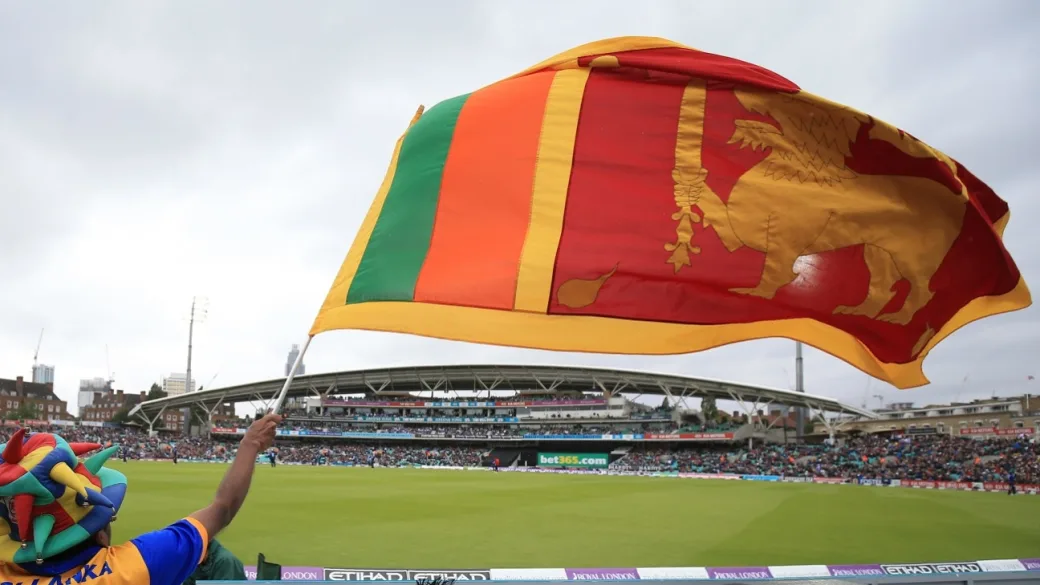
Sri Lanka Cricket secretary Mohan de Silva resigned from his board position on Saturday (03 November 2023). His resignation comes after both widespread criticism of the board following Sri Lanka’s crashing out of the Men’s ODI World Cup, as well as a release from the nation’s sports minister asking SLC’s executive committee to resign or face drastic action.
De Silva did not provide an official reason for his resignation, but it is understood to be at least partly the consequence of Sri Lanka’s poor performance in the World Cup, though personal reasons had also played a part.
Sri Lanka’s sports minister and SLC have been engaged in hostilities lasting over a year, with the board’s use of finances (particularly during last year’s Men’s T20 World Cup), the Lanka Premier League, and their running of other domestic tournaments being particular flashpoints.
SLC’s relationship with the sports minister often tends to be friendly, although it is occasionally characterised by sabre-rattling. According to Sri Lanka’s sports law, the nation’s sports ministry oversees SLC, as it does other national-level sporting bodies. However, in the case of cricket, the ICC’s official policy of not allowing direct government interference in the sport has usually prevented ministers from flexing their power.
The last time the government installed an “interim committee” to act in place of SLC’s member-voted executive committee, back in 2014, the ICC held funds that were due to be paid to the board in escrow.
In any case, the minister’s two-page release accused SLC of – among a variety of faults – failing to provide so much as an indoor training facility, or a swimming pool in which to conduct fitness and injury rehabilitation work. These, at least, have been long-standing grouses from players themselves.
SLC’s officials have responded to the minister’s criticism with strongly-worded statements of their own over the past few months. But the men’s team’s performance at the World Cup has shifted the power dynamic, however briefly.




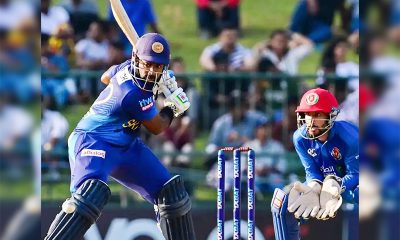




Royal Challengers Bengaluru [RCB] might look at Gujarat Titans [GT] across the ring in Qualifier 1 of IPL 2026, and wonder if they helped create this monster. When GT went to Bengaluru on April 24, they were still a conservative side straddling the middle of the table, and happy with a 57-ball hundred from their opener. But they have been a changed unit since RCB cruised to that chase of 206 against them that day.
Since that match, the halfway point for GT, their run rate has increased by nearly a run per over. That is 20 runs per innings. By the time they faced RCB next, they were giving more importance to balls remaining than to wickets in hand while chasing. When batting first, GT were looking to score above par; there has been a pair of 229s in the two matches they have batted first in since that Bengaluru debacle.
The thing with GT is that they have a team with such strong basics that they don’t need to make only subtle changes to their approach. Their control rate has gone from 80% to 75%. A little more risk, a lot more rewards. Their bowling has only become more streamlined over this period with Jason Holder adding constant threat to an already good attack. The result is a 6-1 win-loss record in the second half of their tournament.
RCB, though, have been solid throughout, carrying forward the change in approach that took them to the title last year. They won five in the first half and four in the second. They have consistently looked to finish matches early or set above-par scores when batting first. A second consecutive top-two finish is just rewards for being the most consistently good side over this period.
They will want to make it straight from Dharamsala to Ahmedabad, where they won their first title last year. Not only to make the final but to also hope to avoid meeting GT in a final at their home, something that should be the right of defending champions. Not least because GT are on a four-match winning streak at home, which includes two wins despite losing the toss.
RCB have used the fewest number of players this IPL, a sign of a settled unit. It would certainly have been fewer if not for the injury to Phil Salt, who is now back in India and racing against time to be ready in time for the playoffs. If he doesn’t make it, though, it brings in the temptation to drop Suyash Sharma for Jacob Duffy considering Suyash has not had a great IPL, and night games in Dharamsala can negate spinners. In fact, Dharamsala hosted the only completed match this season where no spin was used.
Venkatesh Iyer has made a case for himself in the limited opportunities he has got, but Salt should be a no-brainer as opener if he is fit.
Royal Challengers Bengaluru (probable): Virat Kohli, Phil Salt/Venkatesh Iyer, Devdutt Padikkal, Rajat Patidar (capt), Jitesh Sharma, Romario Shepherd, Tim David, Krunal Pandya, Bhuvneshwar Kumar, Jacob Duffy/Suyash Sharma, Josh Hazlewood, Rasikh Salam
GT have played the second-fewest number of players. They seem to have their first XI figured with Nishant Sindhu being persisted with as the extra batter. Their only doubt remains around the Impact Player: extra fast bowler in Prasidh Krishna or extra spinner in R Sai Kishore or Manay Suthar.
Gujarat Titans (probable): Shubman Gill (capt), B Sai Sudharsan, Jos Buttler (wk), Washington Sundar, Jason Holder, Rahul Tewatia, Nishant Sindhu, Rashid Khan, Arshad Khan, Kagiso Rabada, Mohammed Siraj, Prasidh Krishna/R Sai Kishore/Manav Suthar
[Cricinfo]
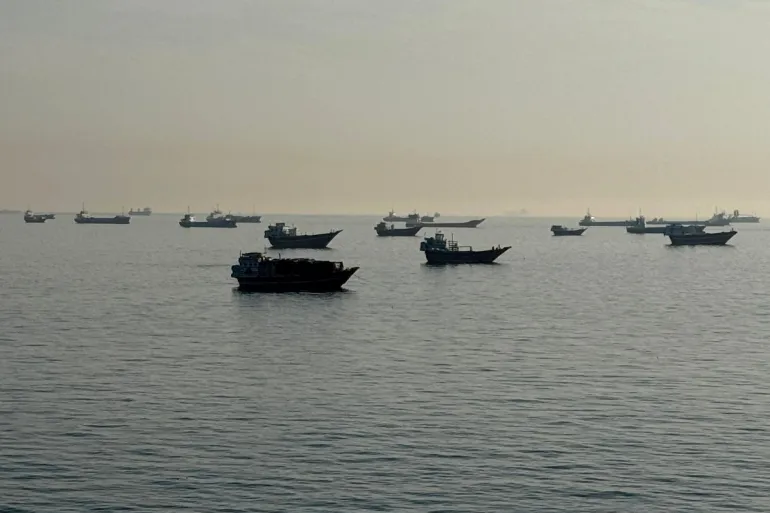
The United States has launched strikes on targets in southern Iran, the US military has said, as Tehran’s top negotiators gather in Qatar for talks aimed at reaching a peace deal with Washington.
US Central Command (CENTCOM) said it carried out the “self-defence strikes” to protect US troops from threats posed by Iranian forces.
“Targets included missile launch sites and Iranian boats attempting to emplace mines,” Navy Captain Tim Hawkins, a CENTCOM spokesperson, said in a statement to Al Jazeera late on Monday.
“US Central Command continues to defend our forces while using restraint during the ongoing ceasefire.”
CENTCOM did not provide further details on the strikes.
The latest attacks come despite there being a ceasefire officially in place between the US and Iran since April 8.
Reporting from Washington, DC, Al Jazeera’s Alan Fisher said the strikes are likely to derail the ongoing negotiations to end the US-Israel war on Iran.
“There is very limited information coming from the US side; we don’t know the extent of the operation. It’s hard to say whether this skirmish is unusual,” he said.
“But Trump is keen to move forward with negotiations and solidify a peace deal.”
Earlier on Monday, a high-level Iranian delegation arrived in Doha to discuss roadblocks to a permanent peace deal.
The arrival of the delegation, which includes Iranian Minister of Foreign Affairs Abbas Araghchi and Iranian Parliament Speaker Mohammad Bagher Ghalibaf, came as US President Donald Trump said that peace talks were “proceeding nicely”, even as he insisted that he would not agree to anything less than a substantial deal.
“It will only be a Great Deal for all or, no Deal at all — Back to the Battlefront and shooting, but bigger and stronger than ever before — And nobody wants that!” Trump wrote on Truth Social.
[Aljazeera]
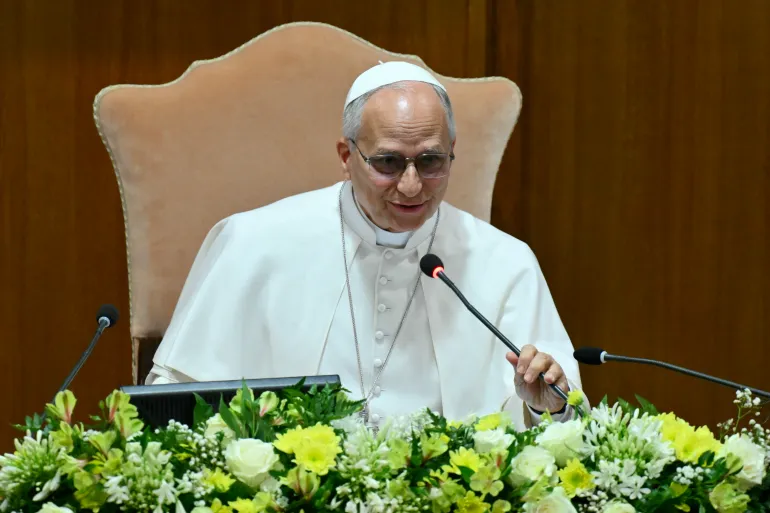
Pope Leo XIV has called for the “disarming” of artificial intelligence (AI), warning that “new forms of slavery” are tied to its rise.
The Catholic Church leader warned on Monday against “a race for ever more powerful algorithms and larger datasets,” driven by “the desire to secure geopolitical or commercial dominance”.
His concerns regarding AI were presented in his first encyclical, titled “Magnifica Humanitas” (Magnificent Humanity), in person at the Vatican. Encyclicals are one of the highest forms of teaching from a pontiff to the church’s 1.4 billion members.
Leo insisted that ownership of AI data must not be left solely in private hands, called for policymakers to protect the rights of workers and keep children safe from the technology, and urged the cooling of competition between AI companies.
“What is needed is a more active political involvement that is capable of slowing things down when everything is accelerating,” Leo said.
The Catholic leader continued by calling for “robust legal frameworks, independent oversight, informed users and a political system that does not abdicate its responsibility”.
“AI now demands to be disarmed, freed from logics that turn it into an instrument of domination, exclusion, and death,” he said. “Like nuclear energy, it must be at the service of all and of the common good.”
Monday’s highly anticipated text, spanning nearly 43,000 words, has been in the works nearly since Leo’s election as pope a little more than a year ago.
Pope Leo presented the encyclical alongside AI experts, including Christopher Olah, co-founder of US giant Anthropic.
Anthropic is embroiled in a legal battle with the United States military after opposing the use of its technology for lethal autonomous warfare and mass surveillance.
At the presentation, Olah said AI companies operate “inside a set of incentives and constraints that can sometimes conflict with doing the right thing”.

He welcomed input from outside actors like the Catholic Church to “push events in a better direction”, saying that “the questions raised by AI are bigger than the AI research community”.
Olah highlighted three areas he said required urgent attention: the risk of widespread job losses, the need to ensure that AI benefits are extended worldwide, and the unresolved question of how to interpret increasingly complex and sometimes opaque system behaviour.
In the encyclical, Leo also sounded the alarm over AI-directed weaponry, saying it was “not permissible to entrust lethal” decisions to tech.
Leo has repeatedly clashed with the White House over the US-Israel war on Iran and its use of religion to justify conflict.
The “just war” theory, espoused recently by the administration of US President Donald Trump, was “outdated”, Leo wrote, adding that “no algorithm can make war morally acceptable”.
[Aljazeera]

Gibson, Dean knock over New Zealand for 80 as England cruise to series win

Solid Royal Challengers Bengaluru, surging Gujarat Titans clash for direct final ticket

US military launches strikes on southern Iran amid talks in Qatar

Pope says AI must be ‘disarmed’ to prevent domination, exclusion, and death

Showers will occur at times in the Western, Sabaragamuwa and North-western provinces and in Galle, Matara, Kandy and Nuwara-Eliya districts.

Election monitors flay JVP for postponing PC polls

‘Dates have the highest sugar content to fight Coronavirus’

Sunday Island 27 December – Headlines

#SundayIsland 17th December – Headlines

Sunday Island – 28th March

Sunday Island Headlines – 21 March

Sunday Island – 21st February – Headlines
-
 Features6 days ago
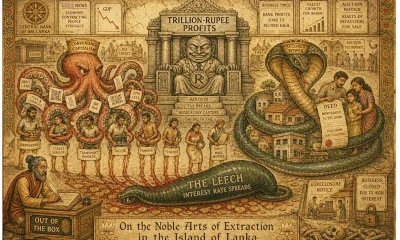
Octopus, Leech, and Snake: How Sri Lanka’s banks feast while the nation starves
-
 Sports6 days ago
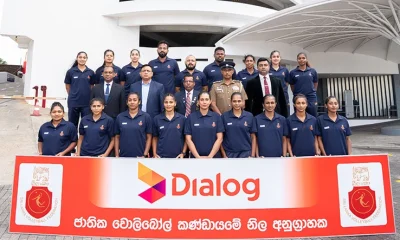
Sri Lanka women’s volleyball team ready for Central Asian challenge
-

 Opinion5 days ago
Murder of Ehelepola family, Bogambara Wewa and Sightings of Wangediya
-

 Business5 days ago
Historic launch of CCWE Fashion Week & International Summit 2026
-
 News5 days ago
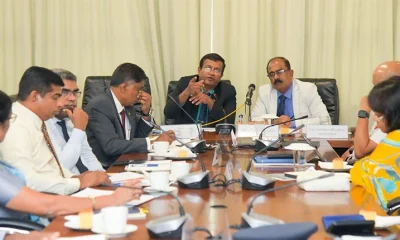
Steps underway to safeguard Sri Lanka’s maritime heritage
-
 Features2 days ago
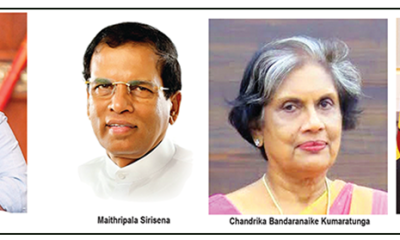
The NPP’s pivot to the past
-
 News1 day ago
Police probe underway to ascertain links between criminals deported from UAE and local politicians
-

 Editorial5 days ago
A play without its protagonist