
Business
Despite its negative impact on migratory birds, environmentalists say ‘Yes’ to wind power- Dr. Rohan Pethiyagoda

By Ifham Nizam
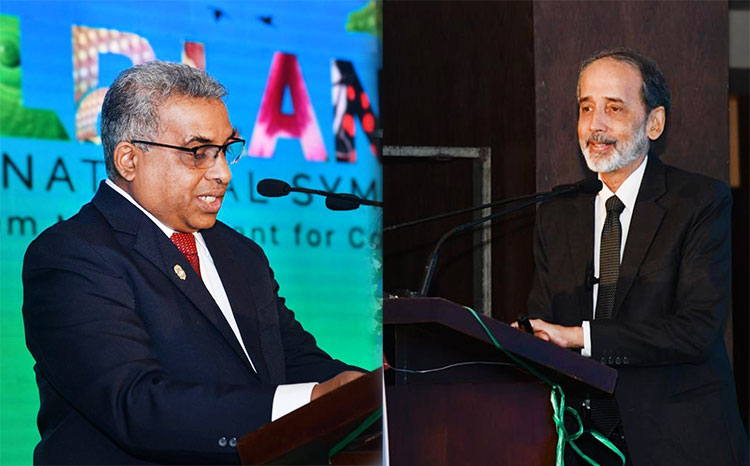
Environmentalists are opposing hydro power but not wind power, despite the latter having a negative impact on migratory birds, biodiversity authority Dr. Rohan Pethiyagoda said.
Speaking at the Eighth Wildlanka Symposium recently at the Water’s Edge, Battaramulla on the topic, `Ethical Dilemmas in Biodiversity Policy’, Pethiyagoda said that the Upper Kotmale Hydro Power Plant Project was opposed for 20 years but was later implemented by former President Mahinda Rajapaksa at double the cost.
Pethiyagoda added: ‘The-50 acre project has had no detrimental effect on the environment to date.
‘It is of concern that Sri Lanka has 4,500 km electric fences that are enough to cover the coastline three and a half times over.
‘Going by the current rate of elephant deaths, since the census of 2011, some 6,000 elephants have been killed.
‘More than 300 people die due to snake bites annually and some 150 people die due to elephant attacks, yet the latter deaths get vast attention.’
Wildlife Department, Director Operations, M.S.L.R.P. Marasinghe, said that wildlife conservation and biodiversity conservation are not merely about relocating elephants from human habitats or dealing with urban snake encounters.
Marasinghe added: ‘It’s a scientific journey towards sustainability; one that recognizes its anthropocentric nature and aims at inter-generational and intra-generational equity.
“In the current discourse on conservation, there is often a call for zero consumption. However, we understand that reaching zero consumption is an ideal that remains distant from reality. The true challenge lies in striking a balance between consumption and conservation that can sustain all aspects of the environment for years to come. Conservation, therefore, is a science-based journey towards sustainability that includes not only protection but also the wise use of our resources.
‘The blame for biodiversity depletion cannot solely be assigned to rural communities who may resort to poaching as a means of redistribution for economic losses. It extends to farmers encroaching on habitats for crop cultivation. It is disheartening to note that some conservation advocates and activists demand harsh penalties, including death sentences, for poaching. Such punitive approaches are rooted in the idea of deterrence, but the modern approach is driven by knowledge acting as a deterrent.
‘It’s worth noting that demand drives both encroachment and poaching. This demand arises from individuals who advocate conservation publicly, while simultaneously engaging in resource-intensive lifestyles. We find ourselves in the midst of a struggle against individuals who, behind the scenes, seek to subvert our conservation policies for personal gain. It is regrettable that some prominent activists rally with them in secret.
‘In a world where insatiable needs prevail, science must take the lead in finding conservation-friendly technologies that can satisfy these demands. The role of the Department of Wildlife Conservation extends beyond handling elephants and snakes. It also encompasses conservation education and the promotion of scientific knowledge enhancement.’








By Ifham Nizam
Saudi Arabia’s Vision 2030 is creating opportunities for Sri Lanka in trade, investment, renewable energy, tourism and employment while strengthening the longstanding friendship between the two countries.
Led by King Salman bin Abdulaziz Al Saud and Crown Prince and Prime Minister Mohammed bin Salman, the programme aims to diversify Saudi Arabia’s economy, attract international investment, develop new industries and reduce dependence on oil revenues.
Launched in 2016, Vision 2030 is built around three pillars: a vibrant society, a thriving economy and an ambitious nation. Its focus on tourism, technology, logistics, renewable energy, industrial development and private-sector growth aligns with Sri Lanka’s need for foreign investment, stronger exports, energy security and sustainable employment.
Trade and investment opportunities
The establishment of the first Saudi–Sri Lanka Joint Business Council in November 2025 created a platform for businesses to identify investment opportunities, develop partnerships and address trade barriers. Saudi participation in Sri Lanka Expo 2027 could further strengthen commercial ties.
Sri Lanka can expand exports of value-added tea, spices, apparel, rubber products and processed foods to Saudi Arabia. Better distribution networks, packaging and compliance with market standards would help local producers, especially small and medium-sized enterprises, compete more effectively.
Saudi investors could explore Sri Lankan tourism, logistics, food processing, renewable energy and export-oriented manufacturing. The goal should be long-term partnerships that create jobs, transfer technology and improve productivity rather than simply increasing trade.
Renewable energy and green investment
Energy is another promising area. Saudi Arabia’s diversification programme includes major investments in renewable energy and emerging technologies. Partnerships in solar power, battery storage, electricity infrastructure and energy efficiency could help Sri Lanka reduce dependence on imported fossil fuels and improve energy security.
Cooperation could also include technical training and technology transfer. Saudi investment in sustainable tourism, modern agriculture, water management and infrastructure could create further opportunities if projects are commercially viable and supported by transparent regulations.
Vision 2030 seeks to make Saudi Arabia a major international tourism destination while improving services for pilgrims visiting Makkah and Madinah.
Sri Lanka could attract more Saudi visitors through better air connectivity, targeted marketing and partnerships with travel operators. Sri Lankan companies could also supply food, hospitality services and other products to Saudi Arabia’s expanding tourism sector.
Employment remains central to bilateral relations. Sri Lankan workers contribute to the Saudi economy, while their remittances provide valuable foreign exchange at home. As Saudi Arabia develops new industries, Sri Lanka can strengthen vocational training and skills-based recruitment in hospitality, healthcare, construction and technical services. Recognised qualifications, ethical recruitment and worker protection would benefit both countries.
Economic cooperation is complemented by Saudi Arabia’s distinctive spiritual role as custodian of Islam’s two holiest mosques.
Through the Custodian of the Two Holy Mosques’ Guests Programme for Hajj, Umrah and Visit, King Salman approved the hosting, at his personal expense, of 1,000 male and female Umrah performers from around the world in June 2026. Implemented by the Saudi Ministry of Islamic Affairs, Dawah and Guidance, the programme’s first group included 250 guests from 16 Asian countries, who visited Madinah and Makkah and took part in cultural and educational activities.
For those invited, performing Umrah and visiting the holy sites is a deeply meaningful religious experience. The initiative reflects Saudi Arabia’s commitment to facilitating worship and strengthening bonds among Muslim communities. It also complements Vision 2030’s Pilgrim Experience Programme, which aims to improve transport, accommodation, digital services and facilities for pilgrims.
This spiritual and cultural engagement adds a human dimension to commercial ties, helping deepen understanding between the two peoples.
Sri Lanka and Saudi Arabia established diplomatic relations in 1974, and their partnership has grown through trade, employment, development cooperation and diplomacy. The next step is to convert this goodwill into measurable results.
Sri Lanka needs a clear portfolio of viable projects, predictable regulations and efficient procedures to attract Saudi investment. Local businesses must be prepared to meet Saudi market requirements, while the Joint Business Council and Sri Lanka Expo 2027 can help connect investors and entrepreneurs.
The partnership should ultimately be judged by increased exports, productive investment, quality employment and the transfer of skills and technology.
Vision 2030 offers Sri Lanka an opportunity to build a more dynamic relationship with Saudi Arabia by combining commercial cooperation with diplomatic, spiritual and people-to-people ties. Together, the two countries can create lasting benefits for their economies and communities.

Hatch, Lankan Angel Network and BOV Capital join forces, with First Capital Holdings PLC committing LKR 300 million as anchor limited partner in a fund built on a commercial investment case.
Starting a business is difficult. Building one that can grow, compete and endure is harder still.
For Sri Lankan founders, the challenge doesn’t end when they prove their idea works. The next stage demands stronger operations, access to new markets and the capital to pursue opportunities that could transform a promising venture into a sustainable business.
A new initiative aims to help more founders take that next step.
Hatch, Lankan Angel Network (LAN) and BOV Capital have launched HLAB, a collective LKR 3 billion fund designed to back early and growth stage regional companies that are incorporated in Sri Lanka. Announced at the final event of First Capital Startup Nation, organised by Hatch, the initiative brings together three established participants in the country’s startup ecosystem around a shared ambition: expanding access to capital for businesses seeking to grow.
Adding institutional participation to the initiative, First Capital Holdings PLC has committed LKR 300 million as the fund’s anchor limited partner, representing 10% of its total size.
From promising startups to enduring businesses
The transition from an early stage venture to a sustainable, growing company is a defining point in a founder’s journey. Businesses must move beyond establishing their models and begin building the operational strength and market reach needed to pursue larger opportunities.
Business
JXG’s Wasanthi Stephen makes history as the first female recipient of the CIPM Sri Lanka Lifetime Gold Award

JXG (Janashakthi Group) celebrates Wasanthi Stephen, Group Chief Human Resources Officer, on becoming the first female recipient of the prestigious CIPM-Baurs Lifetime Gold Award 2026 from the Chartered Institute of Personnel Management (CIPM) Sri Lanka since the award’s inception. Presented on 14 October 2026, at the opening of the National Human Resource Conference (NHRC) 2026 at Monarch Imperial, Kotte, the award marks a historic milestone for Sri Lanka’s Human Resources profession and a proud moment for JXG.
The highest individual recognition in Sri Lanka’s Human Resource Management sphere, the CIPM Sri Lanka Lifetime Gold Award celebrates individuals whose long-standing contributions have advanced the HR profession at organisational, national, and international levels. It recognises professional excellence, ethical leadership, transformational impact, and a sustained commitment to people and institutions.

Showers above 100 mm are likely at some places in the Western, Sabaragamuwa, Central, North-western, Northern and Southern provinces and in Anuradhapura district.

Low-quality coal causes power cuts: Ex-LECO Chief

Power cuts continue

GL stresses importance of post-war Shangri-La investment after CIABOC questions him

Coal inquiry gets extension until 16 December

Dilshan, Hirupama named best athletes at All Island Schools Games Athletics Championships

‘Dates have the highest sugar content to fight Coronavirus’

Sunday Island 27 December – Headlines

#SundayIsland 17th December – Headlines

Sunday Island – 28th March

Sunday Island Headlines – 21 March

Sunday Island – 21st February – Headlines
-

 Features3 days ago
Kotahena:A Small Enclave, An Extraordinary Legacy
-

 News4 days ago
Asgiri Mahanayake calls for immediate release of Gnanasara Thera
-

 News3 days ago
Record 1,600 students take Russian Classical Ballet examination in Sri Lanka
-

 News6 days ago
AC President recuses himself from hearing prison attire case pertaining to Gnanasara Thera
-

 News5 days ago
Naval officer testifies Yoshitha received Rs. 5.15 mn in salaries during SLN service
-

 News3 days ago
Karannagoda pushed for £24,536 for Yoshitha’s UK training, Court told
-

 Editorial5 days ago
Saving Anojan: Beyond Executioner’s Blade
-

 News6 days ago
CID informs Fort Magistrate’s Court investigation into money laundering case against Namal completed