
Latest News
New Zealand make it three wins in three, but Williamson goes off hurt


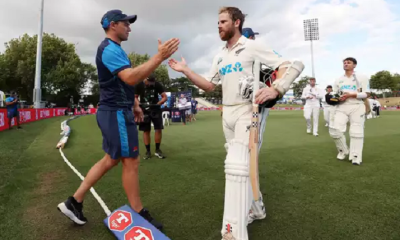
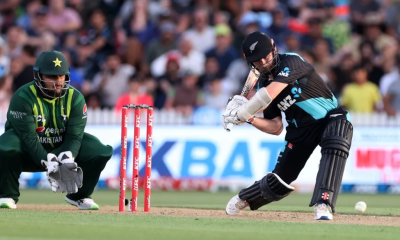
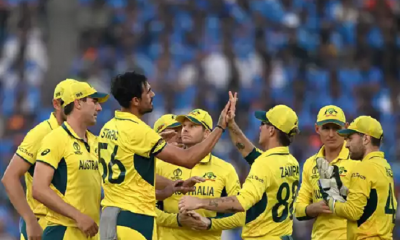
Kane Williamson resumed international cricket by doing Kane Williamson things, scoring a precise 78 against Bangladesh. He shepherded New Zealand close to their eight-wicket win in Chennai, but couldn’t quite see the chase through, as he left the field retired hurt in the 39th over. Daryl Mitchell got New Zealand home with 43 balls to spare, putting the seal on the team’s dominating start to this World Cup.
Williamson had missed seven months of competitive cricket due to a right knee injury he sustained during last season’s IPL, and his World Cup return was thought to be improbable at the time. Even when he was named in the New Zealand side as their captain, he was expected to miss the initial stages of the competition. But not only did he return sooner than expected, Williamson showed little drop in quality, as he went through the gears against Bangladesh.
Williamson struck ten fours and a six in his 108-ball 78, eventually going off with cramps. More than his innings, Williamson’s biggest contribution was to add to two sizable partnerships. First, he made 82 for the second wicket with Devon Conway after New Zealand lost an early wicket. Then alongside Mitchell, he added 108 runs for the third wicket. It made the chase an easy one for New Zealand as they won with plenty to spare.
At the start of New Zealand’s 246-run chase, Bangladesh gave their fans some hope when Mustafizur Rahman removed the high-flying Rachin Ravindra, opening for the first time in ODIs, in the third over. Mustafizur produced a second chance shortly afterwards when Conway, batting on 4, drove away from his body, only for Mehidy Hasan Miraz to drop the chance at point. It was a difficult diving chance, but that one sticking could have charged up Bangladesh.
Soon after the reprieve, Conway struck Shoriful Islam for two fours to break free. Williamson then took his turn on Shoriful, cracking him over point and through point and cover in the 10th over. Then, it was Taskin who went for two fours in the 13th over, before he dropped Williamson at short midwicket when the New Zealand captain was on 27.
Shakib, who suffered that drop, broke the second-wicket stand when he trapped Conway lbw for 45 off 59 balls. Conway’s attempted reverse sweep went awry as he missed the shot, hitting his back-leg. The Conway wicket however did little to help the Bangladesh cause as the next batter, Mitchell, immediately picked up the pace.
He opened his account with a six off Shakib, before Williamson lifted his opposite number over long-on for his first six. Williamson continued to find the odd boundary for the next ten overs, hitting Shakib and Mehidy for four more boundaries before Mitchell got back into action with a stinging pull off Taskin, followed by two straight sixes off Shakib and Taskin.
Even after Williamson called off his innings in the 39th over, Mitchell went after the Bangladesh bowling till the chase was completed in the 43rd over. Mitchell smashed six fours and four sixes in his unbeaten 67-ball 89.
Earlier, when Williamson put Bangladesh to bat first, it took them little time to fall into their familiar top-order slide. Litton Das clipped the first ball of the innings, from Trent Boult, right into Matt Henry’s lap at fine-leg. It was a well-timed shot that he met after coming down the track but he tried it on a difficult angle with the bat. Litton became only the second Bangladeshi opener to fall in the first ball of a World Cup match, the previous being Hannan Sarkar against Sri Lanka’s Chaminda Vaas in 2003.
Tanzid Hasan produced four boundaries in a quick recovery partnership with Mehidy, but the rookie left-hander once again fell on 16. It was a tame dismissal when Tanzid clipped a ball to short square-leg in the eighth over.
A third soft dismissal followed in the 12th over when Mehidy pulled Lockie Ferguson into fine-leg’s lap for 30. He struck three superb cover drives in his 46-ball stay but once again, Bangladesh sent him to a batting position which usually takes a bit of time to getting used to.
New Zealand reduced Bangladesh to 56 for 4 in the next over when part-timer Glenn Philips had the in-form Najmul Hossain Shanto hit to midwicket. Conway took a tumbling catch but Bangladesh regrouped through their most experienced pair.
Shakib and Mushfiqur added 96 runs in almost even time by pressing back at the New Zealand side. Mushfiqur wasted little time by hammering Philips with his favoured slog sweep for a six. Two more Mushfiqur fours later, Shakib pulled Henry before smashing Mitchell Santner for a straight four. Mushfiqur hit Ferguson for his second six, over third man, as Bangladesh looked to be on the road to recovery.
Shortly after Mushfiqur reached his fifty though, Shakib cramped up. After taking a bit of medical attention, the Bangladesh captain took off his helmet as he smashed Ravindra for a straight four and a six over midwicket. He added another six off Ferguson but he was out next ball, again trying to slog the fast bowler.
Mushfiqur followed him back shortly afterwards, though the Henry delivery that bowled him kept really low. It was still a valiant knock given that he had walked in with the task of reviving Bangladesh’s innings.
Tohwid Hridoy, now batting out of position at No 7, couldn’t kick on so it was left to Mahmudullah, batting at No 8 for the first time in 13 years, to ensure a decent finish. He ensured Bangladesh batted out the 50 overs, himself remaining unbeaten on 41, but it was still a sub-par team score.
Brief scores:
New Zealand 248 for 2 in 42.5 overs (Devon Conway 45, Daryl Mitchell 89*, Kane Williamson 78, Mustafizur Rahman 1-36) beat Bangladesh 245 for 9 in 50 overs (Mushfiqur Rahim 66, Shakib Al Hasan 41*, Mehidy Hasan Miraz 30, Mahamudullah 41*; Lockie Ferguson 3-49, Trent Boult 2-45, Matt Henry 2-58) by eight wickets
(Cricinfo)








Two people in a serious condition who were evacuated from a cruise ship with a confirmed outbreak of deadly hantavirus have arrived in the Netherlands for treatment, operator Oceanwide Expeditions has said.
A third passenger in a stable condition was on board an evacuation flight that has been delayed, the operator added.
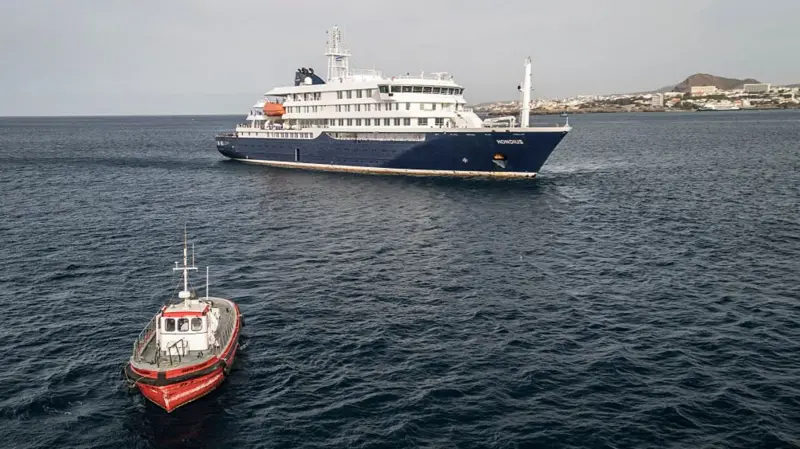
The MV Hondius is now sailing towards Spain’s Canary Islands after being anchored for three days near Cape Verde, an archipelago nation off the West African coast.
The three evacuees were British, Dutch and German. Oceanwide Expeditions said the 65-year-old German evacuee was “closely associated” with a German woman who died on board the ship on 2 May.
The British evacuee has been identified by several media outlets as 56-year-old ex-police officer Martin Anstee, who is understood to be in a “stable condition” in the Netherlands.
A 41-year-old Dutch crew member is also among those who have been evacuated.
Separately, Dutch media reported on Thursday that a KLM flight attendant had been admitted to hospital in Amsterdam with hantavirus symptoms.
The stewardess reportedly came into contact with a 69-year-old Dutch woman after she was briefly on board a KLM plane in South Africa but was deemed too ill to fly.
The 69-year-old later died, and her death is being investigated as a suspected hantavirus case by South African health authorities.
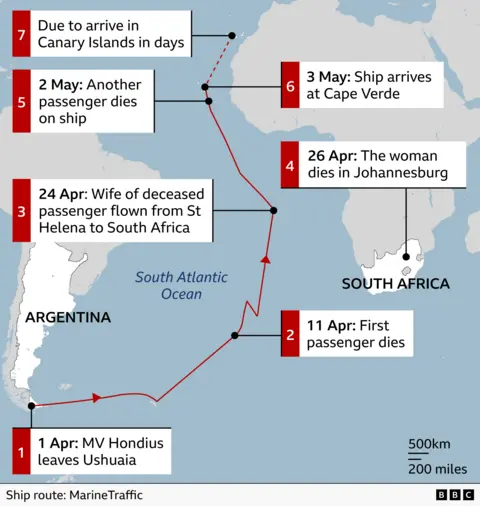
Three people who were aboard the ship have died since it set sail from Argentina a month ago.
Meanwhile, two US states have confirmed to the BBC that they are monitoring three passengers who had returned to the US after disembarking earlier. All are currently not displaying symptoms.
Georgia’s public health department said two residents were being monitored and were in good health, showing no signs of infection.
Arizona’s health department said one resident was being monitored, but was not symptomatic.
The World Health Organization (WHO) has also confirmed a man who had travelled back to Switzerland after disembarking the ship tested positive for hantavirus and is receiving care at a hospital in Zurich.
“The patient had responded to an email from the ship’s operator informing the passengers of the health event,” World Health Organization chief Tedros Adhanom Ghebreyesus said in a statement.
A total of 146 people from 23 different countries remain aboard the MV Hondius under “strict precautionary measures”, Oceanwide Expeditions said.
In its latest update, the World Health Organization (WHO) said eight cases of hantavirus – three confirmed and five suspected – have so far been identified in people who were on the ship.
South African health authorities have said the Andes strain of hantavirus – prominent in Latin America, where the cruise originated – was found in two of the confirmed patients after tests were carried out by the country’s National Institute for Communicable Diseases.
Experts have observed the Andes strain spreading between human patients in previous outbreaks. South Africa says efforts to trace all contacts remain underway.
Officials have said that one of the deceased had the virus, while the other two deaths are under investigation.
The three deaths on board include the 69-year-old Dutch woman who left the MV Hondius when it stopped at the island of St Helena on 24 April. Her husband died on board on 11 April, but is not a confirmed case.
The Dutch woman travelled to South Africa, where she died on 26 April. WHO official Dr Maria Van Kerkhove told the BBC that health experts were carrying out contact tracing on the flight she took.
KLM Airlines on Wednesday issued an advisory saying the woman had also briefly been aboard one of their flights from Johannesburg to Amsterdam on 25 April before the crew decided not to let her fly due to her medical condition.
The third fatality – a German woman – is not a confirmed case either. Her body remains on the ship.
None of the three people who were medically evacuated on Wednesday have tested positive for hantavirus so far, but two are showing symptoms.
It comes as the UK’s Health Security Agency said two British people were self-isolating at home in the UK after potential exposure tothe virus on the ship. They left the vessel earlier in its journey and did not have symptoms.
On board, there were 19 passengers and four crew members listed as British, according to figures released by Oceanwide Expeditions on Tuesday.
This included Anstee, who was evacuated on Wednesday.
Hantavirus typically spreads from rodents, but health experts believe that in this case, it may have passed between humans who were in close contact.
Testing to confirm whether other people on the ship have contracted the virus is ongoing. Health officials have stressed that the risk of transmission to the wider public is low.
The vessel had been anchored near Cape Verde before it set off towards the Canary Islands on Wednesday.
Spanish authorities agreed to the move, but the Canary Islands’ president has opposed the plan.
“I cannot allow [the boat] to enter the Canaries,” Fernando Clavijo told Spain’s Onda Cero radio. “This decision is not based on any technical criteria and nor have we been given enough information.”
Spain’s Health Minister Mónica García said that everyone on board will undergo a medical assessment when they arrive in Tenerife and, if fit to travel, those from abroad will be repatriated to their home countries.
Spaniards will be sent to a defence hospital in Madrid to quarantine.
The evacuation would “avoid contact” with Canary Island citizens and there would be “no risk” to them when it arrives in Tenerife in the coming days, Garcia said.
Dr Van Kerkhove said the way hantavirus is transmitted “is very different than COVID and flu”.
“We’re not talking about casual contact from very far away from one another,” she said, but “really physical contact”.
[BBC]
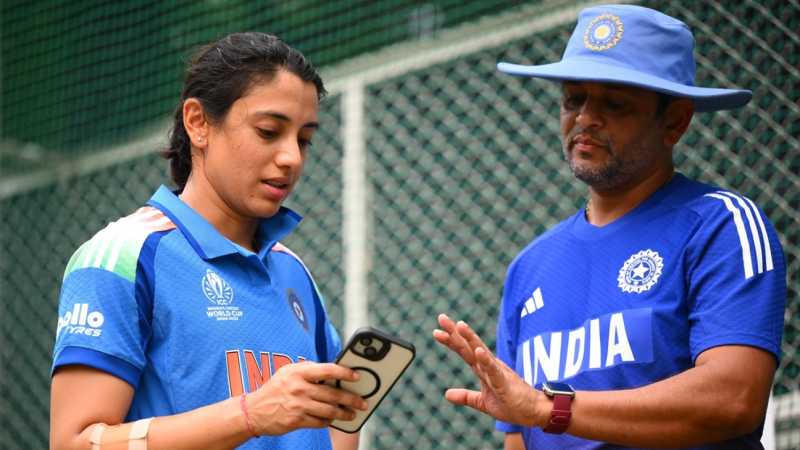
The India and Zimbabwe women’s teams are all set to play an international fixture against each other for the first time when Zimbabwe tour India for white-ball fixtures this October.
The tour comprises three T20Is and three ODIs and will be Zimbabwe’s first visit to India; India are yet to tour Zimbabwe for bilateral fixtures.
The three T20Is will be played in Raipur on October 16, 18 and 20, and the ODIs are on October 23, 25 and 28 in Baroda.
The fixtures were announced by the BCCI on Wednesday, along with two home series for the India A women’s side against Australia A in September and England A in December. Both those series comprise three T20s, three List A games and one multi-day fixture.
The India Under-19 women’s team will also host Sri Lanka U-19 in June and July for three T20s and three 50-over games, and England U-19 in November and December for five T20 fixtures.
The Australia A men’s side will tour India for two multi-day fixtures and three one-dayers in September and October, while the Australia U-19 side will visit India for two multi-day fixtures and three one-dayers also in September and October.
[Cricinfo]

Oil prices have dropped and global stock markets have risen following reports that the US and Iran are close to a deal to end the war.
Brent crude futures, the global benchmark oil price, fell to $97 (£73) a barrel after the reports before rebounding to over $101. The price was over $108 earlier in the day.
The FTSE 100 index of London’s largest public firms and Germany’s Dax index closed over 2% up while the French Cac 40 was up 3%. Asian indexes also ended the day higher while the US S&P 500 was up by more than 1% over the day.
The market movements come after Axios reported that the US believes it is close to a one-page document which will end the war and set up detailed nuclear talks.
Hours later, an Iranian foreign ministry spokesperson told Iranian Students’ News Agency that the US proposal to end the war with Iran was still being considered.
However, not long after that, Trump suggested a deal could still be a way off.
He said on Truth Social that any agreement by the Iranians is “a big assumption” and that a failure to come to a deal will result at bombardments “at a much higher level and intensity ” than was the case during Operation Epic Fury.
Oil prices are still much higher than the $70 a barrel they were hovering around before the start of the US-Israel war with Iran, which has caused caused production and transportation of oil in the region to slump.
Central to the conflict is Iran’s threat to attack oil ships crossing the Strait of Hormuz, a narrow waterway south of the country, in response to US-Israeli strikes since 28 February.
About a fifth of global oil and gas shipments usually cross the strait, which has been effectively closed for weeks. Global gas prices have also soared since the conflict began.
As for stock markets, the big European bourses are lower than they were at the end of February, while the S&P 500 climbed by more than 1%.
The main Asian markets all rose on Wednesday, with the South Korean Kospi closing up 6.45%, the Hong Kong Hang Seng ending the day up 1.22%, and the Japanese Nikkei finishing 0.38% higher.
The Hang Seng is down since the start of war, but the other two are up.
[BBC]

Comprehensive reforms to be introduced in the higher education sector in line with primary and secondary education reforms – PM

Hantavirus-hit cruise ship on way to Canary Islands after three evacuated

Joint programme between President’s Fund and Janashakthi Foundation to expand healthcare facilities for children

Maldivian President concludes state visit to Sri Lanka

India to host Zimbabwe for maiden women’s bilateral series

Showers above 75 mm are likely at some places in the Sabaragamuwa, Central, Uva, Southern and North-central provinces

‘Dates have the highest sugar content to fight Coronavirus’

Sunday Island 27 December – Headlines

#SundayIsland 17th December – Headlines

Sunday Island – 28th March

Sunday Island Headlines – 21 March

Sunday Island – 21st February – Headlines
-

 News3 days ago
CJ urged to inquire into AKD’s remarks on May 25 court verdict
-
 News7 days ago
“Three-in-one blood pressure pill can significantly reduce risk of recurrent strokes”
-

 News4 days ago
USD 3.7 bn H’tota refinery: China won’t launch project without bigger local market share
-

 News20 hours ago
MIT expert warns of catastrophic consequences of USD 2.5 mn Treasury heist
-

 News7 days ago
Alarm raised over plan to share Lanka’s biometric data with blacklisted Indian firm
-

 News5 days ago
Easter Sunday Case: Ex-SIS Chief concealed intel, former Defence Secy tells court
-

 News6 days ago
Ten corruption cases set for court in May, verdict ordered in one case – President
-

 News7 days ago
USD 2.5 mn fraud probe: Interdicted MoF official found dead at home