
Sports
Rain wrecks game after Ben Duckett’s maiden ODI ton


England claimed a 1-0 ODI series win against Ireland in farcical circumstances after the third ODI at Bristol was abandoned 31 overs into the first innings due to rain, with water also getting onto the pitch.
England had reached 280 for 4, with Ben Duckett striking a maiden ODI ton to build on a fast start by Phil Salt, who blitzed 61 off 28 at the top of the order, before the rain arrived during the drinks break at 2.48pm. After a brief pause to see if it would pass, the umpires decided to call on the groundstaff.
There was a further issue when the covers were caught in the wind leaving the pitch exposed, before the three mobile covers came on from Ashley Down Road End. The tractor dragging the covers ended up driving down what would have been just outside off stump for a right-hander batting from the Pavilion End. There was also a delay in closing the gaps between the covers allowing the rain to get onto the playing surface.
Members of the groundstaff then had to squeeze under the covers where they were passed mats to towel down the damaged areas at both ends. Standing umpire Paul Reiffel and third umpire Rod Tucker emerged with reserve umpire David Millns at around 3.15pm to survey the damage. After looking under the covers, and assessing the standing water on the square, the decision was made to call off the match at 3.21pm. The rain relented five minutes later.
An overnight deluge had saturated the outfield, but although play did get underway on time at 12.30pm, fears the ground could not take any more rain were eventually realised.
“It caught everyone by surprise,” Zak Crawley, England’s captain for this series, said. “The ground was already a bit wet this morning after the rain that happened last night, so it didn’t need a lot more rain to get abandoned like that. And obviously a lot of rain fell in not a long space of time.
“I went on the outfield just now and it was soaking wet as well. I think it was all unfit.”
Ireland skipper Paul Stirling echoed those sentiments, having initially hoped the delay would allow his side to turn their fortunes around after a chastening start in the field.
“I think we were all pretty happy when the rain came, but we weren’t quite expecting it to end the game,” he said. “We thought we might get a bit of a break or a bit of a rest and try and regroup and come out there and change it up a little bit. But no, we weren’t expecting the game to be called off.
“We were having a bit of a joke in the dressing room, I think we’re more used to it in Ireland because there is more rain probably. We haven’t really come across that in England where it was so sudden. We wanted to get out there.”
This was the fourth consecutive men’s ODI abandoned at Bristol, following a 2021 no-result against Sri Lanka and two of their three 2019 World Cup matches (Pakistan versus Sri Lanka and Bangladesh versus Sri Lanka) washed out without a ball being bowled. Gloucestershire chief executive Will Brown lamented what he regarded as an unavoidable situation given the volume of rain in the last 24 hours.
“We always had the sense that if we had something similar to last night, 20-30 minutes of rain could be what killed it off. You can see all along the bottom of the square the water is running off in big puddles.
“It is just gutting. We’ve had our fair share of rain offs such as in World Cups and you wonder if we give it a bit longer maybe it can dry out, but it is what it is. The umpires and the match ref know what they are doing, the ground staff are working their backsides off to get it right.”
Brown defended the response from the ground staff, who struggled to fully cover the pitch and surrounding areas in challenging conditions.
“It was hard conditions for them. You could see by how the covers were moving that it was pretty tough for them. It is one thing getting the covers on speedily, but in those conditions it is a different ball game altogether. They were certainly heavy and wet from this morning.
“No one wants to see a match end in that way and we are just collectively gutted for a season-ender for English cricket like that and a season-ender for Gloucestershire in Bristol.
“The conditions last night were shocking. The covers were heavy and wet, and they were trying to move them in tough conditions. It was blowing a hooley, which makes it a lot harder to move. I think they did and admirable job in difficult circumstances.”
In what play was possible, England had been given a bumper start by Salt on his way to his country’s fourth-fastest half-century in the format, from 22 deliveries. He crashed three fours and a six off Mark Adair in the first four balls of the match, with 19 off the first over and, thanks to his 87-run stand with Will Jacks, 100 up after eight overs – both England records in this format.
Duckett had brought up three figures with a six over wide long-off from his 72nd delivery, the penultimate ball of the 30th over. And though Sam Hain fell to Craig Young – the most impressive Irish bowler on show with 3 for 31 – at the end of the next over, Duckett had a shot at becoming England’s first double-centurion and, in turn, the team an outside chance of beating their world-record ODI score of 498 for 8, made against Netherlands last year. Neither got the chance to play out.
It was a tough debut for Ireland’s left-arm spinner Theo van Woerkom, who conceded 47 runs in his four overs. That included having his last four balls hit for 16 by Duckett to bring up England’s 250 after 27 overs. Van Woerkom did at least emerge from the wreckage with a maiden wicket when Crawley scythed a wide delivery to third after bringing up his maiden ODI fifty.
However, for the second time in the series the rain curtailed any prospects of a result. With more than 30 overs of play achieved, spectators were not entitled to a refund.
“It worries me greatly that this is a sign of things to come,” Brown said, looking ahead to next summer with Bristol due to host an ODI between England and Australia on September 29.
“We’ve got a lot of cricket being played in September next year and with climate change we’ve seen heavy rain in June and July, and I think the game needs to be thinking innovatively about how we get games on or prepare pitches and surfaces using different things to get cricket away.”
Brief scores:
England 280 for 4 in 31 overs (Ben Duckett 107*, Phil Salt 61, Zak Crawley 51; Craig Young 3-31) vs Ireland – Match abandoned
(Cricinfo)






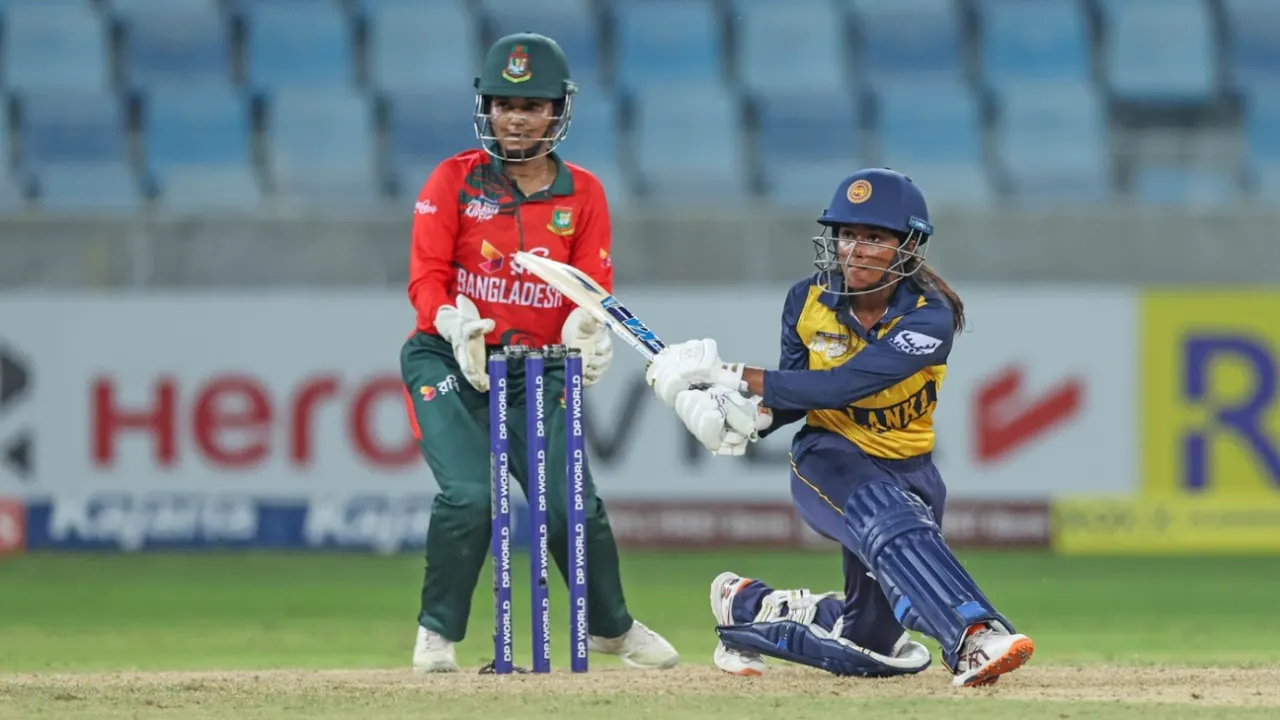
Harshitha Samarawickrema’s splendid 48 not out off 37 balls took Sri Lanka over the line in a low-scoring thriller against Bangladesh. The defending champions secured a semi-final berth with a four-wicket win, and by virtue of topping Group B, will play the side that finishes second in Group A on Friday.
An excellent opening spell of 2 for 17 from Marufa Akter put Bangladesh in firm control of the match after they posted a below-par target of 115, thanks to Chamudi Prabodha’s career-best figures of 3 for 21.
Sri Lanka found themselves behind the required run rate for much of the chase after losing their top order inside the powerplay and slipping to five down by the tenth over. But a resolute Samarawickrama brought Sri Lanka back into the contest by absorbing the pressure throughout the middle overs before landing the final punches to seal the win. This was Sri Lanka’s seventh consecutive win over Bangladesh.
Praboda strangles Bangladesh
This was only the sixth international match the 17-year-old left-arm spinner had played after making her debut against Pakistan in a three-match T20I series last month, and she doubled her tally of wickets on Sunday.
As Bangladesh looked to rebuild after Juairiya Ferdous fell in the fifth over, Praboda struck in her first over, the seventh of the match, to send the dangerous-looking Dilara Akter back to the hut two balls after being hit for a boundary by her. Dilara made a run-a-ball 26 after adjusting to the slow surface. She made her attacking intent known in the third over when she dispatched three consecutive balls from Sri Lanka pacer Chethana Vimukthi for boundaries.
Praboda and the other Sri Lankan spinners bowled with great discipline and used their variations with great guile to put a stranglehold on the Bangladesh batters, who managed just 114 for 8.
With Sobhana Mostary (34 off 41) and Shorna Akter (9 off 14) stretching their steady 41-run stand into the death overs, the Bangladesh dugout must have anticipated a much bigger total than what they eventually managed. Their hopes were bulldozed by Praboda in her last over as she accounted for both batters inside three balls. The left-arm spinner bamboozled Mostary with flight to have her stumped before drawing Dilara into chipping a tossed-up delivery back to her.
An unlucky outing for Athapaththu
Nilakshi Silva and Vimukthi dropped sitters off Chamari Athapaththu’s bowling, with the former putting down Mostary in the 14th over. Athapaththu eventually got a wicket in her last over, but missed out on a second when on-field umpire Humaira Farah turned down a clear caught-behind appeal off the last ball of her spell.
During the chase, her stay at the crease lasted only two balls, as Fahima Khatun took a sharp catch at first slip when she advanced down the pitch to smash Marufa over the top of her head. That shot, on any other day, would have landed in the stands, as is often the case when Athapaththu charges at the bowlers.
Marufa turns a straightforward chase into a contest
Bangladesh needed early wickets to make a contest of what many expected to be a cakewalk for Sri Lanka, with the required rate below a run-a-ball at the start of the chase. Marufa delivered exactly what was needed, accounting for both Sri Lankan openers.
Marufa had Athapaththu caught at first slip off the last ball of the first over before bowling a jaffa in her next over, rattling Imesha Dulani’s stumps with one that ripped through the gate. Her three powerplay overs yielded 2 for 17.
Sri Lanka’s middle order crumbled under pressure as Sanjana Kavindi was bowled by Sultana Khatun off the last ball of the powerplay. They were soon five down for 44 in the tenth over, but a gutsy 38-run stand between Samarawickrama and Nilakshika Silva brought them back into the contest and threatened to take the game away from Bangladesh.
Desperate for a breakthrough, Bangladesh captain Nigar Sultana returned to her trump card in the 17th over, and Marufa obliged with a perfect over to shift the momentum back in her side’s favour. The seamer bowled Silva and conceded only four runs to finish with career-best T20I figures of 3 for 21. It was the fourth time in her 48-match T20I career that she had taken three wickets in the format.
Samarawickrama finishes the job
Ritu Moni had been immaculate in her first three overs, but Samarawickrama plundered 16 runs off her last over – the most conceded in an over in the match – to swing the game in Sri Lanka’s favour.
A lucky inside edge off the second ball raced to the fine-leg boundary as Moni followed Samarawickrama after she backed away to make room on the off side. The next ball landed straight into the advertising cushion at midwicket as the batter swept the medium pacer for six. She then danced down the wicket to launch Nahida Akter for a towering six down the ground, reducing the equation to two off the final over.
The win came off the second ball of the final over, with the ball trickling past the keeper after brushing her pad.
Scores:
Sri Lanka Women 115 for 6 in 19.2 overs (Imesha Dulani 12, Harshitha Samarawickrama 48*, Nilakshika Silva 18, Kaushini Nuthyangana 11*; Marufa Akter 3-21, Sultana Khatun 1-14, Ritu Moni 1-29) beat Bangladesh Women 114 for 8 in 20 overs (Dilara Akter 26, Juairia Ferdous 14, Solbhana Mostary 34, Fahima Khatun 14; Sugandika Kumari 2-22, Chamari Athapaththu 1-20, Chamudi Praboda 3-21, Kavisha Dilhari 1-17) by four wickets
[Cricinfo]

by Rex Clementine
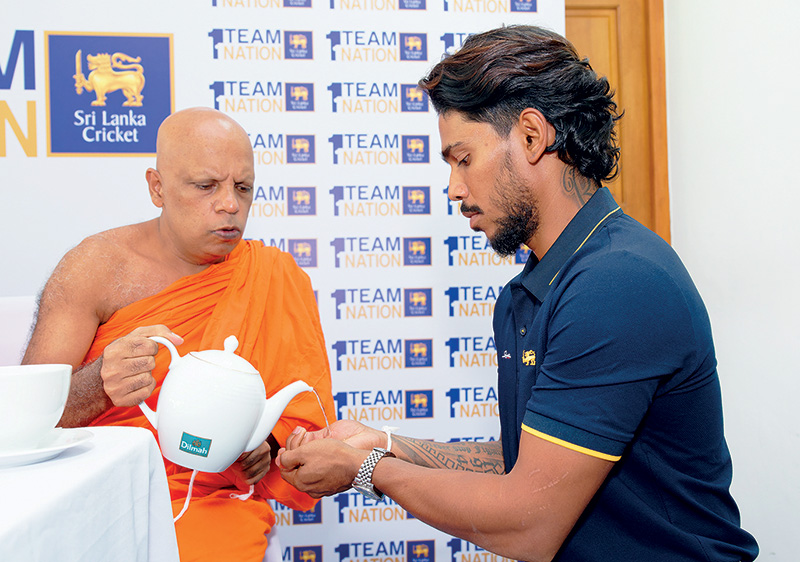
Prolific top order batter Pathum Nissanka has rejoined the Sri Lankan squad after three months on the sidelines following wrist surgery.
Nissanka suffered the injury during Sri Lanka’s tour of the West Indies in June and subsequently flew to London for surgery. The setback ruled him out of the LPL, the Test series against India and the start of the domestic season.
He returned to action for NCC in the domestic T20 competition last week, using the outing to prove his fitness and earn a recall to the national side.
Nissanka travelled to London with the Sri Lankan team on Saturday. The tourists will hold several training sessions in the capital before heading to Southampton for the first T20I next week.
While Nissanka has cleared the fitness hurdle, white-ball skipper Kusal Mendis has not been so fortunate. Mendis, who has been nursing a hamstring injury, was withdrawn from the T20 squad along with left-arm seamer Binura Fernando, with both yet to prove their fitness.
Sri Lanka Cricket announced that Charith Asalanka will lead the side in Mendis’ absence, while Pavan Rathnayake and Dilshan Madushanka have been added to the squad.
There will be plenty of focus on Nissanka during the tour, not least because of the memories he created in England two years ago, when a stunning hundred at The Oval set up one of Sri Lanka’s most memorable overseas Test wins.
Chasing 219 under gloomy, overcast skies, with conditions tailor made for England’s seamers, Nissanka produced an innings of rare quality. Early on, his judgement outside off stump and ability to counter the moving ball drew admiration. Once his eye was in, however, caution gave way to command. Elegant drives flowed before the cuts and pulls came out, underlining that he was anything but a one dimensional player.
Wisden, reflecting on the innings, observed that there was a touch of Roy Dias in Nissanka early on before the Duleep Mendis in him emerged after he had passed fifty. It was an especially fitting comparison given that Roy had coached Nissanka at Sri Lanka Under-19 level.
Nissanka’s unbeaten 127 came from just 124 deliveries and proved instrumental in Sri Lanka securing their first Test victory in England in a decade.
Attention will also be firmly fixed on how Sri Lanka fare in the T20s, a format in which they have struggled in recent months. Their ODI fortunes, however, have been considerably brighter, with victories over Australia and India, two of the world’s leading sides, during the last 24 months.
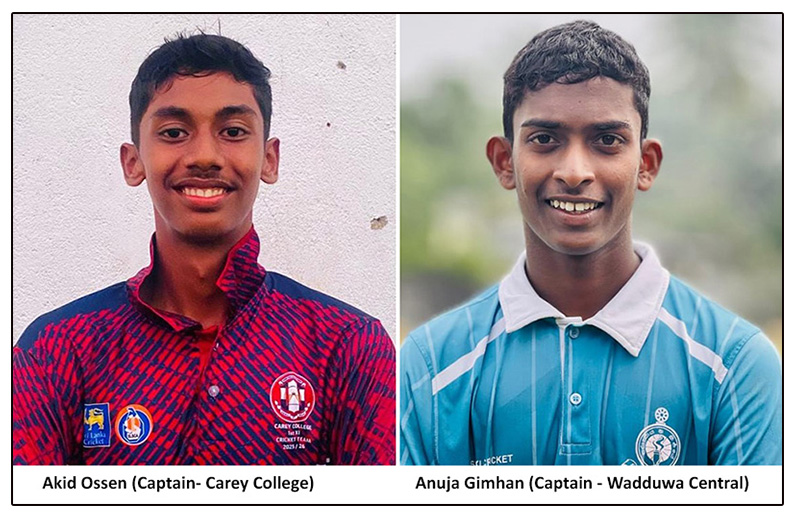
Carey College Colombo will meet Wadduwa Central College in the semi-final of the Under-17 Division II Inter-Schools Limited Overs Cricket Tournament at Ananda Mawatha today.
The tournament, conducted by the Sri Lanka Schools Cricket Association, began with 65 teams divided into eight groups. The top four teams from each group advanced to the second round, where the competition switched to a knockout format.
Carey College entered the second round as group champions, while Wadduwa Central progressed as runners-up from their group. Carey then defeated St. Aloysius’ College, Ratnapura, St. Peter’s College, Bambalapitiya (B), and Trinity College, Kandy (B), in successive knockout rounds.
Wadduwa Central overcame Zahira College, Colombo, Anuradhapura Central College and S. Thomas’ College, Mt. Lavinia (B), to book their place in the last four.
Carey College will be led by Akid Ossen, while Anuja Gihan will captain Wadduwa Central in what promises to be a keenly contested semi-final.
Carey College (from):
Akid Ossen (Captain), Tuan Jappar, Omika Sanhiru, Irusha Vidarshana, Dinan Ekanayake, Thenula Ekanayake, Siluna Sandil, Dulina Nanayakkara, Sandila Nanayakkara, Nethum Peiris, Shenal Jayasekara, Oshada Bandara.
Officials:
Shehan Lasantha David (Master in Charge), Preethiraj Walpitagamage (Coach)
Wadduwa Central (from):
Anuja Gimhan (Captain), Dinith Newumal (Vice captain), Sumesh Malka, Imesh Chathuranga, Ishan Priyadarshana,Vikum Sathsara, Lesandu Sanhindu, Nadith Prabodha, Daham Didula, Yasiru Nethsara, Chamesh Mokshan, Praveen Theekshana, Kaveesha Sayuranga, Senuth Hesara, Binara Gimsara.
Officials:
Gayathri De Silva (Teacher in Charge), Dhanushka Ranmuthu (Head Coach)

Sun directly overhead Galle, Angulugaha, Imaduwa, Telijjawila, Yatiyana and Tangalle about 12.08 noon today (07)

Showers above 50 mm are likely at some places in the Uva and Eastern provinces.

Harshitha’s composed knock seals Sri Lanka’s semi-final berth

‘Choka Malli’ slips out of country before travel ban

Dengue death toll rises to 73

Ranil accuses govt. of undermining democracy

‘Dates have the highest sugar content to fight Coronavirus’

Sunday Island 27 December – Headlines

#SundayIsland 17th December – Headlines

Sunday Island – 28th March

Sunday Island Headlines – 21 March

Sunday Island – 21st February – Headlines
-

 News5 days ago
Denied of promotion to SC despite vacancies, justice Gurusinghe retires
-

 Latest News5 days ago
Grade 5 scholarship exam results released
-

 News5 days ago
22A: SC urged to suspend hearing, appoint full bench
-

 Midweek Review6 days ago
The local and global dynamics of Sri Lanka’s 22nd Amendment
-

 News5 days ago
Govt. seeks NATO assistance
-

 News3 days ago
Namal remanded until Sept. 18 over Airbus deal investigation
-

 News6 days ago
40 professional organisations and TU oppose proposed 22A
-

 Latest News2 days ago
Tharanga creates history with Diamond League crown in Brussels