
Latest News
Rain prevents England push after Sri Lanka struggle with bat again

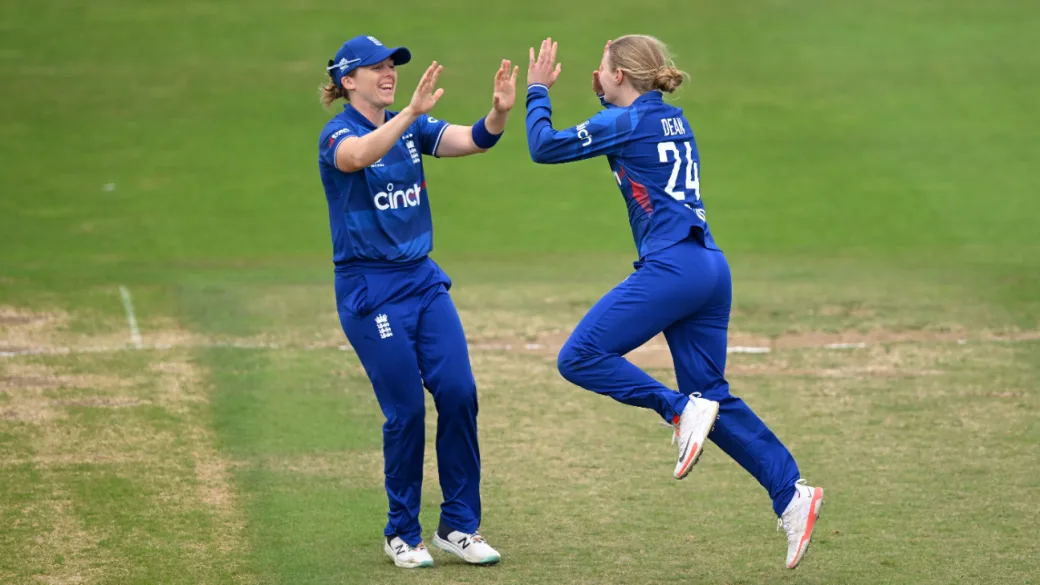
England showed off their burgeoning depth to take command of the second ODI against Sri Lanka before rain descended on Northampton and rendered it a washout with one game left in the series.
Offspinner Charlie Dean and allrounder Alice Davidson-Richards came into the home side for a resting Mahika Gaur and injured Emma Lamb and claimed two wickets each with Lauren Filer, the 22-year-old quick who impressed on her ODI debut in the opening match of this series, also taking two as England moved within one wicket of bowling Sri Lanka out well inside their 50-over allocation for the second time in a row. Then the morning drizzle which had delayed the toss by half an hour returned much heavier, just as some stealthy fielding by Kate Cross ran out Achini Kulasuriya for the ninth wicket, and play never resumed.
After England had opted to bowl, Cross conceded nine runs first up, fours from Chamari Athapaththu – threaded fine and slammed in front of point – bookending a wide. Athapaththu peeled off two more fours through the covers in Cross’s next over, but Cross responded with the last ball – her first to right-hander Vishmi Gunaratne – who edged behind to Amy Jones, punctuating a bright start by Sri Lanka at 26 for 1.
Filer chimed in with the wicket of Harshitha Samarawickrama with a fuller ball that found a faint edge and Jones’ gloves. But Athapaththu was looking dangerous, particularly against Cross. Her four lofted over mid-on sounded like a gun going off and two balls later, she despatched a full delivery over the rope at deep midwicket.
Dean had been called up as part of England’s workload management of Gaur, the 17-year-old seamer who was Player-of-the-Match on ODI debut as England thumped Sri Lanka by seven wickets in Durham on Saturday, and she entered the action in the 10th over to devastating effect. Dean’s first three balls were dots and followed immediately by the prize wicket of Athapaththu, trapped lbw in front of middle and leg stump, ending her innings on a run-a-ball 34 and putting the tourists in trouble at 53 for 3.
Davidson-Richards, making her first England appearance since the winter tour of the Caribbean after Lamb was struck down with a back spasm, accounted for Hansima Karunaratne, who top-edged an excellent short ball to Sarah Glenn at fine leg and Sri Lanka’s slide continued.
Kavisha Dilhari was yet to score when Heather Knight spilled a chance at slip off Dean, but Dean covered her skipper’s error two balls later with a return catch that was a lot simpler than it looked as she fell to her left in her follow through. Davidson-Richards then had Anushka Sanjeewani out chopping on and Sri Lanka were six wickets down with only 79 runs on the board.
Tammy Beaumont put down a chance at point off Hasini Perera, on 19, after Filer had been brought back into the attack. But Filer and Jones combined again to remove Udeshika Prabodhani and when Cross pounced on the chance to run out Kulasuriya at the bowler’s end with a direct hit from midwicket as the batter strolled back to her crease without grounding her bat, Sri Lanka were 106 for 9 from 30.5 overs.
At that moment, the rain that had been hovering round the ground began to fall and the players left the field, only for it to set in and leave the hosts heading into Thursday’s final match in Leicester still with a 1-0 series advantage.
Davidson-Richards received her call-up on Friday and promptly scored a century for South East Stars as they upset competition leaders Blaze in the Rachael Heyhoe Flint Trophy on Sunday. And while she felt that playing her first international match this year was like going back to “business as usual”, she said a return to grassroots cricket had been key to her most recent innings with the bat.
“I was out on a bike ride so I could see it coming and I was like, ‘I’ll just deal with this afterwards’,” she laughed when talking about her latest England selection after being released from the Ashes squad ahead of the June Test. “I went to some club cricket on Saturday and remembered how wonderful cricket is seeing it in its actual true form, which obviously put me in quite a nice position for Sunday. I just remembered how fun cricket is and what it’s like to play on those little club grounds. So it’s been quite fun a few days and I tried to bring that into today.
“If I put pressure on myself that’s when it tends to go a bit tits up. I think just remembering how relaxed I was when I was playing club cricket, I was watching mates I used to play with when I was 15 and stuff and just seeing people playing just for fun… seeing it played in that sort of way, on Sunday I was actually just envisioning playing on that little club ground and remembering how stress-free it was. That really helped calm my brain down and not let Alice get in the way of Alice.”
Competitions like the RHFT, Charlotte Edwards Cup and the Hundred have been crucial in developing England’s talent pool, including the likes of Gaur and Filer, and Davidson-Richards said that would be a “massive factor” for the international side.
“The best teams come from environments where there’s a lot of competition for places,” she said. “You don’t want the same people being picked every single time. You want people pushing the XI that are there and I’m doing my job if I’m making it difficult for them to pick an XI.
“Charlie Dean’s exactly the same. If you’re leaving her out then you’re probably in quite a good place aren’t you because she’s an unbelievable player. The more people that we can get up to that level, the better for the England team, then obviously we’ll just keep pushing each other on.”
Brief scores:
Sri Lanka 106 for 9 in 30.5 overs (Chamarie Athapaththu 34, Charlie Dean 2-12, Alice Davidson-Richards 2-16, Lauren Filer 2-25) vs England – Match abandoned
(Cricinfo)

Latest News
Gill, Sai Sudharsan, Rashid power Gujarat Titans to second spot with fourth straight win

Twenty-eight overs into the contest in Jaipur, Rajasthan Royals (RR) were keeping pace with Gujarat Titans (GT). They were 86 for 3 in seven overs, chasing 230. Dhruv Jurel looked like he had excised his slow-batting demons. He was on 24 off 9 and ready to go bigger. Then, Rashid Khan spun one past Jurel’s slog to peg back his stumps. It was the first of his four wickets. On a night of spin chokeholds by both RR and GT, Rashid’s spell of 4 for 36 was the point of difference between both sides.
At the end of it all, GT zoomed up to second spot in the points table with 14 points. It was their fourth consecutive win, as they continued their late surge in this IPL.
Earlier in the evening, half-centuries from Shubman Gill and B Sai Sudarshan – and their 118-run opening partnership – headlined GT’s biggest IPL score outside Ahmedabad. They had been greeted by an all-pink Jaipur. RR’s jerseys were the same colour, in honour of their women’s empowerment movement. By the end of the powerplay, Gill and Sudharsan couldn’t have felt more at home themselves. They had raced away to 82 for 0, and alongside Rashid’s spell, they headlined a 77-run win.
Jofra Archer took 11 deliveries to get through the first over of the match. It featured nine extras and was the longest opening over in the history of the tournament. By the end of it, Gill and Sai Sudharsan – without taking any big risks – had raced away to 18 for no loss. This was the theme of the powerplay: the opening pair kept getting balls on their pads or bouncers shooting way over their heads. They played most of their shots in the ‘V’ down the ground. By the end of the first six, they were just 18 runs away from their ninth 100-plus partnership, the second-best tally in the IPL, just behind Virat Kohli and AB de Villiers.
Despite their big start, Gill and Sai Sudharsan slowed down in characteristic fashion. Both of them reached their fifties off 30 balls. Yash Raj Punja (1 for 37) and Ravindra Jadeja (1 for 34) did not find much turn off the surface, but bowling in tandem through the middle overs, they cut off the risk-free boundary options for the opening pair.
A leg injury while running between wickets affected Gill’s running as well. Punja took out Sai Sudharsan for 55 off 36, holing out to long-on, and Jadeja speared in a delivery to Jos Buttler at 107kph to rush him on a drive straight to long-off.
After GT’s whirlwind start, 220 was a base expectation from their innings. By the end of the 19th over, they were on track to finish under it, stuck on 208 for 4. Brijesh Sharma had plucked out Jason Holder’s wicket and given away just four runs in the 19th, varying his pace and bowling into the blockhole. However, his gold-dust over was reduced to a footnote when Tushar Deshpande missed his lines in the last over. Rahul Tewatia maneuvered around the crease to leather back-to-back sixes, before Washington Sundar hit one of his own to drag GT to 229 for 4.
It is the stuff of routine now. The bowler chugs in, bowls a perfectly okay delivery, and Vaibhav Sooryavanshi sends him into the stands first-ball. Saturday night was no different, as Sooryavanshi clobbered Mohammed Siraj across the line over the long-on boundary. Next ball, a Siraj yorker rifled towards the stumps, and Sooryavanshi inside-edged onto his foot and fell to the ground.
Sooryavanshi looked set for another big start, despite limping between wickets, blasting Siraj for three fours in four deliveries. On the fifth delivery, he was rushed into a hook off a fiery bouncer that carried to square leg. In the blink of an eye, Sooryavanshi went from zero to 16-ball 36, then from the middle to the dugout.
Siraj (1 for 55) and Kagiso Rabada (2 for 33) became the first pair of IPL bowlers to bowl through the powerplay four matches in a row. Jurel ventured down the track to plunder a 22-run over against Siraj before the powerplay ended. Rashid would pluck him out soon anyway.
With Sooryavanshi and Jaiswal gone, the onus was on Jurel and Ravindra Jadeja – who clobbered six and four off his first two deliveries – to play against type and shift into fifth gear. But Rashid got the ball to jag and turn off a pitch like no other spinner on the night. He also bowled more legbreaks than googlies – a rarity for him – to keep the batters guessing.
Once Jurel perished, Donovan Ferreira saw the ball turn the other way, past an innocuous front-foot defence. Harsh Dubey soon went for another missed slog, Rashid’s third consecutive dismissal to rattle the stumps. Rashid wore a wry smile when Jadeja swiped him over backward square leg for six in the 14th over. Next ball, Jadeja was trapped lbw in front of the stumps as the ball spun into his pads.
Holder soon mopped up the tail, taking the final three wickets in five deliveries and RR had lost their third game in four matches.
Brief scores:
Gujarat Titans 229 for 4 in 20 overs (Sai Sudharsan 55, Shubman Gill 84, Joss Buttler 13, Washington Sundar 37*, Rahul Tewatia 14*; Brijesh Sharma 2-47, Yash Raj Punja 1-37, Ravindra Jadeja 1-34) beat Rajasthan Royals 152/10 in 16.3 overs (Vaibhav Sooryavanshi 36, Dhruv Jurel 24, Ravindra Jadeja, 38, Shubham Dubey 15, Dasun Shanaka 16; Mohammed Siraj 1-15, KagisoRabada 2-33, Rashid Khan 4-33, Jason Holder 3-12) by 77 runs
[Cricinfo]
Latest News
Showers above 100 mm are likely at some places in the Western, Sabaragamuwa, Central, Southern, Uva, North-western and Northern provinces and in Anuradhapura district.

WEATHER FORECAST FOR 10 MAY 2026
Issued at 05.30 a.m. on 10 May 2026 by the Department of Meteorology
The low-level atmospheric disturbance in the vicinity of Sri Lanka is likely to develop into a low-pressure area around 11th of May. Therefore, the prevailing showery conditions over the island are expected to continue during the next few days.
Showers or thundershowers will occur at most places over the island, and cloudy skies are expected over the island. Heavy showers above 100 mm are likely at some places in the Western, Sabaragamuwa, Central, Southern, Uva, North-western and Northern provinces and in Anuradhapura district.
The general public is kindly requested to take adequate precautions to minimize damage caused by temporary localized strong winds and lightning during thundershowers.

Bangladesh commanded proceedings on the first day, but Pakistan changed that around dramatically on the second, led by the youngest member of the team. Azan Awais, making his debut, steered Pakistan into a position of relative comfort in a century partnership alongside Imam-ul-Haq and then another solid stand with fellow debutant Abdullah Fazal.
By the end of the day, Awais had taken his side to 179 for the loss of just Imam’s wicket. Awais had contributed an unbeaten 85, nearing a debut hundred on the third morning. As a result, Pakistan were only another 234 runs behind with nine wickets standing after Bangladesh posted 413.
The confidence and poise he demonstrated across the last session was not immediately obvious when thrown in for an awkward ten overs before tea. The first ball Nahid Rana bowled to him was a wicked short delivery that reared up and hit him square on the badge of the helmet. With Awais visibly dazed, the physio was called and a concussion test began, one he looked in real danger of failing. Batting on, Awais briefly called for the physio again shortly after, but was allowed to stay on.
And once he did, there was no looking back. While Imam remained fidgety, Awais began to demonstrate why he has been the most prolific domestic run-scorer in Pakistan across the last two seasons. A delicious cover drive off Nahid showed his refusal to back down under the stern test. Awais’ ability to force Bangladesh to spread the field kept the hosts unsettled as he found boundaries through the covers, either side of the wicket, and straight down the ground.
Imam’s dismissal, an arm ball from Mehidy Hasan Miraz, appeared to have little impact on Awais’ own confidence. In the final hour during Nitish’s last burst, he pitched the first two balls short, with Awais dispatching them for boundaries either side. When Nahid went full at 147.1kph off the following delivery, Awais merely flicked him to fine leg to make it three in a row. It was the last time Nahid would bowl on the day.
It helped, perhaps, that Fazal showed he was comfortable at the crease during a crucial phase in the game. It was an attritional innings, but crucially, one that has not come to an end. It may easily have ended in the final ten minutes, though, when Bangladesh put down a chance off Taskin at third slip – the second such reprieve for a Pakistan batter after a nick from Imam was grassed earlier.
But the position these young batters found themselves in would not have been possible without an old hand. Mohammad Abbas had said Pakistan had been slightly unlucky on the first day, and then played an instrumental part turning that luck around on the second morning. Four wickets to add to Friday’s one gave the fast bowler a five-wicket haul that undid some of the damage Bangladesh inflicted on Pakistan on day one, thus bowling them out for 413.
It was still the highest first-innings score Bangladesh have ever managed against Pakistan, though it fell short of what they may have hoped when they looked solid at 338 for 4, before losing 5 for 46.
Earlier, Bangladesh had threatened to run away after Litton Das struck three boundaries off Shaheen Shah Afridi’s first three balls. But Pakistan managed to rein the scoring rate back in. It set the stage for Abbas to try and get something out of a pitch his compatriots appeared to have written off for dead.
Always searching for unconventional ways to gain an edge, he surprised Litton Das with a bouncer that, despite his modest pace, grew big on the batter as he tried to mow it over mid-on. Litton found Amad Butt, the substitute fielder, stationed there, and he took a splendid catch for Pakistan’s first success in the morning.
Shortly after, Abbas added a second wicket in the morning as Mehidy Hasan Miraz tried to transfer pressure back onto him. A six off the previous delivery emboldened the batter to scythe him through point, but Mehidy only found Imam’s safe hands.
It appeared Bangladesh had decided to take Pakistan on from one end while Mushfiqur Rahim shepherded them from the other. Taijul Islam went after Hasan Ali in a little cameo that sped up the scoring rate, but, again, found himself succumbing to the unlikely Abbas bumper that he failed to get on top of.
The other quicks finally jumped in to help. Shaheen Shah Afridi broke the innings open by ending Mushfiqur’s stubborn resistance on 71 with a lovely nipping ball post-lunch. But Abbas was not denied his fifth – it was yet another bouncer that Ebadot Hossain could not handle and nicked off to. Bangladesh found a way to get over the 400 mark with a breezy cameo from Taskin Ahmed, who scored 28 off 19 balls, and added 29 with last batter Nahid.
Awais, along with Imam, then came out to bat an hour before tea. He then led the way in ensuring Pakistan’s goals in this Test are far loftier than mere survival.
Brief scores:
Pakistan 179 for 1 in 46 overs (Azan Awais 85*, Imam-ul-Haq 45, Abdullah Fazal 37*; Mehidy Hasan Miraz 1-37) trail Bangladesh 413 in 117.1 overs (Najmul Hosein Shanto 101, Mominul Haq 91, Mushfiqur Rahim 71; Mohammed Abbas 5-92, Shaheen ShahnAfridi 3-113) by 234 runs

Senior Australia players hold off Cricket Australia deal amid BBL pay frustration

One dead in US after being struck by taking off Frontier Airlines plane

Gill, Sai Sudharsan, Rashid power Gujarat Titans to second spot with fourth straight win

Showers above 100 mm are likely at some places in the Western, Sabaragamuwa, Central, Southern, Uva, North-western and Northern provinces and in Anuradhapura district.

Lanka Port City officials to meet investors in Dubai

Research Vessel Dr. Fridtjof Nansen Completes Marine Scientific Survey in Sri Lankan Waters and Departs Colombo

‘Dates have the highest sugar content to fight Coronavirus’

Sunday Island 27 December – Headlines

#SundayIsland 17th December – Headlines

Sunday Island – 28th March

Sunday Island Headlines – 21 March

Sunday Island – 21st February – Headlines
-

 News3 days ago
MIT expert warns of catastrophic consequences of USD 2.5 mn Treasury heist
-
 News5 days ago
CJ urged to inquire into AKD’s remarks on May 25 court verdict
-

 News6 days ago
USD 3.7 bn H’tota refinery: China won’t launch project without bigger local market share
-

 Editorial3 days ago
Clean Sri Lanka and dirty politics
-

 Editorial6 days ago
Deliver or perish
-

 Opinion5 days ago
Security, perception, and trust: Sri Lanka’s delicate balancing act
-

 Editorial2 days ago
The Vijay factor
-

 News1 day ago
SLPP expresses concern over death of former SriLankan CEO