
News
FM highlights importance of adequate funding for developing countries to overcome challenges to achieving SDGs

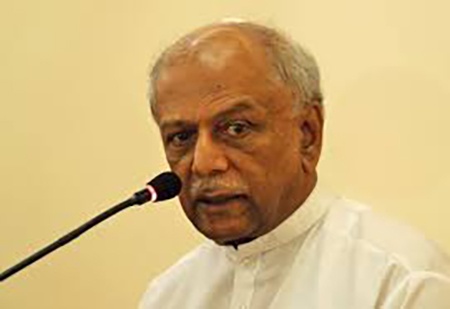
Sri Lanka has reiterated the call of the Group of 77 for adequate funding for development initiatives, enabling the developing countries to overcome the multifaceted challenges that hinder the achievement of the SDGs amidst the current global situation due to the pandemic.
Issuing a statement for the 44th Annual Meeting of Ministers for Foreign Affairs of the Group of 77, Foreign Minister Dinesh Gunawardena noted that the unprecedented consequences arising from the current health crisis has spilled over to economies, as reflected globally by exacerbating the vulnerabilities in trade, tourism, investment, and employment, and Especially, developing countries are facing an additional burden.
In this context, the Minister recalled President Gotabaya Rajapaksa’s call to the international community at the Financing for Development Conference, for debt relief and to adopt fiscal policies to mitigate the impact of COVID-19.
The Forty-Fourth Annual Meeting of Ministers for Foreign Affairs of the Group of 77 was held virtually on Thursday (12 November), chaired by the Minister for Foreign Affairs and International Cooperation of the Co-operative Republic of Guyana.
The interactive dialogue was held on the theme “Major priority issues and the global response to the COVID-19 pandemic and the obstacles it poses to the implementation of the 2030 Agenda and achievement of the SDGs”.
In a video statement, Minister Gunawardena highlighted the strong mandate given by the people of Sri Lanka to the President Gotabaya Rajapaksa both at the presidential election and the general election, for his Vision for Prosperity and Splendor that gives confidence to Sri Lanka to commit further to the goals of the G-77.
He noted that Sri Lanka’s commitment to achieve the SDGs was reflected in the appointment of a Working Group to study the current status of Sri Lanka’s implementation and progress of the SDGs.
Sri Lanka’s Presidential Task Force in charge of Economic Revival and Poverty Eradication operates with the objective of creating a production economy promoting local industries. The Government has granted financial relief to over six million families and vulnerable groups and established a COVID – 19 Healthcare and Social Security Fund. We underscore the priority of making available a vaccine for COVID-19 to all.
The Foreign Minister further underscored the platform provided by the Group to developing countries in articulating and promoting collective interests on all major international economic issues within the UN system and in promoting South-South cooperation for development.
“Poverty remains a great obstacle for the development of the Members States and we share the commitment of this Group to eradicate poverty in all its forms,” he said.
He also recalled the original contribution of Sri Lanka’s Economists, led by Dr. Gamani Corea, former Secretary General of UNCTAD, in mobilizing support for South-South cooperation.
Minister Gunawardena congratulated the President Dr. Mohamed Irfaan Ali, of Guyana for his stewardship of the Group, who made the key note address. Volkan Bozkir, President of the 75th session of the UN General Assembly and António Guterres, Secretary-General of the United Nations also addressed the Meeting.

News
Steps are being taken to provide accommodation facilities for 16,000 university students – Prime Minister

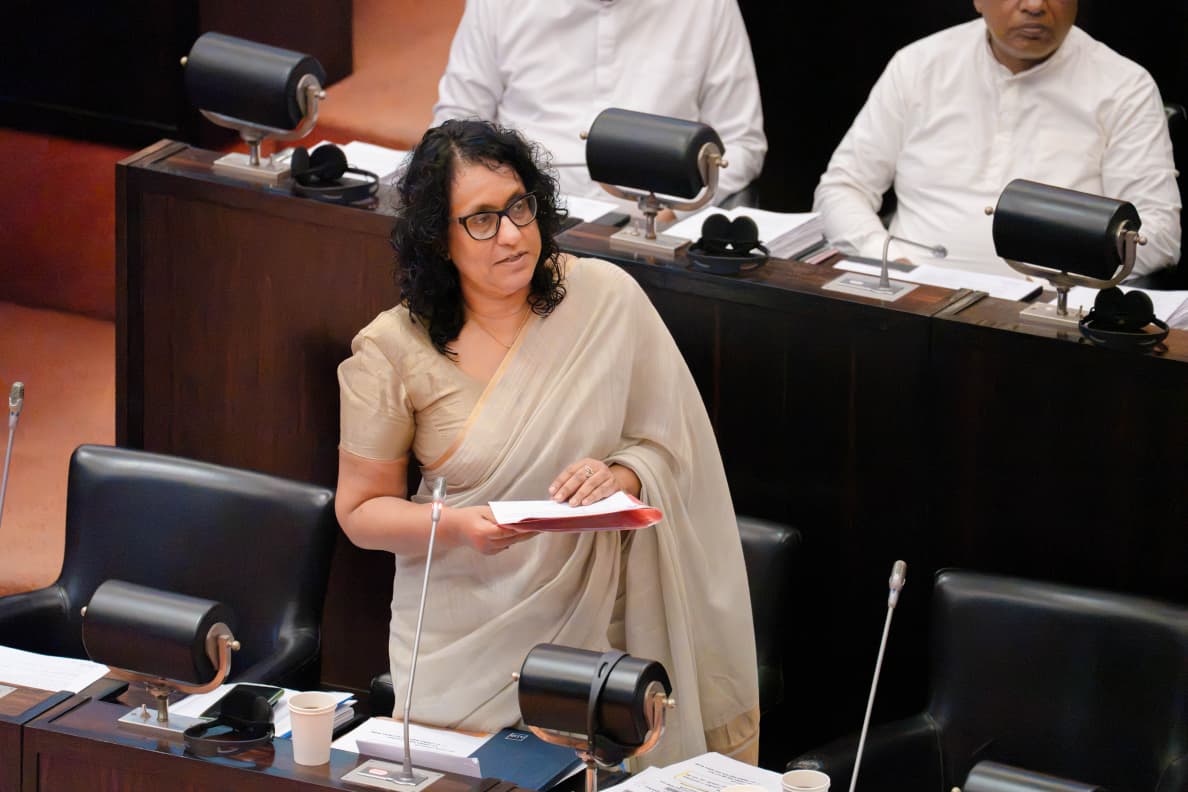
Prime Minister Dr. Harini Amarasuriya stated that accommodation facilities will be provided for 16,000 university students through the new university hostel construction programme, and that steps have also been initiated to formulate a comprehensive policy on university student accommodation.
The Prime Minister made these remarks on Wednesday (09 September) in Parliament while responding to questions raised in Parliament.
The Prime Minister stated:
“The University Grants Commission allocated Rs. 376 million in 2025 and Rs. 453 million in 2026 for the renovation of university hostels. The Ministry of Education, Higher Education and Vocational Education allocated Rs. 400 million in 2026 for hostel renovations and Rs. 1,500 million for the construction of new hostels in 2026. All these funds are from domestic allocations. We are implementing these hostel projects without resorting to borrowing. At the same time, allocations have been made through the 2025 and 2026 Budget Estimates for the construction of new hostels under foreign loan financing. These include Rs. 321 million allocated in 2026 for hostels under the Wayamba Urban Development Project, funded through the Saudi Development Loan.
Under the project to establish the Faculty of Medicine at Sabaragamuwa University of Sri Lanka, Rs. 331 million has been allocated under the Saudi Development Loan for the construction of a hostel.
A further Rs. 10.46 million has been allocated for the renovation of hostels under the Wayamba Urban Development Project. Accordingly, Rs. 466 million was allocated for 2025 and Rs. 662.46 million for 2026.
A total of 55 new hostels are scheduled to be constructed during 2025 and 2026 and in the period ahead.
The number of students expected to benefit from these accommodation facilities is 16,000. The University Grants Commission is currently formulating an overall policy on accommodation facilities for students of Sri Lankas state universities. The policy also includes guidelines relating to private student accommodation.
There are instances where university students obtain accommodation in privately operated hostels or rented houses. However, there have been no guidelines governing such accommodation. Until now, there have been no established guidelines regarding charges or minimum standards that should be maintained. We are now in the process of developing guidelines to ensure the safety of students and to prevent them from being subjected to economic exploitation.
The proposed policy is currently being reviewed by the state universities under the purview of the University Grants Commission. The programme will be implemented by the University Grants Commission in direct collaboration with state universities, and there are currently no plans to involve local authorities.
The objective of this policy is to ensure fair, transparent, safe, affordable, accessible and inclusive accommodation facilities for students. In particular, we intend to address the accommodation requirements of university students with disabilities through this programme.
The policy also recognises that students who are unable to obtain university hostel accommodation may obtain accommodation in registered private hostels.
Under the proposed provisions relating to private hostels, minimum standards are expected to be introduced covering accommodation facilities, sanitation, safety, accessibility, affordability and student welfare. The provisions also include arrangements for the fair allocation of accommodation, with particular priority given to students with disabilities; the establishment of a committee to oversee private student hostels; regular inspections; and necessary action against hostels that fail to comply with the required standards. Following consideration of observations and recommendations received from the universities, the draft policy will be revised and subsequently submitted for the process of finalisation.
Of the 55 hostels, priority has been given to universities located away from urban areas. We commenced this project with two hostels at the University of Vavuniya. Accordingly, priority has so far been given to universities such as the University of Vavuniya, the University of Jaffna – Kilinochchi Campus, the South Eastern University, the Uva Wellassa University and the Sabaragamuwa University, where the accommodation issue is particularly acute. Another aspect being considered under the accommodation policy is the limited availability of private accommodation in all parts of the country. Therefore, we are also considering the possibility of constructing additional hostels through a public-private partnership arrangement. For example, the Government could provide land under an agreed arrangement to facilitate the construction of additional accommodation facilities. Discussions are currently being held with the universities regarding this matter”.
Prime Minister Dr. Harini Amarasuriya further stated that steps are also being taken to look into hostel facilities and student welfare activities at vocational training centres, as well as at the Ocean University of Sri Lanka and the University of Vocational Technology.
[Prime Minister’s Media Division]
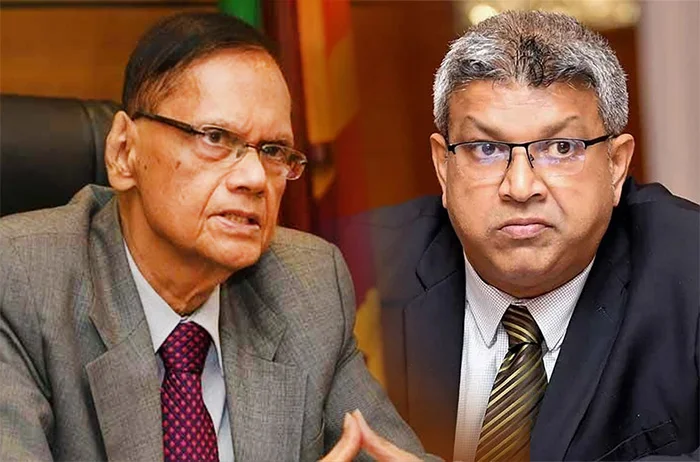
Opp. lashes out at Justice Minister for disparaging remarks about CLA
By Shamindra Ferdinando
The Joint Opposition yesterday (09) tore into Justice and National Integration Minister Harsha Nanayakkara over some disparaging remarks about the Commonwealth Lawyers Association (CLA) in Parliament on Tuesday (08).
The Convenor of the Opposition grouping, former Law Professor Peiris questioned Minister Nanayakkara’s declaration that the CLA was a private club that granted membership on payments received. Emphasising that the CLA consisted of those in the legal profession in Commonwealth countries, Prof. Peiris told the weekly media briefing at the Flower Road Office of former President Ranil Wickremesinghe that the views expressed by the organisation couldn’t be discarded under any circumstances.
Prof. Peiris dealt with Nanayakkara’s response to the CLA’S concerns about several issues, including the composition of the five-member panel of judges. “How could Minister Nanayakkara dismiss concerns raised by CLA on the basis of the paid-membership of the organisation?” Prof. Peiris asked. If membership became an issue, the government would have to reconsider Sri Lanka’s UN membership, the ex-External Affairs Minister said, pointing out that the country had to make regular payments to retain membership of other UN agencies, as well.
Prof. Peiris said that indefensible attacks on international organisations could cause irreparable damage to the country. Appreciating the CLA’s report on the Supreme Court proceedings on the 01 and 02 September, Prof. Peiris stressed the importance of what he called total transparency in the judicial process. He said that whatever the outcome of a particular legal process, it couldn’t be done behind the backs of the public.
Referring to legal processes regarding the 6th Amendment and 13th Amendment, in 1983 and 1987, respectively, Prof. Peiris said, on both occasions the then Chief Justices Neville Samarakoon and S. Sharvananda constituted benches consisting of all Supreme Court judges.
But, the incumbent CJ Preethi Padman Surasena, in spite of the majority of petitioners demanding all available 13 justices to hear the case, decided to leave out those on the seniority list from second position to fourth position.
The government got offended because the CLA pointed that out for the whole world to take notice, Prof. Peiris said. The former parliamentarian noted that the CJ hadn’t even give a reason for declining the widespread call to involve all available 13 judges. According to him, there had been instances where CJ’s appointed seven justices to hear a particular case. Prof. Peiris cited the 2018 bench of seven judges that heard the petitions against President Maithripala Sirisena over the dissolution of Parliament and a panel constituted in 2023 to hear the 2019 Easter Sunday carnage that claimed the lives of 270 people.
The issue at hand is that the five-member panel of judges hadn’t been selected on the basis of seniority, Prof. Peiris said, once the SC determination was sent and released through the Speaker, they would meticulously examine that to make their position known to the people. Prof. Peiris said that what they really wanted to know was that if seniority hadn’t been the basis for selection what the criterion was.
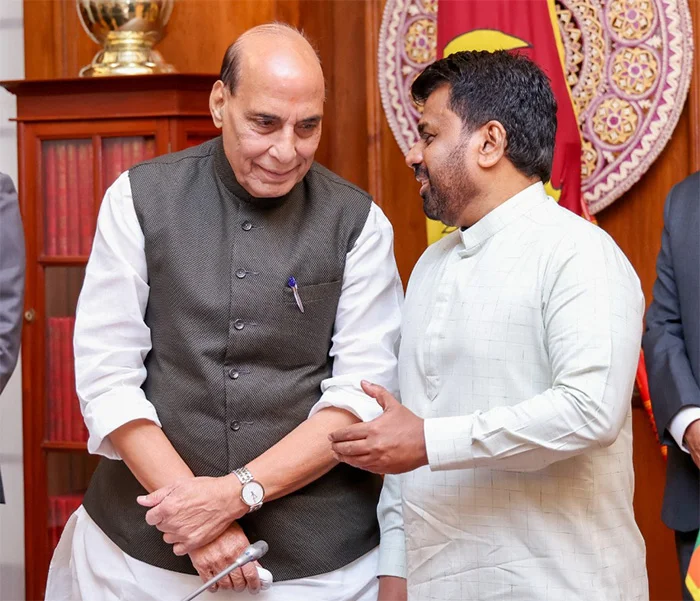
The Indian Defence Ministry in a statement issued yesterday (09) quoted President Anura Kumara Dissanayake as having assured visiting Defence Minister Rajnath Singh that Sri Lanka would never allow its territory to be used for activities inimical to India’s security interests.
The text of the Indian press release: “Visiting Indian Defence Minister Rajnath Singh called on President Anura Kumara Dissanayake in Colombo on September 09, 2026. The two leaders held substantive discussions on issues covering the entire spectrum of the multi-faceted partnership between the two nations, characterised by traditionally warm relations and mutual trust.
The two sides reaffirmed that as civilisational twins, close neighbours and maritime partners, India and Sri Lanka would continue to work together for their development and welfare of the people while working jointly to ensure the safety, security, peace and prosperity of the region. The senior Indian Minister conveyed greetings on behalf of Prime Minister Narendra Modi and underlined that the citizens of the two countries share deep friendship based on strong historical & civilisational links and people-to-people exchanges.
Extending a warm welcome to Mr. Singh, President Dissanayake recalled his interactions with PM Modi and reiterated that Sri Lanka would never allow its territory to be used for any activities inimical to India’s security interests.
President Dissanayake expressed his gratitude for the relief assistance provided by India as part of Operation Sagar Bandhu during Cyclone Ditwah and the comprehensive rehabilitation package extended by New Delhi to facilitate reconstruction and rehabilitation work across different parts of the island. The powerful Indian Defence Minister emphasised that as a closest friend and neighbour of Sri Lanka, India considered it not a favour, but a responsibility to provide assistance as the first responder and would continue to do so in the future as well.
Both leaders virtually inaugurated three Bailey Bridges constructed by the Indian Defence Forces. The two sides also exchanged MoUs on upgradation of L70 Guns for the Sri Lankan Air Force, and cooperation between National Cadet Corps (NCC) & National Defence Colleges (NDC) of both the countries. The MoU on Upgradation of six L70 guns for the Sri Lankan Air Force falls under a Government of India grant. The upgradation of these air defence guns will significantly strengthen the air defence architecture of critical assets in Sri Lanka. These air defence guns were earlier provided to the Sri Lanka Air Force by India.
The MoU on academic cooperation between NDC, India and NDC, Sri Lanka will facilitate knowledge sharing which will be a significant step in further strengthening the academic bonds between both the sister institutes. The MoU on NCC cooperation will formalise the NCC youth exchange programme between India and Sri Lanka. This exchange programme provides a valuable opportunity for NCC cadets from multiple countries across the world to come to New Delhi every year and participate in NCC events.”

Trump says every adult American will get $5,000 if Republicans win midterms

Protesters mistake Pakistan’s U-19 team for asylum seekers in Portsmouth

Steps are being taken to provide accommodation facilities for 16,000 university students – Prime Minister

Showers will occur in the Western and Sabaragamuwa provinces and in Kandy, Nuwara-Eliya, Galle and Matara districts.


Sri Lanka reiterates its territory won’t be used against India

‘Dates have the highest sugar content to fight Coronavirus’

Sunday Island 27 December – Headlines

#SundayIsland 17th December – Headlines

Sunday Island – 28th March

Sunday Island Headlines – 21 March

Sunday Island – 21st February – Headlines
-

 News6 days ago
Namal remanded until Sept. 18 over Airbus deal investigation
-

 Latest News5 days ago
Tharanga creates history with Diamond League crown in Brussels
-

 News5 days ago
Dispute which triggered listed company director being detained at BIA resolved
-

 Features4 days ago
After the parade: What a traffic OIC’s walk-out tells us
-
 Opinion7 days ago
In Memory of Dr Upatissa Pethiyagoda
-

 Editorial6 days ago
Power vs Equality
-
Editorial4 days ago
Arrests as theatre
-
 Latest News6 days ago
SLPP MP Namal Rajapaksa arrested by CIABOC